
Blog
10 Sign Permit Miami FL Mistakes That Cost You in 2026
Avoid the 10 costly mistakes that delay a Miami sign permit. Learn jurisdiction, plans, engineering, and electrical steps for 2026.
Key Takeaways
-
Confirm the jurisdiction first: a Miami mailing address does not guarantee City of Miami rules, since unincorporated Miami-Dade and other municipalities have their own sign codes and offices.
-
Never install or display a permitted sign before the permit is issued, as this risks fines, violations, and a stop work order.
-
Illuminated signs often need a separate electrical permit and inspection, so include wiring and power source details in the original application.
-
Signs over 24 square feet in Miami-Dade County generally require structural calculations and a registered engineer's seal; verify the threshold for your jurisdiction.
-
Get written property owner consent early and confirm whether the $2,500 bond applies to your county sign-permit submission before filing.
-
Check zoning limits on size, placement, and setbacks before finalizing design, and confirm fees on the current schedule rather than outdated online figures.
You ordered the sign. The fabricator is ready. The grand opening is on the calendar. Then a code officer stops by and asks to see your permit. Suddenly your beautiful new sign is a very expensive problem.
Getting a sign permit in Miami, FL sounds simple, but it rarely is. The rules depend on where your property actually sits, what kind of sign you are installing, how big it is, and whether it lights up. A Miami mailing address does not guarantee City of Miami rules, and a missed step can mean rejected plans, stop work orders, or a sign that has to come down.
The good news is that most delays come from the same handful of mistakes, and every one of them is avoidable. In this friendly 2026 guide, we walk through the 10 most common slip-ups we see, so you can sidestep them and get your sign up on schedule. Whether you are a general contractor, a business owner, or a homeowner with a sign project, you will find practical steps you can use right away.

Why Sign Permits in Miami Feel So Tricky
Sign permitting is not one countywide process. The City of Miami, other municipalities in the county, and unincorporated Miami-Dade each run their own review. Each applies its own sign code, uses its own forms, and has its own review office.
On top of that, a single sign can trigger several approvals at once. Zoning looks at size, placement, and type. Building looks at structure and attachment. Electrical looks at any lighting. Think of it as three small permits wearing one trench coat.
Here is a quick look at how the pieces fit together:
| Review Type | What It Checks | Typically Needed When |
|---|---|---|
| Zoning review | Sign type, size, placement, setbacks, number of signs | Almost every permanent sign |
| Building review | Structure, attachment, wind loads, engineering | Freestanding, large, or roof-mounted signs |
| Electrical review | Wiring, power source, lighting, disconnects | Any illuminated sign |
Now let us get into the mistakes.
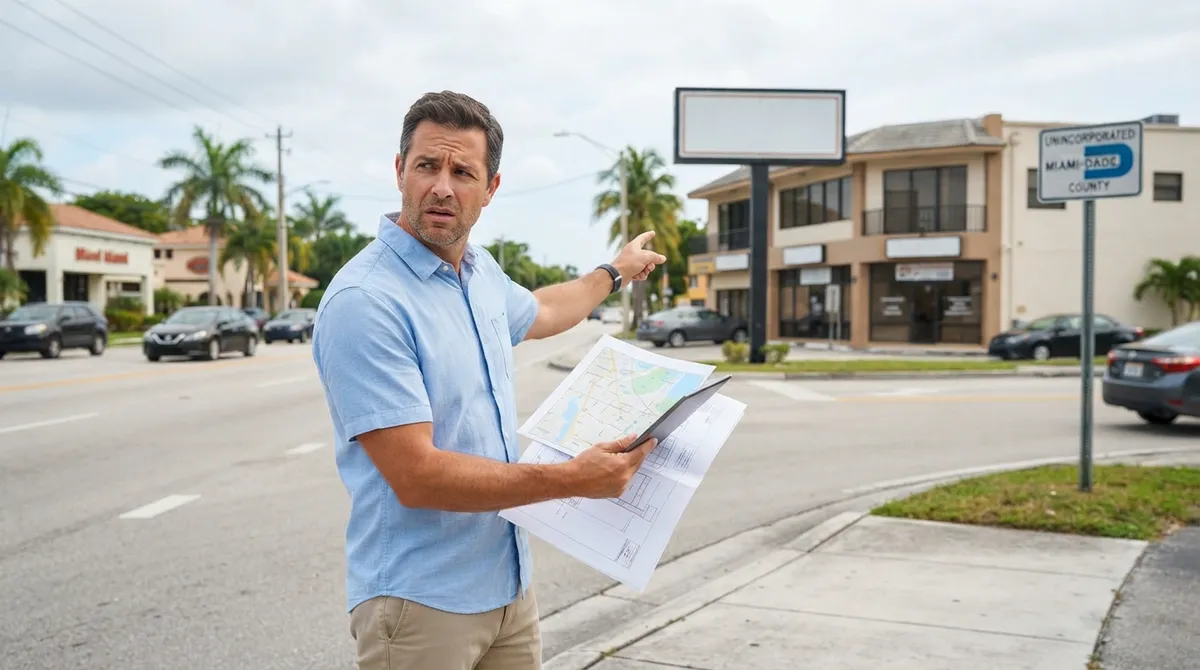
Mistake 1: Assuming Your Miami Address Means City of Miami Rules
This is the number one trip-up. Plenty of properties with a Miami mailing address sit in another municipality or in unincorporated Miami-Dade County. Each one has a different sign code and a different permitting office.
If you file in the wrong place, your application gets bounced back, and you lose days or weeks. Always confirm the jurisdiction first, before you draw a single line of plans.
- Pull up the property address on the county property appraiser map.
- Check the municipality listed for that parcel.
- Confirm with the building or zoning office before you file.
- Document the answer so everyone on the team works from the same information.
If you want a second set of eyes, our team handles this question every day across all 67 Florida counties. You can also read about which Florida jurisdiction reviews my project for a deeper look at city-line confusion.
Mistake 2: Installing the Sign Before the Permit Is Issued
We understand the temptation. The sign is built, the crew is free, and the paperwork is still under review. But a sign that requires a permit cannot be installed, altered, relocated, or displayed until that permit is issued.
Installing early invites violations, fines, and the dreaded stop work order. It can also complicate your timeline for a certificate of use or occupancy. If this has already happened to you, do not panic. Our guide on how to respond to a Florida unpermitted work notice walks through the next steps calmly.
Mistake 3: Assuming Temporary or Real Estate Signs Are Free Passes
In the City of Miami, some temporary sign categories are exempt from a sign permit. That is good news, but it is easy to misread. An exemption from the permit does not remove the other rules. Size, placement, and code requirements still apply.
So a banner or a real estate sign might not need a permit, yet it can still violate the code if it is too large or sits in the wrong spot. Before you hang anything, check the size and placement limits for your jurisdiction. When in doubt, ask first. It costs far less than removing a sign after a notice.
Mistake 4: Submitting Incomplete Plans
Incomplete applications are the quiet killer of timelines. Reviewers cannot approve what they cannot see, so missing details usually mean a correction notice and a restart of the clock.
Typical application materials include:
- A scaled sign drawing with dimensions and construction or attachment details
- A site plan showing the proposed sign, property lines, rights-of-way, and any existing signs
- Building elevations for wall signs
- Electrical details for illuminated signs
- Structural details or calculations where required
- Owner and contractor or qualifier information, with signatures
- Property identification
Build a simple checklist before you submit and compare it against the requirements for your specific jurisdiction. Clean, complete drawings are the fastest route to approval. If your plans need polish, our site plan drafting and architectural drafting teams prepare permit-ready sets every day.
Mistake 5: Forgetting the Electrical Permit for Lit Signs
Illuminated signs often need their own electrical permit and inspection. Owners focus on the zoning and building side, then get surprised when an inspector asks for electrical sign-off.
If your sign has internal lighting, LEDs, neon, or any wired component, plan for the electrical review from day one. Include wiring details and the power source on your drawings. That keeps the electrical piece from becoming a last-minute roadblock. Our MEP engineering team can prepare the electrical documentation so it travels with the rest of your package.
Mistake 6: Skipping the Engineer's Seal on Larger Signs
Structural review is not optional for bigger or freestanding signs. Miami-Dade County's published requirements call for calculations and a registered engineer's seal for signs over 24 square feet. Other jurisdictions may have their own thresholds, so verify the rule for your exact sign.
Showing up without calculations is a guaranteed rejection for larger signs. Florida wind loads are serious business, and reviewers want proof that your sign and its attachment can handle them. We cover who is qualified in our article on who seals structural drawings for Florida permits. Our own engineer signs and seals work in house, so there is no waiting on an outside consultant.
Mistake 7: Overlooking Bond and Owner Consent Requirements
Two small details trip people up more than you would expect. First, Miami-Dade County's materials identify a $2,500 bond requirement for certain sign-permit submissions. Confirm whether it applies to your sign and the current application process before you file.
Second, the property owner must consent to the sign. If you are a tenant or a contractor working for a tenant, get written consent from the owner early. A missing signature can stall everything.
| Item | Why It Matters | When to Confirm |
|---|---|---|
| $2,500 bond | Required for certain county sign-permit submissions | Before filing |
| Owner consent | Property owner must approve the sign | Before drawings are final |
| Qualifier information | Identifies the licensed contractor responsible | At application |
Mistake 8: Guessing at Fees and Timelines
Many owners quote a fee they found online and plan around it. Be careful. Archived City of Miami sign FAQs list historical charges of $0.08 to $1.10 per square foot, or $27 to $110 per sign, but those numbers may be outdated. Always check the current fee schedule before you budget.
Timelines work the same way. The Miami-Dade County sign code provision sets a 30-calendar-day review period for sign-permit applications in unincorporated areas. That clock depends on a complete submission, so a missing document can quietly reset your schedule. Build a cushion into your project plan, and confirm current requirements with the reviewing office. If you want a sense of how long approvals run in general, see how long a building permit takes in Miami.
Mistake 9: Ignoring Zoning Rules Until the Last Minute
Within the City of Miami, sign proposals are reviewed under the Miami 21 Zoning Code along with applicable Florida Building Code requirements. Zoning determines what kind of sign is even allowed on your property, how big it can be, and where it can go.
Many owners design a sign they love, then learn it exceeds the allowed size or sits too close to a property line. Redesigning at that stage costs time and money. Check the zoning limits first, then design to fit. If a new business is opening alongside the sign, you may also need a certificate of use, and it helps to line those approvals up together.
Mistake 10: Doing It All Alone When a Pro Could Save Weeks
Sign permits sit at the crossroads of zoning, building, and electrical review. Handling all three while running a business or a job site is a lot. A single rejected submission can eat weeks.
A permitting service can step in and submit the application on your behalf. That means confirming jurisdiction, preparing or reviewing plans, filing, tracking, answering reviewer comments, and carrying the permit through approval. 1 Contractor Solutions works as Florida's outsourced permitting department, so you give us an address and a problem, and we take it from there. Learn more about our permit facilitation and filing service.
If you want to hear how other owners feel about the experience, you can visit us on Google — 1 Contractor Solutions and read reviews from our customers.
A Simple Step-by-Step Path to Your Miami Sign Permit
If you want a clean way to avoid every mistake above, follow this order:
- Confirm the jurisdiction. Determine whether the property is in the City of Miami, another municipality, or unincorporated Miami-Dade County.
- Review the sign code. Check size, type, placement, and illumination rules for that jurisdiction.
- Get owner consent. Secure written approval from the property owner.
- Prepare complete plans. Include the scaled drawing, site plan, elevations, and electrical details.
- Add engineering if needed. Larger or freestanding signs may require calculations and an engineer's seal.
- File and track. Submit the application and monitor review comments closely.
- Install only after issuance. Wait for the permit, then schedule inspections.
That seven-step rhythm keeps surprises to a minimum. If your project also touches other work, such as a storefront remodel, you can read about fixing a commercial build-out without a permit to avoid compounding problems.
Who Benefits Most From Getting This Right
Different readers feel these mistakes in different ways:
- General contractors lose crew time when a sign permit holds up a storefront finish.
- Design and trade professionals need dependable drafting and sealed documents so projects close out cleanly.
- Real estate professionals and investors want clean permit histories so a closing is not held up by an unpermitted sign.
- Business owners and homeowners simply want the sign up without a fine.
If you are a contractor juggling many jobs, our services for general contractors are built to keep your schedule moving.
What If You Already Made One of These Mistakes?
Take a breath. Mistakes happen, and most of them are fixable. If a sign went up without a permit, a path often exists to bring it into compliance. Our guide on 7 steps to legalize unpermitted work in Florida explains the process, and our after-the-fact permitting team takes on files other people decline.
If you already received a denial, our article on denied permit help in Miami shows how to fix and resubmit. And if you are staring at a stop work order, our urgent permit rescue service is designed for exactly that moment.
Stay Connected With Our Team
We love sharing practical Florida permitting tips. You can follow us on LinkedIn or follow us on Facebook for updates, and our marketing partner Brain Buzz Marketing helps us keep these guides fresh.
Ready to Get Your Sign Permit Moving?
A sign permit in Miami, FL does not have to be a headache. Confirm your jurisdiction, file complete plans, include the right engineering and electrical details, and never install before the permit is issued. Do those things and you will dodge nearly every mistake on this list.
If you would rather hand the whole thing to a team that does this every day, we are here to help. We answer around the clock, respond within 30 minutes, and handle permitting across all 67 Florida counties. Get a free quote and let us take the permit off your plate, so your sign can go up and your business can shine.
FAQs
Do I need a permit for a sign in Miami, Florida?
In most cases, yes. Fixed outdoor signs and interior signs visible from the street generally need a permit before installation, and requirements depend on whether your property is in the City of Miami, another municipality, or unincorporated Miami-Dade County. Some temporary signs are exempt in the City of Miami, but size and placement rules still apply.
Do illuminated signs need a separate electrical permit in Miami?
Often they do. Lit signs can require their own electrical permit and inspection in addition to zoning and building review. Include your wiring and power details in the original application so the electrical piece doesn't slow you down later.
How long does it take to get a sign permit in Miami-Dade County?
Miami-Dade County's sign code sets a 30-calendar-day review period for applications in unincorporated areas. That timeline depends on a complete submission, so confirm current requirements with the County and build in a cushion for corrections.
What documents do I need for a Miami sign permit application?
Plan on a scaled sign drawing with dimensions and attachment details, a site plan showing property lines and existing signs, building elevations for wall signs, and electrical or structural details where required. You will also need owner and contractor information with signatures and complete property identification.
Can a permitting service submit a sign permit application on my behalf?
Yes. A permitting service can confirm your jurisdiction, prepare plans, file the application, track reviews, and respond to comments for you. That saves time and helps avoid the rejections that come from incomplete submissions.
We do this work every day across all 67 Florida counties. Call (866) 314-6931 and we will tell you what your situation actually requires — including when you do not need us.
Related services
Permit Facilitation & Filing
You have a crew scheduled, a client asking for dates, and a permit sitting somewhere in a queue you cannot see. We file it, w…
See the servicePlan Review Coordination
A permit in plan review is not one queue. On a commercial project it can be six queues, each with its own reviewer, its own c…
See the serviceReady to get your permit moving?
One call tells you which jurisdiction controls your project, what it will take, and what it will cost. Most of the time we can scope it on the phone.