
Blog
How to Get a Permit for Drywall After a Flood in Florida
Wondering how to get a permit for drywall replacement after a flood in Florida? Follow these clear steps for rules, exemptions, and the FEMA 50% rule.
Key Takeaways
-
Florida has no single statewide rule for flood-related drywall permits; requirements depend on your city or county, your flood zone, and what else was damaged behind the walls.
-
Confirm with the building department and the floodplain administrator before starting work, since these are often separate offices, and get answers in writing.
-
Permit exemptions are narrow: they typically require no electrical, plumbing, mechanical, gas, or structural work, and property outside a flood hazard area, so many flooded homes fail the test.
-
Even where drywall is exempt from a building permit, floodplain review may still be required, such as a repair-cost form (e.g., Fort Myers Beach).
-
If repair costs reach 50% of the pre-damage market value in a regulated flood hazard area, FEMA's substantial-damage rule may require the home to meet current floodplain standards like elevation.
-
Document the water line, damaged systems, and room-by-room square footage with dated photos and itemized estimates before demolition, and do not close walls until required inspections are complete.
The water is gone, the mud is shoveled out, and now you are staring at bare studs and a stack of wet drywall. Take a breath. You are not alone, and this part is very doable once you know where to start.
The question we hear most from Florida homeowners, general contractors, and restoration crews is simple: how do I get a permit for drywall replacement after a flood? The honest answer is that it depends on your city or county, your flood zone, and what else was damaged behind those walls. There is no single statewide rule. In this guide, we walk through the process step by step so you can avoid delays, skip expensive mistakes, and get your repairs approved the right way in 2026.
Why There Is No One-Size-Fits-All Answer
Florida's building code sets the baseline, but each local building department decides how it applies repairs, exemptions, and floodplain review. Two neighbors on opposite sides of a county line can get two very different answers about the same drywall job.
That is why the first step is always to confirm the rules with the building department that has jurisdiction over your property. Not sure which one that is? Cities near county lines can be tricky, and our building department lookup tool can help you pin it down.
Here is what generally drives the answer:
- Local policy: Some jurisdictions treat limited interior drywall repair as exempt, while others require a permit above a certain size.
- Flood zone status: Properties in a designated flood hazard area often get extra review, even for interior work.
- Scope of work: Drywall alone is one thing. Drywall plus wiring, plumbing, insulation, or framing is another.
- Repair cost: Costs feed into the FEMA substantial-damage calculation, which we cover below.
Step 1: Identify Your Jurisdiction and Flood Zone
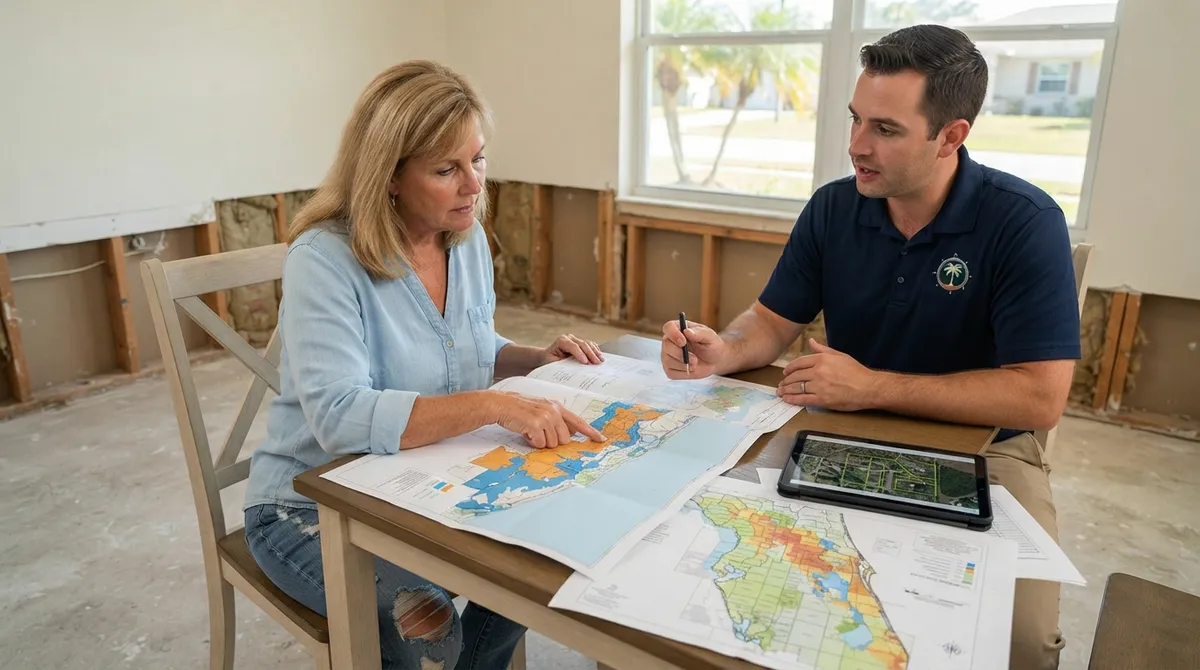
Before you call anyone, gather two basic facts about your property: which agency permits it and what flood zone it sits in. You will need both for nearly every conversation that follows.
- Look up your property address on your county property appraiser's site to confirm whether you are in a city or unincorporated county.
- Check your flood zone on your flood insurance declarations page or the FEMA flood map service.
- Contact the building department and the floodplain administrator for your city or county. In many places these are separate offices, so ask both.
- Write down the name, date, and answer of every person you speak with.
If you would rather not chase phone trees, permit facilitation and filing is exactly what our team handles, across all 67 Florida counties.
Step 2: Ask the Right Questions Before You Start Repairs
This is where a five-minute call can save you weeks. Do not assume that removing wet drywall or doing like-for-like replacement is automatically exempt. Ask the building department directly.
Here is a short list of questions to bring:
- Does my drywall replacement need a building permit, or is there an exemption process?
- Does my flood zone trigger a substantial-damage or improvement review?
- Is there a square-footage threshold for drywall work in my jurisdiction?
- Do I need a repair-cost form or worksheet for floodplain review?
- Will electrical, plumbing, or insulation work in the same walls need their own permits?
- What inspections will be required after the work is done?
Some post-disaster programs allow limited cleanup or repair work under an affidavit, while other jurisdictions require a full permit. Always get the answer in writing when you can.
Step 3: Understand the Local Differences
To show how much the rules can vary, here are a few real examples published by Florida local governments. These are local policies, not statewide thresholds, so treat them as illustrations only.
| Jurisdiction | What Its Published Guidance Says |
|---|---|
| Charlotte County | Drywall work in a designated flood zone is permit-required when it exceeds 100 square feet; smaller repairs may be treated differently. |
| Fort Myers Beach | Limited drywall and finish repairs may not need a building permit, but a repair/improvement cost form is still required for floodplain review. |
| Riviera Beach | Offers a flood-damage repair exemption that requires Building Division approval and excludes electrical, plumbing, structural, mechanical, or gas work. |
| Bay County | Describes a limited statutory exemption that applies only when every condition is met, including a request to the Building Official. |
Notice the pattern. Even where drywall may be exempt, floodplain review often is not. That is the detail that trips up the most homeowners.
Step 4: Check Whether a Permit Exemption Applies
Florida law and local rules offer limited exemptions for certain repairs. A 2025 statutory exemption described by Bay County applies only when all of its conditions are met. In general terms, those conditions include:
- A qualifying single-family home
- Work valued below $7,500
- No electrical, plumbing, mechanical, gas, or structural work
- A property located outside a flood hazard area
- A request for approval submitted to the Building Official
If even one condition is missing, the exemption does not apply. Many flooded homes fail the "no electrical or plumbing" test, because water rises through outlets, switches, and wall cavities.
Also remember that an exemption does not necessarily waive floodplain review, zoning requirements, or contractor licensing rules. Riviera Beach, for example, states that licensing requirements remain in effect even for exempt work.
Step 5: Learn the FEMA 50% Rule
This is the part that surprises people the most. Under the National Flood Insurance Program, a building is considered substantially damaged or substantially improved when repair or improvement costs equal or exceed 50% of its pre-damage market value.
If your property is in a regulated flood hazard area and the rule is triggered, the structure may need to meet current floodplain requirements. That can mean elevation or other upgrades, which is a much bigger project than hanging new drywall.
A few points to keep in mind:
- The local floodplain administrator decides how the rule applies to your property.
- Officials determine the valuation method and what cost documentation they will accept.
- Your drywall cost counts toward the total, along with flooring, cabinets, electrical, and other repairs.
- The 50% rule is important, but it is not a universal drywall-permit rule.
If you want a deeper look, read our guide on the FEMA 50 percent rule in Florida.
Step 6: Document Everything Before You Rip Anything Out
Good documentation makes permit review faster and protects your insurance claim. Do this before demolition if you possibly can, and keep your photos organized by room.
- Photograph the water line on every wall, plus damaged outlets, baseboards, and cabinets.
- Take wide shots of each room and close-ups of any visible electrical or plumbing damage.
- Write a clear scope of work listing every room, wall height, and square footage to be replaced.
- Collect repair estimates or contractor bids with itemized costs.
- Save your insurance claim number, adjuster notes, and any damage assessments.
Your building department may also ask for a permit or exemption form, a repair-cost breakdown, contractor information, plans, and a substantial-damage or improvement worksheet. Having it all ready means fewer rounds of back-and-forth.
Step 7: Account for Hidden Systems Behind the Walls
Drywall is rarely just drywall after a flood. Concealed conditions can change the permit requirements for the entire job.
| What You Find Behind the Wall | Why It Matters for Permitting |
|---|---|
| Water-damaged wiring or outlets | Electrical repair usually requires its own permit and a licensed electrician. |
| Corroded or leaking plumbing | Plumbing repairs generally need a separate permit and inspection. |
| Wet insulation | May need replacement and can trigger an inspection before closing the wall. |
| Damaged framing or studs | Structural repair removes most exemptions and may need engineering. |
| Fire-rated assemblies | Garage or shared walls may need to be restored to their rated condition. |
When structural questions come up, a sealed letter or drawing may be required. Our team provides engineer letters and in-house structural work so a reviewer comment does not turn into a long delay.
Step 8: Hire the Right Licensed Professional
Can you replace drywall yourself after a flood? Sometimes, in some jurisdictions, for some homes. But licensing rules and owner-builder limits vary, and electrical or plumbing work generally requires licensed trades.
If you plan to act as your own contractor, learn what that involves first. Our overview of owner-builder permits explains the basics. If you hire a contractor, confirm that they are properly licensed and registered in your city or county, and that they will pull the permit under their own license.
Restoration companies and general contractors who handle many flood jobs at once often hand permitting to a specialist. Our restoration company support keeps crews on schedule while paperwork moves in the background.
Step 9: Submit the Application and Track It
Once you know what your jurisdiction requires, it is time to file. A typical flood-repair submission includes:
- The completed permit application or exemption request
- Your written scope of work and photos of the damage
- A repair-cost breakdown for floodplain review
- Contractor license and insurance information
- Any required plans, sketches, or sealed documents
Applications can be rejected for small errors, and a reviewer comment can pause everything. If that happens, learn why building permits get rejected and how to respond. For more complex files, plan review coordination keeps comments from stalling your timeline.
Step 10: Schedule Inspections and Close It Out
Do not close up the walls until the required inspections are done. Skipping this step is one of the most common and most expensive mistakes after a flood.
Depending on your scope, expect some combination of these:
- Electrical and plumbing rough-in inspections, if those systems were repaired
- Insulation inspection, where required locally
- Drywall or framing inspection before finish, if your jurisdiction requires it
- Final inspection and permit closeout
If you already covered work before it was inspected, there is still a path forward. See how to handle covered work that missed inspection in Florida. A closed permit also protects you later during a sale, refinance, or insurance review.
What Happens If You Skip the Permit?
It is tempting to rush repairs, especially when families are living in temporary housing. But unpermitted flood repairs can cause real headaches down the road.
- Stop-work orders and code enforcement notices
- Fines and liens that attach to the property
- Delays or surprises at closing when a buyer or lender finds open or missing permits
- Trouble with insurance claims or future flood coverage
If this has already happened, do not panic. You can often fix it. Start with how to legalize unpermitted work in Florida, or see our after-the-fact permit services for hands-on help.
Where 1 Contractor Solutions Fits In
Flood recovery is stressful enough without wrestling with forms. 1 Contractor Solutions works as Florida's outsourced permitting department, handling permit filing, tracking, reviewer comments, revisions, and closeout in all 67 Florida counties. Our drafting and engineering are in house, and our own engineer signs and seals the work, so a reviewer question does not leave you waiting on an outside consultant. We answer around the clock and respond within 30 minutes, day or night.
If you are a homeowner, our homeowner services page explains how we help. If you are a contractor juggling many flooded homes, see our support for general contractors. We also have local pages, such as Lee County and Charlotte County, where storm and flood repairs are common. And when a permit is stuck, urgent permit rescue is available.
Curious how others feel about working with us? You can visit us on Google for 1 Contractor Solutions reviews, and you can follow us on LinkedIn or follow us on Facebook for Florida permitting updates. Our marketing partner is Brain Buzz Marketing.
A Quick Pre-Permit Checklist
Before you call the building department, run through this list one more time:
- I know which city or county has jurisdiction over my address.
- I know my flood zone designation.
- I have dated photos of the damage and water line.
- I have a written scope of work with square footage.
- I have estimates showing itemized repair costs.
- I know whether electrical, plumbing, or structural work is involved.
- I have confirmed my contractor's license and registration.
If you can check every box, you are ahead of most applicants. If not, that is fine. That is exactly what we are here for.
Ready to Get Your Flood Repairs Permitted?
Getting a permit for drywall replacement after a flood comes down to a few clear moves: confirm your jurisdiction, check your flood zone, ask about exemptions and the 50% rule, document everything, and get inspections before you close the walls. The local rules vary, but the process does not have to feel overwhelming.
If you want a trusted team to take the paperwork off your plate, get a free quote and tell us your address and what happened. We will tell you what your jurisdiction requires and then go do the work, so you can get back home.
FAQs
Do I need a permit to replace drywall after a flood in Florida?
It depends on your city or county, because Florida has no single statewide rule for flood-related drywall. Some jurisdictions exempt small repairs, while others require a permit, especially in a flood zone or when electrical or plumbing work is involved. Check with your local building department before you start.
Does replacing drywall in a Florida flood zone require a permit?
Often it does, or at least it triggers extra floodplain review. For example, Charlotte County requires a permit for drywall over 100 square feet in a designated flood zone, while Fort Myers Beach may waive the permit but still require a repair-cost form. These are local policies, so confirm yours.
What is FEMA's 50% rule for flood-damaged homes?
The rule applies when repair or improvement costs equal or exceed 50% of the building's pre-damage market value. If it is triggered in a regulated flood hazard area, the home may need to meet current floodplain requirements. Your local floodplain administrator decides how it applies.
Do I need a permit to remove wet drywall before repairs begin?
Many jurisdictions allow cleanup and removal of wet materials without a full permit, and some use an affidavit process after a disaster. Rules vary, though, so call your building department first. Take photos before demolition to support your permit and insurance claim.
Can I replace flood-damaged drywall myself?
In some jurisdictions a homeowner can do limited work, but permit rules and owner-builder limits vary. Electrical and plumbing repairs generally require licensed trades. Confirm what your building department allows before you pick up a tool.
We do this work every day across all 67 Florida counties. Call (866) 314-6931 and we will tell you what your situation actually requires — including when you do not need us.
Related services
Permit Facilitation & Filing
You have a crew scheduled, a client asking for dates, and a permit sitting somewhere in a queue you cannot see. We file it, w…
See the servicePlan Review Coordination
A permit in plan review is not one queue. On a commercial project it can be six queues, each with its own reviewer, its own c…
See the serviceReady to get your permit moving?
One call tells you which jurisdiction controls your project, what it will take, and what it will cost. Most of the time we can scope it on the phone.