
Blog
Denied Permit Help Miami: How to Fix and Resubmit in 2026
Got a denied permit in Miami? Learn how to read the notice, fix and resubmit, or appeal, plus key deadlines and jurisdiction tips for 2026.
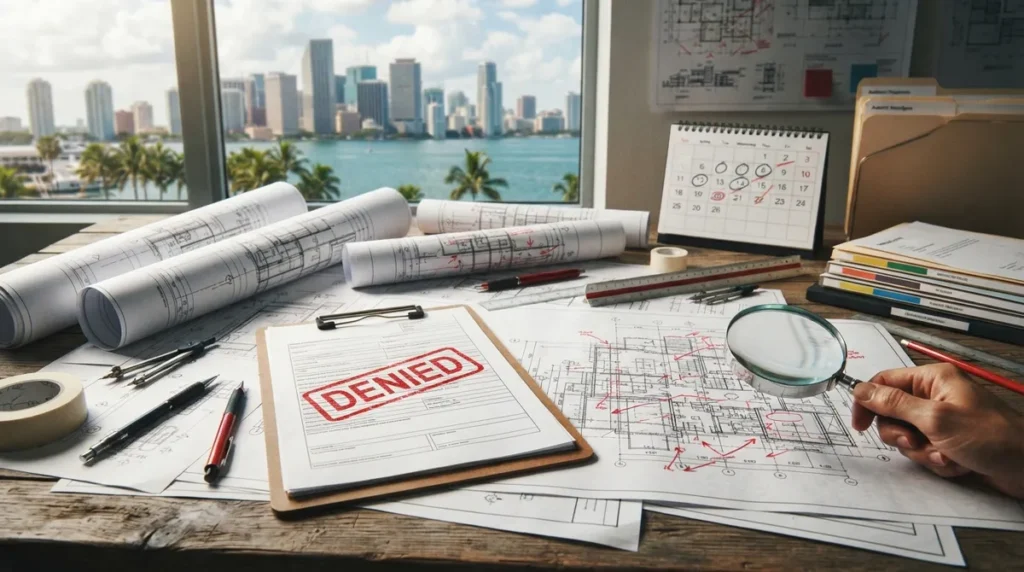
Key Takeaways
-
Most permit denials are not final; they're correction lists requiring you to identify specific code violations cited in your notice. Florida law requires agencies to specify noncompliant features and applicable code sections, so request written clarification if your denial is vague.
-
Confirm which jurisdiction controls your property immediately—City of Miami, unincorporated Miami-Dade County, or other municipalities each have separate permitting systems and appeal routes. Filing with the wrong office costs critical time.
-
Revise and resubmit your plans to address missing or incorrect information rather than appeal in most cases, as resubmittal is typically faster and doesn't require a hearing. Appeals only make sense when you believe the code was misinterpreted.
-
Appeal deadlines are strict: City of Miami zoning and Certificate of Use appeals require filing within 15 calendar days, while Miami-Dade BORA appeals need complete packets three weeks before the next board meeting. Date-stamp your denial notice immediately.
-
Common Miami denials stem from incomplete plan sets, missing product approvals (especially Miami-Dade NOA for windows and doors), structural documentation gaps, MEP conflicts, and missing professional seals. Address each cited item in a coordinated response letter referencing specific sheets.
-
Do not start work before approval; building without a permit adds penalties and code violations that are harder to resolve. A clean, organized resubmittal package with comment-by-comment responses and revised clouded plans speeds reviewer processing significantly.
Opening a denial notice from a Miami building department is a gut punch. Your crew is scheduled, your client is asking questions, and now a piece of paper says you are not cleared to build. Take a breath. A denial is almost never the end of the road. It is usually a to-do list written in reviewer language.
Whether you are a general contractor with a crew waiting, a solar company trying to hit an install date, a realtor with a closing on the calendar, or a homeowner who just wants a new addition, the path forward looks similar. Figure out who denied you and why, decide whether to fix and resubmit or appeal, and move fast on the right one.
This guide walks you through exactly that. If you need denied permit help Miami style guidance right now, you will find the steps, the deadlines to watch, and the honest limits of what any permitting professional can and cannot do. Let's turn that denial into an approval.

What a Permit Denial in Miami Actually Means
Most denials are not final rulings on whether your project can ever happen. In practice, a "denial" or "correction notice" means a reviewer found something in your plans, documents, or application that does not yet satisfy the code or zoning rules. Your job is to find out exactly what.
Florida law is on your side here. Under Florida Statutes § 553.79, when a local agency denies or revokes a permit for Florida Building Code noncompliance, it must identify the specific noncompliant project features and the applicable code chapters and sections, and give that information to you. If your notice is vague, ask the department to provide the specifics in writing.
You can learn more about why plans get bounced in our guide on why a building permit gets rejected.

Step One: Confirm Who Has Jurisdiction
Miami-Dade is a patchwork. The City of Miami, unincorporated Miami-Dade County, and other municipalities across the county each run their own building departments, portals, and appeal routes. Sending your response to the wrong office is one of the fastest ways to lose a week.
- City of Miami: handles properties inside city limits, with its own permitting system and a Hearing Boards Division for certain appeals.
- Unincorporated Miami-Dade: handled through the county, with the Building Official and the Board of Rules and Appeals (BORA) in the picture.
- Other municipalities: cities like Coral Gables, Hialeah, and Miami Beach may have their own building departments and procedures.
Near city lines, it is not always obvious which one controls your address. Our building department lookup tool and our guide on which Florida jurisdiction reviews your project can help you sort that out. For local context, see our Miami-Dade County and Miami pages.
Common Reasons Miami Permits Get Denied
Reviewers see the same issues again and again. Knowing them helps you read your notice with a clearer head.
| Denial Reason | What It Usually Means | Typical Fix |
|---|---|---|
| Incomplete plan set | Missing sheets, details, or notes | Complete drawings and resubmit |
| Structural deficiencies | Load paths, connections, or wind-load data not shown | Sealed structural revisions or engineer letter |
| Product approval issues | Windows, doors, or roofing lack valid approvals | Provide correct Miami-Dade NOA or Florida approval |
| MEP conflicts | Electrical, mechanical, or plumbing details do not meet code | Revised MEP drawings |
| Zoning noncompliance | Setbacks, lot coverage, or use not allowed | Redesign, variance, or zoning appeal |
| Missing signatures or seals | Documents lack required professional sign-off | Obtain sealed documents |
Product approvals trip up a lot of Miami projects. If that sounds familiar, read about Miami-Dade NOA versus Florida Product Approval.
Fix and Resubmit or Appeal? How to Decide
Here is the honest truth: most denials are best handled by correcting and resubmitting. It is usually faster than an appeal, and it does not require a hearing. Appeals make sense when you believe the department misapplied the code or made a wrong interpretation, and no plan revision will solve the underlying dispute.
| Situation | Better Route |
|---|---|
| Reviewer cites missing or unclear information | Revise and resubmit |
| Plans conflict with a specific code section | Revise and resubmit |
| You believe the code was misinterpreted | Request clarification, then consider appeal |
| Zoning determination or Certificate of Use denial | Review City appeal options quickly |
| Building Official decision in Miami-Dade | Consider a BORA appeal |
How to Respond to a Denial: A Practical Walkthrough
Here is the process we recommend to contractors, owners, and agents who need denied permit help Miami professionals can actually execute.
- Read the notice line by line. Highlight every cited code section, missing document, and reviewer comment.
- Confirm the jurisdiction and permit type. Building, zoning, use, and trade permits can follow different tracks.
- Note every deadline. Some appeals have short windows, so date-stamp the notice the day it arrives.
- Ask for clarification where comments are vague. Reviewers can often point you to the exact detail they want to see.
- Coordinate your design team. Architect, engineer, and trades should answer their own comments so nothing conflicts.
- Build a comment-response letter. Address each item in order and reference the sheet where the fix appears.
- Resubmit through the required portal. Use the jurisdiction's official system and keep confirmation records.
- Track the review status. Florida law requires local agencies to post application requirements and update status online until issuance, so check often.
Florida law also requires local enforcement agencies to allow electronic submission of completed applications, which makes resubmittals faster than they used to be. For the mechanics, see our overview of revisions and resubmittals and plan review coordination.
Understanding Appeal Options and Deadlines
Appeals are where deadlines get real. The right route depends on who made the decision and what kind of decision it was, so verify everything against your denial notice and the agency's current instructions.
City of Miami Appeals
The City of Miami's Hearing Boards Division handles certain appeals, including zoning interpretations, Planning Director determinations, and Certificate of Use denials or revocations. The City states that these appeals generally must be filed within 15 calendar days of the applicable posting or letter date. If the deadline lands on a weekend or City holiday, it extends to the next business day.
The City's published guidance lists an $800 appeal fee for an original applicant or aggrieved party, with notice and advertising costs possibly added. Fees and eligibility can change, so confirm with the City before filing. Also keep in mind that this 15-day window is not a universal deadline for every building permit denial.
Miami-Dade Board of Rules and Appeals (BORA)
For decisions by the Miami-Dade Building Official on matters that official regulates, BORA provides an appeal route. The published form calls for a written appeal explaining the issue, the Building Official's written decision, the relevant code sections, and supporting materials. Packets are due three weeks before the next Board meeting, and incomplete packets are not accepted.
| Appeal Path | Who Decides | Key Detail to Verify |
|---|---|---|
| City of Miami zoning or CU appeal | Hearing Boards Division | Generally 15 calendar days; $800 fee plus possible notice costs |
| Miami-Dade Building Official decision | Board of Rules and Appeals | Packet due three weeks before meeting; complete packet required |
Because these details change, check the City of Miami and Miami-Dade County official pages before you file.
What to Gather Before You Resubmit or Appeal
A clean, organized package is half the battle. Reviewers move faster when they can see every answer without hunting for it.
- The full denial or correction notice, with date received
- A comment-by-comment response letter
- Revised, sheet-numbered plans with changes clouded or noted
- Sealed engineering, if structural or wind-load items were cited
- Product approval documents for windows, doors, and roofing
- Survey, site plan, and zoning information where relevant
- Proof of ownership, contractor licensing, and registration paperwork
Contractors working in multiple municipalities should also review the municipality registration requirements, since missing registration can stall an otherwise good application.
Tips for Each Type of Reader
General Contractors and Design Trades
Keep one point of contact for all reviewer communication. When your architect, engineer, and trade subs each answer separately, comments get missed and plans drift out of sync. A single coordinated response package saves rounds of review.
Solar Companies
Solar denials often come down to structural attachment details, roof loading, or electrical single-line issues. Having code-compliant structural and electrical documentation ready before you file helps a lot. See our page for solar contractors.
Realtors and Investors
A denial can quietly derail a closing or renovation plan. Research open and denied permits early, and line up a fix before the calendar gets tight. Our open permit search tool and realtor and closing support can help.
Homeowners and Residential Owners
You do not have to speak fluent code. Ask the department to explain each cited item in plain terms, then hand the list to your designer or a permitting professional. Homeowners can find more on our homeowner resources page.
How a Permitting Professional Can Help
A good permit-services team cannot guarantee approval or replace the authority having jurisdiction, and you should be wary of anyone who promises otherwise. What they can do is remove friction: read the denial, sort out the right jurisdiction, revise the drawings, coordinate the engineer, file the resubmittal, and follow the reviewers until approval.
That is what we do at 1 Contractor Solutions. Our drafting and engineering are in house, and our own engineer signs and seals the work, so when a reviewer flags something we fix it without waiting on an outside consultant. We are also a licensed private provider, which can matter when you want plan review handled outside the county queue. If your situation is urgent, our urgent permit rescue team handles denials, stop work orders, and closings held up by permit problems. You can also read our take on who can rescue a denied building permit in Florida.
Curious how other clients have fared? See what people say on Google by using our link to visit us on Google — 1 Contractor Solutions, and you can also follow us on LinkedIn or follow us on Facebook for permitting updates.
Mistakes That Make a Denial Worse
- Waiting too long. Some appeal windows are measured in days, not weeks.
- Resubmitting without answering every comment. Partial responses restart the clock.
- Filing with the wrong jurisdiction. City, county, and municipality rules differ.
- Ignoring the cited code sections. Fixing the wrong thing wastes a review cycle.
- Sending incomplete appeal packets. BORA does not accept them.
- Starting work anyway. Building before approval can add penalties and code problems that are much harder to unwind. Read about the penalty for building without a permit in Florida before you take that risk.
Ready to Turn Your Denial Into an Approval?
A denied permit in Miami feels like a wall, but it is really a checklist. Confirm the jurisdiction, read every cited item, decide between resubmitting and appealing, protect your deadlines, and send a clean, organized response. With the right team behind you, most projects get moving again faster than owners expect.
If you would like a second set of expert eyes on your notice, get a free quote and we will tell you which jurisdiction controls your project, what it will take to fix, and how quickly we can get it back in front of the reviewer. We answer around the clock and respond fast, so your project does not have to sit still.
FAQs
Why was my building permit denied in Miami?
Common reasons include incomplete plans, structural or wind-load gaps, missing product approvals, MEP conflicts, zoning issues, or missing seals. Under Florida Statutes § 553.79, a denial for Florida Building Code noncompliance must identify the specific project features and the code chapters and sections involved, so your notice should tell you exactly what to fix.
Can I appeal a denied building permit in Miami, and what is the deadline?
Yes, but the route and deadline depend on the decision. The City of Miami generally requires certain zoning and Certificate of Use appeals within 15 calendar days of the posting or letter date, while Building Official decisions in Miami-Dade can go to the Board of Rules and Appeals with packets due three weeks before the meeting. Always confirm current rules with the agency.
Should I revise and resubmit my plans or appeal?
In most cases, revising and resubmitting is the faster and simpler path, especially when the reviewer is asking for missing or corrected information. Appeals make more sense when you believe the code was misapplied and no plan change will resolve the dispute.
Is my property under the City of Miami or Miami-Dade County jurisdiction?
It depends on your exact address, since the City of Miami, unincorporated Miami-Dade, and other municipalities each run separate permitting systems. Use a building department lookup or ask a permitting professional to confirm before you file anything.
Can a Florida permitting service help with permit corrections and resubmittals?
Absolutely. A permitting service can decode your denial, revise plans, coordinate engineering, file the resubmittal, and track reviewer comments. They cannot guarantee approval or replace the authority having jurisdiction, but they can make the process far smoother.
We do this work every day across all 67 Florida counties. Call (866) 314-6931 and we will tell you what your situation actually requires — including when you do not need us.
Related services
Permit Facilitation & Filing
You have a crew scheduled, a client asking for dates, and a permit sitting somewhere in a queue you cannot see. We file it, w…
See the servicePlan Review Coordination
A permit in plan review is not one queue. On a commercial project it can be six queues, each with its own reviewer, its own c…
See the serviceReady to get your permit moving?
One call tells you which jurisdiction controls your project, what it will take, and what it will cost. Most of the time we can scope it on the phone.