
Blog
What Happens If You Ignore a Florida Stop Work Order
Ignoring a Florida stop work order can mean added costs, delays, and CO trouble. Learn the risks, penalties by order type, and how to resume legally.
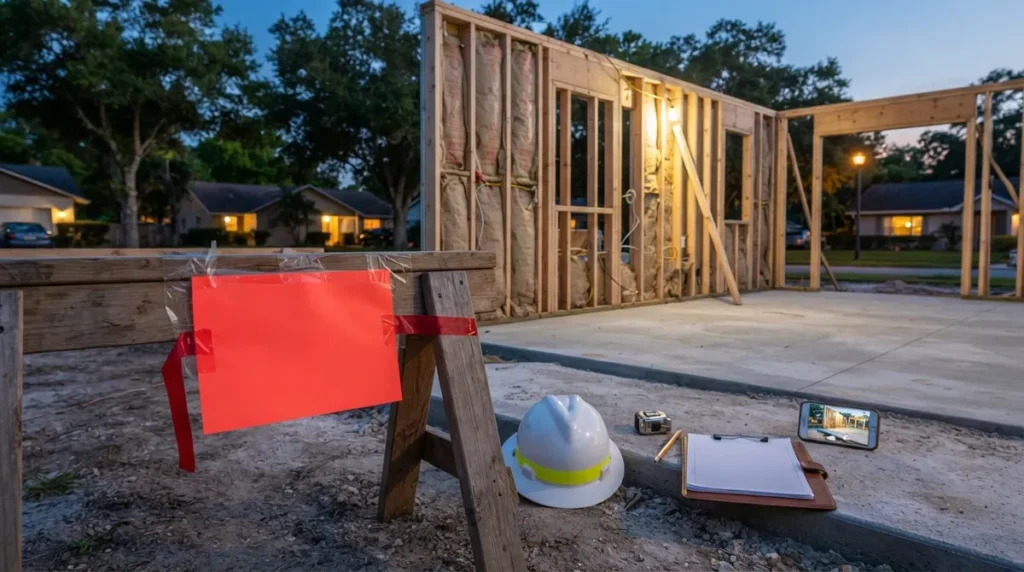
Key Takeaways
-
Ignoring a stop work order rarely stays small: continuing work can escalate a fixable permit issue into code-enforcement action and add penalties, investigation fees, and re-inspection costs.
-
Immediately stop the covered work, secure the site, and document conditions with dated photos before contacting the issuing department to learn what corrections are required.
-
Penalties depend on the issuing authority and statute: workers' comp orders under §440.107 carry $1,000-per-day penalties, while unlicensed contracting under §489.127 has its own limits, so check which agency issued your order.
-
Continuing work can cost you the certificate of occupancy and force removal or opening of covered work that missed inspection, which is especially costly for sellers, renters, and businesses.
-
Never assume unaffected work may continue; ask the issuing authority in writing which work is allowed and keep that answer on file.
-
Dispute an order through the proper appeal or hearing channel rather than continuing construction, and resume only after written confirmation that the order has been lifted.
You open your email or find an orange notice taped to the job-site gate, and your stomach drops. A stop work order. Your crew is scheduled, materials are on site, and the client keeps asking about the finish date. It is tempting to think, "Let's just keep going and sort it out later." We get it. Nobody likes a surprise that freezes a project.
But here is the friendly truth: what happens if you ignore a stop work order in Florida is almost never good, and it almost never stays small. Ignoring one can turn a fixable paperwork problem into a bigger enforcement case, with added costs, stalled inspections, and even trouble getting a certificate of occupancy down the road.
The good news? Most stop work orders can be resolved with the right steps and the right help. In this guide, we'll walk through what a stop work order really is, what can happen if you push past it, how different types of orders carry different penalties, and exactly how to get back to work legally. Whether you are a general contractor, a solar company, a realtor, or a homeowner, you will find a clear path forward below.
What Is a Stop Work Order in Florida?
A stop work order is a written directive from a building official or another authorized agency telling you to halt specific construction activity. It identifies the reason work must stop and spells out the conditions that must be met before work may resume.
Here is the part many people miss: read the order carefully. It may apply to the entire project or only a portion of it. The wording matters, and so does who issued it.
Common reasons orders are issued
- Work started without a required permit
- Work that does not match the approved plans
- Expired permits with ongoing construction
- Code noncompliance that raises safety concerns
- Missed or failed inspections with work continuing anyway
- Unlicensed contracting activity
- Workers' compensation coverage problems
Under Florida Statutes Chapter 553, building construction, alteration, repair, and demolition generally require a permit. That is why so many stop work orders trace back to permitting gaps, and why they are often fixable with proper documentation.
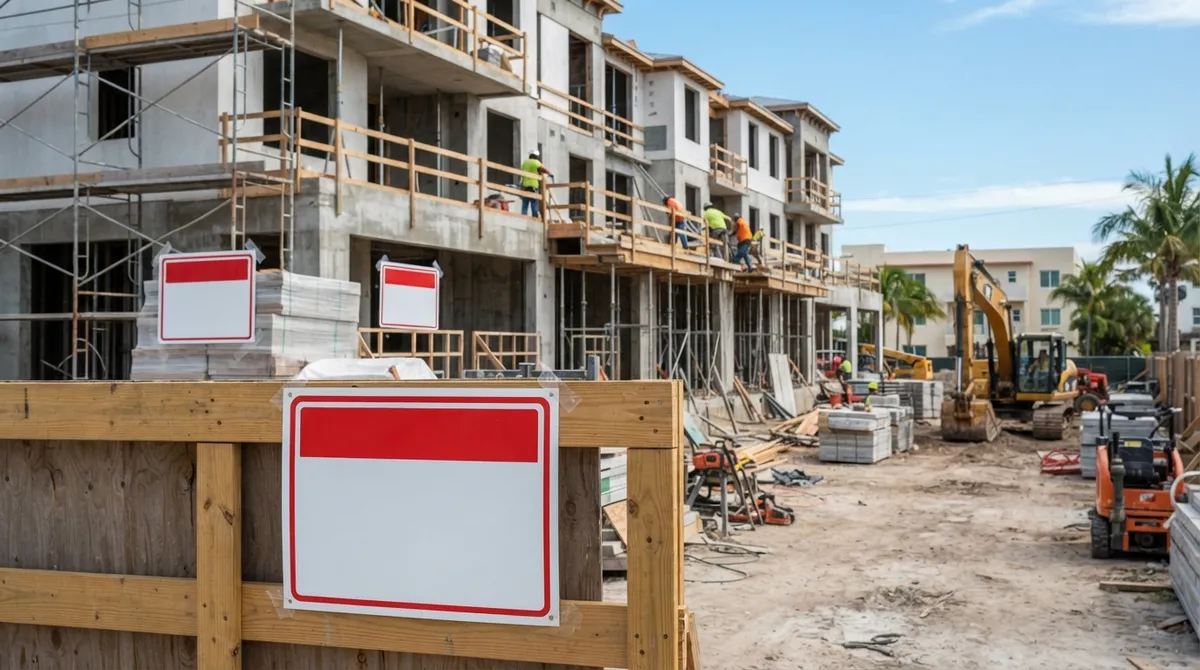
What Happens If You Ignore a Stop Work Order?
Let's get straight to the point. Continuing construction after an order does not make the original problem disappear. It stacks a second problem on top of the first.
One important note up front: there is no single statewide fine amount for every building-code stop work order. Penalties, citation procedures, and escalation depend on the applicable statute and on your county or municipality. Here is what commonly follows.
1. Escalating code enforcement
Continuing work after an order can compound the underlying violation and expose the owner and other responsible parties to local code-enforcement action. What started as "work without a permit" can become "work without a permit plus defiance of an order," which tends to be viewed far less kindly.
2. Added costs and fees
Even where a flat fine is not set, the financial hit adds up fast: investigation fees, penalty permit fees, engineering letters, revised plans, re-inspections, and the cost of idle crews and equipment.
3. Permit and inspection delays
Building departments are far more cautious with projects that ignored an order. Expect tougher scrutiny, more documentation requests, and slower approvals.
4. Trouble with certificates of occupancy or completion
A local building official may deny a permit or a certificate of occupancy or completion under circumstances authorized by law. Unresolved violations can leave your project stuck at the finish line, which is a nightmare for anyone trying to sell, rent, or open for business.
5. Possible removal or opening-up of work
If work continued without inspections, officials may require covered or finished work to be exposed so it can be verified. That means demolition of finishes you just paid for. We cover this scenario in our guide on how to handle covered work that missed inspection in FL.
Not All Stop Work Orders Are the Same
This is where people get tripped up. Florida stop work orders can arise under different laws, and each carries its own consequences. Mixing them up leads to bad assumptions, so here is a quick comparison.
| Type of Order | Typical Trigger | Key Consequence of Ignoring It |
|---|---|---|
| Building-code / permit order | Work without permit, plan deviations, code issues | Local code-enforcement action; penalties vary by county or city |
| Private-provider safety order (§553.791) | Code noncompliance posing an immediate threat to public safety and welfare | Work must stop until the threat is addressed and the order is lifted |
| Workers' compensation order (§440.107) | Missing or lapsed workers' comp coverage | $1,000-per-day penalty for operating in violation of the order |
| Unlicensed contractor action (§489.127) | Contracting without the required license | Local civil penalties, with a maximum of $2,000 under the cited provision, and separate code-enforcement penalties up to $2,500 per day per violation |
A quick caution: the $1,000-per-day figure belongs to workers' compensation orders, and the unlicensed-contractor penalties belong to that specific violation. They should not be treated as the standard penalty for every building-department order. Always check which agency issued yours and under what authority.
The "Immediate Threat" Standard Explained
Under Florida Statutes §553.791, a stop work order in the private-provider context may be issued for code noncompliance that poses an immediate threat to public safety and welfare. The statute defines that threat as a building-code violation that, if allowed to persist, could result in death, serious bodily injury, or significant property damage.
That is a high bar, and it signals how seriously these orders are meant to be taken. If your order falls into this category, pushing ahead is not just a paperwork risk. It is a real-world safety risk, and it can create liability for everyone involved.
In that same private-provider dispute context, the statute provides that the local building official must be available to meet with the private provider within two business days after issuing a stop work order or denying a permit or certificate request. That is not a general appeal deadline for every order, so do not assume it applies to yours.
Who Is Responsible: Owner, Contractor, or Both?
Here is a question we hear constantly. The honest answer is that responsibility can reach several parties depending on the facts. Property owners, contractors, and sometimes subcontractors may all face exposure.
- Property owners: Code enforcement often attaches to the property itself, so liens and holds can follow the address, not just the contractor.
- Contractors: Licensing consequences and enforcement action can follow if you worked after an order or without proper permits.
- Solar and specialty trades: If your crew keeps installing after an order, your next jobs in that jurisdiction may get extra scrutiny.
- Realtors and buyers: An unresolved order or open violation can derail a closing. See how to fix a Florida closing held up by unpermitted work.
What to Do Right After You Receive a Stop Work Order
Take a breath. You have options, and acting calmly and quickly is your best strategy. Here is a simple sequence to follow.
- Stop the work covered by the order. Secure the site, notify your crew and subcontractors, and document the current condition with dated photos.
- Read the order closely. Note the issuing agency, the cited reason, the conditions for resuming, and whether it covers the whole project or part of it.
- Contact the issuing department promptly. Ask what corrections are required and what review or hearing process exists.
- Gather your records. Pull permits, approved plans, inspection reports, contracts, and any correspondence.
- Fix the root cause. That may mean obtaining or amending a permit, producing drawings, or getting an engineer letter.
- Get written confirmation before resuming. Resume only after the authority confirms the order has been lifted or the affected work is authorized.
If you are in a specific market, local procedures matter. Our guides on clearing a stop work order in West Palm Beach, stop work order help in Tampa, and the steps after a stop work order in Broward walk through jurisdiction-specific details.
Can I Keep Working on Parts Not Mentioned in the Order?
This is a common gray area, and our advice is to never assume. Some orders are narrow and cover only a particular trade or area. Others are broad. If the language is unclear, do not guess and keep building. Ask the issuing authority in writing which work, if any, may continue, and keep that answer on file.
What If the Order Seems Wrong or Too Broad?
It happens. Mistakes and overreach are possible, and you may have grounds to challenge an order. But the right way to do it is through the proper channel, not by continuing work.
- Contact the issuing building department or agency right away.
- Ask about the correction, appeal, or hearing process.
- Consult a Florida-licensed contractor, design professional, or attorney as appropriate.
- Keep written records of every conversation and submission.
Continuing to build while you dispute an order undermines your credibility and can strengthen the case against you. Stopping, documenting, and appealing is the safer play.
How to Get a Stop Work Order Lifted
Lifting an order usually comes down to resolving the reason it was issued. The exact requirements are set by the issuing authority and the order itself, but the path often looks like this.
| Underlying Problem | Typical Fix |
|---|---|
| No permit | Prepare plans and file an after-the-fact permit; pass inspections |
| Expired permit | Renew or reopen with updated documentation |
| Work not matching plans | Submit revised plans or as-built drawings for approval |
| Structural or code question | Provide sealed engineering or an engineer letter |
| Missed inspections | Field verification, opening up work, or alternative verification |
For many of these, professional drawings and engineering are the key that unlocks the process. You may find these resources helpful:
- How to fix a stop work order for unpermitted work in FL
- After-the-fact permit requirements in Florida: 2026 guide
- What is an as-built drawing and when do you need one?
- Engineer letter vs. missed inspection: which wins?
Real-World Impact by Audience
The stakes look a little different depending on who you are, so here is how ignoring an order tends to play out.
General contractors
Your reputation with building departments is an asset. Working through an order can damage relationships and slow every future submittal in that jurisdiction. Resolving it cleanly keeps your pipeline moving.
Solar companies
Utility interconnection and inspections hinge on clean permit records. An ignored order can stall final approval and delay permission to operate, leaving a finished system sitting idle.
Realtors and investors
Open violations and unresolved orders can freeze a sale. Lenders and title companies often want clean records, so resolving the issue before closing is far easier than scrambling at the table.
Homeowners and residential owners
You may feel stuck between a contractor who disappeared and a notice on your door. Take heart: legalization is often possible. See our guide on 7 steps to legalize unpermitted work in Florida.
Why Working With a Permitting Team Helps
You do not have to untangle this alone. A stop work order is stressful precisely because it feels like a locked door, and the key is usually a well-prepared package of plans, engineering, and a coordinated submittal.
1 Contractor Solutions acts as Florida's outsourced permitting department across all 67 counties. Our in-house drafting and engineering team prepares the drawings, our engineer seals them, and we handle filing, tracking, reviewer comments, and resubmittals. If a reviewer flags something, we fix it without waiting on an outside consultant. You can learn more about our urgent permit rescue service built for exactly these situations, and see what others say when you visit us on Google — 1 Contractor Solutions.
We also love sharing knowledge, so feel free to follow us on LinkedIn or follow us on Facebook for Florida permitting tips as they develop. And for those curious about the marketing side of our team, check out Brain Buzz Marketing.
The Bottom Line
Ignoring a stop work order rarely saves time. It tends to multiply costs, invite stricter enforcement, and put your permits, inspections, and certificate of occupancy at risk. The safest course is to stop the covered work, clarify what is required with the issuing authority, correct the underlying issue, and resume only with written authorization.
The sooner you act, the more options you keep. If you are staring at an order right now, you are not alone, and it is very often fixable. Get a free quote and let our team help you clear the order, get your plans and permits in order, and get your project moving again. We respond within 30 minutes, day or night.
FAQs
What should I do immediately after receiving a stop work order in Florida?
Stop the work covered by the order, secure the site, and read the order carefully to see what it covers and what conditions must be met. Then contact the issuing department, gather your permits and plans, and fix the underlying issue before resuming. You've got this, and getting help early makes it much easier.
What fines can a Florida building department impose for violating a stop work order?
There is no single statewide fine for every building-code order, since penalties depend on the statute and on your county or city. Some orders carry specific penalties, like the $1,000-per-day penalty for violating a workers' compensation stop work order under §440.107. Always confirm which agency issued yours and under what law.
Can a stop work order affect my certificate of occupancy?
Yes, it can. A local building official may deny a permit or a certificate of occupancy or completion in circumstances authorized by law, so unresolved violations can leave your project stuck at the finish line. Resolving the order first keeps your closeout on track.
How do I get a stop work order lifted and legally resume construction?
You generally need to correct the cited issue, which may mean obtaining or amending a permit, submitting plans or engineering, and passing inspections. Then get written confirmation from the issuing authority that the order is lifted before any work resumes. The exact requirements are set by the authority and the order itself.
Who is responsible for a stop work order, the property owner or the contractor?
It depends on the facts, and responsibility can reach owners, contractors, and sometimes subcontractors. Code enforcement often attaches to the property, so open violations can follow the address even if the contractor is long gone. A permitting professional can help sort out next steps for your situation.
We do this work every day across all 67 Florida counties. Call (866) 314-6931 and we will tell you what your situation actually requires — including when you do not need us.
Related services
Permit Facilitation & Filing
You have a crew scheduled, a client asking for dates, and a permit sitting somewhere in a queue you cannot see. We file it, w…
See the servicePlan Review Coordination
A permit in plan review is not one queue. On a commercial project it can be six queues, each with its own reviewer, its own c…
See the serviceReady to get your permit moving?
One call tells you which jurisdiction controls your project, what it will take, and what it will cost. Most of the time we can scope it on the phone.