
Blog
What Do Reroof Permit Requirements in Fort Lauderdale Include?
A friendly guide to Fort Lauderdale reroof permit requirements: LauderBuild, NOA approvals, affidavits, review stops, and inspections explained.
Key Takeaways
-
Fort Lauderdale requires a building permit for all reroof work, issued by Building Services and checked against the Florida Building Code, so skipping it risks costly problems at resale or insurance time.
-
Applications go through the LauderBuild portal: upload each supporting document as its own clearly named PDF rather than one combined file, since combined files can confuse reviewers and cause delays.
-
Match the Miami-Dade NOA product approval exactly to the system you install, including attachment method and limitations, because mismatched NOAs are a common cause of permit delays.
-
A Notice of Commencement is required for jobs costing $5,000 or more, recorded with the Broward County Clerk before work begins; file it early to avoid last-minute delays.
-
For single-family homes assessed at $300,000 or more, include a notarized Hurricane Mitigation Affidavit and the Property Appraiser valuation to document roof-to-wall connections.
-
Existing gas vents through the roof must be leak-checked by a licensed plumbing or mechanical contractor before the roofing final inspection, so schedule that trade early. Verify current requirements with Building Services, as the checklist is not exhaustive.
Picture this: your roofing crew is booked, the shingles (or tiles) are ordered, and the weather looks perfect. Then someone asks, "Is the permit in?" Suddenly, everything stops. If that sounds stressful, take a breath. Understanding reroof permit requirements in Fort Lauderdale is much easier once you know what the City actually asks for, and in what order.
Fort Lauderdale requires a building permit for reroof work. The City's Building Services division issues those permits and checks the work against the Florida Building Code and local rules. Applications now run through a digital portal called LauderBuild, which means no more paper stacks, but it also means missing documents can slow you down quickly.
Whether you're a general contractor juggling ten jobs, a roofer scaling up, a realtor helping a client close, or a homeowner doing it by the book, this friendly guide walks you through the forms, thresholds, review stops, and inspections. We'll also flag the common snags, so your roof project stays on schedule.
Do You Really Need a Permit to Reroof in Fort Lauderdale?
Short answer: yes. A reroof permit is required for reroof work in Fort Lauderdale. This isn't just red tape. Florida's hurricane-driven building code exists so your roof stays on your house when the next big storm rolls through.
The permit does a few important things:
- Confirms the roofing system is code-compliant for Florida's high-wind conditions
- Verifies product approvals so the materials are rated for use
- Creates an inspection record that matters for insurance, resale, and future buyers
- Protects owners from unpermitted work that can complicate closings later
Skipping the permit might save a little time today, but it can create expensive headaches down the road. If you've already inherited a roof without paperwork, our guide on how to legalize an existing roof in Florida explains your options.
How the LauderBuild Portal Works
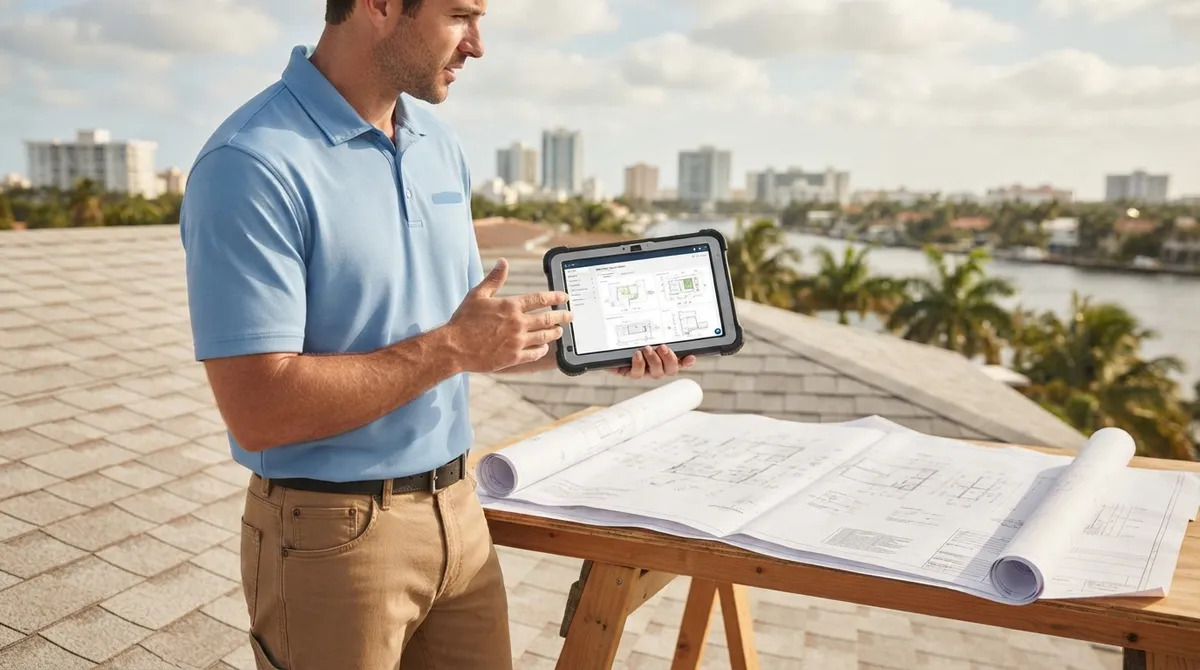
Fort Lauderdale accepts permit applications digitally through LauderBuild. The City recommends uploading all application documents at the time of submission and uploading each supporting document as a separate PDF file. That small detail matters more than people think. A single combined PDF can confuse reviewers and trigger delays.
Here's a simple way to approach the portal:
- Create or confirm your LauderBuild account and make sure the contractor's license and registration information is current.
- Gather every document before you start so you can upload everything at once.
- Save each document as its own PDF with a clear file name (for example, "NOA-Tile-System.pdf").
- Submit the application and watch the permit record for review comments.
- Respond to comments promptly and upload revisions as separate, labeled files.
- Schedule inspections online through the same portal once the permit is issued.
Many busy contractors hand this entire workflow to a permitting partner. If that sounds appealing, take a look at how to use roofing permit services in Fort Lauderdale.
The Core Document Checklist
The City's roofing checklist spells out what applicants should submit. It's not exhaustive, so always verify current requirements for your specific property and scope. Still, it gives you a solid starting point.
| Document | Applies To | Why It Matters |
|---|---|---|
| Building permit application | All reroofs | Starts the official permit record |
| Completed roofing application packet | All reroofs | Describes the roof system and scope of work |
| Miami-Dade County NOA product-approval information | All reroofs | Proves the roofing materials are approved for use |
| Rooftop equipment affidavit | All reroofs | Addresses equipment sitting on the roof |
| Asbestos-responsibility statement | All reroofs | Documents responsibility for asbestos compliance |
| Notice of Commencement | Job cost of $5,000 or more | Recorded with Broward County Clerk before work begins |
| Property Appraiser valuation + notarized Hurricane Mitigation Affidavit | Single-family homes assessed at $300,000 or more | Supports enhanced roof-to-wall connection requirements |
Think of this table as your pre-flight checklist. If even one row is missing, expect a delay.
Product Approvals and Why They Trip People Up
Product approval documentation is one of the most common sticking points. The City's checklist calls for Miami-Dade County Notice of Acceptance (NOA) information on the roofing products you plan to install.
The NOA tells reviewers exactly what the product is approved for, including the system, the attachment method, and the limitations. If the product on your NOA doesn't match the roof you're actually installing, the reviewer will notice.
To keep things smooth:
- Match the NOA to the exact product and system on your application
- Check that the NOA is current and covers your deck type and slope
- Upload the full NOA rather than a cover sheet or a screenshot
- Confirm the installation method aligns with the approved assembly
Not sure how to read the numbers? Our walkthrough on how to read a Florida product approval number for roofing breaks it down in plain English.
The Notice of Commencement Threshold
The City checklist calls for a Notice of Commencement when the job cost is $5,000 or more. It's filed with the Broward County Clerk at the Governmental Center East. In practical terms, most reroofs clear that threshold easily.
Why does this matter? The Notice of Commencement protects owners by putting the project on public record, which ties into Florida's construction lien rules. Because filing instructions and thresholds can change, confirm the current rules before you rely on any number, including the one in this article.
A Quick Tip for Contractors
Don't wait until the permit is almost ready to start the Notice of Commencement. Recording it early, with accurate legal descriptions and owner information, keeps the project on track and prevents last-minute scrambling.
The Hurricane Mitigation Affidavit for Higher-Value Homes
Here's a requirement that surprises many homeowners. For a single-family residence with an assessed value of $300,000 or more, the City checklist additionally requests two things:
- The Broward County Property Appraiser's assessed valuation
- A completed, notarized Hurricane Mitigation Affidavit
The affidavit addresses enhanced or verified roof-to-wall connections. In other words, the City wants confidence that your roof is truly anchored to your walls, not just sitting on top of them. The checklist specifies when each option is due, so read that section carefully.
If the existing roof-to-wall connections can't be verified, an engineer may need to evaluate and document them. That's where sealed documentation becomes important. Learn more about who seals structural drawings for Florida permits, and see why verification sometimes happens later in why Florida requires load path verification.
Review Stops You Should Expect
Once your application is in, it doesn't just go to one reviewer. The City checklist identifies building, mechanical, and flood review stops. Depending on your project, additional requirements may apply.
| Review Stop | What They Look At | What Can Trigger Extra Questions |
|---|---|---|
| Building | Roof system, product approvals, code compliance | Mismatched NOA, unclear scope, missing affidavits |
| Mechanical | Rooftop equipment and related penetrations | HVAC units, vents, or equipment being moved or replaced |
| Flood | Property location and flood conditions | Properties in flood zones or with related structural work |
Additional requirements can depend on the roof system, property location, flood conditions, rooftop equipment, and whether related mechanical or other work is included in the same permit. If your scope grows mid-project, such as adding structural repairs or new equipment, tell the City early rather than hoping it slides through.
Gas Vents, Roof Penetrations, and Final Inspection
Here's a detail that catches roofers off guard. The City's roofing package notes that existing gas vents penetrating the roof must be checked for leaks by a certified or licensed plumbing or mechanical contractor before the roofing final inspection.
That means you may need another trade involved before you can close out the permit. Build that coordination into your schedule so a simple vent check doesn't hold up your final.
The package also states that the roofing contractor is responsible for providing the owner with the required roofing permit and explaining the permit form. Homeowners, don't be shy about asking questions. A good contractor will happily walk you through it.
Inspections: What to Expect After Permit Issuance
Once the permit is issued, inspections are scheduled online through LauderBuild. The City's permitting page says inspections are generally conducted between 8:00 a.m. and 3:30 p.m., but required inspection stages and scheduling details depend on your permit record. Always check the record itself rather than assuming.
A smooth inspection day usually looks like this:
- Keep the permit and approved documents accessible on site, digitally or printed.
- Make sure the roof is safely accessible for the inspector.
- Have the product labels and materials verifiable against the NOA.
- Complete any required vent checks before requesting final.
- Schedule the next inspection promptly once the previous stage passes.
If an inspection is missed or work gets covered before it's checked, don't panic. There are paths forward, which we cover in how to handle covered work that missed inspection in Florida.
Can a Homeowner Pull Their Own Reroof Permit?
This is one of the most common questions we hear. The City's roofing package emphasizes that the roofing contractor is responsible for providing the owner with the required roofing permit, which suggests a contractor-driven process. Owner-builder rules in Florida have specific conditions and limitations, so confirm with Fort Lauderdale Building Services before assuming you qualify.
For many homeowners, hiring a licensed roofer and a permitting partner is the least stressful route. If you're curious about the owner-builder path, see 3 things to know about an owner builder permit in Fort Lauderdale.
Common Mistakes That Slow Down Fort Lauderdale Reroof Permits
After seeing countless roofing applications, a few patterns show up again and again:
- Combining documents into one big PDF instead of uploading separately
- Submitting an NOA that doesn't match the installed system
- Forgetting the Hurricane Mitigation Affidavit on higher-value single-family homes
- Overlooking the Notice of Commencement on jobs over the threshold
- Ignoring rooftop equipment and related mechanical review
- Skipping the gas vent leak check before final inspection
Roofers will find more patterns in 5 roofing permit mistakes West Palm Beach pros avoid, and the lessons apply across South Florida.
What If You've Already Reroofed Without a Permit?
It happens more often than you'd think, whether a prior owner skipped the permit or a contractor cut corners. The good news is that Florida has a path called after-the-fact permitting. It typically involves documenting what was installed, verifying product approvals, and sometimes obtaining engineering support.
Start with what to do if your reroof was done without a permit in Florida. If you're a property owner preparing to sell, how to sell a Florida house with unpermitted additions offers helpful context as well.
Verify Before You Build
One more honest reminder: the City says its checklist is not exhaustive and requirements can change. Forms get updated, thresholds shift, and your specific property may trigger extra conditions. Before work begins, verify the latest forms and permit-specific conditions directly with Fort Lauderdale Building Services.
That one phone call or portal check can save weeks.
How 1 Contractor Solutions Can Help
At 1 Contractor Solutions, we act as Florida's outsourced permitting department. We handle permit filing, tracking, plan review coordination, and revisions, backed by in-house drafting and engineering with sealed drawings when you need them. We serve contractors, roofers, solar companies, realtors, and homeowners across all 67 Florida counties, with same-day response.
Curious how other local pros see our work? You can visit us on Google — 1 Contractor Solutions and read what customers say. You can also follow us on LinkedIn and follow us on Facebook for Florida permitting tips, or learn about our marketing partner, Brain Buzz Marketing.
Ready to Get Your Fort Lauderdale Reroof Permit Moving?
Reroof permits don't have to be a headache. Know the documents, match your product approvals, mind the thresholds, and plan your inspections, and you'll be miles ahead of most applicants. If you'd rather hand the paperwork to people who live and breathe Florida permitting, we'd love to help. Reach out today to get a free quote and let us get your roof project permitted and moving.
FAQs
Do I need a permit to reroof a house in Fort Lauderdale?
Yes, a building permit is required for reroof work in Fort Lauderdale. The City's Building Services division issues the permit and checks the work against the Florida Building Code and local requirements, so it's well worth doing right the first time.
How do I apply for a reroof permit through LauderBuild?
You submit your application digitally through the City's LauderBuild portal. The City recommends uploading all application documents at submission and saving supporting documents as separate PDF files. You'll also use the portal to track review comments and schedule inspections.
Do I need a Notice of Commencement for a reroof in Fort Lauderdale?
The City's checklist calls for a Notice of Commencement when the job cost is $5,000 or more, filed with the Broward County Clerk at the Governmental Center East. Thresholds and filing rules can change, so confirm the current requirements before you apply.
Does Fort Lauderdale require a hurricane mitigation affidavit for a reroof?
For single-family homes with an assessed value of $300,000 or more, the City checklist requests the Broward County Property Appraiser's valuation and a completed, notarized Hurricane Mitigation Affidavit. It addresses enhanced or verified roof-to-wall connections, and the checklist explains when each option is due.
What inspections are required during a Fort Lauderdale reroof?
Required inspection stages depend on your permit record, so check it in LauderBuild. Inspections are scheduled online and are generally conducted between 8:00 a.m. and 3:30 p.m. Also remember that existing gas vents through the roof must be leak-checked by a licensed contractor before final.
We do this work every day across all 67 Florida counties. Call (866) 314-6931 and we will tell you what your situation actually requires — including when you do not need us.
Related services
Permit Facilitation & Filing
You have a crew scheduled, a client asking for dates, and a permit sitting somewhere in a queue you cannot see. We file it, w…
See the servicePlan Review Coordination
A permit in plan review is not one queue. On a commercial project it can be six queues, each with its own reviewer, its own c…
See the serviceReady to get your permit moving?
One call tells you which jurisdiction controls your project, what it will take, and what it will cost. Most of the time we can scope it on the phone.