
Blog
How to Read a Florida Product Approval Number for Roofing
Learn what a Florida Product Approval number for roofing is, how to look it up, and how to match it to your plans for a smoother permit.
Key Takeaways
-
An FL# (Florida Product Approval number) identifies a roofing product or system approved under Florida's statewide process, but it is not a permit and does not authorize construction by itself.
-
Always confirm the approval is current in the Florida Building Commission product approval database, since numbers on old quotes or data sheets can be expired or superseded.
-
Match the approval documents to your project: check deck type, materials, attachment method, design pressures, installation limits, and code edition before filing.
-
An FL# and a Miami-Dade NOA are distinct identifiers and are not interchangeable; confirm which document your local building department accepts.
-
Miami-Dade and Broward (HVHZ) projects require applicable HVHZ approvals and additional code provisions, so verify local acceptance before purchasing materials.
-
Listing only the FL number without matching approval documents, or swapping underlayment or fasteners, are common causes of roofing permit rejections.
You've signed the roofing contract, the crew is lined up, and then the permit office asks one simple question: what's the Florida Product Approval number for this roof? If your quote just says "shingles" or "standing seam," that question can stop everything cold. Don't worry, you're in good company. Contractors, homeowners, and even seasoned roofers trip over this one.
So, what is a Florida Product Approval number for roofing? It's an identifier, often written as FL# or FL number, that points to a roofing product or system approved through Florida's statewide product approval process for use under the Florida Building Code. It is not a permit number, and it is not a blanket thumbs-up for every roof in every location.
In this friendly how-to guide, we'll walk through exactly how to find, read, and use a Florida Product Approval number for roofing so your permit package moves forward instead of bouncing back. We'll also cover the Miami-Dade NOA, the High-Velocity Hurricane Zone (HVHZ), and the common mistakes that cause denials. Let's get your roof approved.
What a Florida Product Approval Number for Roofing Actually Is
Think of a Florida Product Approval number as a product's "passport." It tells the building department that a specific manufacturer's product or system went through Florida's statewide review process and was approved for use under the Florida Building Code.
For roofing, that approval is tied to a particular manufacturer, product category, and approved system or assembly. In other words, the number doesn't just say "this shingle is great." It says "this product, installed this way, over this kind of deck, meets the stated requirements."
Florida's statewide system covers a wide range of roofing categories, including:
- Built-up roofing
- Modified bitumen
- Single-ply membranes
- Metal roofing
- Asphalt shingles
- Underlayments
- Roof insulation, fasteners, and other roofing components
One key point: an FL number does not authorize construction by itself. The local building department still reviews your permit application and decides whether the submitted product and installation meet the code and any local rules.
FL Number vs. Permit Number vs. Miami-Dade NOA
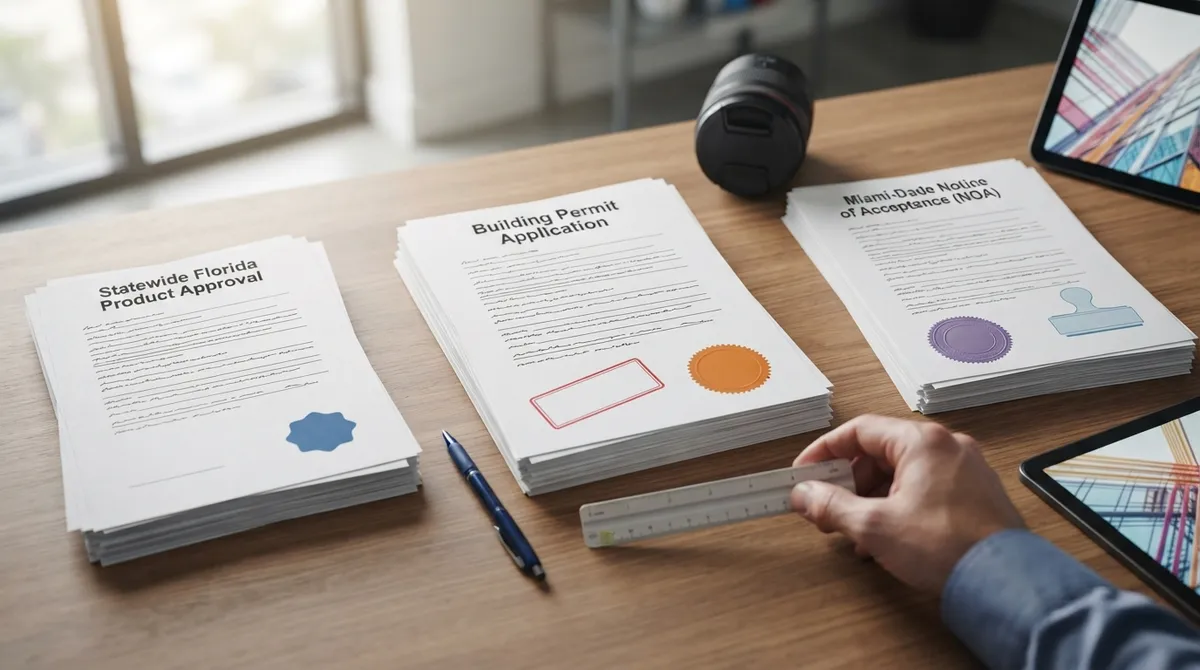
These three get mixed up constantly, and mixing them up is a classic cause of delays. Here's a quick comparison to keep them straight.
| Identifier | What It Identifies | Who Issues It | Does It Authorize Work? |
|---|---|---|---|
| Florida Product Approval (FL#) | A product or system approved under the Florida Building Code | Florida statewide product approval process | No |
| Building Permit Number | Your specific project at your specific address | Local building department | Yes, once issued and inspected |
| Miami-Dade NOA | A product accepted for use in Miami-Dade, including the HVHZ | Miami-Dade County product control | No |
The NOA and the FL number are distinct identifiers. Miami-Dade notes that NOAs can be used when applying for optional Florida statewide approval, but you should never treat the two as interchangeable. Always confirm which document your local permitting authority actually accepts.
How to Look Up a Roofing FL Number Step by Step
Ready to do some detective work? Here's the simple process.
- Gather the product details. Get the manufacturer name, exact product name, and the roof system your contractor plans to install.
- Find the FL number on the quote or submittal. Many manufacturers list it on data sheets. Treat it as a starting point, not the final answer.
- Search the Florida Building Commission product approval database. This is the official place to look up an FL number and review its approval documents.
- Check the status and revision. Confirm the approval is current, not expired or superseded. A number printed on an old quote can be out of date.
- Download the approval documents. The real details live in the documents, not just the number.
- Match the approval to your roof. Compare it to your plans, deck type, and site conditions before you file.
That fourth step is where people slip. The number might be real, but if the revision is old, your reviewer may reject it.
What to Check Inside the Approval Documents
An approval applies only within the conditions and configurations shown in its documents. This is where a quick read can save you weeks. Look for these items:
- Roof deck or substrate: Wood, concrete, or metal deck? The approval is written for specific substrates.
- Materials and components: Underlayment, fasteners, adhesives, and flashing may all be specified.
- Attachment method: Fastener type, spacing, or adhesive approach must match what's installed.
- Design pressures: Does the approved assembly meet the wind pressures your roof is designed for?
- Installation details and limitations: Slope limits, overlap requirements, and other conditions.
- Code edition: Make sure the approval aligns with the code edition your jurisdiction is enforcing.
If any of those don't line up with your plans, you have a mismatch. And a mismatch is one of the most common reasons a roofing permit gets sent back for corrections.
Matching the Approval to Your Plans and Site
A roof isn't just a product, it's an assembly installed on a real building in a real location. Reviewers want to see that the approval, the plans, and the site all tell the same story.
Here's how that plays out for different audiences:
- General contractors: Confirm the approval covers your deck type and attachment method before the crew shows up, not after a failed inspection.
- Homeowners: Ask your roofer for the FL number and approval documents up front. A trustworthy pro will happily hand them over.
- Realtors and investors: If you're evaluating a property with an older or questionable roof, the approval trail can help you understand what was supposed to be installed.
- Design trade professionals: Make sure your drawings call out the approved system, not just a generic "roofing per code."
When roofs were installed without proper documentation, you may need to work backward. Our guide on how to legalize an existing roof in Florida explains how that process works.
The HVHZ: Extra Rules in Miami-Dade and Broward
Miami-Dade and Broward counties make up Florida's High-Velocity Hurricane Zone. Projects there face additional requirements, and a product or assembly must have the applicable approval and meet the code provisions for the project's location.
Miami-Dade describes its HVHZ product approvals as designed to meet wind requirements of up to 175 mph (three-second gust) for typical buildings and structures. That's a county statement about its approval context, not a universal design pressure for every roof, so always rely on your project's engineering and plans.
Here's a quick HVHZ cheat sheet:
| Question | Outside HVHZ | Inside HVHZ (Miami-Dade and Broward) |
|---|---|---|
| Primary approval identifier | Florida Product Approval (FL#) | Applicable HVHZ approval, often a Miami-Dade NOA |
| Extra code provisions | Standard Florida Building Code | Additional HVHZ requirements apply |
| Best practice | Verify FL# and documents | Confirm local acceptance and required HVHZ documentation |
Planning a project in South Florida? These resources are worth a read: 14 things to check before hiring high volume roofing permits help in Miami-Dade and how to speed up roofing permit approval in Miami, FL.
Common Mistakes That Get Roofing Permits Rejected
We've seen the same few slip-ups cause the same headaches. Here's what to avoid:
- Listing only the FL number. The number alone isn't enough without the matching approval documents.
- Using an expired or outdated revision. Always confirm current status.
- Ignoring the deck or substrate. An approval for one deck type doesn't cover another.
- Swapping components. Changing underlayment or fasteners can break the approved assembly.
- Treating an NOA and an FL number as the same thing. They aren't interchangeable.
- Forgetting HVHZ requirements. In Miami-Dade or Broward, extra rules apply.
Roofers across the state run into these regularly. Our rundown of roofing permit mistakes West Palm Beach pros avoid and permit facilitation mistakes Florida roofers make can help you stay a step ahead.
Does Every Roofing Product Need an FL Number?
Great question, and the honest answer is that it depends on the product, the application, and your local jurisdiction. Florida's statewide system covers many roofing categories, but the specific documentation your building department requires can vary.
Rather than guess, confirm with your permitting authority exactly which approval documents they accept for your roof type. If you're also wondering about older roofs, you may find our article on whether Florida requires product approvals for old roofs helpful.
Why the Right Documentation Speeds Up Your Permit
A clean, matching product approval package does something wonderful: it shortens plan review and reduces back-and-forth with the building department. When the approval, plans, and site conditions all agree, reviewers have fewer reasons to issue comments.
It also helps with related paperwork. Understanding the difference between a product approval and a permit approval is key, and we break it down in product approval vs. permit approval: which fixes your install.
And if a permit was denied, you can usually fix it. See who can rescue a denied building permit in Florida for next steps.
How a Florida Permitting Service Can Help
Let's be real: verifying approvals, reading the fine print, and lining everything up with your plans takes time most contractors and homeowners would rather spend elsewhere. That's where a permitting partner earns their keep.
At 1 Contractor Solutions, we help identify the correct approval documents, verify that the selected roof system matches the plans and site conditions, and organize the product approval information for submittal. We handle filing, tracking, plan review coordination, and revisions across all 67 Florida counties, with in-house drafting and engineering when your project needs sealed drawings.
To be clear, the contractor and design professional remain responsible for selecting and installing a compliant system. We make sure the paperwork reflects it correctly and moves through review smoothly. If your project needs engineering support, our team can also help with permit-ready plans Florida officials approve.
Want to see how we work? You can visit us on Google — 1 Contractor Solutions and read what customers say, or follow us on LinkedIn and follow us on Facebook for Florida permitting tips. Our website is supported by Brain Buzz Marketing.
Your Quick Pre-Submittal Checklist
Before you file, run through this list:
- FL number (or applicable HVHZ approval) identified for every roofing component
- Approval status and revision confirmed as current in the official database
- Approval documents downloaded and read
- Deck or substrate matches the approval
- Attachment method and materials match the approved assembly
- Design pressures and code edition align with your project
- Local acceptance confirmed, especially in Miami-Dade and Broward
- Plans reference the approved system by name and number
Wrapping Up and Next Steps
A Florida Product Approval number for roofing is a powerful starting point, but it's only the beginning. The real win comes from matching the approval documents to your actual roof assembly, site conditions, code edition, and local requirements. Do that, and your permit review gets a whole lot smoother.
Feeling overwhelmed, or just short on time? We're happy to help you sort it out with same-day response and in-house sealed drawings when you need them. Reach out today to get a free quote and let's get your roofing permit moving.
FAQs
What does an FL number mean on a roofing product?
An FL number, or Florida Product Approval number, identifies a roofing product or system approved through Florida's statewide process for use under the Florida Building Code. It's a great starting point, but it isn't a permit and doesn't guarantee the product fits every roof.
Is a Florida Product Approval number the same as a Miami-Dade NOA?
No, they're two separate identifiers. A Miami-Dade Notice of Acceptance is issued through the county's product control process, and Miami-Dade notes NOAs can be used when applying for optional statewide approval. Always confirm which document your local building department accepts.
Can I use the same roofing approval throughout Florida, including the HVHZ?
Not automatically. Miami-Dade and Broward are HVHZ jurisdictions with additional requirements, so a product or assembly must have the applicable approval and meet the code provisions for your location. Check with the permitting authority before you buy materials.
What should I check in a roofing product approval before applying for a permit?
Confirm the approval is current, then compare its details to your plans: roof deck, materials, attachment method, design pressures, installation conditions, and code edition. If anything doesn't match, your permit can be sent back for corrections.
Who verifies roofing product approvals for a Florida building permit?
The local building department reviews your permit application and decides whether the submitted product and installation meet code. A Florida permitting service can help organize and verify the documents beforehand, while the contractor and design professional remain responsible for a compliant system.
We do this work every day across all 67 Florida counties. Call (866) 314-6931 and we will tell you what your situation actually requires — including when you do not need us.
Related services
Permit Facilitation & Filing
You have a crew scheduled, a client asking for dates, and a permit sitting somewhere in a queue you cannot see. We file it, w…
See the servicePlan Review Coordination
A permit in plan review is not one queue. On a commercial project it can be six queues, each with its own reviewer, its own c…
See the serviceReady to get your permit moving?
One call tells you which jurisdiction controls your project, what it will take, and what it will cost. Most of the time we can scope it on the phone.