
Blog
How to Get an After-the-Fact Permit in Duval County
Yes, Duval County allows after-the-fact permits. Learn the steps, costs, and inspection tips to legalize unpermitted work in Jacksonville in 2026.
Key Takeaways
-
Yes, Jacksonville's Building Inspection Division lets owners apply for permits on work already started or completed, but filing does not guarantee approval.
-
Work must still meet applicable codes; the City will review and inspect it, and corrections or opening concealed work may be required.
-
Expect a $250 fine for starting work before applying, plus a doubled permit fee under Jacksonville Code §320.408, separate from any corrective work costs.
-
Prepare as-built drawings, site plans, and any needed engineer letters or product approvals before submitting through JAXEPICS to speed up review.
-
Keep build-time photos and receipts, since they can help reduce how much finished walls or ceilings must be opened for inspection.
-
Filing a permit does not automatically stop code enforcement; follow every notice deadline and complete inspections and corrections to close the violation.
So you just found out that the deck, the bathroom remodel, or the water heater swap in your Jacksonville property was done without a permit. Take a breath. You are far from the first person to land in this spot, and there is usually a clear path out. The big question most people ask first is simple: does Duval County allow after the fact permitting?
The short answer is yes. In Jacksonville, which administers building permitting for most of Duval County, an owner can generally apply for a permit after permit-required work has started or even finished. But approval is not automatic, and it is not free of consequences. The City still reviews the work, inspects it, and can require corrections.
In this friendly walkthrough, we will cover how the process works, what it may cost, what inspectors look for, and the exact steps to follow in 2026. Whether you are a homeowner, a general contractor, a solar company, or a real estate pro, you will leave knowing what to do next.
Does Duval County Allow After-the-Fact Permitting?
Yes. Jacksonville's Building Inspection Division, the permitting authority for most building work in Duval County, allows owners to seek permits for work that has already started or been completed. Think of it as the "make it right" lane.
Here is the important part. A retroactive permit does not legalize work simply because you filed an application or paid a fee. The work still has to meet the applicable codes. If it does not, you will need to correct it before the permit can be finalized.
A few quick reality checks:
- Filing is allowed, approval is earned. The City must review and inspect the work.
- Corrections may be required. Anything that does not comply with code has to be fixed.
- Concealed work may need to be exposed. If inspectors cannot verify what is behind a wall or ceiling, they can ask you to open it up.
- Not every municipality is the same. Some beach communities and other jurisdictions inside the county have their own rules, so confirm who actually controls your address.
If you want a statewide view of how this works, our guide on how to get an after-the-fact permit in Florida is a great companion read.
What Will It Cost? Fines, Double Fees, and Other Charges
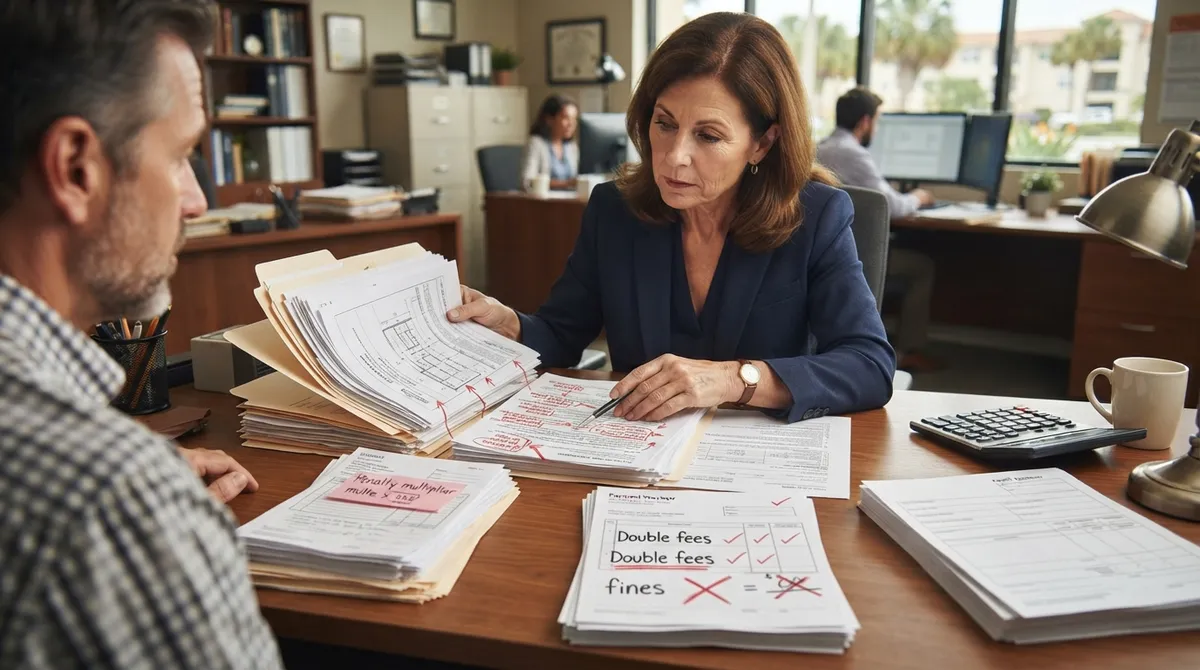
Nobody loves talking about money, but let's be upfront so there are no surprises. Several charges can stack up when work happens before a permit is issued.
| Cost Item | What to Know | Verify With the City? |
|---|---|---|
| Starting-work-without-permit fine | Jacksonville's residential guidance cites a $250 fine for starting work before applying | Yes, confirm current amount |
| Doubled permit fee | Jacksonville Code §320.408 is cited as requiring twice the regular permit fee when work begins before a permit | Yes, check the current code and fee schedule |
| Plans and engineering | Drawings, as-builts, or engineer letters may be needed to document the work | Depends on scope |
| Corrective work | Repairs, upgrades, or opening walls so inspectors can verify compliance | Depends on findings |
The fine is separate from permit fees and separate from any corrective work. Because fee schedules and enforcement rules can change, always confirm the current numbers directly with Jacksonville's Building Inspection Division before relying on any figure you read online, including this one.
For a broader look at pricing across the state, check out our breakdown of after-the-fact permit costs in Florida.
How to Get an After-the-Fact Permit in Duval County: Step by Step
Ready to roll up your sleeves? Here is a practical sequence that works for most residential and light commercial projects in Jacksonville.
- Confirm which jurisdiction controls your property. Most of Duval County is handled by Jacksonville, but a few areas have separate authorities. A quick check now prevents wasted filings later.
- Figure out whether the work required a permit. Florida Building Code §105.1 generally requires permits before construction, alteration, repair, or installation of regulated building systems, subject to exemptions. If you are unsure, ask the Building Inspection Division about your specific scope.
- Gather what you know about the work. Photos, receipts, contractor names, dates, product information, and any older permits are all helpful.
- Prepare plans or as-built documentation. Depending on the work, you may need drawings, a site plan, or a sealed engineer letter showing what was built and that it meets code.
- Submit the application. Jacksonville provides online permit submission through its permitting systems, including JAXEPICS for applicable submissions. Confirm the correct permit type and required documents first.
- Respond to review comments. Reviewers may ask for clarifications, revisions, or added details. Answer promptly and completely.
- Schedule inspections. Inspectors verify the work. If something is hidden, be ready to open it up.
- Correct any deficiencies and finalize. Once the work passes, the permit can be closed out.
If paperwork is not your favorite thing, that is perfectly okay. Our team handles permit facilitation and filing so you are not stuck guessing which form goes where.
What Documents and Plans Will Jacksonville Want?
The exact list depends on the project, but here is what typically comes up for after-the-fact submissions:
- A completed permit application for the correct permit type
- Scaled drawings or as-built plans showing what actually exists
- Site plans for additions, pools, fences, or accessory structures
- Structural details for framing, roofs, or load-bearing changes
- Electrical, plumbing, or mechanical information for those trades
- Product approvals or specifications for items like windows, doors, or roofing materials
- Contractor license information or owner-builder documentation
Where drawings are needed, accurate as-built drawings make a huge difference. They show reviewers exactly what was built, not what someone intended to build. And when a design professional needs to certify structural adequacy, an engineer letter can be the missing piece.
Will You Have to Open Walls or Ceilings?
This is the question that keeps people up at night, so let's tackle it head on. Sometimes yes, sometimes no.
Inspectors need to confirm that the work complies with code. If framing, wiring, plumbing, or insulation is hidden behind finished surfaces and they cannot verify it any other way, the City may require access. That can mean a few small inspection openings or, in less fortunate cases, larger sections.
Ways to reduce the pain:
- Keep photos from the build. Progress photos can sometimes help show what is behind the finish.
- Ask for alternatives early. An engineer's field verification may sometimes reduce the amount of demolition needed, though acceptance is up to the City.
- Plan for small openings. Targeted openings are usually less costly than reopening entire rooms.
Our article on whether you will really have to demolish unpermitted work goes deeper on this topic with plenty of reassurance.
Common Scenarios: Roofs, Additions, Solar, and More
Different projects raise different questions. Here is a quick comparison of what tends to matter most.
| Project Type | Typical Focus | Helpful Documentation |
|---|---|---|
| Roof replacement | Decking, fastening, underlayment, product approvals | Photos, product data, engineer letter if needed |
| Room addition | Structure, egress, electrical, energy compliance | As-built plans, structural verification, site plan |
| Solar installation | Electrical safety, roof attachment, structural loading | Electrical diagrams, structural letter, equipment specs |
| Pool or screen enclosure | Barriers, electrical bonding, wind loads | Site plan, engineering for enclosures |
| Interior remodel | Electrical, plumbing, mechanical changes | Floor plan, trade details, inspection access |
If your issue is specifically a roof, our guide on unpermitted roofs in Florida is worth a look. Solar companies facing a similar situation may find value in our article on legalizing unpermitted installs.
What If You Received a Code Enforcement Notice?
A notice can feel stressful, but it is also a roadmap. If the City has flagged unpermitted work, contact them promptly and follow every deadline and instruction in the notice.
Applying for a permit may be part of resolving the violation, but filing alone does not automatically stop enforcement or erase penalties. Think of the permit as one step in a larger process that usually includes inspections, corrections, and a final sign-off.
A smart approach looks like this:
- Read the notice carefully and note the deadline.
- Call the issuing office to confirm what they need.
- Prepare and submit the permit application and supporting documents.
- Keep records of every submission and conversation.
- Complete corrections and inspections before the deadline, or ask in writing about extensions.
We cover this topic in more detail in our code compliance violations service page and in our guide on what to do when you get a code enforcement notice.
Tips for Homeowners, Contractors, and Real Estate Pros
Everyone approaches after-the-fact permitting from a slightly different angle. Here is how to make the process smoother for your situation.
For Homeowners
If a previous owner skipped permits, you are not alone, and you can fix it. Start by checking for open permits and then talk to a professional about the scope. Our open permit search tool can help you see what is on record.
For General Contractors and Solar Companies
Document everything. Keep sealed plans, product approvals, and inspection records organized so you can respond quickly to reviewers. Repeat issues are often cheaper to prevent than to fix, so build permit checks into your project kickoff.
For Real Estate Professionals
Unpermitted work can delay a closing in a hurry. Getting ahead of it, even before listing, can protect your deal. If you are in that situation, take a look at our guide on clearing a permit hold before closing for ideas that translate well across Florida.
Why Getting Professional Help Can Save Time
You can absolutely work through this on your own, especially for smaller projects. But after-the-fact permitting has a few traps: choosing the wrong permit type, submitting incomplete drawings, or missing a required engineering document. Each one can add weeks.
1 Contractor Solutions works as Florida's outsourced permitting department, serving all 67 counties, including Duval County and Jacksonville. Our in-house drafting and engineering team prepares as-built plans and sealed documents, files the application, tracks it, and works through reviewer comments. We also take on after-the-fact and expired permits that others often decline.
Want to see how other customers feel about working with us? You can visit us on Google and read 1 Contractor Solutions reviews, and you are welcome to follow us on LinkedIn or follow us on Facebook for practical Florida permitting tips.
Official Resources Worth Bookmarking
Because fees, forms, and procedures can change, it is smart to keep official sources handy. The City of Jacksonville's Building Inspection Division publishes residential permitting guidance on its residential permits page. It is the best place to confirm current charges, requirements, and enforcement deadlines before you file.
Final Thoughts
So, does Duval County allow after the fact permitting? Yes, Jacksonville lets owners seek permits for work already started or completed, as long as the work is reviewed, inspected, and brought into compliance. Expect possible fines and doubled fees, be ready for inspections, and prepare to open concealed work if needed. With the right documents and a steady plan, most situations can be resolved.
If you would like a friendly hand, we are here for you. Reach out today to get a free quote and let our team help you turn that unpermitted project into a properly closed permit.
FAQs
Does Duval County allow after the fact permitting?
Yes! Jacksonville's Building Inspection Division, which handles permitting for most of Duval County, allows owners to apply for permits on work that has already started or been completed. Just keep in mind that the work still has to be reviewed, inspected, and brought up to code.
What is the fine for working without a permit in Jacksonville?
The City's residential guidance cites a $250 fine for starting permit-required work without first applying, and Jacksonville Code §320.408 is cited as requiring double the regular permit fee. Fees can change, so double-check current amounts with the Building Inspection Division before you file.
Will I have to open walls or ceilings for an after-the-fact inspection?
Possibly, but not always. If inspectors cannot verify concealed work any other way, they may ask for access, so keeping build-time photos and having an engineer's verification ready can help limit how much needs to be opened.
Does filing a permit stop code enforcement action?
Not automatically. Applying for a permit is often a key step in resolving a violation, but you still need to follow the notice's deadlines, pass inspections, and complete any corrections to fully close things out.
What documents do I need for a retroactive permit in Duval County?
It depends on your project, but you will usually need an application, as-built or scaled drawings, and possibly structural, electrical, or product approval details. Confirm the exact list with Jacksonville's Building Inspection Division, or let a permitting team help you assemble it.
We do this work every day across all 67 Florida counties. Call (866) 314-6931 and we will tell you what your situation actually requires — including when you do not need us.
Related services
Permit Facilitation & Filing
You have a crew scheduled, a client asking for dates, and a permit sitting somewhere in a queue you cannot see. We file it, w…
See the servicePlan Review Coordination
A permit in plan review is not one queue. On a commercial project it can be six queues, each with its own reviewer, its own c…
See the serviceReady to get your permit moving?
One call tells you which jurisdiction controls your project, what it will take, and what it will cost. Most of the time we can scope it on the phone.