
Blog
What Happens If Your Florida Pool Was Built Without a Permit?
Found a pool built without a permit in Florida? Learn how legalization works, what inspectors check, and how to avoid costly mistakes in 2026.
Key Takeaways
-
Don't cover, fill, or demolish an unpermitted pool before the local building department inspects it, since altering the work can make verification harder and more costly.
-
Florida has no single statewide retroactive-permit process; each county or city sets its own procedures, fees, and inspection requirements, so confirm your jurisdiction first.
-
Under Florida Statutes §515.27, a new residential pool must have at least one qualifying safety feature, such as a compliant barrier, approved safety cover, exit alarms, or a qualifying pool alarm, to pass final inspection.
-
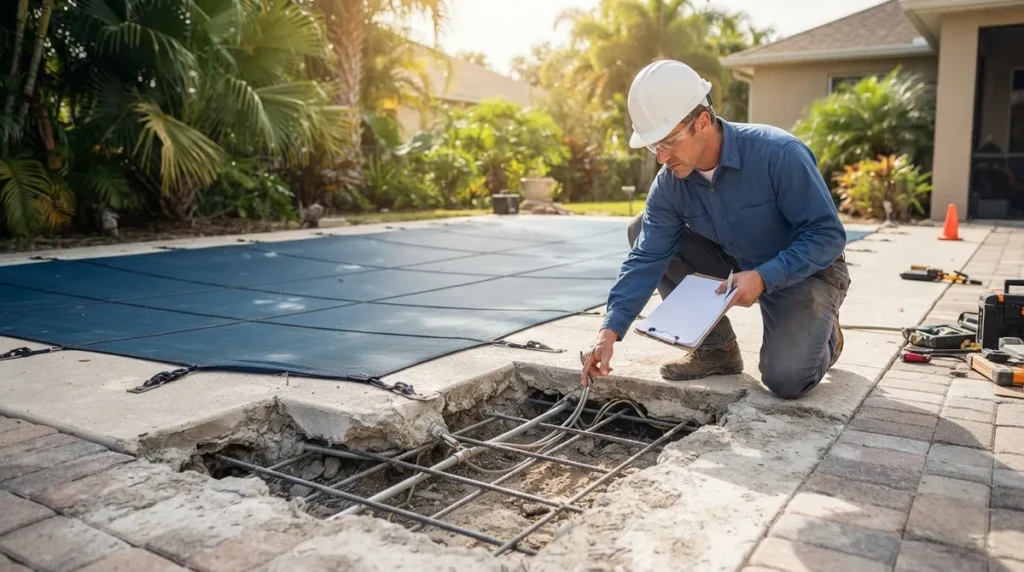
Concealed work like steel reinforcement, plumbing, and electrical bonding may need to be exposed, pressure-tested, or verified with an engineer letter before an after-the-fact permit can be approved.
-
Removal is usually a last resort; most issues can be fixed through corrections and inspections, but pools inside setbacks or easements, with serious bonding problems, or with non-compliant barriers face higher risk.
-
Check permit history during due diligence, not at closing, and disclose known issues honestly, since unpermitted pools can delay lenders, appraisers, insurers, and sales.
Picture this: you're closing on a gorgeous Florida home with a sparkling backyard pool, and then someone mentions the pool might not have a permit. Your stomach drops. Or maybe you've owned the house for years and just found out the previous owner skipped the paperwork. Take a breath. You're far from alone, and there's usually a path forward.
A pool built without a permit in Florida is more common than most people realize, especially in older neighborhoods and homes that have changed hands a few times. The good news is that local building departments handle these situations every day. The less-good news is that there's no single statewide fix, so the right steps depend on your county or city, the type of pool, and what the inspectors can actually verify.
In this friendly guide, we'll walk through why permits matter, what Florida law says, how the legalization process typically works, what it may cost you in time and effort, and how to avoid the biggest mistakes. Whether you're a homeowner, a real estate professional, or a contractor cleaning up someone else's mess, you'll leave with a clear game plan.
Why a Pool Built Without a Permit in Florida Is a Big Deal
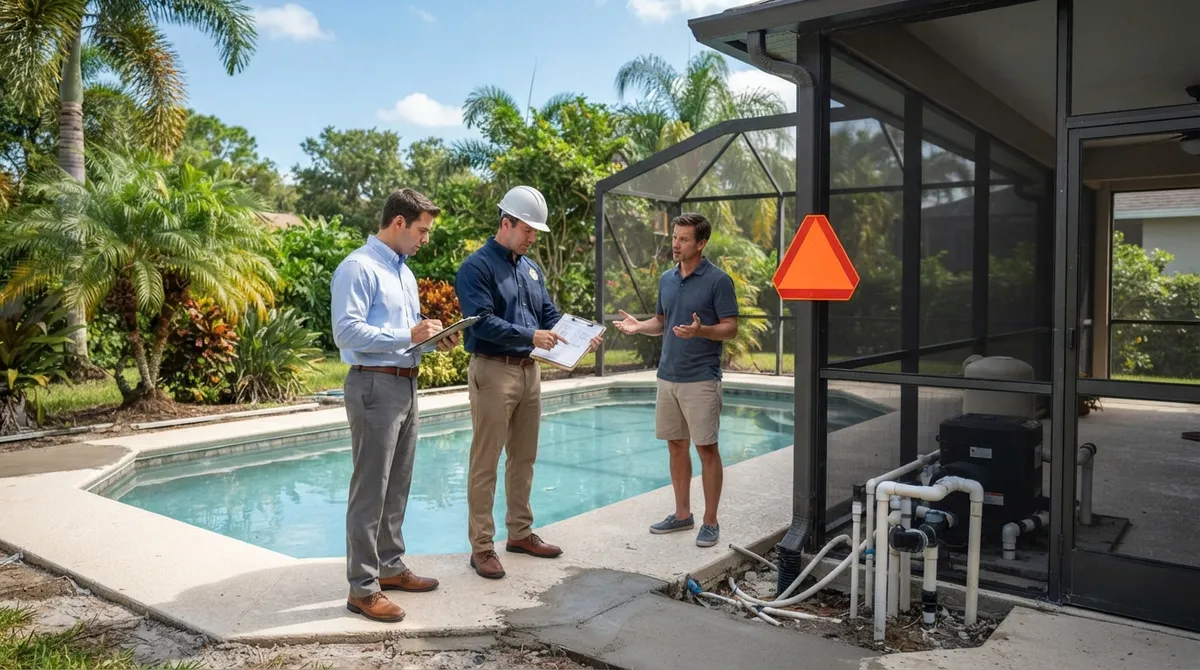
Florida generally requires a permit before anyone builds, alters, or modifies a structure. Under Florida Statutes §553.79, unpermitted work is unlawful unless a specific exception applies, and the local building department (or another authorized enforcing agency) administers those permits.
A pool isn't just a hole filled with water. It involves excavation, structural steel, electrical bonding, plumbing, drainage, barriers, and safety features that protect kids and pets. A permit exists so someone qualified can confirm all of that was done correctly.
When a pool skips the process, several issues can surface:
- Safety concerns: Barriers, alarms, and electrical bonding may never have been verified.
- Insurance trouble: Carriers can raise questions about unpermitted structures after a claim.
- Sale complications: Lenders, appraisers, and buyers' agents often flag unpermitted work.
- Code enforcement exposure: A neighbor complaint or inspection can trigger a violation notice.
If your property already has an open violation, our guide on penalties for building without a permit in Florida explains what local governments can do.
What Florida Law Says About Pool Permits and Safety
Two big pieces of Florida law come into play here: the permit requirement itself and the residential pool safety rules.
The Permit Requirement
Florida Statutes §553.79 makes building work without a required permit unlawful. There is no single statewide retroactive-permit checklist, though. Each county or municipality sets its own process, fees, and inspection procedures. That means a pool in Tampa may be handled differently than one in Miami-Dade or Orlando.
Residential Pool Safety Features
Chapter 515 of the Florida Statutes covers residential swimming pool safety. Under §515.27, a new residential pool must have at least one qualifying safety feature to pass final inspection and receive a certificate of completion. Here's a quick snapshot:
| Safety Feature Option | Key Detail |
|---|---|
| Compliant pool barrier or enclosure | Must meet §515.29 requirements |
| Approved safety pool cover | Must meet applicable safety standards |
| Exit alarms on doors/windows | Minimum sound pressure rating of 85 dBA at 10 feet |
| Self-closing, self-latching doors | Release mechanism at least 54 inches above the floor |
| Qualifying pool alarm | Must meet statute specifications |
Failure to equip a new residential pool with a required safety feature is a second-degree misdemeanor under §515.27, though the statute also describes a 45-day compliance-and-education provision that can prevent a penalty in the circumstances it states.
Barrier Requirements
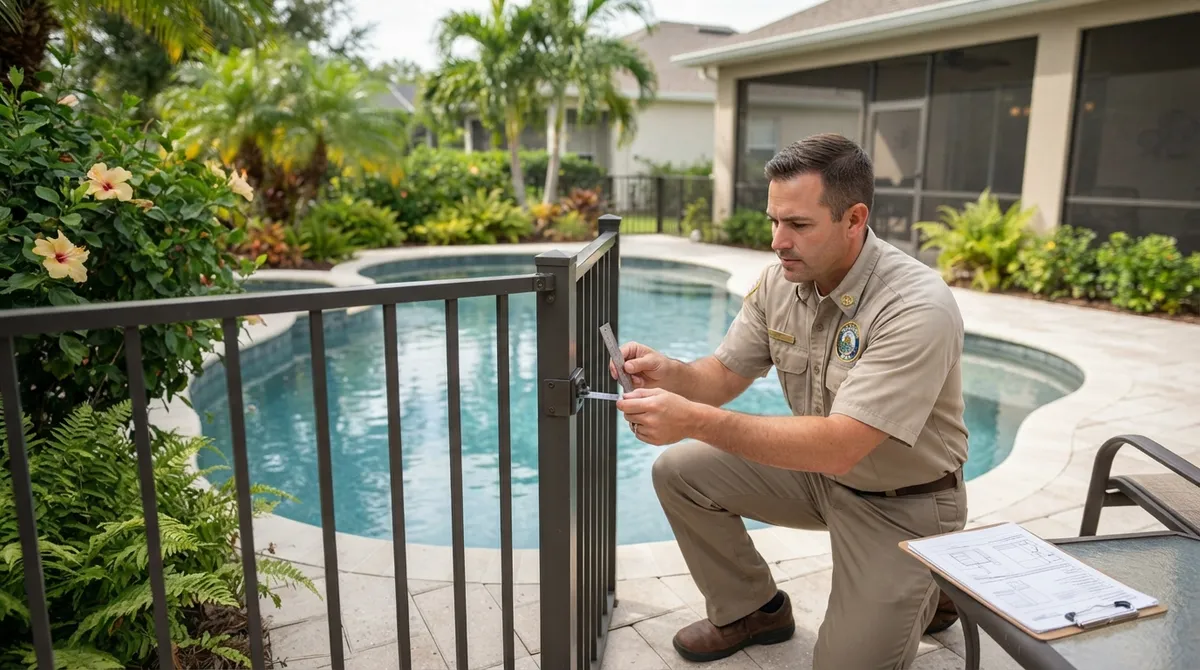
Section 515.29 sets the rules for residential barriers, including a minimum height of 4 feet on the outside, restrictions on openings and climbable features, and requirements for gates. Aboveground pools and their ladders or steps also have specific safety provisions.
One more heads-up: public and commercial pools follow different rules. Under §§514.03 and 553.79, public pools need an operating-permit application before a building permit and an operating permit before a certificate of completion or occupancy. Don't assume residential rules apply to those.
First Steps When You Discover an Unpermitted Pool
Finding out your pool lacks a permit feels overwhelming, but a calm, organized response makes all the difference. Here's a sensible order of operations:
- Don't cover, fill, or demolish anything yet. Altering the work before the local authority sees it can make verification harder.
- Confirm the right jurisdiction. Property near city lines can fall under the county or a municipality. Our building department lookup tool helps you find who actually controls your address.
- Search for existing records. Use an open permit search to see whether a permit was pulled, expired, or never closed.
- Gather what you have. Collect any plans, receipts, contractor information, photos, or inspection paperwork.
- Talk to a permitting professional before contacting the city. A short conversation can help you frame the issue and avoid surprises.
Is It Unpermitted or Just Expired?
Sometimes the pool had a permit that was never finaled. That's a different problem than having no permit at all, and the fix is often simpler. Learn more about how to close an expired permit in Florida if that sounds like your situation.
How Legalizing an Existing Pool Typically Works
While every jurisdiction does things a little differently, the legalization path usually follows a similar rhythm. Think of it as telling the building department, "Here's what exists, and here's proof it's safe."
Common Steps in the Process
- Contact the authority having jurisdiction to learn their after-the-fact or retroactive permit procedure.
- Prepare documentation of what was built. This often includes a site plan, pool design details, and as-built drawings.
- Submit the permit application for the existing pool, along with subsidiary electrical and plumbing permits where required.
- Schedule inspections to verify the pool, barrier, bonding, and safety features.
- Correct any deficiencies the inspector identifies and request reinspection.
- Receive final approval and close the permit.
For a deeper walkthrough, see our overview of how to legalize unpermitted work in Florida.
What Documents Might You Need?
| Document | Why It's Requested |
|---|---|
| Site plan | Shows pool location, setbacks, easements, and drainage |
| As-built drawings | Documents the pool as it actually exists |
| Engineer letter or sealed drawings | Verifies structural or electrical compliance when concealed work can't be seen |
| Electrical and plumbing details | Confirms bonding, equipment, and piping meet code |
| Barrier and safety-feature details | Demonstrates compliance with Chapter 515 |
| Contractor or owner information | Identifies who performed the work |
Miami-Dade County's pool-permit guidance, for example, calls for pool design details and a site plan and notes that electrical and plumbing permits may also be needed. Treat that as a local example, not a statewide checklist. Your county may ask for more, or less.
Professional as-built drawings and a clean site plan are often the backbone of a successful application.
The Concealed-Work Challenge
Here's where pools get tricky. Inspectors normally verify steel reinforcement, plumbing lines, and electrical bonding before concrete and decking hide them. With an existing pool, that work is already buried.
If concealed work can't be inspected, the local authority may require one or more of the following:
- Exposing portions of the work for inspection
- Testing, such as pressure testing of plumbing
- Engineering documentation or a sealed engineer letter
- Corrective work if something doesn't meet code
This is exactly where an in-house engineering team earns its keep. When a reviewer asks for structural or electrical verification, having engineering support on hand keeps the process moving instead of stalling while you hunt for a consultant.
Will the County Make You Remove the Pool?
This is the question that keeps people up at night, so let's address it plainly. A permit doesn't automatically legalize a pool that violates building, zoning, setback, drainage, electrical, plumbing, or other applicable requirements. If the pool can be brought into compliance, that's the usual outcome. If it can't, the authority may direct the owner to modify or remove the work.
In practice, removal is typically a last resort, not the default. Most issues can be addressed through corrections, documentation, and inspections. The biggest risk factors tend to be:
- A pool built inside a required setback or easement
- Serious electrical bonding or grounding problems
- A barrier that can't be made compliant
- Flood-zone or drainage conflicts
For a closer look at this concern, read will you really have to demolish unpermitted work?
Comparing Your Options
Depending on your goals, you generally have a few paths. Here's how they stack up:
| Option | Best For | Considerations |
|---|---|---|
| Legalize with an after-the-fact permit | Most owners who want to keep the pool | Requires documentation, inspections, and possible corrections |
| Fix and finish an existing open permit | Pools with a permit that expired or never finaled | Often simpler than a brand-new application |
| Modify the pool to comply | Pools with specific violations like barriers or alarms | Cost depends on the deficiency |
| Remove or fill the pool | Pools that cannot be brought into compliance | Usually requires its own permit and inspections |
| Ignore it | No one, honestly | Risks fines, escalating enforcement, and sale or insurance problems |
Costs and timelines vary widely by jurisdiction, so use our guide on after-the-fact permit costs in Florida as a starting point rather than a promise.
Selling, Buying, or Insuring a Home With an Unpermitted Pool
If you're a real estate professional or buyer, an unpermitted pool is one of those items that can quietly derail a closing. Lenders and title companies may flag it, appraisers may question value, and insurers may ask for proof of compliance.
A few practical pointers:
- Check early. Run a permit search during due diligence, not the week of closing.
- Disclose honestly. Florida sellers have disclosure obligations, and hiding known issues creates bigger problems later.
- Negotiate with a plan. A realistic legalization timeline gives everyone something concrete to work with.
- Get a professional opinion. A permitting specialist can tell you quickly whether the issue is a simple closeout or a heavier lift.
Our team supports transactions through realtor and closing support, and if you're racing a deadline, urgent permit rescue is built for exactly that scenario. You can also read about what to do when an open permit is found at closing.
Tips for General Contractors and Pool Pros
If you're a general contractor or pool builder, this topic hits close to home. Maybe a homeowner hired a previous contractor who vanished, or a customer says "I thought the permit was handled." Either way, you may be the one asked to clean it up.
Keep these best practices in mind:
- Verify the permit status before you touch anything. Don't build on top of unverified work.
- Document everything. Photos, measurements, and notes protect you and speed up approvals.
- Confirm who is legally allowed to pull the permit. See who can pull a permit in Florida.
- Bring in engineering early when concealed work needs verification.
- Track the application actively. Reviewer comments sit idle if nobody answers them.
Pool and spa pros can learn more on our page for pool and spa contractors, and general contractors can explore how we support GCs.
How 1 Contractor Solutions Can Help
At 1 Contractor Solutions, we act as Florida's outsourced permitting department. For an unpermitted pool, that means we work out which jurisdiction controls your property, prepare or review the drawings, coordinate the application, track it, handle reviewer comments, and carry it through to closeout. Because our drafting and engineering are in house and our own engineer signs and seals the work, we can answer reviewer questions without waiting on an outside consultant.
We work across all 67 Florida counties, including Hillsborough County, Miami-Dade County, Orange County, and Sarasota County. Our after-the-fact and expired permit work covers exactly this kind of situation, and our code compliance violation support helps if you've already received a notice.
Curious how others feel about working with us? You can see what our 1 Contractor Solutions customers say on Google, and you can follow us on LinkedIn or follow us on Facebook for Florida permitting updates.
Practical Tips to Avoid This Problem Next Time
An ounce of prevention really does beat a pound of cure here. Whether you're building a new pool or buying a home with one, these habits will protect you:
- Ask any pool contractor for the permit number and verify it with the building department.
- Never agree to "skip the permit to save time or money." The savings rarely survive the cleanup.
- Keep your final inspection paperwork and certificate of completion in a safe place.
- Before buying a home, run a permit history search and ask for documentation on pools, additions, and screen enclosures.
- If you're an owner-builder, understand your responsibilities. Our owner-builder permit page is a good place to start.
Ready to Get Your Pool Legal?
A pool built without a permit in Florida feels stressful, but it's usually a solvable problem with the right documentation, inspections, and a little patience. The key is to start with the facts: confirm your jurisdiction, avoid altering the work, gather what you have, and build a clean application that answers the building department's questions before they ask them.
You don't have to figure this out alone. If you'd like a clear, honest read on your situation, get a free quote from our team and let's get your pool permitted, protected, and back to being the best part of your backyard.
FAQs
What should I do if I discover a pool was built without a permit in Florida?
Start by leaving the work as-is, since covering or altering it can make verification harder. Then confirm which building department has jurisdiction, search for any existing permit records, and gather plans and photos. A quick call with a permitting professional can help you plan next steps before you contact the city.
Can I get a retroactive permit for an unpermitted pool in Florida?
In many cases, yes. Most Florida jurisdictions have an after-the-fact process that involves submitting documentation of the existing pool and passing inspections. Requirements and fees vary by county and city, so it's smart to confirm the exact process with your local building department.
Can a Florida county require an unpermitted pool to be removed?
It's possible, but usually it's a last resort. A permit doesn't legalize a pool that violates setback, zoning, or safety requirements, so the authority may require corrections or, if compliance can't be achieved, modification or removal. Most pools can be brought into compliance with the right documentation and fixes.
What are the Florida pool fence and safety-barrier requirements?
Florida Statutes §515.29 requires residential pool barriers to be at least 4 feet high on the outside, with limits on openings and climbable features plus specific gate requirements. Under §515.27, a new residential pool also needs at least one qualifying safety feature, such as an approved cover, exit alarms, or self-closing, self-latching doors.
Will an unpermitted pool affect selling or insuring a Florida home?
It very well can. Lenders, appraisers, title companies, and insurers often flag unpermitted structures, which can slow or complicate a sale or a claim. Legalizing the pool before listing, or building a plan with the buyer, usually keeps things much smoother.
We do this work every day across all 67 Florida counties. Call (866) 314-6931 and we will tell you what your situation actually requires — including when you do not need us.
Related services
Permit Facilitation & Filing
You have a crew scheduled, a client asking for dates, and a permit sitting somewhere in a queue you cannot see. We file it, w…
See the servicePlan Review Coordination
A permit in plan review is not one queue. On a commercial project it can be six queues, each with its own reviewer, its own c…
See the serviceReady to get your permit moving?
One call tells you which jurisdiction controls your project, what it will take, and what it will cost. Most of the time we can scope it on the phone.