
Blog
6 Things to Know About a Correction Notice on an ATF Permit
Got a correction notice on your Florida after-the-fact permit? Learn what it means, what it asks for, and how to respond step by step.
Key Takeaways
-
A correction notice is a written list of items the building department needs before finishing review; it is not a denial, fine, or code-enforcement citation, and your application remains active.
-
In many Florida jurisdictions, such as Bay County, you typically upload requested revisions to the existing application rather than reapplying from scratch.
-
Concealed work on an after-the-fact permit may need to be exposed for inspection or evaluated by a licensed engineer, with St. Lucie County requiring third-party analysis at the owner's cost.
-
Answer each numbered comment individually in a response letter, revise only what was requested, and upload to the same permit record following your jurisdiction's process.
-
Ignoring a correction notice can stall your application and may lead to violations, fines, or liens, so respond promptly and completely.
-
Fees, penalties, and timelines vary by county and city; there is no single statewide after-the-fact fee, so confirm details with your local building department.
You filed an after-the-fact permit, took a breath, and then it showed up: a correction notice in your permit portal. Maybe your stomach dropped a little. Totally normal! If you're wondering what is a correction notice on an after the fact permit in Florida, here's the friendly version: it's the building department's written to-do list. It says, "We need a few more things before we can finish reviewing this."
It is not a denial. It is not a fine. It's a request to fix, clarify, or add information to the application you already submitted. In 2026, thousands of Florida contractors, solar installers, realtors, and homeowners get these notices every year, and most of them are fixable with the right response.
Below are six things every applicant should understand about correction notices on after-the-fact permits, plus practical steps to answer yours with confidence.

1. A Correction Notice Is a Review Comment List, Not a Denial
A correction notice is a written request from a building department asking you to fix or clarify deficiencies in a permit application, plans, or supporting documents. Think of it as the reviewer saying, "Almost there, but we need more."
Here's what it is not:
- Not a final denial. Your application is still active.
- Not a code-enforcement citation. Those come from a separate process.
- Not a reason to start over. Many counties, such as Bay County, say you generally don't need to reapply. You upload the requested revisions or missing information to the existing application.
That said, the notice does not erase the fact that work was done before a permit existed. Florida Statutes §553.79 generally requires a permit before covered construction, alteration, repair, or demolition begins. Applying afterward is the right move, but it doesn't automatically legalize the work or waive enforcement. If you want the bigger picture on this process, our guide on what after-the-fact permitting in Florida involves is a great companion read.
2. How After-the-Fact Permits Differ From Regular Permits
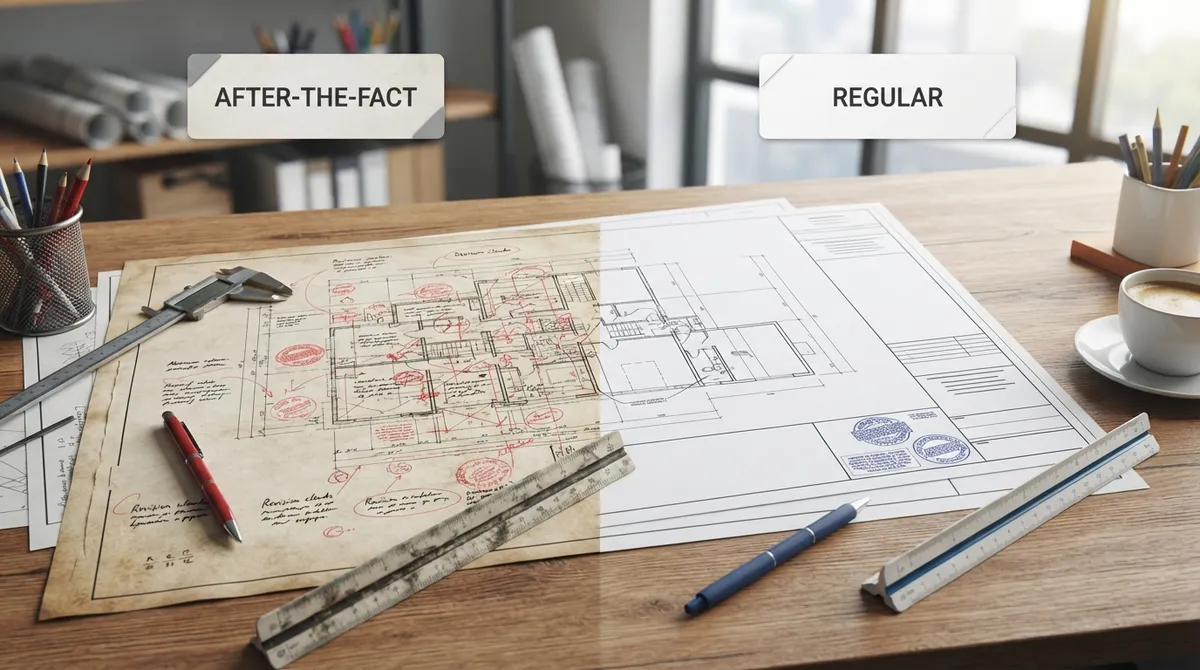
A regular permit asks for approval before you build. An after-the-fact (ATF) permit asks for approval of work that's already started or finished. That one difference changes what reviewers want to see.
Because the work already exists, reviewers can't just trust a drawing of what you plan to do. They often need proof that what's built actually meets the Florida Building Code. That's why correction notices on ATF permits can feel more detailed than on a standard application.
| Feature | Standard Permit | After-the-Fact Permit |
|---|---|---|
| Timing | Before work begins | After work started or finished |
| Plans show | Proposed design | As-built conditions |
| Concealed work | Inspected during construction | May need exposure or engineering evaluation |
| Fees | Standard schedule | May include added or doubled fees (varies locally) |
| Correction notice focus | Design compliance | Design compliance plus proof of existing work |
If you're not sure which path you're on, our overview of expired permits versus after-the-fact permits can help you sort it out.
3. What a Correction Notice Typically Asks For
Every jurisdiction words these notices differently, and the exact items depend on your project, the applicable Florida Building Code provisions, and the local enforcing agency. Still, a few requests come up again and again.
Common Correction Items
- Revised or clearer plans (floor plans, elevations, details)
- Structural or code-compliance details that don't match what was built
- Product approvals or Notice of Acceptance documentation for windows, doors, or roofing
- Signed and sealed engineering documents or an engineer letter
- Corrected contractor or owner information, including license details
- Evidence that concealed work complies with code
Notice that most of these are documentation fixes. That's good news, because documentation is something a skilled team can solve. For plan-related items, services like as-built drawings and engineer letters are often exactly what reviewers want to see.
4. Concealed Work May Need to Be Verified
Here's where ATF permits get unique. If the work is hidden behind drywall, under a slab, or inside a roof system, the inspector can't see it. So the building department may require that it be exposed for inspection, or accept an evaluation by a design professional instead.
St. Lucie County, for example, specifically notes that concealed work on an after-the-fact permit may require a third-party engineering analysis at the owner's cost. That's one county's rule, so check your own jurisdiction, but the idea is common across Florida.
Here's how that usually plays out:
- The reviewer flags concealed or covered work in the correction notice.
- You and your team decide whether to open the area or hire a licensed engineer to evaluate it.
- The engineer inspects, documents, and seals a letter or report.
- You upload that documentation to the same permit record.
- The reviewer decides if it satisfies the comment.
Using an engineer letter can save you from tearing out finished work. We walk through the idea in how to use an engineer letter to save your permit, and our in-house team handles structural engineering with sealed drawings.
5. How to Respond Step by Step
Okay, deep breath. Here's a calm, repeatable way to answer a correction notice. Most Florida jurisdictions follow a version of this process, though your portal may look different.
- Read the entire notice first. Don't skim. Note every numbered comment and any deadline.
- Sort comments by type. Separate drawing issues, engineering issues, and administrative issues like missing signatures.
- Answer each comment individually. Reviewers love a response letter that matches their comment numbers one by one.
- Revise the plans and documents. Update only what's requested, and keep revision clouds or notes so changes are easy to spot.
- Upload to the same permit record. Follow your jurisdiction's stated process. Avoid emailing documents unless the department tells you to.
- Schedule required inspections. ATF permits usually involve inspections to verify the built work.
- Keep your records. Save the notice, your revised plan set, upload confirmations, and inspection records.
A tidy response package is half the battle. Our walkthrough on how to respond to a correction notice after the fact in Florida goes deeper, and our revisions and resubmittals service exists for exactly this moment.
6. Fees, Timelines, and Consequences Vary by Jurisdiction
Here's the honest part: there's no single statewide answer. Florida law sets the foundation, but each county and city applies its own fees, inspection steps, and enforcement approach.
| Topic | What the Research Shows |
|---|---|
| Permit required before work | Fla. Stat. §553.79 generally makes it unlawful to begin covered work without a permit |
| After-the-fact fee | No single statewide amount; St. Lucie County states its ATF fee is double (a local example) |
| Penalties for unpermitted work | Fla. Stat. §489.127 includes civil penalties up to $2,000 for specified citations and up to $2,500 per day in certain enforcement-board processes; applicability depends on the violation |
| Private provider review | Fla. Stat. §553.791 provides a 20-business-day review period for certain applications with a private-provider affidavit |
| Reapplication | Many jurisdictions, like Bay County, let you revise the existing application |
A few important notes. Those penalty figures are not automatic charges on every ATF permit. They depend on who performed the work and which enforcement process applies. And the 20-business-day private provider timeline is a specific statutory pathway, not a universal deadline for every correction notice.
Curious about costs? Our breakdown of after-the-fact permit costs in Florida and the penalty for building without a permit in Florida can help you plan realistically.
Common Questions People Ask
Can I keep working while the notice is pending?
Usually, you should pause work on the unpermitted portion until your jurisdiction says otherwise. Local stop-work requirements may apply, and continuing could complicate your case. When in doubt, ask the building department or your permitting team first.
What if I ignore the notice?
Ignoring it is the one move we'd gently steer you away from. An unanswered correction notice can stall your application, and depending on the jurisdiction, open the door to violations, fines, or liens. A quick response keeps things moving.
How Different Audiences Can Approach a Correction Notice
Your next move depends a bit on who you are. Here's a friendly cheat sheet:
- General contractors: Build a standard response template and keep your sealed drawings organized. Our general contractor support can handle tracking across multiple jurisdictions.
- Solar companies: Correction notices often hit structural and electrical documentation. Having code-compliant, sealed paperwork ready speeds approvals. See our solar contractor services.
- Realtors and investors: A notice during a sale can threaten your closing date. Early action matters, and our realtor and closing support is built for that pressure.
- Homeowners and property owners: You don't need to be an expert. Gather what you have, ask for help decoding the comments, and lean on a professional for drawings. Our homeowner resources are a good starting point.
- Architects, designers, and trades: If you need dependable outsourced drafting without adding headcount, our drafting-only service lets you keep your own engineer and your own client relationship.
Why Working With a Permitting Team Helps
You can absolutely respond to a correction notice yourself. But a lot of applicants find the process faster and calmer with help, especially when the notice mixes drawing edits, engineering requests, and inspection scheduling.
1 Contractor Solutions acts as Florida's outsourced permitting department. We work across all 67 counties and have filed in more than 400 municipalities. Because our drafting and engineering are in house, and our own engineer signs and seals the work, a reviewer comment doesn't send you chasing an outside consultant. We read the notice, tell you what it really requires, and then fix it. You can also see what our customers say on Google to get a feel for how we work.
For stubborn cases, our after-the-fact and expired permit service takes on the files other firms decline, and our plan review coordination keeps reviewer conversations moving. If a deadline is looming, urgent permit rescue is there for you. You can also follow us on LinkedIn or follow us on Facebook for Florida permitting updates.
Final Thoughts and Next Steps
So, what is a correction notice on an after the fact permit in Florida? It's a written, fixable list of items a building department needs before it can finish reviewing work that was done without a permit. It's not the end of the road. It's a checkpoint.
Read it carefully, answer every comment, upload your revisions to the same record, schedule the inspections, and keep good records. If the notice involves concealed work or engineering questions, bring in a licensed professional early. And remember that fees and consequences vary by jurisdiction, so always confirm details with your local building department.
You've got this, and you don't have to do it alone. If you'd like a team to read the notice, build the response, and carry your permit through approval, get a free quote today. We answer around the clock, respond fast, and se habla español.
FAQs
What does a correction notice mean on a Florida building permit?
It's a written list from the building department naming missing information or code deficiencies that must be fixed before review can finish. It's not a denial, and it usually means your application is still alive and moving. Think of it as a friendly nudge with homework attached.
Do I have to reapply after receiving a permit correction notice?
Usually not. Many jurisdictions, such as Bay County, let you upload the requested revisions to your existing application instead of starting over. Always check your local building department's instructions to be sure.
Can a Florida building department require walls or ceilings to be opened for inspection?
Yes, it can. When work is concealed, the department may require it to be exposed or may accept an evaluation by a licensed design professional. St. Lucie County, for example, notes that a third-party engineering analysis may be required at the owner's cost.
Are after-the-fact permit fees higher in Florida?
They can be, but it varies by location. There's no single statewide after-the-fact fee. St. Lucie County, for instance, states its fee is double, which is a local example, so check with your own jurisdiction.
What happens if I don't correct an after-the-fact permit application?
Your application may stall, and depending on the jurisdiction you could face violations, fines, or liens. Responding promptly and completely is the best way to keep your project on track and avoid extra headaches.
We do this work every day across all 67 Florida counties. Call (866) 314-6931 and we will tell you what your situation actually requires — including when you do not need us.
Related services
Permit Facilitation & Filing
You have a crew scheduled, a client asking for dates, and a permit sitting somewhere in a queue you cannot see. We file it, w…
See the servicePlan Review Coordination
A permit in plan review is not one queue. On a commercial project it can be six queues, each with its own reviewer, its own c…
See the serviceReady to get your permit moving?
One call tells you which jurisdiction controls your project, what it will take, and what it will cost. Most of the time we can scope it on the phone.