
Blog
Best Expired & After-the-Fact Permit Service in Florida
Expired permit or unpermitted work in Florida? Learn the difference, local fees, and how to choose the best reinstatement and after-the-fact service.
Key Takeaways
-
Expired permits (lapsed records) and after-the-fact permits (work done with no permit) follow different paths, so identify which applies before paying for any service.
-
Florida Statutes § 553.79 allows closing an expired permit when work is substantially complete, or six years after issuance without a final inspection if no apparent safety hazards exist, but closure is never automatic.
-
Florida has no statewide reinstatement process; fees and rules vary by jurisdiction, such as Palm Beach County's $75 fee within 180 days versus Orlando's minimum or 25% of the original fee, capped at $1,000.
-
Check the permit status, jurisdiction, inspection history, code enforcement cases, and whether the permit scope matches what was built before spending money on a fix.
-
For after-the-fact work, do not cover or alter concealed work until the building department has reviewed it, since exposing and inspecting walls is often required.
-
Avoid any provider who guarantees approval before reviewing your records, and get scope, fees, and exclusions in writing from a service with local experience.
Let's be honest: nobody wakes up excited to discover a lapsed permit. Maybe your roofer vanished before the final inspection. Maybe a buyer's inspector found a kitchen remodel that never saw a building department. Or maybe you just realized the permit on your garage conversion quietly ran out months ago. Take a breath. You're in good company, and this is fixable more often than most people think.
The tricky part is that "reinstate an expired permit" and "get an after-the-fact permit" are two different problems with two different paths. Pick the wrong one and you can burn weeks and money. This guide walks you through the difference, what Florida law actually says, what typical local fees look like in 2026, and how to find the best reinstate-expired-plus-after-the-fact service in Florida for your situation. Whether you're a contractor, a solar company, a realtor, or a homeowner, you'll leave with a clear plan.
Expired Permit vs. After-the-Fact Permit: Know Which Problem You Have
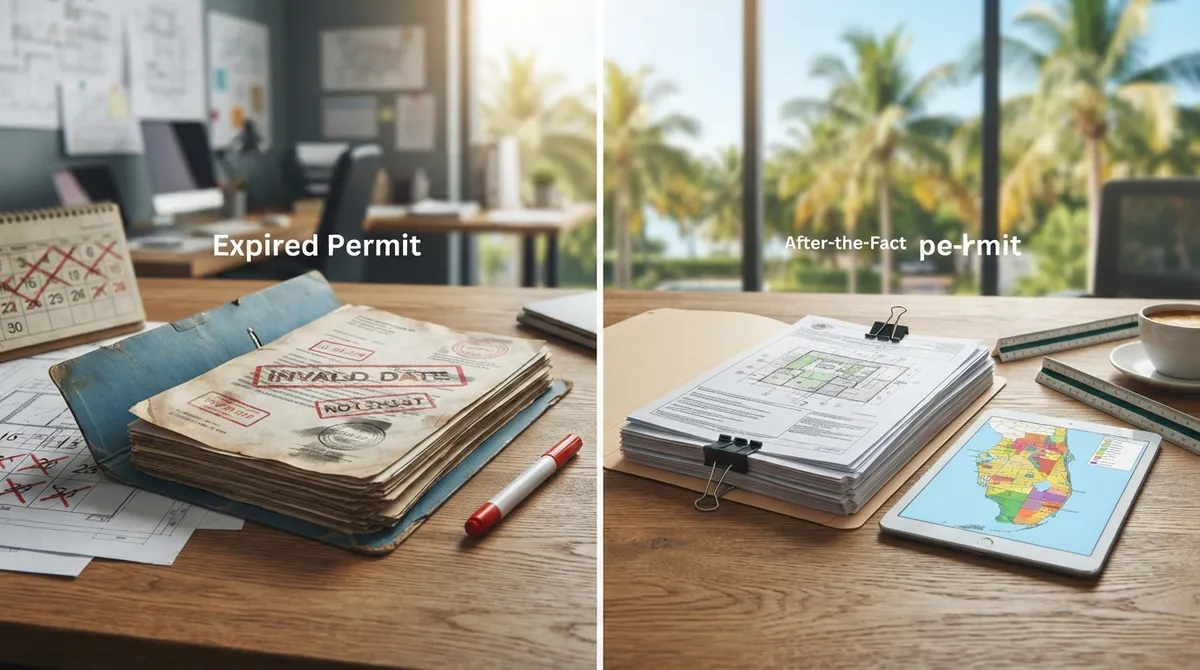
Here's the simple version. An expired permit is one that was issued by your building department but lapsed, usually because inspections stalled or no approved inspection happened within the allowed window. An after-the-fact (ATF) permit covers work that was done without the required permit in the first place.
Why does the distinction matter? Because the building department treats them differently. Reinstatement deals with an existing record. An ATF permit generally means a new application, review, and inspection for work that already exists. Your local department makes the final call on which route applies.
| Factor | Expired Permit | After-the-Fact Permit |
|---|---|---|
| Permit ever issued? | Yes | No |
| Typical route | Renewal, extension, reinstatement, or closure | New application and review for completed work |
| Common documents | Permit record, inspection history, extension request | Plans or as-builts, surveys, engineering letters, photos |
| Inspections | Remaining or missed inspections | Full inspection, sometimes with exposed work |
| Fees | Often a percentage of the original fee | Often higher, may include penalties |
Many real-world jobs are actually a blend. A permit may have been pulled for the roof, but the contractor also added a patio enclosure that was never covered. That's why the best service handles both under one roof. If you're sorting out which situation applies to you, our guide on expired permit vs. after-the-fact: which fix do you need is a helpful companion read.
What Florida Law Says About Closing Expired Permits
Florida Statutes § 553.79 gives local enforcement agencies a pathway to close an expired permit when the agency determines its requirements have been substantially completed. The statute also allows an agency to close a permit six years after issuance without a final inspection if it determines there are no apparent safety hazards.
That's encouraging, but let's keep expectations realistic. These provisions don't guarantee automatic closure, and they don't eliminate local review. Each building department decides how it applies the rule, what evidence it wants, and what inspections or documentation it will require. This is exactly why jurisdiction-specific knowledge matters so much. For a deeper walkthrough, see how to close an expired permit in Florida.
How Florida Jurisdictions Handle Expired Permits Differently
Florida has no single statewide playbook for reinstatement. A few local examples show just how much the process can vary:
- Orlando: Reviews renewal requests and may decide a replacement permit is needed instead. For certain renewals within six months, the city lists the greater of a minimum permit fee or 25% of the original fee, capped at $1,000.
- Pinellas County: Offers an online renewal action for expired permits.
- Collier County: Distinguishes extensions from void permits. Extensions of up to 90 days carry a fee of at least $100, capped at $500, while void permits generally need a brand-new application.
- Palm Beach County: Lists a $75 renewal or extension fee within 180 days of inactive status. After 180 days, the fee is 30% of the original permit fee with a $75 minimum.
Please treat these as examples, not statewide rates. Fees, eligibility windows, and code editions change, so always confirm current numbers with your building department. You can use our building department lookup to identify who actually controls your address, which isn't always obvious near city lines.
How to Check Your Permit Status First
Before you spend a dollar on any service, find out what you're actually dealing with. Permits can be expired, inactive, or void, and each status leads somewhere different.
- Identify the jurisdiction. Confirm whether the city or county reviews your address.
- Pull the permit record. Look at the status, issue date, expiration date, and scope of work.
- Review the inspection history. Note which inspections passed, failed, or never happened.
- Check for code enforcement cases. An open case changes the urgency and the strategy.
- Compare the permit scope to what was built. Extra work beyond the permit may need its own ATF route.
Our open permit search tool is a great place to start, especially if you're a buyer or realtor trying to see what's lingering on a property.
What a Good Reinstatement Service Actually Does
A strong expired-permit service isn't just a courier. Here's what you should expect:
- Retrieving and reading the full permit record
- Spotting missing inspections, documents, or contractor-of-record issues
- Coordinating directly with the building department on the right path
- Preparing renewal, extension, or closure submittals
- Arranging licensed contractors or design professionals when the jurisdiction requires them
- Tracking the file until the department closes it out
What a service cannot do is guarantee approval, waive code requirements, or replace a contractor or design professional where the jurisdiction requires one. Anyone promising a fixed outcome before reviewing your records deserves a skeptical eyebrow raise. 1 Contractor Solutions handles this kind of work through its after-the-fact and expired permits service, taking on the files many firms decline.
What an After-the-Fact Permit Typically Requires
ATF work is where documentation really counts. Because the work already exists, the building department needs proof that it meets code, and sometimes that means seeing inside the walls.
Depending on the work type, the authority may require:
- As-built drawings or site plans of what was actually built
- A survey for exterior structures
- Sealed engineering or structural letters
- Product approvals and installation details
- Corrections to bring work up to code
- Exposure of concealed work for inspection
- Applicable permit fees and any penalties
A word of friendly caution: confirm the process with the building department before you cover, paint, or alter anything. Closing up drywall on work that needs inspection is a classic and expensive mistake. For plan-related needs, in-house as-built drawings and engineer letters can keep everything moving without waiting on an outside consultant.
Reinstatement vs. After-the-Fact: Typical Timeline and Effort
| Scenario | Likely Path | Common Hurdles |
|---|---|---|
| Permit expired, inspections mostly done | Renewal or extension, then final inspection | Fee tied to original permit value |
| Permit void or past the extension window | New application, sometimes ATF-style review | Re-submitting plans and fees |
| Old permit, no final inspection, six-plus years | Possible closure under § 553.79 if no apparent hazards | Local discretion and evidence requests |
| No permit ever pulled | After-the-fact application | As-builts, engineering, exposed-work inspections |
Timelines vary widely by county, workload, and how clean your documentation is. A well-prepared package almost always moves faster than a scrambled one.
How to Choose the Best Service for Your Situation
Here's a practical checklist for comparing providers. You don't need to be an expert; you just need to ask the right questions.
- Verify licensing and insurance. Confirm the relevant Florida credentials for the work involved.
- Ask about your specific city or county. Local experience beats general experience every time.
- Get the scope and fees in writing. Know who signs and submits applications.
- Clarify exclusions. Government review fees, plans, inspections, and construction costs are usually separate.
- Check for in-house engineering and drafting. It removes the "waiting on someone else" delay when a reviewer flags something.
- Watch for red flags. Guaranteed approval or a fixed outcome before reviewing records is a warning sign.
Responsiveness matters too, especially when a closing date or crew schedule is on the line. For urgent cases, our urgent permit rescue service is built for denials, stop work orders, and held-up closings.
Why This Matters for Different Readers
General Contractors and Trades
An expired permit tied to your license can create headaches on future jobs. Cleaning up old files protects your standing and keeps new permits flowing. Explore support built for general contractors.
Solar Companies
Solar jobs are paperwork-heavy, and lapsed permits or missing final inspections can stall interconnection. Reinstating quickly keeps customers happy. See how we support solar contractors.
Realtors and Buyers
Open or expired permits show up at the worst time: right before closing. Early research and a clear fix plan can save the deal. Our realtor closing support was designed for exactly this.
Homeowners
You may have inherited a problem from a prior owner or a contractor who disappeared. You didn't cause it, but you can solve it, and our homeowner resources are a good starting point.
Common Mistakes to Avoid
- Assuming an expired permit will simply disappear if you ignore it
- Covering concealed work before the building department weighs in
- Paying for "guaranteed" results before anyone reviewed your records
- Applying in the wrong jurisdiction near city lines
- Skipping the code enforcement check
- Treating state-law closure options as automatic
Each of these can add time and cost. A quick, honest records review at the start prevents most of them.
Why 1 Contractor Solutions Is Worth a Look
1 Contractor Solutions works as Florida's outsourced permitting department, handling filing, tracking, plan review coordination, revisions, and closeout across all 67 counties. The team has filed in more than 400 municipalities, and because drafting and sealed engineering are in-house, reviewer comments get fixed fast instead of bouncing between outside consultants. Responses come within 30 minutes, day or night, and se habla español.
Want to see what other clients say? Visit us on Google — 1 Contractor Solutions and read the reviews. You can also follow us on LinkedIn and follow us on Facebook for Florida permitting updates. For the statute itself, you can read the official Florida Statutes § 553.79 text.
Your Next Step
An expired permit or unpermitted work feels heavy, but it's a solvable problem with the right records review, the right path, and a team that knows your local building department. Start by checking your permit status, gathering what you have, and asking providers the questions above. If you'd like a clear read on whether you need reinstatement, an after-the-fact permit, or both, get a free quote and let's sort it out together.
FAQs
How do I reinstate an expired building permit in Florida?
Start by confirming the permit's status (expired, inactive, or void) and your jurisdiction's renewal or extension rules. Many departments allow a renewal or extension for a fee, while void permits generally require a new application, so check with your local building department or a permitting service first.
What is the difference between reinstating an expired permit and getting an after-the-fact permit?
Reinstatement fixes a permit that was issued but lapsed. An after-the-fact permit covers work that was done without the required permit, usually through a new application, plans or as-builts, and inspections. Your local building department decides which route applies.
Can an expired Florida building permit be closed without a new permit?
Sometimes. Florida Statutes § 553.79 lets a local agency close an expired permit when requirements are substantially completed, or six years after issuance without a final inspection if no apparent safety hazards exist. It's not automatic, though, so the agency still has to review and agree.
How much does it cost to renew an expired permit in Florida?
It depends on the county or city. For example, Palm Beach County lists $75 within 180 days of inactive status, while Orlando lists a minimum fee or 25% of the original fee, capped at $1,000, for certain renewals. Always confirm current fees with your local department.
Can I sell a Florida home with an expired or open permit?
Often you can, but open or expired permits commonly surface during inspections, title work, or lender review and can delay closing. Resolving them before listing, or building the fix into the contract, usually keeps things smoother for everyone.
We do this work every day across all 67 Florida counties. Call (866) 314-6931 and we will tell you what your situation actually requires — including when you do not need us.
Related services
Permit Facilitation & Filing
You have a crew scheduled, a client asking for dates, and a permit sitting somewhere in a queue you cannot see. We file it, w…
See the servicePlan Review Coordination
A permit in plan review is not one queue. On a commercial project it can be six queues, each with its own reviewer, its own c…
See the serviceReady to get your permit moving?
One call tells you which jurisdiction controls your project, what it will take, and what it will cost. Most of the time we can scope it on the phone.