
Blog
5 Things to Know About a Roof Permit in Cape Coral FL
Planning a re-roof? Here are 5 friendly, practical things to know about a roof permit in Cape Coral FL in 2026, from documents to inspections and fees.

Key Takeaways
-
A residential re-roof in Cape Coral requires a permit, filed online through the City's EnerGov Self-Service Portal using the residential push-button roofing application.
-
Only certified roofing contractors (CCC) or eligible owner-builders can apply, and owner-builders are expected to use the portal starting July 1, 2026.
-
A Roof Data Sheet is always required, and a Notice of Commencement is needed for projects valued at $2,500 or more.
-
Product approvals and installation instructions must be on the job site for inspections, since missing paperwork can cause a failed inspection and delay.
-
Sheathing inspection or affidavit is required if the new-construction permit predates March 1, 2002, or no full re-roof has been completed since March 1, 2007.
-
Switching from shingle or metal to tile requires an engineer's evaluation of the existing trusses, and fees ($75 vs. $100 plus a 2.5% surcharge) should be confirmed before budgeting.
Replacing a roof is one of those projects that feels simple until the paperwork shows up. You pick the shingles, schedule the crew, and then someone mentions the words roof permit Cape Coral FL. Suddenly there are portals, affidavits, inspections, and a fee schedule that doesn't seem to match itself.
Take a deep breath. It's very manageable once you know the pieces. In 2026, the City of Cape Coral uses an online process for residential re-roofs, and the rules are laid out in published guidelines. The trick is knowing which details apply to your home and which can wait.
Whether you're a homeowner planning a replacement, a general contractor lining up crews, a realtor helping a buyer, or a solar company coordinating a roof-mounted install, this friendly guide walks through five things worth knowing before the first shingle comes off. Always confirm final details with the City, since requirements can shift with your roof type and property.
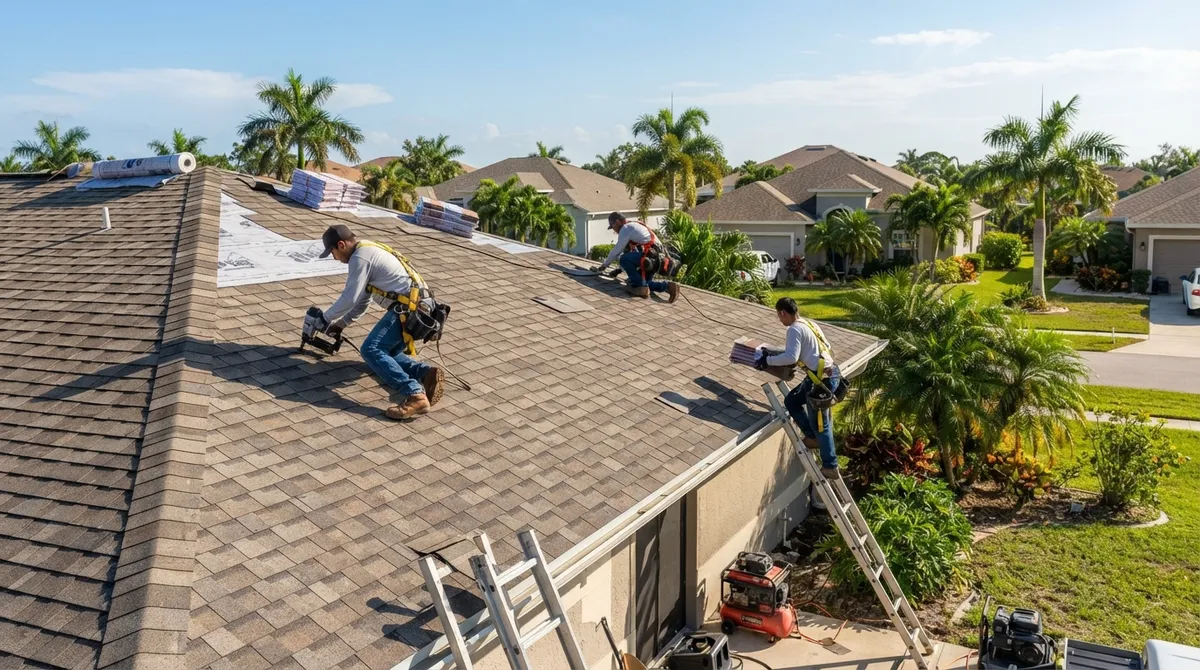
1. Yes, a Residential Re-Roof Needs a Permit
Let's answer the big question first. Cape Coral requires a permit for residential re-roofing. The City's January 2026 guideline directs applicants to the residential push-button roofing application, which is filed through the City's EnerGov Self-Service Portal.
That permit exists for good reasons. A roof is a major piece of your home's wind resistance, and Florida's building code takes it seriously. The permit lets the City verify that your product approvals, installation methods, and underlying deck all meet current standards.
Who Can Apply?
Only certain people can pull the permit. Here is how the City describes it:
- A certified roofing contractor (CCC) can apply for the residential re-roof permit.
- An eligible owner-builder can apply as well.
- Licensed contractors are required to apply online.
- Owner-builders are also expected to use the portal as the standard process beginning July 1, 2026.
If you're curious how owner-builder rules work elsewhere in the state, our guide on how to get an owner-builder permit in Port Charlotte shows the general flavor, though each city has its own twists.
When a Different Permit Applies
Not every roof job uses the standard application. The City directs a flat-only re-roof to a separate Roofing Various permit guideline, rather than the standard shingle/metal or tile-to-tile re-roof application. If your home has a mix of pitched and flat sections, it's worth confirming which path covers your scope before anyone submits anything.

2. The Document Checklist Is Short, but Specific
Good news: the baseline paperwork for a standard residential re-roof isn't a mountain. The City lists a Roof Data Sheet as always required. From there, additional documents depend on your property and scope.
| Document | When It Applies |
|---|---|
| Roof Data Sheet | Always required for a standard residential re-roof |
| Notice of Commencement (NOC) | Project value of $2,500 or greater |
| FEMA packet or elevation certificate | Depends on the property and scope |
| Eagle Management Affidavit | Parcels in an eagle nesting zone |
| Owner-builder affidavit | When an eligible owner-builder applies |
| Private-provider notice | When a private provider is used |
A few of these deserve a little more explanation.
The Notice of Commencement
The City's guidelines state that a Notice of Commencement is required when the project value is $2,500 or greater. Most full re-roofs clear that threshold easily. The NOC gets recorded and then verified by the City, and that verification is actually the first inspection in the sequence. Verify the current filing requirements for your specific permit before you start.
Floodplain and Environmental Reviews
Cape Coral is a canal-and-waterway city, so parcel conditions matter. The City notes that floodplain and environmental reviews may apply based on the parcel, and an environmental review may apply in an eagle nesting zone. That's why the FEMA packet, elevation certificate, and Eagle Management Affidavit sometimes enter the picture.
3. Expect a Sequence of Inspections
Once the permit is issued, the work is inspected in stages. The exact inspections depend on your scope and permit type, but the City's sequence may include:
- NOC verification: confirming the recorded Notice of Commencement.
- Roof dry-in: checking the underlayment stage.
- Sheathing affidavit or city sheathing inspection: verifying the roof deck attachment where required.
- Ridge metal/vent and 90-pound membrane inspections: when applicable to the roof system.
- Final roof inspection: the closeout that wraps up the permit.
Here's a practical tip that saves a lot of headaches. Product approvals and installation instructions for the roofing system, including the dry-in membrane and the finished roofing, must be available at the job site for inspection. If the inspector arrives and the paperwork is back at the office, you may be looking at a failed inspection and a delay.
If you want to understand what those approval numbers actually mean, take a look at how to read a Florida product approval number for roofing.
4. Know the Sheathing and Tile-Conversion Rules
Two details trip people up more than any others, so let's give them their own spotlight.
When Sheathing Inspection or an Affidavit Is Required
Cape Coral's push-button re-roof guidance requires a sheathing inspection or affidavit in specified cases. Two dates matter most:
- March 1, 2002: if the home's new-construction permit predates this date, a sheathing inspection or affidavit is required.
- March 1, 2007: if a full re-roof hasn't been completed since this date, the same requirement applies.
Who handles it depends on who pulled the permit. Contractors may submit a sheathing affidavit, while owner-builders must arrange the City inspection under the cited guidance. For many older Cape Coral homes, this requirement comes into play, so it's smart to check your home's history early.
Wondering what happens when you can't document older roof work? Our article on how to legalize an existing roof in Florida covers the path for roofs that were never properly permitted.
Switching From Shingle or Metal to Tile
Dreaming of a tile roof? That's a lovely upgrade, but it adds weight. The City's residential roofing guidance says a change from shingle or metal roofing to tile requires an engineer's evaluation of the existing trusses. Tile is significantly heavier than most other roofing materials, so the structure has to be confirmed as capable of carrying it.
That's where sealed engineering comes in. If you need to know who stamps those evaluations, see who seals structural drawings for Florida permits. A related read is what a roof uplift letter is, which comes up often on wind-related roof reviews.
5. Fees Need a Quick Double-Check
Now for the part that surprises people: the published fee numbers don't line up perfectly. Cape Coral's current miscellaneous fee schedule lists a $100 Roofing Miscellaneous fee, plus a 2.5% surcharge on permits associated with Florida Building Code enforcement. The City's January 2026 re-roof guideline, however, separately lists a $75 Roofing Misc fee.
| Source | Roofing Fee Listed | Surcharge |
|---|---|---|
| Current miscellaneous fee schedule | $100 Roofing Miscellaneous | 2.5% Florida Building Code enforcement surcharge |
| January 2026 re-roof guideline | $75 Roofing Misc | Surcharge also applies |
That discrepancy isn't a reason to panic. It simply means you should confirm the current fee for your specific permit type before you finalize a budget. For a look at how roofing permit costs compare in nearby markets, see how to figure out your roof permit cost in Cape Coral, and for a neighboring example, what a roof permit costs in Bradenton.
A Simple Step-by-Step Path to Your Permit
Here's the whole journey in one tidy list, so you can see how the pieces fit together.
- Confirm your scope. Decide whether you're doing a standard shingle/metal re-roof, a tile-to-tile re-roof, a conversion to tile, or a flat-only job.
- Check your home's history. Look at the new-construction permit date and your last full re-roof to see if sheathing rules apply.
- Gather your documents. Start with the Roof Data Sheet, then add the NOC and any parcel-based items.
- Confirm product approvals. Make sure the roofing system's approvals and installation instructions are ready for the job site.
- Apply through the portal. Use the residential push-button roofing application in EnerGov.
- Verify the fee. Confirm the current amount for your permit type.
- Schedule inspections. Move through the sequence from NOC verification to the final roof inspection.
Why Roofing Permits Go Sideways (and How to Avoid It)
Most delays come from small, avoidable things. A missing affidavit. A product approval that wasn't on site. A tile conversion that skipped the truss evaluation. A fee budgeted from the wrong document.
If you work in the trades and want to sidestep the most common slip-ups, our piece on 7 permit facilitation mistakes Florida roofers make is a handy companion. And if a project has already stalled, it's good to know there are ways to recover, as covered in who can rescue a denied building permit in Florida.
What About Past Work Done Without a Permit?
Sometimes a buyer or new owner discovers that a previous roof was installed without a permit. That's more common than you'd think, and it can complicate a sale or insurance claim. If that sounds familiar, what to do if your reroof was done without a permit in Florida walks through the options calmly and clearly.
Cape Coral Permits Beyond the Roof
Plenty of owners tackle more than one project at once. If you're also planning extras around the property, we've covered a tent permit in Cape Coral and an open permit search in Cape Coral, which is especially useful if you're buying a home and want to confirm nothing is still open on the roof.
How 1 Contractor Solutions Can Help
Permitting is not construction, and it doesn't have to eat your week. At 1 Contractor Solutions, we act as Florida's outsourced permitting department. We prepare or review the plans, file the application, track it, work every reviewer comment, and carry the permit through closeout. Our drafting and engineering are in house, and our own engineer signs and seals the work, so a truss evaluation for a tile conversion doesn't mean waiting on an outside consultant.
Roofers in particular may like our Roof Permit Partnership Program, and you can explore our full range of roof permit services or learn more about our work in Cape Coral. We respond within 30 minutes, day or night, and se habla español. You can also visit us on Google — 1 Contractor Solutions to see what customers say, and keep up with us if you follow us on LinkedIn or follow us on Facebook. Our marketing partner, Brain Buzz Marketing, helps us share updates like this one.
The Bottom Line
A roof permit in Cape Coral comes down to five friendly truths: a permit is required for residential re-roofing, the document list is short but specific, inspections follow a clear sequence, sheathing and tile-conversion rules deserve early attention, and fees should be confirmed before you budget. Get those five right, and the process feels far less intimidating.
Ready to hand off the paperwork and keep your crew on schedule? Reach out and get a free quote today, and let us turn your roof permit into one less thing to worry about.
FAQs
Do I need a permit to replace a roof in Cape Coral, Florida?
Yes, Cape Coral requires a permit for residential re-roofing. The City directs applicants to the residential push-button roofing application in its EnerGov Self-Service Portal, so it's best to start there before any work begins.
How much does a roof permit cost in Cape Coral, FL?
The City's published numbers differ: the current fee schedule lists a $100 Roofing Miscellaneous fee plus a 2.5% Florida Building Code enforcement surcharge, while the January 2026 re-roof guideline lists $75. Confirm the current fee for your specific permit type before you budget.
When is a roof sheathing inspection or affidavit required in Cape Coral?
It's required in specified cases, including when the home's new-construction permit predates March 1, 2002, or a full re-roof hasn't been completed since March 1, 2007. Contractors may submit a sheathing affidavit, while owner-builders must arrange the City inspection.
Do I need an engineer's report to change my roof from shingles or metal to tile?
Yes, the City's guidance says a change from shingle or metal roofing to tile requires an engineer's evaluation of the existing trusses. Tile is heavier, so the structure needs to be confirmed as capable of supporting it.
Can a homeowner apply for a roof permit in Cape Coral, or must a roofing contractor do it?
Either a certified roofing contractor (CCC) or an eligible owner-builder may apply. Licensed contractors must apply online, and owner-builders are also expected to use the portal as the standard process beginning July 1, 2026.
We do this work every day across all 67 Florida counties. Call (866) 314-6931 and we will tell you what your situation actually requires — including when you do not need us.
Related services
Permit Facilitation & Filing
You have a crew scheduled, a client asking for dates, and a permit sitting somewhere in a queue you cannot see. We file it, w…
See the servicePlan Review Coordination
A permit in plan review is not one queue. On a commercial project it can be six queues, each with its own reviewer, its own c…
See the serviceReady to get your permit moving?
One call tells you which jurisdiction controls your project, what it will take, and what it will cost. Most of the time we can scope it on the phone.