
Blog
How to Get a Tent Permit in Cape Coral, FL (2026)
Learn how to get a tent permit in Cape Coral, FL, plus fire rules, special-event requirements, and what to confirm with the city.
Key Takeaways
-
Cape Coral has a dedicated TENT and Seasonal Permit, so assume a tent may need city review, and call Planning and Permitting (239-574-0546) before setting up, since exact size and duration thresholds aren't published.
-
A tent permit covers the temporary structure, while a special-event permit covers the event itself; large events may need both, and the special-event application should be submitted 90 days ahead.
-
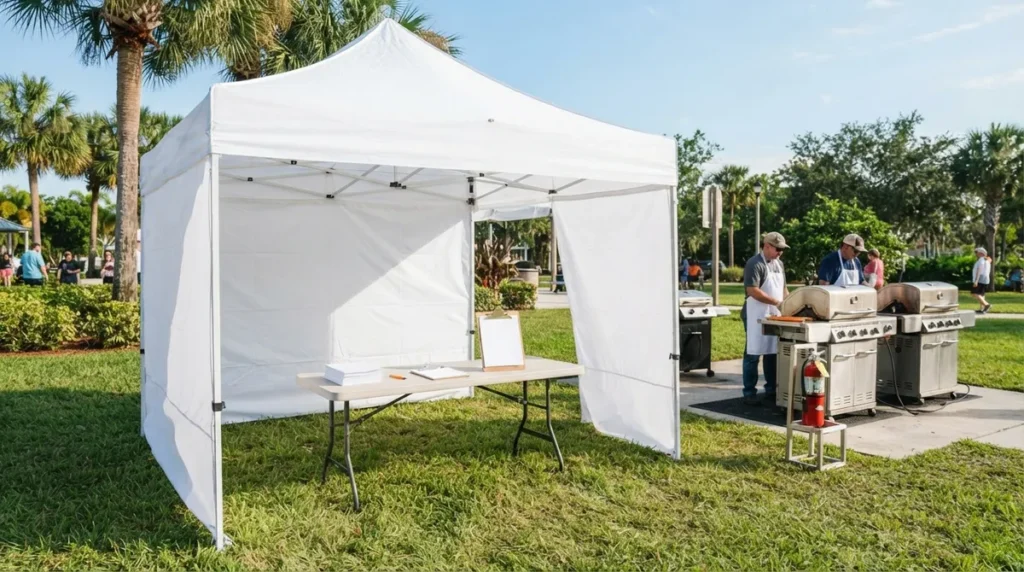
Cooking under publicly occupied tents is strictly prohibited in Cape Coral, and cooking equipment must be at least 10 feet from structures, buildings, or occupied tents.
-
A fire inspection is required before cooking begins, and after-hours inspections cost $125 for the first two hours and should be requested at least one week before the event.
-
Special events on city property require commercial general liability insurance of at least $1,000,000 per occurrence, and liquor liability coverage if alcohol is served; private-property events aren't required to carry event insurance but it's recommended.
-
Don't assume the $200 tiki/chiki hut fee applies to a tent permit; ask the city for the current fee for your specific permit type, since the tent fee isn't published in the sources reviewed.
Planning a wedding reception, a grand opening, a church fundraiser, or a backyard party that needs a big white tent? Wonderful! Here's the not-so-wonderful part: in Cape Coral, that tent may need paperwork before the first pole goes into the ground. Getting a tent permit in Cape Coral, FL isn't hard once you know the steps, but skipping it can lead to a stop-work-style shutdown right when your guests are arriving.
The good news is that you don't have to figure this out alone. In this friendly, step-by-step guide, we'll walk through what the City of Cape Coral publishes about tents and seasonal permits, how a tent permit differs from a special-event permit, what fire and cooking rules apply, and what to double-check with the city before you commit to a date. Whether you're a general contractor setting up a job-site canopy, a property owner hosting an event, or a realtor staging an open house, this guide will help you move forward with confidence.
One quick honesty note up front: the city's online materials don't spell out every detail (like exact size thresholds, duration limits, or the fee), so we'll flag those spots clearly and tell you who to call to confirm them.
Do You Need a Tent Permit in Cape Coral?
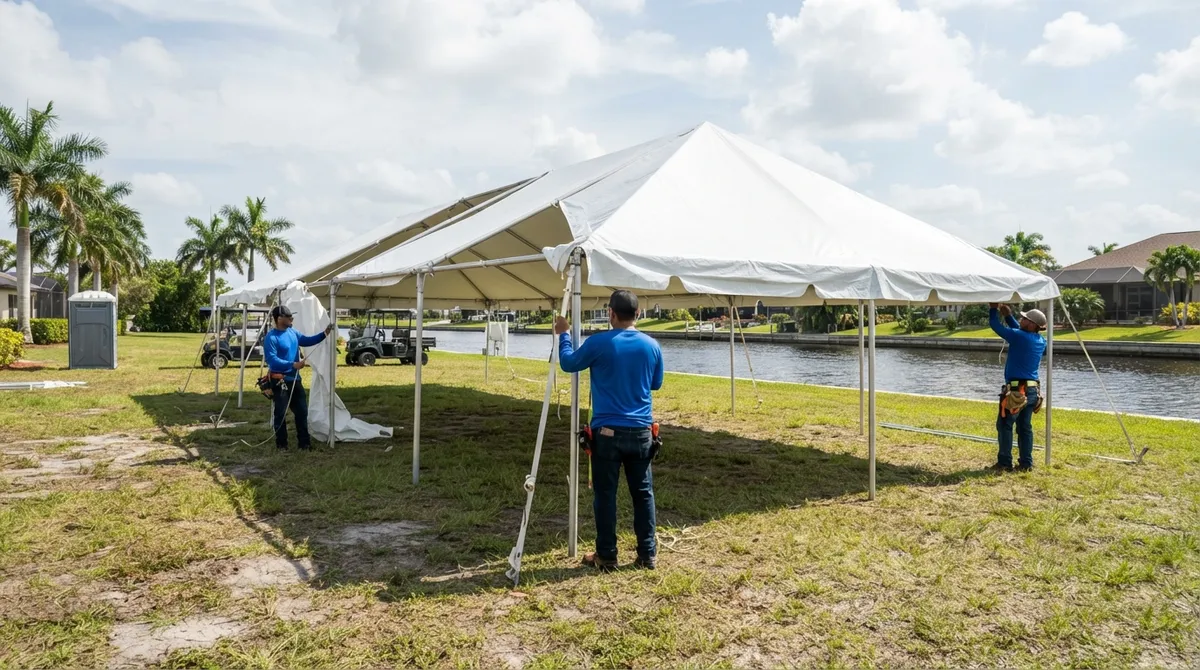
Cape Coral lists a dedicated "TENT and Seasonal Permit" application under its Planning Division applications. That tells us the city treats temporary tents as something to be reviewed, not just set up on a whim. However, the application page links to the form without publishing the exact eligibility rules, so we can't promise a universal size cutoff or time limit here.
The safest approach is simple: if you plan to erect a tent of any meaningful size, for any meaningful length of time, assume you should ask the city first. A quick call is far cheaper than a correction notice, a delayed event, or a last-minute teardown.
Here's a quick way to think about whether you should reach out to the city:
- Commercial use: Tents for sales, grand openings, seasonal retail, or vendor events should be verified with Planning.
- Public or ticketed events: These often trigger a separate special-event review (more on that below).
- Food or cooking: Any tent involving cooking brings fire-safety rules into play.
- Large gatherings: Bigger crowds mean more fire, safety, and parking questions.
- Longer stays: A tent that stays up for days or weeks is more likely to need formal approval than a one-afternoon canopy.
Tent Permit vs. Special-Event Permit: What's the Difference?
This is the number-one point of confusion, so let's clear it up. In Cape Coral, a tent permit and a special-event permit are distinct processes. One governs the temporary structure itself; the other governs the event happening inside or around it.
| Feature | Tent and Seasonal Permit | Special-Event Permit |
|---|---|---|
| What it covers | The temporary tent or seasonal structure | The event itself (crowds, vendors, alcohol, parking) |
| Where to apply | City Planning Division application list | City special-event permit process |
| Lead time | Confirm with Planning | Apply 90 days before the event |
| Typical trigger | Erecting a tent (confirm thresholds with the city) | Events described as having more than 500 participants in the venue; confirm other triggers with the city |
| Insurance | Confirm with the city | Required on city property; recommended on private property |
So, can you need both? Yes, it's possible. A large festival under a tent could require the tent and seasonal permit and a special-event permit, plus a fire review. Always ask the city to confirm which combination applies to your situation.
Step-by-Step: How to Apply for a Cape Coral Tent Permit
Here's a practical sequence that keeps you organized and avoids surprises. Think of it as your event-planning checklist for the permitting side.
- Define your tent and your timeline. Write down the tent dimensions, how many days it will stand, the exact address, and what's happening inside (dining, sales, a ceremony, cooking, etc.).
- Call Cape Coral Planning and Permitting first. Because the published materials don't list exact size thresholds, duration limits, or fees, ask directly. The city lists Permitting Services at 239-574-0546 and permits@capecoral.gov for questions.
- Locate the TENT and Seasonal Permit application. It's listed on the city's Planning Division applications and documents page.
- Build a simple site plan. Show the tent location, setbacks, parking, exits, restrooms, generators, and anything else that sits near it.
- Gather supporting documents. Ask the city whether it wants a flame-resistant certificate, product information, or a letter from the tent rental company.
- Submit through the EnerGov portal. Cape Coral's permitting division directs applicants to submit applications through its online EnerGov portal.
- Respond quickly to reviewer comments. If the city asks for corrections, answer promptly so your approval doesn't miss your event date.
- Schedule any required fire inspection. Especially for food, cooking, or large gatherings, plan inspections well before opening day.
What Documents Should You Prepare?
Since the exact required documents for the tent permit aren't published in the sources we reviewed, treat this as a smart-prep list and confirm each item with Planning. For the special-event side, the city's checklist is more specific, and those items are a great model for what reviewers like to see.
- A clear site plan identifying tents, food vendors, restrooms, parking, generators, stages, and alcohol areas.
- A flame-resistant tent certificate when applicable (the special-event checklist lists this as an additional document).
- Proof of insurance for events on city property: commercial general liability coverage of at least $1,000,000 per occurrence.
- Liquor liability insurance if alcohol will be served, regardless of attendance, according to the city checklist.
- Contact details for the property owner, tent company, and event organizer.
- Event details such as dates, hours, estimated attendance, and setup/takedown times.
For events on private property, the city's special-event process does not require event insurance, though it's recommended. Honestly, even when it isn't required, it's a smart move. One windy afternoon can change your mind about that.
Fire Safety Rules You Can't Ignore
If there's one area where Cape Coral is crystal clear, it's cooking. The city's Food and Cooking Notice says cooking under publicly occupied tents is strictly prohibited. That surprises a lot of first-time event hosts who picture a catering station tucked right inside the tent.
Here are the key fire-safety points published by the Cape Coral Fire Division:
- No cooking under occupied tents. Plan cooking areas outside the tent.
- 10-foot clearance. Cooking equipment must be at least 10 feet from structures, buildings, or occupied tents.
- Fire protection requirements. Cooking vendors must meet applicable fire-protection requirements.
- Fire inspection before operation. A fire inspection is required before cooking begins.
- After-hours inspections. The notice states these cost $125 for the first two hours and should be requested at least one week before the event. Confirm the current fee and scheduling with the city.
Here's a quick reference table to keep handy while you plan your layout:
| Safety Item | What Cape Coral Says | Your Action |
|---|---|---|
| Cooking under tents | Strictly prohibited under publicly occupied tents | Move all cooking outside |
| Cooking distance | At least 10 feet from structures, buildings, or occupied tents | Mark the clearance zone on your site plan |
| Fire inspection | Required before cooking operations | Book early |
| After-hours inspection | $125 for first two hours; request one week ahead | Verify fee and availability |
| Flame-resistant certificate | Listed on special-event checklist when applicable | Ask your tent rental company |
Understanding Costs and Fees
Let's talk money, carefully. The City of Cape Coral publishes a 2026 miscellaneous permit fee schedule, and it includes a $200 fee for tiki/chiki huts. That figure is easy to stumble across when searching, but it is not identified as the fee for a temporary tent permit. Please don't assume it applies to your tent.
Instead, ask the city for the current fee for the exact permit type you're filing. When you call, it helps to have these ready:
- Tent size and type (pole, frame, or pop-up canopy)
- Number of days it will stay up
- Whether the use is commercial, private, or seasonal
- Whether food, alcohol, or generators are involved
- Whether the location is private property or city property
Remember to budget for the extras too: tent rental, certificates, inspections, and insurance. Those often add up more than the permit itself.
Timing: When Should You Start?
Early. Truly early. The city's special-event permit page says applications should be submitted 90 days before the event. Even if your project only needs the tent and seasonal permit, starting 90 days out gives you breathing room for corrections, inspections, and unexpected questions.
Here's a simple planning timeline:
- 90+ days out: Call the city, confirm which permits apply, and submit special-event paperwork if needed.
- 60 days out: Finalize your site plan, vendor list, and insurance.
- 30 days out: Confirm approvals, coordinate with your tent company, and line up inspections.
- 7+ days out: Request any after-hours fire inspection, since the city asks for at least one week of notice.
- Event week: Keep approved documents on site and easily accessible.
Tips for Contractors, Realtors, and Property Owners
Different people use tents in different ways, so here are a few audience-specific pointers.
General Contractors and Design Professionals
If you're using a tent for a job-site staging area, a client event, or a grand-opening build-out, confirm whether it ties into a larger commercial project. Tent work sometimes overlaps with Certificate of Use timing or tenant improvements. If a project is already moving through review, our guide on what a tenant improvement permit in Cape Coral needs is a helpful companion read.
Realtors and Investors
Hosting an open house or a broker event under a tent? Verify the rules before you advertise. Sorting out permits up front keeps your marketing calendar clean. And if you're evaluating a property with past permitting troubles, see how to sell a Florida house with unpermitted additions.
Homeowners and Residential Property Owners
A backyard wedding or milestone birthday under a tent feels casual, but the same safety principles apply, especially around cooking, generators, and neighbors. Private-property events may not need event insurance under the city's special-event process, but it's still recommended.
Common Mistakes to Avoid
After seeing how permitting works across Florida, a few mistakes show up again and again. Dodge these, and you'll already be ahead of the game:
- Assuming a tent permit covers everything. The event itself may need its own special-event review.
- Planning cooking inside the tent. It's prohibited under publicly occupied tents.
- Applying too late. Ninety days isn't a suggestion for special events; it's the published timeline.
- Guessing at fees. Don't borrow the tiki hut number. Ask the city.
- Forgetting the site plan. Reviewers want to see where tents, restrooms, parking, and generators sit.
- Skipping insurance details. Alcohol service needs liquor liability coverage regardless of attendance, per the city checklist.
Already built or set up something without approval? You're not out of options. Our article on after-the-fact permit requirements in Florida explains how owners and contractors get back on track.
When It Helps to Bring in a Permitting Partner
Some people love paperwork. Most of us don't! If your event is large, your timeline is tight, or you're juggling a tent plus food vendors plus alcohol plus parking, a permitting partner can take the heavy lifting off your plate. At 1 Contractor Solutions, we handle permit filing, tracking, plan review coordination, and drawings across all 67 Florida counties, with same-day response and in-house sealed drawings when a project calls for them.
For event organizers, that can mean help identifying which approvals apply, preparing a clean site plan, coordinating with Cape Coral reviewers, and keeping your submission moving. You can also see what customers say by visiting our 1 Contractor Solutions profile on Google, and you can follow us on LinkedIn or follow us on Facebook for permitting tips as rules evolve.
Need help beyond a single tent? Our Cape Coral team page covers permitting in Cape Coral, and if a denial or delay ever hits, urgent permit rescue is there to help.
Quick Checklist Before You Submit
Before you hit "submit" in the portal, run through this final list:
- Called or emailed Cape Coral Permitting Services to confirm requirements
- Confirmed whether a special-event permit is also needed
- Prepared a site plan showing tents, vendors, restrooms, parking, and generators
- Collected the flame-resistant tent certificate if applicable
- Lined up insurance (required on city property; recommended on private property)
- Planned all cooking outside tents with at least 10 feet of clearance
- Scheduled fire inspections with enough notice
- Confirmed the exact fee for your permit type
Ready to Put Up Your Tent the Right Way?
Getting a tent permit in Cape Coral, FL comes down to a few smart habits: ask early, confirm details with the city, keep cooking out of occupied tents, and treat the tent permit and special-event permit as two separate pieces of the puzzle. Do that, and your event day can be about celebrating, not scrambling.
If you'd rather have an experienced team guide the process, we'd love to help. Reach out anytime and get a free quote for permit filing, tracking, and plan support. And if you'd like marketing help spreading the word about your event or business, our friends at Brain Buzz Marketing are a great resource. Here's to a safe, smooth, and beautifully permitted event!
FAQs
Do I need a permit to put up a tent in Cape Coral, Florida?
Cape Coral offers a dedicated TENT and Seasonal Permit application, so it's wise to assume a permit may be needed. The city's online materials don't list exact size or duration thresholds, so give Planning and Permitting a quick call before you set anything up.
Do I need both a tent permit and a special-event permit in Cape Coral?
Possibly! They're separate processes. The special-event application is described as applying to events with more than 500 participants in the venue and should be submitted 90 days ahead, so confirm with the city which permits your specific event requires.
Can food vendors cook under a tent in Cape Coral?
No, cooking under publicly occupied tents is strictly prohibited under the city's Food and Cooking Notice. Cooking equipment must also be at least 10 feet from structures, buildings, or occupied tents, and a fire inspection is required before operation.
How much does a tent permit cost in Cape Coral, FL?
The sources we reviewed don't list a specific tent permit fee. The city's 2026 miscellaneous fee schedule shows $200 for tiki/chiki huts, but that isn't identified as the tent permit fee, so verify the current cost with the city before budgeting.
What insurance is required for a tent event in Cape Coral?
For events on city property, the special-event checklist calls for commercial general liability coverage of at least $1 million per occurrence. Private-property events don't require event insurance under that process, though it's recommended, and alcohol service requires liquor liability insurance.
We do this work every day across all 67 Florida counties. Call (866) 314-6931 and we will tell you what your situation actually requires — including when you do not need us.
Related services
Permit Facilitation & Filing
You have a crew scheduled, a client asking for dates, and a permit sitting somewhere in a queue you cannot see. We file it, w…
See the servicePlan Review Coordination
A permit in plan review is not one queue. On a commercial project it can be six queues, each with its own reviewer, its own c…
See the serviceReady to get your permit moving?
One call tells you which jurisdiction controls your project, what it will take, and what it will cost. Most of the time we can scope it on the phone.