
Blog
5 Stop Work Order Mistakes to Avoid in Florida (2026)
Got a Florida stop-work order? Learn 5 costly mistakes to avoid and the clear steps to resolve unpermitted work and get building again in 2026.
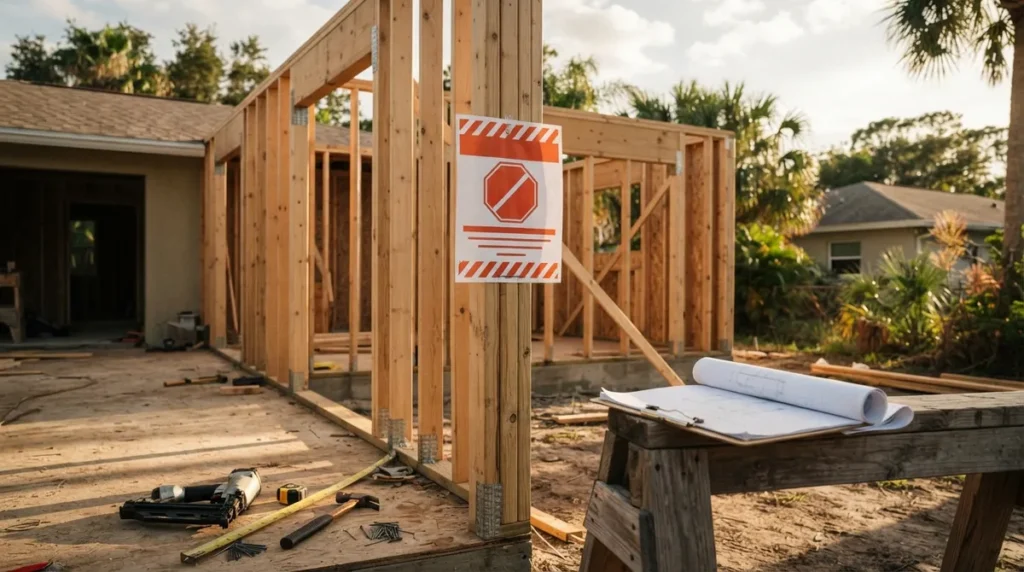
Key Takeaways
-
Stop all work immediately when a stop-work order is posted; continuing can raise resolution costs and may bring citations, such as up to $500 per violation in Hillsborough County.
-
Filing an after-the-fact application or paying its fee does not lift a stop-work order; wait for written clearance from the building department before resuming any work.
-
Submit complete documentation, including as-built drawings, site plans, structural or MEP details, and engineer letters, to avoid repeated correction rounds that add weeks of delay.
-
Expect that concealed work may need to be opened or verified through selective openings, photos, or an engineer's sealed letter rather than a visual check alone.
-
Check for other approvals beyond the building permit, such as zoning, floodplain (including the FEMA 50 percent rule), environmental, HOA, or right-of-way requirements.
-
Confirm the controlling jurisdiction and the order's specific conditions first, since fees, procedures, and appeal routes vary by county and city across Florida.
Few things stop a project colder than a bright orange notice taped to your door or job-site fence. One minute your crew is framing, the next everyone is standing around wondering what just happened. If you are reading this, there is a good chance you are dealing with a stop work order after the fact in Florida, meaning work was already underway (or even finished) before a permit was in place.
First, take a breath. This happens to good contractors, careful homeowners, and savvy investors alike, and it is far more fixable than it feels in the moment. The real trouble usually comes from what people do next. A few well-meaning missteps can turn a manageable permit problem into a pile of fines, delays, and frustrated inspectors.
In this friendly guide, we walk through the five most common mistakes we see after a stop-work order, explain how after-the-fact permitting really works in Florida, and show you a clear path back to a legal, finished project. Whether you are a general contractor, solar installer, realtor, or homeowner, you will find practical steps you can use today.
What a Stop Work Order Actually Means in Florida
A stop-work order is a written directive from the local building department telling you to halt construction. Under Florida Statute §553.79, covered building construction, alteration, repair, or demolition generally requires a permit from the local enforcing agency before work begins. When work starts without one, the building official can step in.
Here is the important part: a stop-work order is not a verdict. It is a pause button, and the order itself spells out the reason and what must happen before work can resume. Local departments run their own procedures, forms, fees, and appeal routes, so the written order in your hand is the rulebook for your situation.
It also helps to know that Florida law defines a stop-work order in specific contexts. For example, §553.791 describes it, in the private-provider setting, as a written statement that gives the reason for the order and the conditions under which work may resume. Your local order may follow other provisions, so always read it closely.
What Is an After-the-Fact Permit?
An after-the-fact (ATF) permit is a local process for bringing work that began, or was completed, without a permit into official review. Think of it as a way to get the work seen, evaluated, and approved after the fact. If you want a deeper look at how the process works, our guide on what after-the-fact permitting is in Florida breaks it down.
An ATF permit does not automatically legalize anything. You may need plans, supporting documents, inspections, and corrections before you earn final approval.
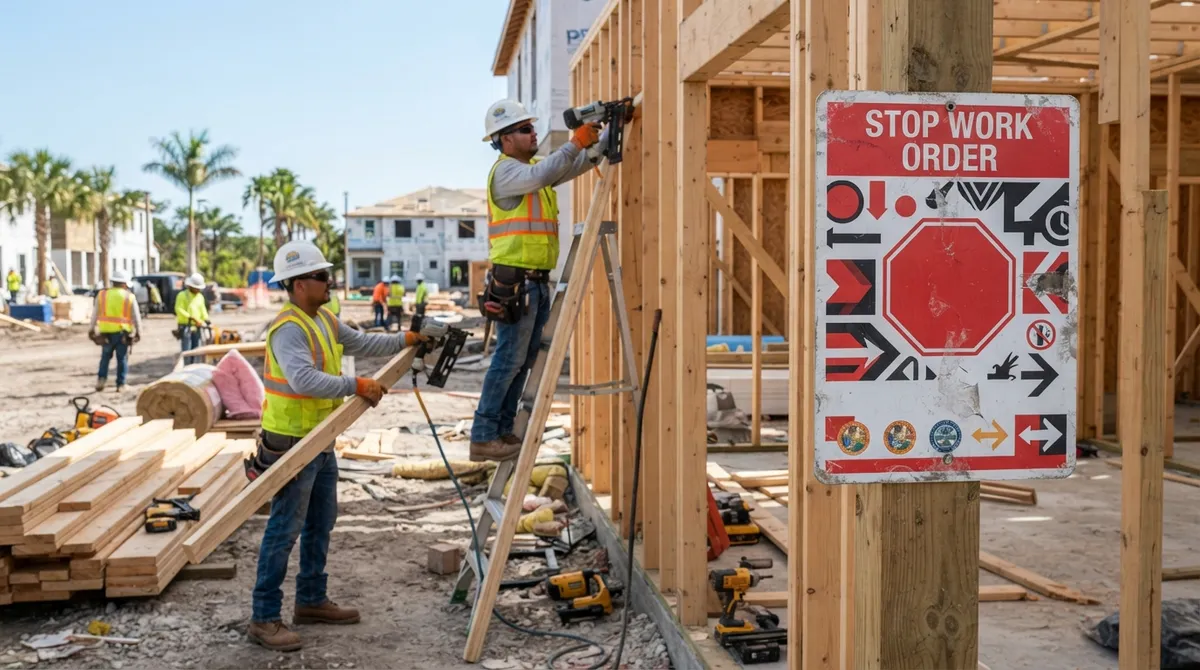
Mistake #1: Keeping Work Going While You Sort It Out
This is the big one, and it is completely understandable. The crew is booked, materials are on site, and the schedule is tight. So it feels harmless to keep going while the paperwork catches up.
Unfortunately, continuing work under an active stop-work order is the fastest way to make things worse. Hillsborough County, for example, directs owners to stop immediately and contact building services about an ATF permit, and warns that continuing can raise the cost of resolving the violation and may result in a citation of up to $500 per violation. That figure is county guidance rather than a statewide rule, but it shows how seriously departments take it.
Here is what to do instead:
- Stop all work at the site right away, including "small" finishing tasks.
- Secure the property so it is safe and weather-protected (ask the building department what temporary protection is allowed).
- Photograph the current state of the work.
- Read the order carefully and note every condition for resuming.
- Contact the issuing department to confirm next steps.
If you are working in the Tampa Bay area, our page on Hillsborough County permitting is a handy place to start.
Mistake #2: Assuming an Application Lets You Resume Work
Here is a myth we hear constantly: "I filed the after-the-fact application, so I am good to go back to work." Sadly, not quite.
Filing an application, or even paying a fee, does not clear a stop-work order. Under Florida law, a permit application alone is not authorization to proceed. The local enforcing agency must issue the permit after the required review. And the stop-work order may have its own conditions, such as correcting deficiencies, passing inspections, or receiving written authorization to resume.
| Action Taken | Does It Lift the Stop-Work Order? | What Is Usually Needed Next |
|---|---|---|
| Filing an ATF application | No | Plan review and permit issuance |
| Paying an ATF fee | No | Approval of the application |
| Receiving a permit | Not automatically | Written clearance from the issuing authority |
| Passing required inspections | Moves you toward closure | Final approval and any corrections completed |
The safest rule is simple: do not restart until you have written confirmation from the building department that work may resume. If you are unsure, ask. A quick phone call is far cheaper than a second violation.
Mistake #3: Submitting Thin or Incomplete Documents
An ATF application with missing pieces tends to bounce back again and again. Each round of corrections adds days or weeks, and a project already on hold cannot afford that.
Depending on the work and the jurisdiction, reviewers may ask for several items:
- Existing-condition or as-built drawings showing what was actually built
- Site plans and property survey information
- Structural details, product approvals, and engineer letters where required
- Electrical, mechanical, and plumbing (MEP) documentation
- Contractor license and insurance details, or owner-builder paperwork
Plans that clearly show the real, built conditions go a long way. That is where as-built drawings and engineer letters earn their keep. A sealed set that matches what is physically on site gives reviewers confidence and reduces back-and-forth.
For a fuller walkthrough of paperwork, see our guide on the after-the-fact permit application in Florida.
Mistake #4: Hiding Concealed Work from the Inspector
Nobody loves the idea of opening a finished wall. But concealed construction cannot be verified by an ordinary visual inspection, so the building official may require portions of the work to be opened or otherwise documented.
Trying to dodge this step, or hoping the inspector will not ask, usually backfires. Inspectors know what to look for, and credibility matters. Being upfront tends to lead to smoother, more cooperative reviews.
Common ways concealed work gets verified include:
- Selective openings (small inspection holes rather than full demolition)
- Photographs and field documentation taken by a licensed professional
- Engineer observation and a sealed letter confirming code compliance
- Non-destructive testing where appropriate
The exact evidence and inspection sequence depend on the type of work and the local building official. In many cases, a well-prepared engineer letter plus targeted openings is far less disruptive than people fear. Our post on what happens during a Florida ATF site inspection sets expectations so there are no surprises.
Mistake #5: Ignoring Other Approvals Beyond the Building Permit
Here is a sneaky one. Even a perfectly approved building permit may not resolve other compliance issues tied to the same project. A stop-work order can sit on top of several overlapping requirements.
Before you assume you are finished, check whether your project touches any of these:
- Zoning, setbacks, or lot coverage
- Floodplain rules, including the FEMA 50 percent rule in Florida
- Environmental or FDEP environmental permits
- Historic preservation review
- Right-of-way or driveway approvals
- HOA or condo association approvals
Each of these may be handled by a different department with its own timeline. Asking every applicable office early saves you from a second, unexpected hold later.
A Clear Path Forward: How to Resolve the Stop-Work Order
Now for the good news. There is a dependable route from stop-work order to finished, legal project. While details vary by county and city, the general flow looks like this:
- Stop work and secure the site. Follow the order exactly as written.
- Identify the issuing authority. City and county jurisdictions can overlap, especially near boundary lines. Our building department lookup tool helps you confirm who is in charge.
- Gather what exists. Collect receipts, photos, contracts, product approvals, and any prior inspection records.
- Prepare plans and supporting documents. This often means as-builts, structural or MEP documentation, and engineer letters.
- Apply for the after-the-fact permit. File with the local building department and pay the required fees.
- Respond to reviewer comments. Handle corrections and resubmittals promptly and completely.
- Complete inspections and corrections. Open concealed areas if required and fix any deficiencies.
- Get written clearance. Confirm the stop-work order is lifted before resuming any work.
If you are not sure where you stand, the open permit search tool can reveal existing permit records tied to the address.
Fees, Timelines, and What to Expect
People understandably want a number and a date. The honest answer is that both vary by jurisdiction and project. Fees, penalties, and timelines are set locally, and they depend on the scope of work and how complete your submission is.
| Factor | How It Affects Your Timeline or Cost |
|---|---|
| Scope of work | Larger or more complex work means more review and inspection |
| Document quality | Complete, sealed plans reduce correction rounds |
| Concealed work | May require openings, testing, or engineer verification |
| Jurisdiction | Fees, penalties, and procedures differ by county and city |
| Responsiveness | Fast replies to comments keep the file moving |
One quick note on timelines: the 20-business-day permit-review period in §553.791 applies to specified applications using a private provider. It is not a general promise for after-the-fact permits, so do not count on it as a clock for your local review. For cost context, see our overview of after-the-fact permit costs in Florida.
Who Needs to Know This: Quick Tips by Audience
A stop-work order lands differently depending on who you are. Here are a few friendly pointers:
- General contractors: Protect your license and your schedule. Document everything, communicate with the owner, and get sealed documentation moving quickly. See our page for general contractors.
- Solar companies: Installations without proper permits can stall interconnection. Clean structural and electrical documentation speeds approvals. Learn more for solar contractors.
- Realtors and investors: Unpermitted work can derail a closing. Early research and legalization planning keep deals alive. Visit our realtor resources.
- Homeowners: You are not in trouble for asking questions. Start by understanding what was built and by whom. Our homeowner page is a gentle place to begin.
When It Is Smart to Call in Help
You can absolutely manage some of this yourself, but a stop-work order is a stressful moment, and the details are easy to get wrong. A knowledgeable partner can identify the controlling jurisdiction, prepare sealed documents, file the application, and handle reviewer comments so you can focus on your project.
That is exactly what 1 Contractor Solutions does. As Florida's outsourced permitting department, the team works across all 67 counties, with in-house drafting and engineering, same-day response, and experience carrying after-the-fact files through to closeout. If you want to see what other customers say, you can visit us on Google — 1 Contractor Solutions. For urgent situations, our urgent permit rescue service is built for stop-work orders, denials, and held-up closings.
You can also follow us on LinkedIn or follow us on Facebook for permitting tips and updates. For the underlying law, the Florida Senate publishes the full text of Chapter 553, Section 791 of the Florida Statutes.
Wrapping Up: You Can Fix This
A stop-work order after the fact in Florida feels like a roadblock, but it is really a detour with a map. Avoid the five big mistakes: do not keep working, do not assume an application lifts the order, do not submit thin documents, do not dodge concealed-work inspections, and do not forget the other approvals your project may need.
Follow the written order, work with your local building department, and bring in sealed, accurate documentation. Do that, and most projects find their way back to a legal, finished, and insurable result.
Ready for a calm, clear plan? Reach out today to get a free quote and let us help you get your project moving again.
FAQs
What should I do first if I receive a stop-work order for unpermitted work in Florida?
Stop all work right away and read the written order carefully, since it explains the reason and the conditions for resuming. Then contact the issuing building department to confirm your next steps, and consider bringing in a permitting professional to guide you.
Can I keep working after I submit an after-the-fact permit application?
No, not until the department says so in writing. An application or fee payment alone does not authorize work, so wait for permit issuance and written clearance to resume before picking your tools back up.
Will the inspector make me open walls for an after-the-fact inspection?
Possibly. Because concealed work cannot be checked by eye, the building official may require selective openings or other documentation, such as an engineer letter. The exact requirements depend on the type of work and your local department.
How long does it take to clear a stop-work order in Florida?
It varies by county, city, and project scope. Complete, sealed documents and quick responses to reviewer comments usually help the most, while concealed work or extra approvals can add time.
Do all Florida counties handle after-the-fact permits the same way?
Not quite. Procedures, forms, fees, penalties, and appeal routes differ by county and municipality, so always follow the written order and confirm requirements with the specific local building department.
We do this work every day across all 67 Florida counties. Call (866) 314-6931 and we will tell you what your situation actually requires — including when you do not need us.
Related services
Permit Facilitation & Filing
You have a crew scheduled, a client asking for dates, and a permit sitting somewhere in a queue you cannot see. We file it, w…
See the servicePlan Review Coordination
A permit in plan review is not one queue. On a commercial project it can be six queues, each with its own reviewer, its own c…
See the serviceReady to get your permit moving?
One call tells you which jurisdiction controls your project, what it will take, and what it will cost. Most of the time we can scope it on the phone.