
Blog
Where to File an After-the-Fact Permit in Florida (2026)
Wondering where to file an after-the-fact permit in Florida? Learn how to find the right city or county building department and what to submit.
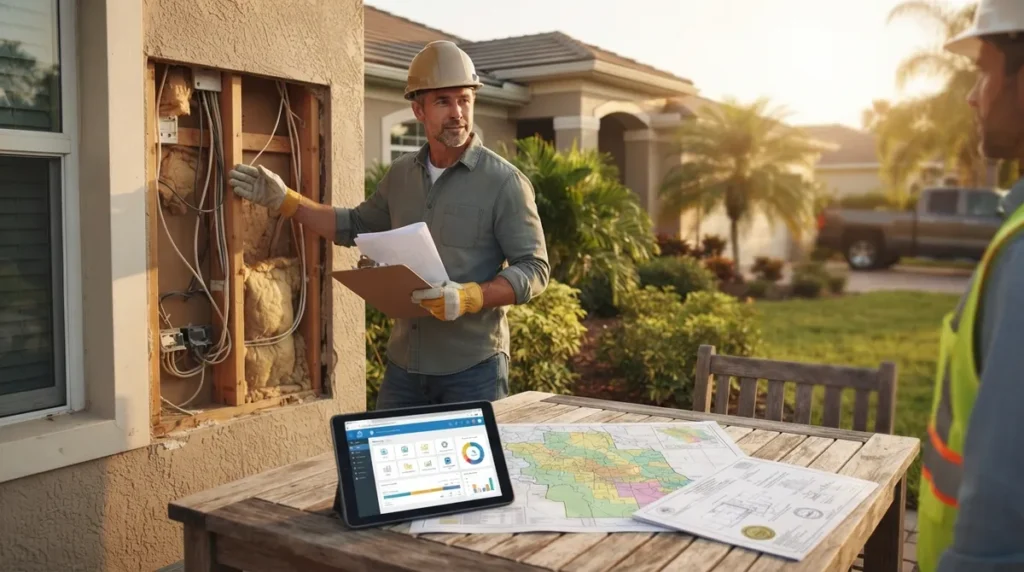
Key Takeaways
-
Florida has no statewide office for after-the-fact permits; you file with the city or county building department that has jurisdiction over your property, based on whether the address is incorporated.
-
Confirm jurisdiction first using your county property appraiser's parcel lookup, the city's GIS map, your property tax bill, or a quick call to the county building department to avoid filing with the wrong agency.
-
Florida Statutes 553.79 requires local agencies to accept completed permit applications electronically, so you will usually apply through the agency's online portal rather than on paper.
-
Expect to provide as-built drawings, a site plan, and often sealed engineering letters, since reviewers cannot observe work that is already finished or concealed.
-
Applying after construction does not waive code requirements; the building official may require you to expose hidden work, provide testing or photos, or correct noncompliant items before final approval.
-
Call the department before submitting to ask how they handle unpermitted work and whether a violation is already open, since this conversation can reveal exactly what documentation they expect.
So you've discovered work on your property that was never permitted. Maybe a prior owner skipped the paperwork, a contractor vanished, or a buyer's inspector flagged something right before closing. Take a breath. This happens in Florida more often than you'd think, and it is fixable.
The first question almost everyone asks is the same: where do I file an after the fact permit with the Florida building department? Here's the short answer that surprises people: there is no single statewide office. You file with the local building department that has jurisdiction over your property, and that is either a city or a county depending on where your address sits.
In this guide, we'll walk through how to find the right agency, how to submit, what you'll need, and what to expect afterward. Whether you're a homeowner, a general contractor, a solar company, or a real estate professional, you'll leave knowing exactly where to start.
The Short Answer: File With the Local Building Department
Florida does not run one central building department for permits. Instead, each city, town, and county operates its own local enforcement agency. An after-the-fact (ATF) permit, sometimes called a retroactive permit, is filed with the agency that would have issued the permit in the first place.
That means your ATF application goes to one of two places:
- A municipal building department if your address is inside city limits.
- The county building department if your address is in unincorporated county territory.
Getting this wrong is the single most common (and most expensive) early mistake. Paying fees or submitting plans to the wrong agency can cost you weeks, and the work still isn't legalized.

Step 1: Confirm Which Jurisdiction Controls Your Address
This step sounds simple but trips people up, especially near city boundaries. A mailing address that says "Tampa" or "Miami" does not guarantee the property is inside that city's permitting jurisdiction.
Here are practical ways to confirm the right agency:
- Check your parcel or folio number. Your county property appraiser's website shows the taxing jurisdiction and municipality for the parcel.
- Use the city's GIS or jurisdiction map. Many cities publish address lookups. For example, Fort Lauderdale processes permits only for addresses inside its city boundaries and points applicants to its property GIS map to verify.
- Call the county building department. They can usually tell you in one minute whether your parcel is incorporated.
- Read your property tax bill. It lists the municipality, if any.
Miami-Dade County is a great example of why this matters. Its online permitting portal serves properties in unincorporated Miami-Dade, while properties inside an incorporated municipality are handled by that city or town. Same county, completely different offices.
If you want a head start, our building department lookup tool can help you identify who controls your address. And if you're still unsure, we cover this in depth in which Florida jurisdiction reviews my project.
City vs. County: Quick Comparison
| Factor | City / Municipal Department | County Department |
|---|---|---|
| Who it serves | Addresses inside city limits | Unincorporated areas of the county |
| Where to verify | City GIS map or jurisdiction lookup | County property appraiser or building site |
| Submission method | City permit portal or approved method | County permit portal or approved method |
| Fee schedule | Set by the city | Set by the county |
| ATF checklist | City-specific | County-specific |
Step 2: Find the ATF Checklist and Submission Method
Once you know the agency, look for its after-the-fact or unpermitted work guidance. Not every department uses the exact same name. You may see "permit after the fact," "retroactive permit," "permit for work without permit," or a note inside the standard permit application.
Florida law helps you here. Under Florida Statutes section 553.79, local enforcement agencies must post their permit application types and the attachments or other requirements for each. They must also allow completed applications to be submitted electronically. In-person, paper submission may still be accepted at the building official's discretion.
In practice, that means you will usually apply through the agency's online permitting portal. Look for:
- A posted list of required documents for your permit type (roof, electrical, addition, etc.)
- Any ATF-specific forms or affidavits
- The fee schedule, including any penalty or investigation fees
- Instructions on how to schedule inspections once the permit is issued
Can't find an ATF checklist? Call or email the department and ask how they handle unpermitted work. Their answer often differs from what you'd assume.
Step 3: Gather What the Building Department Will Expect
An after-the-fact application is still a permit application. The building code review still applies, and the work must meet the Florida Building Code. The exact paperwork depends on your jurisdiction and project, but most departments ask for some combination of the following.
| Document | Why It's Needed |
|---|---|
| Completed permit application | Identifies the property, owner, and scope of work |
| Description of existing work | Tells reviewers what was built and when |
| As-built plans or drawings | Shows the work as it actually exists today |
| Site plan or survey | Confirms setbacks and placement |
| Contractor or owner-builder information | Establishes who is responsible for the permit |
| Engineer letter or sealed drawings | Verifies structural or system compliance when required |
| Product approvals or specs | Documents windows, roofing, or equipment used |
Many ATF jobs need sealed documentation, because the reviewer can't watch the work happen. That's where as-built drawings and engineer letters become the backbone of the application. If you're wondering whether your project needs a seal, our guide on sealed drawings for after-the-fact permits breaks it down.
Step 4: Understand the Review, Inspections, and Possible Corrections
Here's the part that catches people off guard. Applying after construction does not waive code requirements, and it doesn't guarantee approval. The building official decides what's needed to evaluate work that's already finished or hidden.
Depending on your project, the department may require you to:
- Expose concealed work (open a wall, ceiling, or section of roofing) so an inspector can verify it
- Provide photos, documentation, or testing results
- Submit a professional evaluation from a licensed engineer
- Correct or replace noncompliant work before the permit can be finalized
This varies widely by scope and local procedure. A simple water heater swap is a very different conversation than a bedroom addition with unknown framing. For a closer look at what to expect, see what happens during a Florida ATF site inspection.
What an After-the-Fact Permit Typically Costs
Cost is the question homeowners and buyers ask second, right after "where do I file?" The honest answer is that it depends on your local fee schedule and your project value. Expect the standard permit fee, and potentially additional charges or enforcement-related fees for work done without a permit.
Costs commonly fall into these buckets:
- Permit fees based on the local schedule and valuation of the work
- Additional ATF or investigation fees where the jurisdiction charges them
- Drafting and engineering for as-builts, sealed letters, or structural verification
- Inspection and correction costs if anything must be opened up or repaired
Don't assume the fee is waived or that applying voluntarily is penalty-free. Ask the department how they treat unpermitted work, and whether a notice of violation has already been issued. We unpack the numbers in our guide to after-the-fact permit costs in Florida.
Who Should Be Thinking About This?
The "where do I file" question comes up from several different directions. Here's how it tends to show up for each group.
Homeowners and Residential Property Owners
You may have bought a house with an old addition, enclosed patio, or converted garage. Filing an ATF permit protects your insurance, resale value, and peace of mind. Start with the jurisdiction check, then talk to the department before you submit anything. Our page for Florida homeowners explains how we help.
General Contractors and Design Trades
If a client inherited unpermitted work, or a sub skipped a permit, you're the one who gets the call. Knowing the right agency and ATF requirements up front keeps the job moving. See how we support general contractors.
Solar Companies
Installs completed without a permit can stall interconnection and inspections. Filing correctly with the right authority having jurisdiction is the first step toward legalizing the system. Learn more on our solar contractor page.
Realtors, Investors, and Buyers
Unpermitted work often surfaces during inspections, appraisals, or title review. A permit hold can derail a closing fast. Knowing where to file lets you give your client a real timeline. Explore our realtor closing support.
A Realistic Filing Walkthrough
To pull it all together, here's the process most applicants follow from start to finish:
- Confirm whether the property is in a city or unincorporated county using the address or parcel number.
- Visit that agency's permitting page and locate the ATF or unpermitted-work guidance.
- Call the department to ask how they handle your specific situation and whether a violation is already open.
- Prepare as-built drawings, site plan, and any engineering the department requires.
- Submit through the agency's portal (or in person if the building official allows it).
- Pay the permit and any additional fees, then respond to reviewer comments promptly.
- Schedule inspections, expose or correct work as directed, and obtain final approval.
Skipping the phone call in step three is tempting, but it's often the move that saves the most time. Departments differ, and a five-minute conversation can reveal exactly what they want to see.
Common Mistakes to Avoid
- Filing with the wrong agency. City and county lines are not always obvious.
- Assuming approval is automatic. The work must still meet the Florida Building Code.
- Submitting thin documentation. Incomplete as-builts are a top cause of rejections.
- Ignoring an open violation. A code notice can change fees and deadlines, so address it directly.
- Waiting until closing week. ATF permits take time, and lenders and title companies rarely move on your schedule.
For a deeper dive on what goes wrong, check out these after-the-fact permit steps that work and our overview of how to legalize unpermitted work in Florida.
When It Makes Sense to Bring in a Permitting Professional
You can absolutely file an ATF permit yourself, and plenty of owners do. But if the project involves structural elements, concealed work, an active violation, or a tight closing date, professional help tends to pay for itself.
At 1 Contractor Solutions, we act as Florida's outsourced permitting department. We determine which jurisdiction actually controls your address, prepare as-builts and sealed drawings with our in-house engineering team, file the application, track it, and work every reviewer comment through approval. Our after-the-fact and expired permit service covers all 67 Florida counties, and we respond within 30 minutes. You can also see what clients say when you visit us on Google — 1 Contractor Solutions.
Want to stay in the loop on Florida permitting tips? Follow us on LinkedIn or follow us on Facebook. For official statutory language on local permit requirements, you can also review Florida Statutes section 553.79.
Conclusion: Start Local, Start Smart
The answer to "where do I file an after the fact permit with the Florida building department" is refreshingly simple once you know it: file with the city or county building department that has jurisdiction over your property. Verify the jurisdiction, find the ATF checklist, gather solid as-built documentation, and talk to the department before you submit.
Unpermitted work isn't the end of the road. It's a project with a clear path forward, and the sooner you start, the more options you have. If you'd like a team to take the weight off your shoulders, we're happy to help. Get a free quote and we'll tell you exactly which agency controls your address and what it will take to get your work legalized.
FAQs
Where do I apply for an after-the-fact building permit in Florida?
You apply with the local building department that has jurisdiction over your property, which is either the city or the county depending on your address. There is no single statewide office for ATF permits, so verifying jurisdiction first saves you time and fees.
How can I find out whether my property is under city or county jurisdiction?
Check your parcel or folio number on the county property appraiser's website, use the city's GIS jurisdiction map, or call the county building department. Our building department lookup tool can also point you in the right direction.
Can I apply for an after-the-fact permit online?
In most cases, yes. Florida Statutes section 553.79 requires local agencies to allow completed permit applications to be submitted electronically, though in-person paper submission may be allowed at the building official's discretion.
Will the building department make me open walls or expose completed work?
Possibly. The building official decides what's needed to verify concealed or finished work, which can include exposing it, providing documentation or an engineer's evaluation, or correcting anything that doesn't meet code. Requirements vary by project and jurisdiction.
Can a Florida permitting service file an after-the-fact permit for me?
Absolutely. A permitting service like 1 Contractor Solutions can confirm the correct jurisdiction, prepare as-built drawings and sealed engineering, submit the application, and work through reviewer comments so you aren't navigating it alone.
We do this work every day across all 67 Florida counties. Call (866) 314-6931 and we will tell you what your situation actually requires — including when you do not need us.
Related services
Permit Facilitation & Filing
You have a crew scheduled, a client asking for dates, and a permit sitting somewhere in a queue you cannot see. We file it, w…
See the servicePlan Review Coordination
A permit in plan review is not one queue. On a commercial project it can be six queues, each with its own reviewer, its own c…
See the serviceReady to get your permit moving?
One call tells you which jurisdiction controls your project, what it will take, and what it will cost. Most of the time we can scope it on the phone.