
Blog
How to Handle Unpermitted Work in Florida: Is There Amnesty?
Florida has no statewide amnesty for unpermitted work, but after-the-fact permits offer a real path forward. Learn the steps, costs, and risks.
Key Takeaways
-
Florida has no statewide amnesty that automatically legalizes unpermitted work; owners must use their local building department's after-the-fact permit process.
-
After-the-fact permits require documenting existing work with as-built drawings, passing reviews, and letting inspectors open concealed areas to verify code compliance.
-
Code-enforcement fines under Florida Statutes §162.09 can reach $250 per day for a first violation and $500 per day for a repeat, so acting before a notice arrives is important.
-
Local amnesty programs are time-limited and municipality-specific; Miami Beach's program ran through April 30, 2026, so always verify whether a successor program exists before relying on one.
-
Florida Building Code §109.4 allows an extra work-before-permit surcharge, so budget for permit fees, engineering, possible corrections, and that surcharge together.
-
Voluntarily coming forward and gathering photos, receipts, and old plans early generally leads to a smoother, more favorable resolution than waiting for a neighbor report or inspector flag.
If you just discovered that a deck, addition, roof, or kitchen remodel at your Florida property was built without a permit, take a deep breath. You are far from alone, and there is a path forward. The first question most people ask is simple: is there amnesty for unpermitted construction in Florida? It is a fair question, and the honest answer is a little more nuanced than a plain yes or no.
Florida does not have a single, statewide amnesty program that automatically legalizes unpermitted work. What it does have is an after-the-fact permitting process, run by each local building department, that lets owners bring existing work into compliance. Some cities have also offered limited, time-limited amnesty programs that waive certain fees. In this guide, we will walk you through what is really available in 2026, what it costs, what inspectors look for, and exactly how to move from worried to permitted. Whether you are a homeowner, a contractor, a solar installer, or a real estate professional, you will find practical steps you can use right away.
The Short Answer: Is There Amnesty for Unpermitted Construction in Florida?
There is no blanket, statewide amnesty. Florida Statutes §553.79 generally makes it unlawful to start covered construction, alteration, repair, or demolition without first getting a permit from the appropriate enforcing agency. Nothing in state law automatically forgives work that skipped that step.
That said, "no amnesty" does not mean "no solution." Most unpermitted work can be resolved through a local after-the-fact permit process. Think of it less like a free pass and more like a do-over: you apply for the permit that should have been pulled, supply the documentation, and pass the required reviews and inspections.
Here is how the main options compare:
| Option | What It Is | Who Offers It | Key Catch |
|---|---|---|---|
| Statewide amnesty | Automatic legalization of unpermitted work | Does not exist | Cannot be relied on |
| After-the-fact permit | Apply for the permit you should have had | Local city or county building department | Must pass reviews and inspections |
| Local amnesty program | Time-limited fee waivers for voluntary applicants | Select municipalities only | Deadlines and eligibility vary |
| Removal or correction | Fix or tear out noncompliant work | Required if work cannot be approved as built | Can be costly |
Why Florida Requires Permits in the First Place
Permits are not just paperwork. They exist so a qualified reviewer and inspector confirm that work meets the Florida Building Code, particularly for wind resistance, structural strength, electrical safety, and plumbing integrity. In a state that deals with hurricanes every year, that verification matters.
When work skips the permit, nobody has checked those safety items. That is why building departments, lenders, insurers, and buyers all care so much. It is also why the after-the-fact process is more than a rubber stamp.
How After-the-Fact Permitting Actually Works
An after-the-fact permit, sometimes called a retroactive permit, is the practical "amnesty" most Florida owners will use. You are essentially asking the local jurisdiction to review and approve work that already exists. If you want a deeper dive, our guide on how to get an after-the-fact permit in Florida covers the process in more detail.
Here is the general flow, step by step:
- Identify the correct jurisdiction. The city or county that controls your address may not be who you assume, especially near city lines. Our building department lookup tool can help.
- Check existing records. Search for open permits, expired permits, and code-enforcement cases tied to the property using an open permit search.
- Document what was built. Measure and photograph the work. Often this means creating as-built drawings that show the structure as it exists today.
- Get engineering support if needed. Structural, electrical, or mechanical work may require sealed plans or an engineer letter confirming code compliance.
- Submit the application. File the permit application, plans, and any supporting documents with the building department.
- Respond to reviewer comments. Expect corrections and resubmittals. This is normal, and good preparation shortens it.
- Pass inspections and close out. Once inspections are approved, the permit can be finaled.
What Will It Cost? Fees and Penalties Explained
Costs vary by city and county, so any number you read online should be treated as a rough guide. Several different charges can come into play, and it helps to keep them separate in your mind.
The Florida Building Code, in Section 109.4, allows an additional fee when work starts before a permit is issued. The exact amount depends on the local fee schedule, so you will want to confirm it with the building department handling your property. You can also read more in our breakdown of after-the-fact permit costs in Florida.
| Cost Category | What It Covers | Typical Behavior |
|---|---|---|
| Standard permit fee | The normal fee for the work type | Based on project value or scope |
| Work-before-permit surcharge | Extra fee for starting without a permit (FBC §109.4) | Set by local fee schedule |
| Plans and engineering | Drawings, sealed plans, engineer letters | Depends on complexity |
| Inspection and correction costs | Opening walls, repairs, retesting | Depends on what inspectors find |
| Code-enforcement penalties | Civil fines if a violation case exists | Separate from permit fees |
Understanding Code-Enforcement Fines
Code-enforcement penalties are a separate matter from permit fees. Florida Statutes §162.09 sets general civil-penalty limits of up to $250 per day for a first violation and up to $500 per day for a repeat violation. Qualifying local governments may adopt higher limits, and irreparable or irreversible violations have their own limits.
The good news: fines generally apply when a violation case is opened and not corrected. Acting early, before a notice arrives, often keeps things simpler. If you have already received a notice, our guide to code compliance violations explains next steps, and you can also read about the penalty for building without a permit in Florida.
Local Amnesty Programs: The Miami Beach Example
While Florida has no statewide amnesty, some municipalities have offered limited programs. Miami Beach is a helpful example. Its Building Code Violation Amnesty Program covered specified residential, multifamily, mixed-use, and commercial projects and waived certain fees for qualifying voluntary applicants. The city page cited for the program says it was extended through April 30, 2026.
Here is the important takeaway: that is a local, time-limited program, not a statewide benefit. Because that date has now passed, you should verify directly with the city whether any successor program exists. Never assume an old amnesty is still open. Deadlines, eligible project types, and which fees are waived can all change.
If you are in Miami-Dade, you may also find our resource on 6 steps to legalize unpermitted construction in Miami useful.
What Inspectors Will Want to See
This is the part that surprises many owners. An after-the-fact inspection is not a quick glance. Because the work is already finished, inspectors need ways to verify what you cannot see.
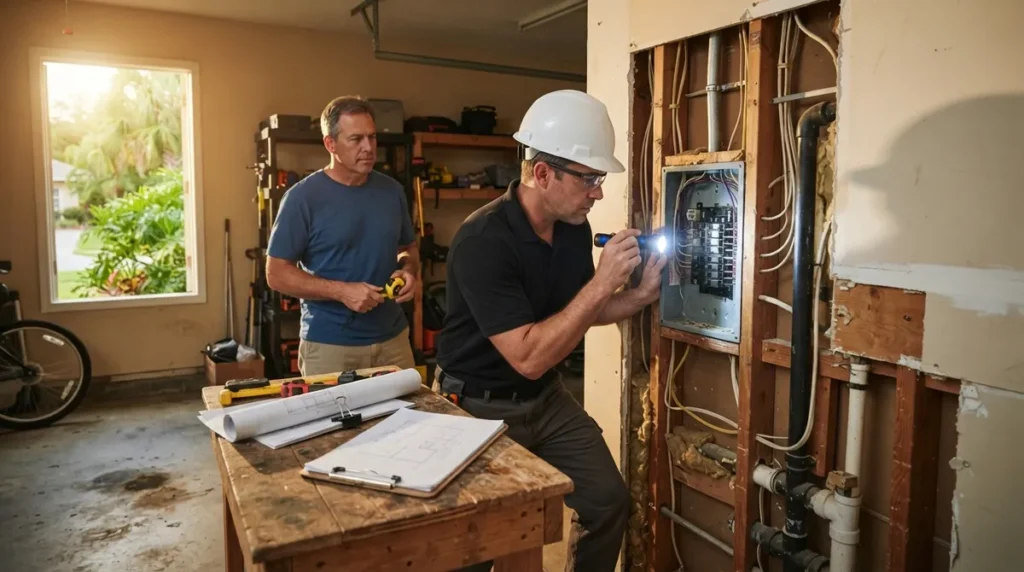
- Exposed concealed work. Inspectors may require walls, ceilings, or floors to be opened so they can verify framing, wiring, plumbing, or connections.
- Structural verification. They may ask for engineering proof that foundations, trusses, or load paths are adequate.
- Electrical and plumbing checks. Wiring, panels, fixtures, and venting must meet code, even though they are already installed.
- Product approvals. Windows, doors, roofing products, and other materials may need to show Florida or Miami-Dade product approval.
If work cannot be approved as built, corrections are required. In some cases, removal may be necessary before the permit can close. That is why it is smart to have a professional assess the work before you apply. For a closer look at this question, see will you really have to demolish unpermitted work.
Who Needs to Act, and Why: A Guide by Reader Type
Unpermitted work affects different people in different ways. Here is how it typically plays out.
Homeowners and Residential Property Owners
Maybe a prior owner skipped permits, or a contractor disappeared halfway through. You are still the one who owns the problem. Resolving it protects your insurance coverage, your resale value, and your peace of mind. Our homeowner resources are a great place to start.
Real Estate Professionals and Buyers
Unpermitted work can surface during an appraisal, inspection, or title review and stall a closing. Buyers may inherit the problem after purchase, so it pays to research permit history early. Our realtor and closing support is built for exactly these time-sensitive situations.
General Contractors and Design Trades
Contractors often get called in after a client discovers unpermitted work or a subcontractor never finaled a permit. Accurate drawings and clean engineering make approvals much smoother. Learn more about support for general contractors.
Solar Companies
Solar installs that went in without a permit, or with an expired one, need code-compliant structural and electrical documentation to get legalized. See our guidance for solar contractors.
Practical First Steps You Can Take Today
You do not need to have every answer before you begin. Start with these simple moves:
- Contact the building department for the property's jurisdiction and ask how it handles after-the-fact permits.
- Check permit and code-enforcement records so there are no surprises.
- Gather photos, receipts, contracts, and any old plans you can find.
- Ask what documents and inspections will be required for your specific work type.
- Confirm whether a Florida-licensed architect, engineer, or contractor is needed before you submit.
- Do not assume a permit can be closed without verifying the actual construction.
Being proactive tends to go better than waiting. Voluntarily coming forward is generally viewed more favorably than being reported by a neighbor or flagged by an inspector. For more on this, read how to self-report unpermitted work in Florida.
Common Mistakes to Avoid
A few missteps can turn a manageable situation into a stressful one. Watch out for these:
- Waiting too long. Problems rarely fix themselves, and fines can accumulate once a case is opened.
- Relying on an old amnesty notice. Local programs expire. Always verify current availability.
- Hiding or covering the work. Concealing it can make inspection harder and more expensive.
- Guessing at the jurisdiction. Filing with the wrong agency wastes weeks.
- Submitting incomplete plans. Missing drawings are one of the biggest causes of rejections and delays.
Our article on how to avoid Florida fines for unpermitted work goes deeper on this topic.
How 1 Contractor Solutions Can Help
Think of 1 Contractor Solutions as Florida's outsourced permitting department. We are not a construction contractor. We are the team contractors, realtors, and homeowners call when a permit is standing between them and their goals. We work across all 67 Florida counties and have filed in more than 400 municipalities.
Because drafting and engineering happen in house, with our own engineer signing and sealing the work, we can fix reviewer comments quickly instead of waiting on an outside consultant. Our after-the-fact and expired permit services handle the files many others decline, and our urgent permit rescue is available when a closing, stop work order, or denial is on the clock. You can also visit us on Google — 1 Contractor Solutions to see what our customers say, or follow us on LinkedIn and follow us on Facebook for Florida permitting updates.
Conclusion: There Is No Blanket Amnesty, But There Is a Way Forward
So, is there amnesty for unpermitted construction in Florida? Not statewide. But most owners can still resolve unpermitted work through an after-the-fact permit, and a few cities have offered time-limited programs worth checking. The key is acting early, documenting the work, and getting the right professionals involved so inspectors can verify what was built.
You do not have to figure this out alone. Our team will tell you which jurisdiction controls your property, what it will take, and then handle the plans, filing, tracking, and revisions through closeout. Ready to get started? Get a free quote today and let us help you turn that unpermitted work into permitted peace of mind.
FAQs
Is there a statewide amnesty program for unpermitted construction in Florida?
No, Florida does not have a single statewide amnesty that automatically legalizes unpermitted work. Instead, owners typically use their local building department's after-the-fact permit process. Some cities have offered limited, time-limited amnesty programs, so it is worth asking your jurisdiction what is currently available.
Can I get an after-the-fact permit for work that is already finished?
Yes, in most cases you can apply for the permit that should have been pulled originally. You will usually need to provide plans or as-built drawings and pass the required reviews and inspections. Inspectors may ask to see concealed work, and anything that cannot be approved as built may need to be corrected.
Can Florida code enforcement fine me for building without a permit?
Yes, code enforcement can assess civil penalties that are separate from permit fees. Under Florida Statutes §162.09, the general limits are up to $250 per day for a first violation and $500 per day for a repeat violation, though some local governments may have higher limits. Resolving the issue early can help you avoid those daily fines.
Will inspectors make me open walls or ceilings to check unpermitted work?
Often, yes. Because the work is already complete, inspectors may require concealed areas to be exposed so they can verify structural, electrical, or plumbing requirements. A professional can review your project ahead of time so you know what to expect.
Does Miami Beach or my county currently offer an amnesty program?
Miami Beach previously ran a Building Code Violation Amnesty Program that was extended through April 30, 2026, so you should confirm with the city whether a successor program exists. Other counties and cities may have their own rules. The best move is to contact the building department for your property's jurisdiction directly.
We do this work every day across all 67 Florida counties. Call (866) 314-6931 and we will tell you what your situation actually requires — including when you do not need us.
Related services
Permit Facilitation & Filing
You have a crew scheduled, a client asking for dates, and a permit sitting somewhere in a queue you cannot see. We file it, w…
See the servicePlan Review Coordination
A permit in plan review is not one queue. On a commercial project it can be six queues, each with its own reviewer, its own c…
See the serviceReady to get your permit moving?
One call tells you which jurisdiction controls your project, what it will take, and what it will cost. Most of the time we can scope it on the phone.