
Blog
6 Steps to Legalize Unpermitted Construction Miami
A friendly, step-by-step guide to legally resolving unpermitted construction in Miami, from jurisdiction research through final inspection.
Key Takeaways
-
Unpermitted construction must be legalized through Miami-Dade's Work Without Permit (WWP) process, which requires sealed engineering plans, Hold Harmless Agreements, and code-compliance affidavits—not just photos.
-
Identify your governing jurisdiction first, as Miami-Dade includes dozens of municipalities with separate permitting departments; getting this wrong delays applications significantly.
-
Concealed structural, electrical, and plumbing work requires physical inspection and may necessitate opening walls or ceilings; photographs alone rarely satisfy inspectors for hidden systems.
-
Current property owners are legally responsible for legalizing previous owners' unpermitted work under Florida Statutes 489.127; unresolved violations can block sales, refinances, and insurance claims.
-
Research permit and violation history through Miami-Dade's online databases before filing to identify open permits or active code violations that could derail transactions or applications.
-
Hire licensed architects, engineers, and contractors for as-built drawings and corrective work; using unlicensed workers raises additional legal risks and typically fails inspections.
Discovering that your Miami property has unpermitted construction can feel like a gut punch, whether you're a homeowner planning to sell, a realtor prepping a listing, or a general contractor who just inherited someone else's mess. The good news? You are far from alone, and this is genuinely fixable in most cases. Every year, thousands of Florida property owners work through the process to legalize unpermitted construction miami inspectors and building officials will actually sign off on, and with the right roadmap, you can too.
This isn't about finding a shortcut or hoping nobody notices. It's about rolling up your sleeves, documenting what's there, and bringing the work up to Florida Building Code standards so you can move forward with confidence, whether that means closing a sale, refinancing, or simply sleeping better at night. Below, we'll walk through six concrete steps that make up a realistic legalization journey, along with the facts, forms, and friendly warnings you need along the way.
Why Legalizing Unpermitted Construction in Miami Matters
Unpermitted work isn't just a paperwork technicality. It can affect your home's safety, your insurance coverage, and your ability to sell or refinance down the road. Florida Statutes section 489.127 specifically identifies performing work that requires a permit without one as a violation, and repeat violations by unlicensed individuals can even escalate to criminal penalties.
Miami-Dade County has published clear guidance for its Work Without Permit (WWP) process, but the exact path depends heavily on where your property sits. A house in the City of Miami follows different procedures than one in unincorporated Miami-Dade County or another municipality like Coral Gables or Hialeah. That's why the very first move is always figuring out who has jurisdiction, something a knowledgeable permit facilitation and filing team can sort out quickly.

Step 1: Identify Your Governing Jurisdiction
Before you file anything, you need to know exactly which building department has authority over your property. Miami-Dade County is huge, and it includes dozens of municipalities each with their own permitting departments, plus large swaths of unincorporated county land governed directly by Miami-Dade.
Getting this wrong wastes time and can send your application into the void. Our jurisdiction lookup guidance and building department lookup tool exist precisely because this step trips up so many owners and even seasoned contractors.
- Properties within the City of Miami are handled by the city's own building department
- Unincorporated Miami-Dade properties fall under the county's Building Division
- Other cities like Coral Gables, Hialeah, or Miami Beach each maintain separate permitting offices
- All jurisdictions must still comply with the Florida Building Code and countywide standards
Step 2: Research Permit and Violation History
Once you know your jurisdiction, it's time to dig into the property's paper trail. Miami-Dade County makes this relatively painless by offering online searches for permits, plans, Certificates of Occupancy, Certificates of Use, and code-compliance records, all without needing to file a formal public-records request first.
This research step tells you what's already on file, whether there are open permits lingering from a previous owner, and whether any code violations have already been issued. Real estate professionals especially appreciate this stage, since an open permit found at closing can derail a deal if it's discovered too late. Our open permit search tool is built for exactly this kind of due diligence.
| Research Item | Where to Check | Why It Matters |
|---|---|---|
| Permit History | Miami-Dade online permit search | Reveals prior work, open permits, expired permits |
| Code Violations | Code-compliance records portal | Shows active enforcement actions or fines |
| Certificates of Occupancy/Use | County CO/CU database | Confirms legal use and occupancy status |
| Master Permits | County records search | Identifies open master permits tied to the folio |
Step 3: Document the Existing Construction Thoroughly
This is where things get technical, and where many DIY attempts stall out. Legalizing unpermitted work means proving that what was built meets the Florida Building Code, and that usually requires more than a few snapshots on your phone.
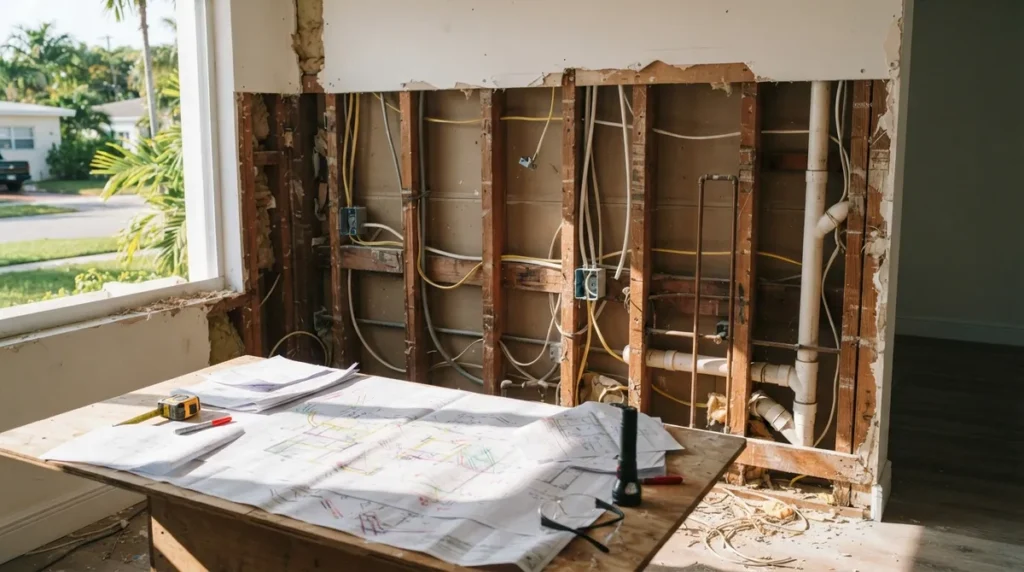
Inspectors may require opening up concealed areas, walls, ceilings, or finishes, so structural, electrical, plumbing, and mechanical components can be physically verified. Photographs alone are rarely enough for anything involving framing, wiring, or plumbing lines hidden behind drywall.
- Take comprehensive photos and videos of all visible construction, inside and out
- Identify areas where concealed work may need to be exposed for inspection
- Gather any existing plans, receipts, or contractor records if available
- Note the approximate age and scope of the unpermitted work
- Consult with a licensed engineer about structural and safety concerns
This is precisely the kind of situation where as-built drawings become essential. A qualified team can measure, document, and translate what actually exists into drawings the building department can review.
Step 4: Assemble the Right Professionals and Plans
Depending on the scope of the unpermitted work, you'll likely need a licensed architect or engineer to prepare as-built plans, and possibly a licensed contractor to perform corrective work. Structural changes, additions, and anything touching electrical, plumbing, mechanical, or gas systems almost always require sealed drawings.
Miami-Dade's Work Without Permit process typically calls for a Work Without Permit Certificate, a property-owner Hold Harmless Agreement, and affidavits confirming the work meets minimum Florida Building Code inspection standards. Having in-house structural engineering and MEP engineering support speeds this along enormously, since revisions can be turned around without waiting on a third-party consultant.
Documents Commonly Required for Legalization
- Work Without Permit Certificate application
- Hold Harmless Agreement signed by the property owner
- As-built architectural and engineering plans
- Affidavits confirming code compliance where inspections were missed
- Photographs and, where required, documentation of opened concealed work
Step 5: Submit Your Application and Respond to Plan Review
With plans and affidavits in hand, it's time to submit the after-the-fact or Work Without Permit application to the correct building department. This is rarely a one-and-done submission. Plan reviewers commonly issue comments requesting clarifications, additional details, or corrections, and each round of resubmittal takes time.
Having a team that handles plan review coordination and revisions and resubmittals in-house means comments get addressed quickly instead of sitting in a queue while you wait for an outside consultant to call back. As a licensed private provider, 1 Contractor Solutions can even perform the plan review directly for many project types, shaving weeks off the timeline through private provider plan review and inspections.
Step 6: Complete Corrections, Pass Inspections, and Close the Permit
Once your plans are approved, any required corrective work needs to happen, and inspections need to be scheduled and passed. This might involve exposing framing for a structural inspection, testing electrical circuits, or verifying plumbing connections. Only after all required inspections pass does the permit officially close.
For older or particularly stubborn cases, Miami-Dade County's special Code Relief program offers a narrow path, but it only applies to construction that commenced before March 1, 2002. If your project doesn't qualify for Code Relief, the standard Work Without Permit process is the route to take.
| Program | Eligibility | Key Requirement |
|---|---|---|
| Standard Work Without Permit (WWP) | Most residential and commercial unpermitted work | Full documentation, minimum permit documents, all trades addressed |
| Code Relief Program | Limited to specific structures | Construction must have commenced before March 1, 2002 |
Common Pitfalls That Slow Down Legalization
Even motivated property owners run into snags. Here are the mistakes we see most often, and how to sidestep them.
- Assuming photos alone will satisfy inspectors for concealed structural or MEP work
- Hiring an unlicensed person to perform corrective work, which raises separate legal risks under Florida Statutes
- Failing to check both permit and code-violation history before submitting an application
- Underestimating how long plan review and corrections can take without dedicated coordination
- Assuming a permit exemption for minor work also excuses electrical, plumbing, or structural requirements
Starting or continuing work without a required permit can lead to stop-work orders, added fees, mandatory corrections, or even removal of the work. It can also complicate a future sale, refinance, insurance claim, or certificate of occupancy request. If you're facing a code compliance violation, addressing it sooner rather than later almost always saves money and stress.
Who Benefits Most From Professional Legalization Support
This process touches more people than just homeowners. Understanding who needs help clarifies why a dedicated permitting partner makes sense.
General Contractors and Design Trade Professionals
Contractors managing renovations often discover unpermitted additions mid-project. Having access to reliable architectural drafting and sealed engineering means you're not stuck waiting weeks for an outside firm while your crew sits idle. Design professionals who prefer to outsource drafting entirely can rely on drafting-only services when they already have their own engineer of record.
Real Estate Professionals and Property Buyers
Realtors and investors regularly encounter unpermitted work during due diligence. A thorough realtor and closing support service can research permit history fast enough to keep a transaction on schedule, rather than watching a deal collapse over surprise violations.
Solar Companies
Distributed energy installers sometimes find that a roof or electrical panel has undocumented modifications. Coordinating solar contractor permitting alongside legalization work keeps installation timelines on track instead of stalling out over an unrelated compliance issue discovered mid-project.
Florida Homeowners and Residential Property Owners
Homeowners are often surprised to learn they're responsible for a previous owner's unpermitted work. Florida law places that responsibility on the current property owner, regardless of who performed the original construction. That's a tough pill to swallow, but working with a team that handles homeowner permitting support makes the burden far lighter.
How 1 Contractor Solutions Can Help
At 1 Contractor Solutions, we've built our business around exactly this kind of challenge. We're Florida's outsourced permitting department, and our after-the-fact and expired permits team specifically takes on the files other firms decline. Because our drafting and engineering departments are in-house, with our own engineer signing and sealing the work, we can respond to reviewer comments immediately instead of waiting on an outside consultant.
We work across all 67 Florida counties, including deep experience in Miami-Dade County and the city of Miami itself, along with Broward County and beyond. Whether you're dealing with a stop-work order, a stalled sale, or a folio full of question marks, our team answers around the clock, responds within 30 minutes, and speaks both English and Spanish. You can also visit us on Google — 1 Contractor Solutions to see how we've helped other Miami-area property owners through this exact process.
For broader background on Florida's contractor licensing rules that intersect with legalization work, the Florida Statutes on contractor regulation are worth a look, and Miami-Dade's own Building Department resource page lays out current WWP guidance directly from the county.
Bringing It All Together
Legalizing unpermitted construction in Miami isn't a quick weekend project, but it is absolutely achievable when you approach it methodically. Identify your jurisdiction, dig into the permit history, document what's really there, bring in the right licensed professionals, submit a solid application, and see it through to final inspection. Each step builds on the last, and skipping any of them tends to cause delays down the road.
If all of this feels like a lot to juggle alongside your day job, your listings, or your construction schedule, you don't have to figure it out alone. Our team has spent over 15 years handling exactly these kinds of Florida permitting challenges, and we'd love to help you cross the finish line. Feel free to get a free quote and let's talk through your specific property and timeline. You can also stay connected and see updates from our team by choosing to follow us on LinkedIn or follow us on Facebook for more permitting tips and Florida building code updates.
FAQs
How do I legalize unpermitted construction in Miami?
You'll want to start by identifying which jurisdiction governs your property, then research the permit and violation history, document the existing construction, bring in licensed professionals for plans, submit your application, and complete inspections. It sounds like a lot, but taking it one step at a time makes it manageable, and you don't have to do it solo!
Can I get an after-the-fact permit in Miami-Dade County?
Yes, Miami-Dade County has a Work Without Permit process designed for exactly this situation, requiring documentation, affidavits, and a Hold Harmless Agreement from the property owner. Just keep in mind the special Code Relief program only covers work that started before March 1, 2002, so most current cases go through the standard WWP route.
What happens if unpermitted work is hidden behind walls or ceilings?
Concealed work is often the trickiest part of the whole process, since inspectors typically need to physically verify structural, electrical, and plumbing components rather than relying on photos alone. This might mean opening up a section of drywall or ceiling, but it's a normal part of getting everything properly documented and approved.
Can a previous owner's unpermitted construction be legalized by the current owner?
Absolutely, and honestly this happens all the time. Florida places responsibility on the current property owner regardless of who did the original work, so plenty of homeowners find themselves cleaning up a mess they didn't create, and a good permitting team can make that process feel a lot less overwhelming.
Can unpermitted work affect selling or refinancing my Miami property?
It definitely can, since open permits or undocumented construction often show up during title searches, appraisals, or closing preparations. The friendly news is that resolving it before you list or refinance tends to be much smoother than trying to untangle it under a closing deadline.
We do this work every day across all 67 Florida counties. Call (866) 314-6931 and we will tell you what your situation actually requires — including when you do not need us.
Related services
Permit Facilitation & Filing
You have a crew scheduled, a client asking for dates, and a permit sitting somewhere in a queue you cannot see. We file it, w…
See the servicePlan Review Coordination
A permit in plan review is not one queue. On a commercial project it can be six queues, each with its own reviewer, its own c…
See the serviceReady to get your permit moving?
One call tells you which jurisdiction controls your project, what it will take, and what it will cost. Most of the time we can scope it on the phone.