
Blog
How to Get an EV Charger Permit in Cape Coral, FL (2026)
Learn how to get an EV charger permit in Cape Coral, FL: required documents, CSS portal steps, inspections, and public charging rules.
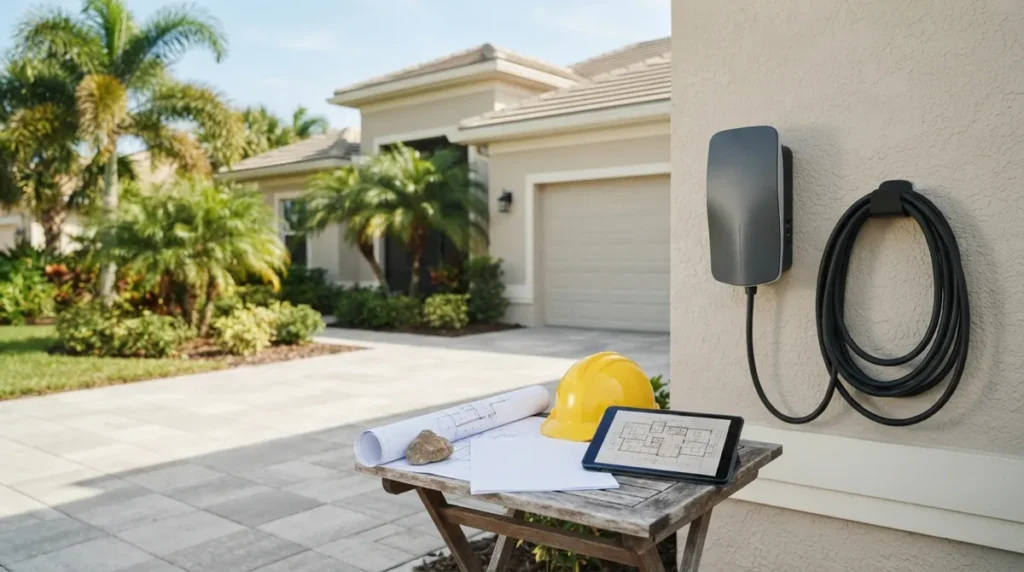
Key Takeaways
-
In most Cape Coral homes, an EV charger requires a City electrical permit, submitted through the CSS portal under Electrical - Residential with the Miscellaneous work type.
-
Always required documents are a site plan, an electrical plan showing circuit and breaker sizes, and the charger's manufacturer spec sheet; mismatched amperage between documents commonly triggers reviewer comments.
-
Flood-zone parcels may need FEMA documentation or an elevation certificate, so gather these before submitting to avoid review delays.
-
Do not energize the charger until the electric final inspection passes; required inspections include electric rough (if applicable), hook-up, and final.
-
Public-use chargers in Florida require annual FDACS registration before service, and fee-charging stations also need a valid Weights and Measures device permit.
-
No published EV-charger-specific fee exists, so check the City's current miscellaneous permit fee schedule and contact Permitting Services for a project estimate.
So you just brought home a shiny new electric vehicle, and now you are staring at a charger box wondering how a simple wall-mounted unit turned into a government paperwork project. Take a breath. You are in good company, and the process is far friendlier than it first looks.
Here is the short version: in most cases, installing an EV charger at a Cape Coral home requires a City electrical permit. That surprises plenty of folks, because a charger feels like an appliance. But it is a dedicated, high-amperage circuit, and the City wants an inspector to confirm it is safe before it powers up your garage.
This guide walks you through the whole thing in plain English. You will learn how to apply, which documents to gather, what inspections to expect, and how public or commercial charging adds a few extra state-level steps. Whether you are a homeowner, a general contractor, a solar company adding chargers to an install, or a realtor helping a client, you will leave with a clear game plan for your ev charger permit cape coral fl project.
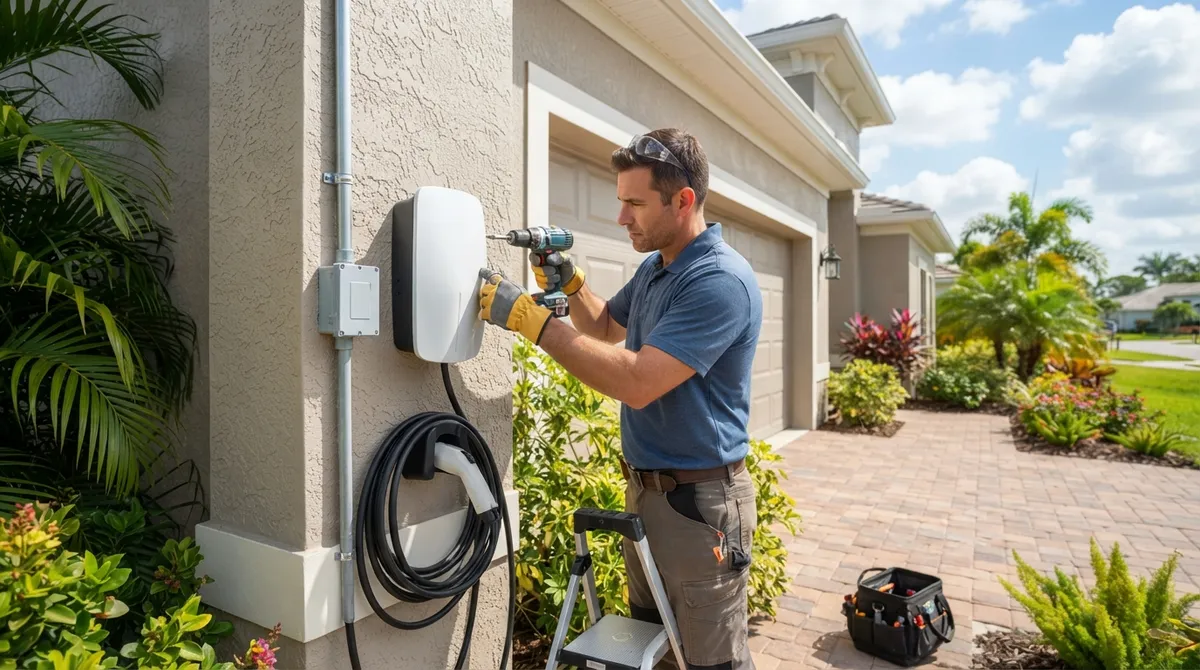
Do You Need a Permit for an EV Charger in Cape Coral?
Short answer: yes, in most situations. The City of Cape Coral publishes a residential EV charging station guideline (revised January 2026) that directs applicants to pull an electrical permit before installation.
Florida law also plays a role. Florida Statutes §366.94 preempts state-level regulation of EV charging stations and says local governments issue permits under state-established standards and other applicable state law. In plain terms, the state sets the big-picture rules, but your local building department still handles the permit and inspections.
A quick reality check on who this applies to:
- Homeowners adding a Level 2 charger in a garage or carport
- Contractors installing chargers as part of a remodel or new build
- Solar companies bundling a charger with a panel or battery install
- Realtors and investors checking whether an existing charger was installed legally
Not sure whether your specific situation triggers a permit? When in doubt, confirm with the City's Permitting Services Division before you buy materials. A five-minute question can save you a stop-work order later.
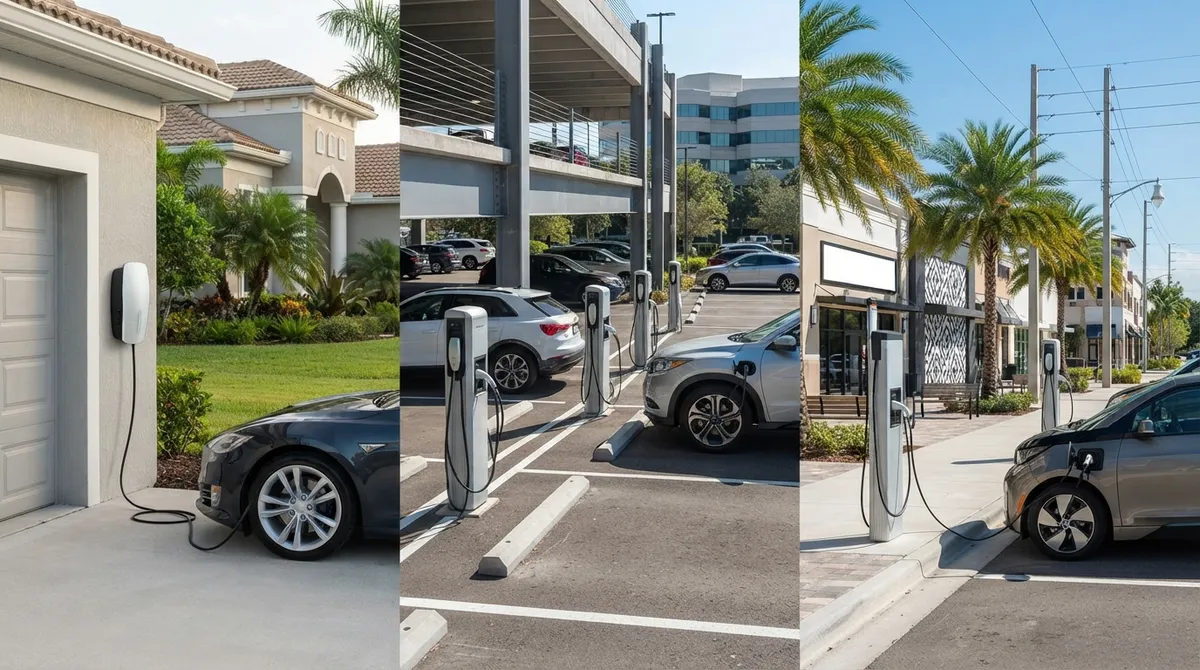
Residential vs. Commercial vs. Public Charging: What Changes
Not every charger lives in the same regulatory bucket. The path depends on who can use the charger and whether anyone pays to use it. Here is a quick comparison.
| Charger Type | Typical Permit Path | Extra State Requirements |
|---|---|---|
| Private home charger (1 and 2 family residence) | City electrical permit, residential application | None identified for private use |
| Commercial or business charger (employees or tenants only) | Confirm commercial permit path with the City | Depends on whether the public can use it |
| Public-use charger (free) | Local permits as applicable | FDACS registration before public service; annual renewal |
| Public-use charger (fee charged) | Local permits as applicable | FDACS registration plus a Weights and Measures device permit |
The City's guideline is written specifically for residential properties. If you are planning a commercial project, confirm the correct permit path with the City first, because commercial work often calls for sealed plans and different review steps.
How to Apply for a Residential EV Charger Permit in Cape Coral
Cape Coral uses its online CSS portal for permit applications. Here is the step-by-step flow based on the City's January 2026 guideline.
- Create or log in to your CSS portal account. The portal is where applications, documents, and fees live.
- Start a new application. Select Electrical - Residential (1 and 2 family residences).
- Choose the work type. Select Miscellaneous as the work type for an EV charging station.
- Enter your property and project details. Use the correct parcel and address, and describe the charger clearly (for example, a Level 2 charger on a dedicated circuit).
- Upload required documents. We cover these in the next section.
- Pay the permit fees. Fees are set by the City's current schedule.
- Respond to reviewer comments. If the reviewer asks for changes, resubmit promptly.
- Schedule inspections once the permit is issued. Do not energize the charger until it passes final.
Who can apply? The City says an electrical contractor or an eligible owner-builder may submit the residential permit. Owner-builders must provide an Owner/Builder Affidavit, and eligibility and documentation should be confirmed with the City before applying. If you are curious about how that works, our guide on getting an owner-builder permit covers the general idea, though always follow Cape Coral's own rules.
Documents You Will Need for the Application
Incomplete submittals are the number one reason permits stall. Gather everything before you click submit.
Always Required
- Site plan: shows the house, the charger location, and where the electrical service sits
- Electrical plan: shows the circuit, breaker size, wire size, and disconnecting means
- Manufacturer specifications: the charger's spec sheet showing amperage, voltage, and listing information
Required Depending on the Parcel and Project
- Notice of Commencement: may apply depending on project value and scope
- FEMA documentation and/or an elevation certificate: Cape Coral has a lot of flood-zone parcels, so floodplain review can come into play
That flood-zone piece matters more than most people expect. Cape Coral is canal-heavy, and a charger mounted low on a wall in a flood zone can raise questions. Having your elevation information ready up front keeps review moving. If you want to understand the basics, our article on flood zone permitting in Florida is a helpful primer.
What Your Electrical Plan Should Show
A clean electrical plan makes reviewers happy. You do not need a novel, but it should be clear and consistent with your charger's spec sheet.
Good plan sets typically include:
- The charger make, model, and rated amperage
- The dedicated branch circuit and breaker size
- Conductor size and type, plus conduit information
- The panel location and available capacity
- Disconnect and grounding details
- The mounting location on the site plan
One common snag: the panel simply does not have room for another large circuit. In that case, a load calculation or a panel upgrade may be part of the story. That is where drafting and MEP support earn their keep. If you need help, MEP engineering support can turn a rough sketch into a reviewer-ready plan.
Inspections to Expect
Per the City's guideline, the listed inspections for a residential EV charging station include:
| Inspection | When It Applies |
|---|---|
| Electric rough | If applicable, before walls or ceilings close up |
| Hook-up / SRV CHG | If applicable, when the charger is connected |
| Electric final | Required, final sign-off on the completed installation |
| Notice of Commencement | May apply depending on the project |
Floodplain review may also be part of the process where applicable. Schedule each inspection only when the work is truly ready. A failed inspection can mean reinspection fees and lost days, so a quick walk-through with your electrician is time well spent.
How Much Does an EV Charger Permit Cost in Cape Coral?
This is the question everyone asks, and here is the honest answer: there is no single, published EV-charger-specific fee we can point to. Cape Coral publishes its permit fee schedules separately and notes that fees can change.
What that means for you:
- Check the City's current miscellaneous permit fee schedule before you apply.
- Contact the Permitting Services Division for a project-specific estimate.
- Budget for potential extras like plan preparation, a panel upgrade, or elevation documentation.
Processing time works the same way. We did not find a reliable published turnaround figure, so ask the City what current review times look like. Complete submittals almost always move faster than incomplete ones, so that is the one thing you can control.
Public Charging Stations: Extra State Requirements
If your charger will be available to the public, such as at a retail center, a hotel, or a multifamily property open to visitors, Florida adds requirements on top of the local permit. These are separate from the City's construction and electrical permit.
- FDACS registration: Florida requires a public EV charger to be registered with the Florida Department of Agriculture and Consumer Services before it is placed into public service. FDACS says public-use stations must register annually, whether or not users pay.
- Weights and Measures device permit: FDACS states that each public charging device that charges a fee must also have a valid Weights and Measures device permit.
No fee amounts were identified in the available sources, so check directly with FDACS for current charges. For the official details, see the Florida Department of Agriculture and Consumer Services EV charging page. Property owners and managers should put this on the checklist early, because opening a station without registration is a headache nobody needs.
Common Mistakes That Slow Down EV Charger Permits
After seeing plenty of permit files, a few patterns show up again and again. Dodge these and you will be ahead of the game.
- Skipping the permit entirely. It feels easy to have an electrician just swap in a circuit. But unpermitted electrical work can cause trouble at sale, with insurance, or when an inspector spots it.
- Uploading mismatched documents. If the plan says 48 amps and the spec sheet says 40, expect comments.
- Forgetting flood documentation. Many Cape Coral parcels need elevation or FEMA paperwork.
- Selecting the wrong application type. Use the residential electrical application with the Miscellaneous work type for home chargers.
- Energizing before final. Wait for the inspection to pass.
If a charger was already installed without a permit, do not panic. There is a path forward. Our guides on after-the-fact electrical permits in Florida and legalizing unpermitted work explain how owners typically get back on solid ground.
Tips for Contractors, Solar Companies, and Realtors
Different readers need different things from this process, so here is a quick cheat sheet.
General Contractors and Electricians
Build the charger permit into your project schedule from day one. If you are adding a charger to a larger remodel, confirm whether it belongs on the main permit or needs its own. Keep manufacturer spec sheets handy so you can upload them without hunting.
Solar Companies
Chargers and solar often travel together, and both touch the electrical panel. Coordinate load calculations so the charger, PV system, and any battery do not fight over the same capacity. If you handle high volumes, see our tips on speeding up solar permit expediting in Florida.
Realtors and Investors
If a listing advertises an EV charger, ask whether it was permitted and inspected. An open or missing permit can surface during due diligence. Our walkthrough on who pays for open permits when buying a Florida home is worth a read before closing.
When to Get Professional Help
Plenty of EV charger permits are straightforward. But a little help can be a real time-saver when:
- Your panel needs a load calculation or upgrade
- The parcel sits in a flood zone and needs extra documentation
- You are installing multiple chargers or a public-facing station
- A reviewer issued comments you are not sure how to answer
- You are an owner-builder who wants a second set of eyes on the submittal
That is where permit facilitation and filing comes in. At 1 Contractor Solutions, we act as Florida's outsourced permitting department. We prepare or review plans, file the application, track it, handle reviewer comments, and carry it through approval and closeout, with in-house drafting and engineering so fixes do not wait on an outside consultant. If you ever need to tie off loose ends, our team can also help with plan review coordination.
Want to see what other Florida property owners and pros say about working with us? Visit us on Google — 1 Contractor Solutions for reviews, and feel free to follow us on LinkedIn or follow us on Facebook for permitting updates. Our Southwest Florida projects, including Cape Coral and the rest of Lee County, are a big part of what we do. You can learn more about permitting services in Cape Coral on our local page.
Quick Cape Coral EV Charger Permit Checklist
Before you submit, run through this list one more time:
- Confirm the project is residential (1 or 2 family) and the permit path is correct
- Decide who is applying: licensed electrical contractor or eligible owner-builder
- Prepare the site plan, electrical plan, and manufacturer specs
- Check whether a Notice of Commencement is needed
- Gather FEMA documentation or an elevation certificate if your parcel calls for it
- Review the City's current fee schedule or request an estimate
- Plan your rough, hook-up, and final inspections
- If the charger is public-facing, handle FDACS registration and any Weights and Measures permit
Ready to Charge Up Without the Paperwork Headaches?
Getting an EV charger permit in Cape Coral is very doable once you know the steps: use the CSS portal, choose the residential electrical application with the Miscellaneous work type, upload your site plan, electrical plan, and manufacturer specs, and pass your inspections. Public charging adds FDACS registration and, when you charge a fee, a Weights and Measures permit. Always double-check current requirements and fees with the City, since they can change.
If you would rather hand off the paperwork and keep your crew (or your weekend) free, we are happy to help. Get a free quote and let our team handle your EV charger permit from filing to final.
FAQs
Do I need a permit to install an EV charger at my home in Cape Coral, Florida?
In most cases, yes. Cape Coral's residential EV charging station guideline (revised January 2026) calls for an electrical permit submitted through the City's CSS portal. If you are unsure about your specific setup, a quick call to the Permitting Services Division will point you in the right direction.
Can a homeowner apply as an owner-builder for an EV charger permit in Cape Coral?
Yes, the City says an electrical contractor or an eligible owner-builder may apply for the residential permit. Owner-builders need to provide an Owner/Builder Affidavit, and it is smart to confirm eligibility and paperwork with the City before you apply.
What documents are required for a Cape Coral EV charger permit?
A site plan, an electrical plan, and manufacturer specifications are always required. Depending on your parcel and project, you may also need a Notice of Commencement, FEMA documentation, and/or an elevation certificate.
Do public EV chargers in Florida need FDACS registration or a weights-and-measures permit?
Yes. A public-use charger must be registered with the Florida Department of Agriculture and Consumer Services before it goes into public service, and registration is annual. If the station charges a fee, each device also needs a valid Weights and Measures device permit, which is separate from your local construction permit.
How much does an EV charger permit cost in Cape Coral?
There is no single EV-charger-specific fee we could verify, and Cape Coral notes that fees can change. Check the City's current miscellaneous permit fee schedule or ask the Permitting Services Division for a project-specific estimate.
We do this work every day across all 67 Florida counties. Call (866) 314-6931 and we will tell you what your situation actually requires — including when you do not need us.
Related services
Permit Facilitation & Filing
You have a crew scheduled, a client asking for dates, and a permit sitting somewhere in a queue you cannot see. We file it, w…
See the servicePlan Review Coordination
A permit in plan review is not one queue. On a commercial project it can be six queues, each with its own reviewer, its own c…
See the serviceReady to get your permit moving?
One call tells you which jurisdiction controls your project, what it will take, and what it will cost. Most of the time we can scope it on the phone.