
Blog
How to Speed Up Solar Permit Expediting in Florida
Learn how solar permit expediting works across Florida's 67 counties, including required documents, timelines, and the new five-day review rule.
Key Takeaways
-
Florida's 2025 five-business-day review requirement applies only to qualifying residential rooftop solar applications; confirm with your local building department how they're implementing this rule before counting on the deadline.
-
Missing digitally signed and sealed plans, incomplete electrical diagrams, or incorrect permit classification are the most common rejection triggers—catching these issues before submission prevents costly back-and-forth cycles.
-
Battery storage systems typically require additional electrical review and may need separate permits or revisions; disclose battery equipment, location, and specifications clearly in your initial application.
-
Roof-mounted and ground-mounted solar systems use different permit types that vary by jurisdiction; what qualifies as an electrical trade permit in Tampa may require a miscellaneous residential permit in another county.
-
Utility interconnection is a separate process from local building permits and must be coordinated simultaneously rather than sequentially to reduce total project timeline by weeks.
-
Core documents required include site plans with setbacks, array layouts, equipment specifications, one-line diagrams, structural wind-load calculations per Florida Building Code 8th Edition, and NEC Article 690 compliance documentation.
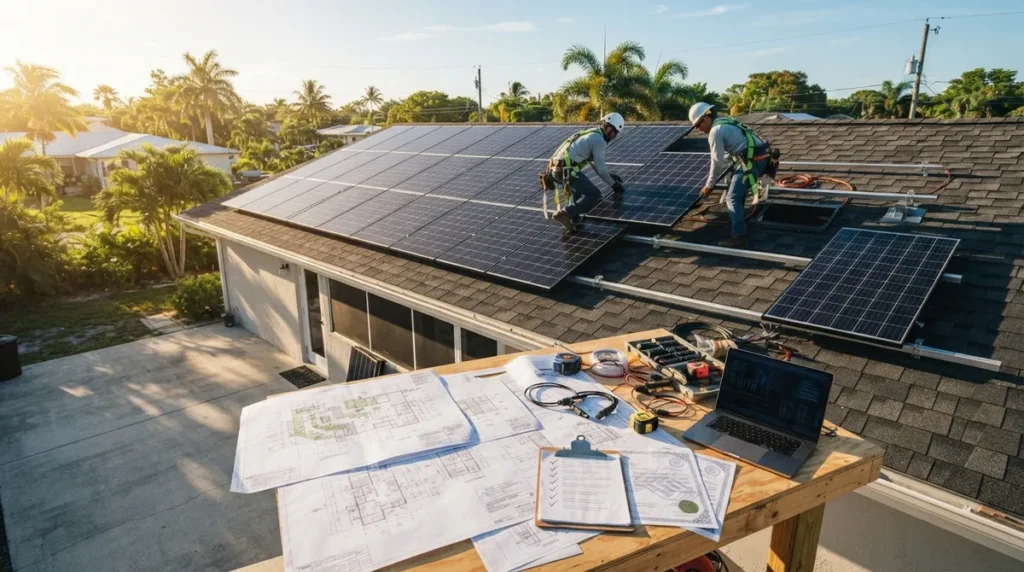
If you've ever watched a solar installation crew sit idle while paperwork gathers dust at the county building department, you already know the frustration. Solar permit expediting in Florida isn't just a nice-to-have anymore. With hurricane season stress-testing every roof and Florida's booming solar market, getting your paperwork right the first time can mean the difference between a project that moves smoothly and one that stalls for weeks. Grab a cup of coffee, because we're about to walk through everything you need to know to keep your solar permits moving through Florida's local building departments without unnecessary hiccups.
Whether you're a solar installer juggling a dozen jobs a month, a general contractor adding solar to a renovation, a homeowner in Bradenton dreaming of lower electric bills, or a realtor trying to confirm a property's solar system was properly permitted before closing, this guide is for you. We'll cover the current rules, the documents reviewers expect, common rejection triggers, and how a permitting partner like 1 Contractor Solutions can help keep your project on schedule.

Why Solar Permit Expediting Matters More Than Ever in Florida
Florida's sunshine makes it one of the most attractive states for solar investment, but that popularity comes with a catch: building departments across the state's 67 counties are handling record volumes of solar applications. Add in Florida's strict wind-load and structural requirements, and it's easy to see why even a well-designed system can hit a snag if the paperwork isn't airtight.
Solar permit expediting is the process of preparing, submitting, and actively tracking your permit application so it moves through review as quickly as the jurisdiction allows. It doesn't guarantee approval overnight, but a complete, code-compliant package dramatically reduces back-and-forth with reviewers. That's especially true now that Florida has introduced a faster review framework for qualifying residential rooftop solar projects.
The Five-Business-Day Rule: What You Need to Know
Florida's 2025 permitting reforms introduced a five-business-day review requirement for qualifying residential rooftop solar and other single-trade permit applications. Under this framework, local governments are generally expected to review qualifying applications within five business days or the application may be treated as approved by law, subject to the statute's specific conditions.
Here's the important caveat: this deadline only applies to applications that meet the statute's qualifying criteria, and implementation details can vary by jurisdiction. Before you count on the five-day clock, it's worth confirming with the local building department how they're applying the rule. Our team regularly checks these details through our Building Department Lookup tool to avoid surprises.
What Documents Do You Need for a Florida Solar Permit?
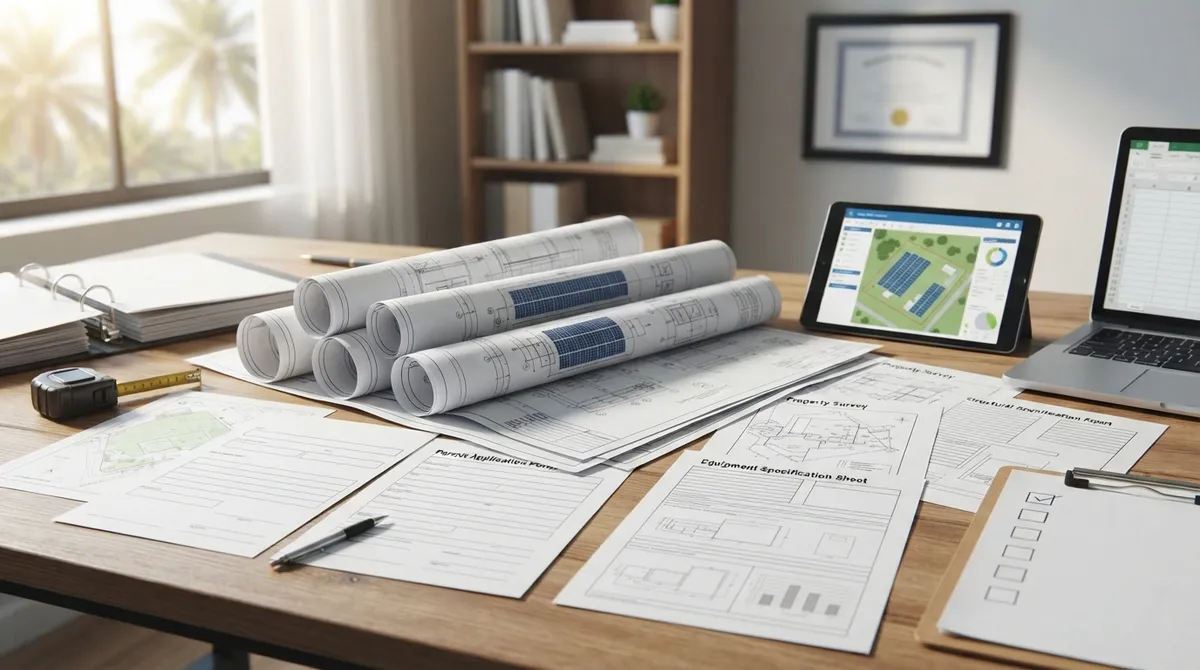
Every jurisdiction has its own checklist, but most Florida solar permit applications require a similar core package. Missing even one item can trigger a rejection or a lengthy correction cycle, so let's break down what reviewers typically want to see.
- Site or roof plan showing the location of the array, access pathways, and setbacks from roof edges.
- Array layout detailing panel placement, orientation, and total system size.
- Equipment specifications for panels, inverters, racking, and any battery storage components.
- Electrical one-line or three-line diagram showing conductor sizing, grounding, disconnects, and interconnection point.
- Structural or wind-load calculations confirming the roof and mounting system can handle Florida's wind exposure requirements.
- Mounting and attachment details specific to the roof type and structure.
- Compliance documentation referencing the Florida Building Code, 8th Edition (2023), and applicable National Electrical Code provisions, including NEC Article 690 and interconnection rules under NEC 705.12.
Ground-mounted systems often need additional zoning, setback, and foundation information, while commercial installations may require a more extensive construction document package. If you're not sure which permit type applies to your project, our Plans and Engineering team can help sort that out before you ever submit.
Roof-Mounted vs. Ground-Mounted: Different Permits, Different Rules
Here's something that trips up a lot of first-time filers: not every solar system uses the same permit type. In Hillsborough County, for example, roof-mounted residential PV systems are typically classified as electrical trade permits, while ground-mounted systems may fall under a residential miscellaneous permit category. Tampa's published checklist even notes that residential trade permit applications may be auto-issued after submission and payment, provided all required documentation is in order.
This kind of local variation is exactly why a one-size-fits-all approach to solar permitting doesn't work in Florida. What flies in Tampa might need extra steps in St. Petersburg or Bradenton.
| Jurisdiction | Common Permit Type (Roof-Mounted) | Notable Local Detail |
|---|---|---|
| Hillsborough County | Electrical trade permit | Requires digitally signed and sealed plans plus Notice of Commencement when applicable |
| Tampa | Residential trade permit | May be auto-issued after submission and payment, subject to documentation |
| Charlotte County | Residential solar permit | Flat fee structure (e.g., $90) plus valuation-based building fees for larger systems |
| Collier County | Building/electrical combination review | Fees and review process outlined in county building code schedule |
How Long Does Solar Permitting Actually Take in Florida?
This is probably the question we hear most from solar companies and homeowners alike. The honest answer is: it depends on your jurisdiction, the completeness of your application, and whether your project qualifies for the five-business-day review track.
Generally, a clean, complete residential rooftop solar application in a jurisdiction that has adopted efficient review practices can move quickly, sometimes within the statutory window. Commercial systems, ground-mounted arrays, and projects involving battery storage typically take longer because they trigger additional structural, electrical, and sometimes zoning or environmental review.
For a deeper look at typical review windows across the state, check out our detailed breakdown on Florida solar permit timelines.
Common Causes of Delay (And How to Avoid Them)
Nothing derails a solar project faster than an avoidable rejection. Based on what we see across Florida jurisdictions, here are the usual suspects:
- Missing digitally signed and sealed plans
- Incomplete or inconsistent one-line electrical diagrams
- Incorrect permit classification (applying for the wrong permit type)
- Inadequate wind-load or structural calculations for the specific roof type
- Missing setback information for roof access pathways
- Incomplete equipment specifications, especially for inverters and batteries
- Failure to disclose battery storage or other ancillary equipment upfront
A permit expeditor's job is to catch these issues before submission, not after a rejection letter arrives. That's the whole point of process management: reducing the number of round trips between your team and the reviewer's desk.
Do Batteries and Storage Systems Need Separate Permits?
Battery storage is becoming a standard add-on for Florida solar installations, especially with hurricane-related power outages on everyone's mind. In many jurisdictions, adding a battery to a solar system does require additional electrical review, and sometimes a separate permit or permit revision entirely.
The key is disclosure. If your application doesn't clearly identify the battery equipment, its location, and its electrical specifications, you're almost guaranteed a correction request. Our MEP Engineering team builds these details into the initial submission so reviewers see the full picture from day one.
Utility Interconnection: A Separate but Essential Step
Here's something that catches a lot of people off guard: your local building permit and your utility interconnection application are two completely different processes. Even after your permit is approved and inspections pass, you still need utility approval before the system can legally operate in parallel with the grid.
Depending on your location, this might involve Florida Power & Light, Duke Energy, Tampa Electric, or a municipal utility provider. Coordinating both tracks simultaneously, rather than sequentially, is one of the best ways to shave weeks off your total project timeline.
How a Permit Expediter Helps Keep Solar Projects Moving
So what exactly does a permitting partner do that you couldn't do yourself? Quite a bit, actually. Here's a step-by-step look at how the process typically works when you bring in expediting support:
- Identify the correct local permit type and jurisdiction (not always obvious near county or city lines)
- Prepare or quality-check the full application package, including sealed plans and diagrams
- Submit through the jurisdiction's online portal correctly the first time
- Monitor plan review status and respond quickly to reviewer comments
- Coordinate revisions and resubmittals without losing momentum
- Track inspection scheduling and requirements
- Confirm final approval and closeout documentation
It's worth being upfront here: expediting doesn't remove the need for licensed contractors, engineers, code compliance, or required inspections. What it does is manage the process so nothing slips through the cracks. Think of it as project management for paperwork, run by people who know exactly what each Florida building department expects.
At 1 Contractor Solutions, our in-house drafting and engineering department means that when a reviewer flags something, we can fix it directly rather than waiting on an outside consultant. We're also a licensed private provider, which means we can perform plan review ourselves in qualifying jurisdictions instead of leaving you stuck in the county queue.
Working Across Florida's 67 Counties
Solar companies scaling across multiple Florida markets face a unique challenge: what works in Miami won't necessarily work in Orlando or Jacksonville. Each county and municipality has its own portal, fee schedule, and documentation quirks.
Having a single permitting partner who understands these differences across Hillsborough, Pinellas, Manatee, Broward, and Miami-Dade counties lets solar contractors focus on installation instead of relearning local rules for every job. If you're expanding into new territory, our Solar Contractors page outlines exactly how we support high-volume permitting programs.
What About Fees?
Permit fees vary significantly by jurisdiction, so it's important not to assume a statewide flat rate. For example, Charlotte County lists a flat fee for certain residential solar applications, with additional charges calculated based on project valuation once it crosses certain thresholds. Other counties calculate fees differently based on system size, equipment value, or a combination of factors.
| Fee Factor | What It Typically Affects |
|---|---|
| System valuation | Determines building permit fee tier in many counties |
| Permit type (electrical vs. building) | Different fee schedules may apply |
| Battery storage addition | May trigger additional electrical permit fees |
| Notice of Commencement | Generally required when contract price exceeds $5,000 |
It's also worth remembering that for most Florida construction projects, a Notice of Commencement becomes relevant once the direct contract price exceeds $5,000. Some local checklists, including Hillsborough County's, require a recorded copy before the first inspection can happen.
Real Estate and Solar: What Buyers and Agents Should Know
If you're a realtor or investor evaluating a property with an existing solar system, don't assume everything was permitted correctly just because panels are on the roof. Unpermitted or improperly closed-out solar installations can create headaches during closing, from insurance complications to buyer financing delays.
Our Realtor and Closing Support service helps confirm permit history and resolve open permits before they become a closing-day surprise. It's a small step that can save everyone involved a lot of stress.
Bringing It All Together
Solar permit expediting in Florida isn't about shortcuts. It's about knowing exactly what each jurisdiction requires, preparing a complete and code-compliant package the first time, and staying on top of every step until final approval. Whether you're navigating the five-business-day rule for a residential rooftop system, coordinating a commercial ground-mount installation, or just trying to figure out which permit type applies to your project, having an experienced partner in your corner makes all the difference.
1 Contractor Solutions has spent over 15 years handling permitting across all 67 Florida counties, and our in-house engineering and drafting teams mean fewer delays and faster corrections when reviewers have questions. You can visit us on Google — 1 Contractor Solutions to see what our clients say about working with us, or check out our updates by following us on LinkedIn and Facebook for the latest on Florida permitting changes.
For general background on Florida's building code framework, the Florida Building Code, 8th Edition is a helpful reference, and homeowners can review consumer-facing guidance through resources like the U.S. Department of Energy's solar information pages.
Ready to stop guessing and start moving your solar projects through review faster? Request your free quote today and let our team handle the permitting details while you focus on what you do best.
FAQs
Do I need a permit to install solar panels in Florida?
Yes, in almost every case you'll need a local permit before installing solar panels in Florida, and it typically involves both building and electrical review. The exact permit type depends on whether it's roof-mounted or ground-mounted, so it's worth confirming with your local building department or a permitting partner before you start.
How long does a solar permit take in Florida?
It really depends on your jurisdiction and how complete your application is, but qualifying residential rooftop projects may fall under Florida's five-business-day review framework. Commercial systems, ground-mounted arrays, or anything involving battery storage usually take a bit longer since they trigger additional review steps.
What is Florida's five-business-day solar permit rule?
It's a 2025 permitting reform that requires local governments to review qualifying residential rooftop solar applications within five business days, or the application may be treated as approved by law under certain conditions. Since the rule has specific qualifying criteria, it's smart to double-check with the local jurisdiction how they're applying it to your particular project.
Do roof-mounted and ground-mounted solar systems use different permits in Florida?
Often, yes! Many counties, like Hillsborough, classify roof-mounted residential PV as an electrical trade permit while ground-mounted systems may fall under a residential miscellaneous permit. It's one of those small details that can trip people up, so getting the classification right from the start really does save time.
Can a permit expediter obtain solar permits in Florida?
A permit expediter can prepare your application package, submit it correctly, track the review, and coordinate revisions, which genuinely speeds things along. That said, expediting doesn't replace the need for licensed contractors, engineers, or required inspections, so think of it as skilled process management rather than a guaranteed shortcut.
We do this work every day across all 67 Florida counties. Call (866) 314-6931 and we will tell you what your situation actually requires — including when you do not need us.
Related services
Permit Facilitation & Filing
You have a crew scheduled, a client asking for dates, and a permit sitting somewhere in a queue you cannot see. We file it, w…
See the servicePlan Review Coordination
A permit in plan review is not one queue. On a commercial project it can be six queues, each with its own reviewer, its own c…
See the serviceReady to get your permit moving?
One call tells you which jurisdiction controls your project, what it will take, and what it will cost. Most of the time we can scope it on the phone.