
Blog
How to Get an After-the-Fact Pool Permit in Florida
Wondering if you can get an after-the-fact pool permit in Florida? Learn the steps, documents, costs, and inspection rules in this friendly 2026 guide.
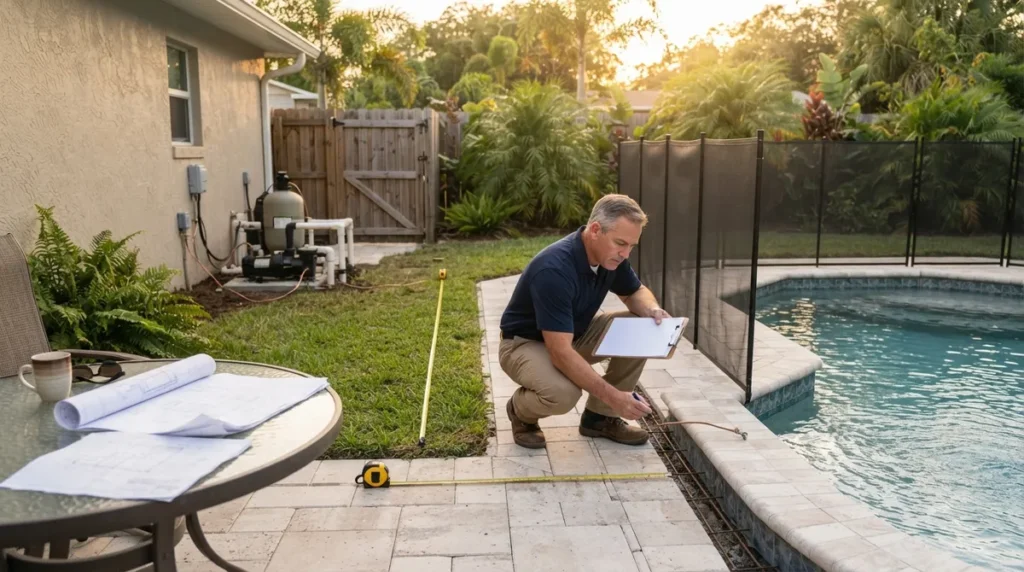
Key Takeaways
-
Yes, Florida owners can generally apply for an after-the-fact pool permit, but approval is not automatic; the local building department decides whether the pool is legalized as built, needs corrections, or must be removed.
-
Paying the after-the-fact fee does not excuse code violations: setback, drainage, structural, electrical, or barrier problems may require modification or removal.
-
Call the city or county building department first to confirm jurisdiction, ask how it handles unpermitted work, and check for any open code enforcement case or stop work order.
-
Prepare a complete packet with a current survey, signed and sealed site plan showing grading, pool plans or as-built drawings, and electrical bonding, plumbing, and barrier/gate details.
-
Expect inspectors to request openings, pressure or electrical testing, or sealed engineering documentation for concealed components like steel, plumbing, and bonding wires.
-
Leaving the permit open after final inspection can derail a home sale, so close out the permit with final sign-off before listing or closing.
So you just found out your pool was built without a permit. Maybe you bought the home last spring and the paperwork never turned up. Maybe a prior owner skipped the process. Or maybe a contractor swore he would pull the permit and then, well, didn't. Take a breath. You are far from the first Florida owner to land here, and there is usually a path forward.
The question most people ask first is simple: can I get an after-the-fact permit for a pool in Florida? In most cases, yes, you can apply. But approval is never automatic, and the local building department decides whether the pool can be legalized as built, needs corrections, or has to come out. The good news is that a well-prepared application dramatically improves your odds.
This friendly, step-by-step guide walks you through what an after-the-fact pool permit really involves, what documents to gather, what inspectors look for, and what it may cost in 2026. Whether you are a homeowner, a general contractor, a pool builder, or a real estate professional with a closing on the calendar, you will leave knowing exactly what to do next.
Can You Get an After-the-Fact Permit for a Pool in Florida?
Yes, a Florida property owner can generally apply to the local building department for an after-the-fact permit for a pool built without a required permit. The key word is apply. The city or county building department with jurisdiction reviews the application and decides whether the pool complies with applicable code and local requirements.
Florida Statute 553.79(1)(a) generally makes it unlawful to construct or alter a building without first obtaining the required permit. Applying after construction does not erase that original violation, and it does not guarantee approval. Think of the after-the-fact process as a way to bring the pool into the system, not a rubber stamp.
If you want a broader view of how this works for all kinds of projects, our guide on how to get an after-the-fact permit in Florida is a helpful companion read.
Who decides?
Your permitting authority is usually the city or county building department where the property sits. Forms, fees, required documents, and enforcement steps vary by jurisdiction. If you are unsure which office actually controls your address, which is not always obvious near city lines, our building department lookup tool can point you in the right direction.
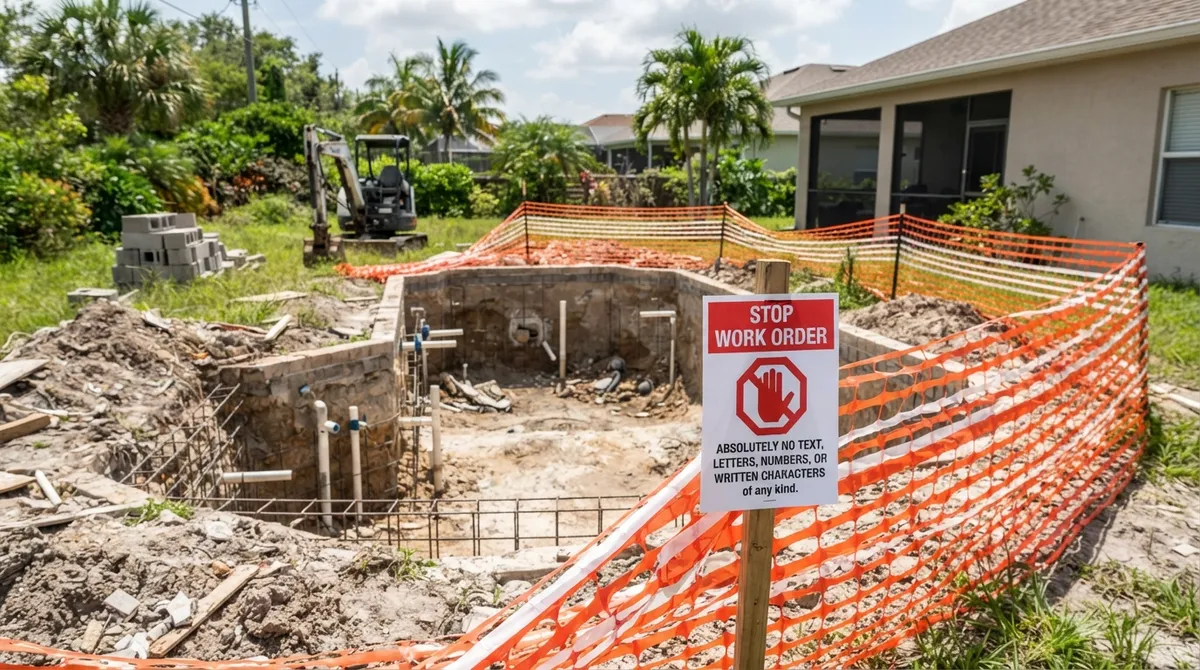
What Can Go Wrong: Possible Outcomes for an Unpermitted Pool
It helps to know the full range of results before you start. Not every unpermitted pool ends the same way.
| Outcome | What It Means | Typical Trigger |
|---|---|---|
| Approved as built | Pool passes review and inspections and receives final approval | Complete documentation and code-compliant construction |
| Approved after corrections | Pool is legalized once specific fixes are made | Missing barrier, bonding, or electrical issues |
| Additional testing or engineering required | Officials request openings, tests, or sealed documentation | Concealed components cannot be inspected in place |
| Denied or required to be modified/removed | Pool cannot be legalized as built | Setback, drainage, structural, or other serious violations |
Please do not assume paying an extra fee will legalize a pool that violates setbacks, drainage, structural, electrical, or barrier rules. An added fee does not excuse code violations.
How to Get an After-the-Fact Pool Permit: Step by Step
Here is the process in plain English. Details change by jurisdiction, but this sequence works for most Florida projects.
- Confirm the jurisdiction. Identify the exact city or county building department that controls your parcel.
- Call or check the department's website. Ask how they handle work done without a permit and what their application packet requires.
- Check for open violations. Look for any existing code enforcement case or stop work order on the property.
- Gather your documents. Survey, site plan, pool plans, and equipment details (more on this below).
- Get plans prepared and sealed if required. Many departments want signed, sealed drawings for the as-built condition.
- Submit the application and pay fees. Expect the added after-the-fact fee schedule to apply.
- Respond to reviewer comments. Plan reviewers often issue comments; answer each one completely.
- Pass inspections. Complete any required inspections and corrective work.
- Close out the permit. Get the final sign-off so the record shows a closed, approved permit.
Skipping straight to submission without confirming the local process is one of the most common reasons these applications stall. A short call up front can save weeks.
Documents You Will Likely Need
The building department needs enough information to judge work that is already finished. Requirements vary, but expect some version of the following.
- A current survey showing the pool and existing structures on the lot
- A site plan showing pool location, setbacks, and grading
- Construction plans or as-built drawings of the pool
- Electrical details, including bonding and grounding information
- Plumbing and equipment details
- Barrier and safety feature details (fences, gates, alarms, or other required protection)
- Owner and contractor information
For example, Flagler County's pool requirements call for a survey showing the proposed pool location and existing structures, plus a signed, sealed site plan illustrating existing and proposed grading. Other jurisdictions ask for different items, so always verify locally.
This is where as-built documentation really matters. If you do not have usable drawings, our team prepares as-built drawings and site plans that match what is actually in your yard. And because our engineering is in house, an engineer sealed letter or drawing can often be produced without waiting on an outside consultant. You can learn more about that on our engineering services page.
What Inspectors May Ask You To Do
Here is the part that surprises most owners. A pool is full of components that get buried or covered: steel, plumbing lines, bonding wires, and electrical conduit. When an inspector cannot see a critical item, they have options.
- Open up the work. The department may require exposing portions of the pool deck or equipment pad.
- Require testing. Pressure tests or electrical testing may be requested.
- Request engineering documentation. A sealed engineer letter can sometimes document structural or electrical conditions.
- Order corrective work. Missing bonding, barrier gaps, or equipment problems may need to be fixed.
The exact remedy is decided locally and depends on the work and the evidence available. The more organized and complete your submission, the less guesswork the reviewer has to do. You can read more about this in our article on what inspections Florida after-the-fact permits require.
How Much Does an After-the-Fact Pool Permit Cost?
There is no single statewide after-the-fact pool fee. Florida Statute 553.79 establishes the general permit requirement, but each jurisdiction sets its own fee schedule and penalties. Here are a few published local examples to show how much the structure can vary.
| Jurisdiction | Published Approach (Example) | Note |
|---|---|---|
| City of Miami | Two times the scheduled fee plus a base fee for certain work started without permits on homestead properties; four times plus a base fee for non-homestead or commercial properties | Confirm current schedule and applicability with the City of Miami |
| Homestead | Double permit fees plus $100 for work started before obtaining a permit, with additional amounts for repeat offenses | Local example only |
| Aventura | Double-fee structure | Check the current city schedule |
Remember that these are local examples, not statewide rates. On top of permit fees, budget for survey updates, sealed plans, any required testing, and corrective construction. For a deeper look at budgeting, see our guides on after-the-fact permit costs in Florida and what it costs to legalize an unpermitted pool.
Residential vs. Public Pools: A Quick Distinction
Most readers here are dealing with a private backyard pool, but it is worth knowing that public pools follow additional rules. Florida Statute 553.79(13) links building permit approval for a public swimming pool to proof of an application for an operating permit under 514.031. A certificate of completion or occupancy cannot be issued until that operating permit is issued.
That is distinct from the typical residential pool process. If your pool serves an HOA, condo, hotel, or other shared community, ask the local department which path applies before you submit anything.
Common Mistakes That Slow Down Pool Legalization
After helping owners and contractors through these files, we see the same stumbling blocks again and again. Avoid these and you will move faster.
- Submitting without calling the building department first
- Using an outdated or unsigned survey
- Skipping bonding and electrical documentation
- Ignoring barrier and gate requirements
- Assuming the added fee fixes setback problems
- Not responding fully to reviewer comments, which triggers extra rounds
- Leaving the permit open after final inspection, which creates trouble later
That last one matters at sale time. Our article on open permits found at closing explains how an unresolved file can derail a deal.
What Different Readers Should Know
Homeowners and residential property owners
Start with a call to the building department and gather your survey. If the home came with the pool, ask whether any permit history exists. Our homeowner resources explain how we guide owners through the process from first phone call to final sign-off.
Real estate professionals and buyers
An unpermitted pool can complicate financing, appraisals, insurance, and closings. Early research is your friend. Our realtor and closing support team helps you evaluate and clear these issues before the closing date arrives, and you can run a quick open permit search to see what is on record.
General contractors and pool and spa professionals
If a client inherited unpermitted work, or you are trying to legalize a job another trade left behind, we can handle the paperwork while you stay on schedule. Take a look at our resources for pool and spa contractors and general contractors.
Designers and architects
If you need dependable outsourced drafting or engineering to support an as-built submission, our drafting only option provides the permit set while you keep your own seal and client relationship.
Why Working With a Permitting Team Helps
You can absolutely start the process on your own. But after-the-fact work is more nuanced than a standard new-construction permit. The department is reviewing something already built, and the burden is on you to prove it complies.
At 1 Contractor Solutions, we act as Florida's outsourced permitting department. We help identify which jurisdiction actually controls your address, prepare or review the plans, file the application, track it, work every reviewer comment, and carry it through approval and closeout. Our after-the-fact and expired permits service is built for exactly this kind of file, and we handle the files other people decline. If a stop work order or denial is already in play, our urgent permit rescue team can step in quickly.
We work across all 67 Florida counties and respond within 30 minutes, day or night. You can read what our customers say on our reviews page, or visit us on Google — 1 Contractor Solutions to see feedback from real clients.
Quick-Start Checklist
- Confirm your building department and any open cases
- Pull your survey and any prior permit records
- Photograph the pool, barrier, equipment, and electrical connections
- Have as-built drawings and a site plan prepared
- Ask the department about required inspections, openings, or testing
- Submit a complete packet and answer every comment
- Finish inspections and get the permit closed
Stay connected for more Florida permitting tips. You can follow us on LinkedIn or follow us on Facebook, and for the statute itself you can review Florida Statute 553.79 directly.
Final Thoughts: You Have Options
An unpermitted pool feels stressful, but it is usually fixable. Yes, you can apply for an after-the-fact permit in Florida, and with accurate documents, honest communication with the building department, and a willingness to make corrections, many pools do get legalized. The key is to move deliberately instead of hoping the issue goes away.
If you would like a friendly team in your corner, we are ready to help. Whether you need as-built drawings, sealed engineering, or someone to run the whole file from application to closeout, get a free quote and we will tell you exactly what your pool will take to legalize.
FAQs
Can I get an after-the-fact permit for an unpermitted pool in Florida?
Yes, in most cases you can apply to your local building department for an after-the-fact pool permit. Approval is not guaranteed, though. The department reviews the work and decides whether it meets code or needs corrections.
What documents are needed for an after-the-fact pool permit in Florida?
Most departments ask for a survey, a site plan, and plans or as-built drawings of the pool. You may also need electrical, plumbing, barrier, and safety feature details. Requirements differ by city and county, so confirm the list locally before you submit.
Will the county make me uncover or tear out parts of my pool?
Possibly. If inspectors cannot see critical components, they may require openings, testing, engineering documentation, or corrective work. A pool that violates setback, structural, electrical, or barrier rules may need modification, and in some cases removal.
How much does an after-the-fact pool permit cost in Florida?
There is no single statewide fee, since each jurisdiction sets its own schedule. Some, like Miami and Homestead, publish double-fee structures plus a base charge. Budget for plans, surveys, testing, and any corrective work too.
Can I sell a Florida home with an unpermitted pool?
It can be tricky, since unpermitted work can raise issues with financing, appraisals, and closings. Getting the pool legalized and the permit closed before listing usually makes the sale far smoother.
We do this work every day across all 67 Florida counties. Call (866) 314-6931 and we will tell you what your situation actually requires — including when you do not need us.
Related services
Permit Facilitation & Filing
You have a crew scheduled, a client asking for dates, and a permit sitting somewhere in a queue you cannot see. We file it, w…
See the servicePlan Review Coordination
A permit in plan review is not one queue. On a commercial project it can be six queues, each with its own reviewer, its own c…
See the serviceReady to get your permit moving?
One call tells you which jurisdiction controls your project, what it will take, and what it will cost. Most of the time we can scope it on the phone.