
Blog
After-the-Fact Permit vs. Tear-Out: Unpermitted Addition?
Built an addition without a permit in Florida? Compare after-the-fact permits vs. tear-out, costs, inspections, and next steps in 2026.
Key Takeaways
-
Florida Statutes §553.79 generally requires a permit before building, enlarging, or altering a structure, and a room addition almost never qualifies for an exemption.
-
Unpermitted additions typically leave two paths: pursue an after-the-fact permit to legalize the work, or remove some or all of it, with the right choice depending on code compliance and zoning.
-
There is no single statewide after-the-fact fee or penalty; costs vary by county or city and can include permit fees, local surcharges, drawings, engineering, and corrections.
-
Zoning issues like setback encroachments or lot coverage violations cannot be fixed by a building permit, so they may require removal or a variance regardless of construction quality.
-
Inspectors may require concealed framing, wiring, or plumbing to be exposed, so photos, engineering letters, and as-built documentation can help limit how much must be opened.
-
Unpermitted work is generally not grandfathered in, so legalizing an addition before selling or refinancing helps avoid appraisal, lender, insurance, and disclosure problems.
So you've discovered that a room addition in Florida was built without a permit. Maybe you built it yourself years ago. Maybe a prior owner did it, or a contractor swore up and down they'd "take care of the paperwork" and never did. First, take a deep breath. You are far from alone, and in many cases there is a workable path forward.
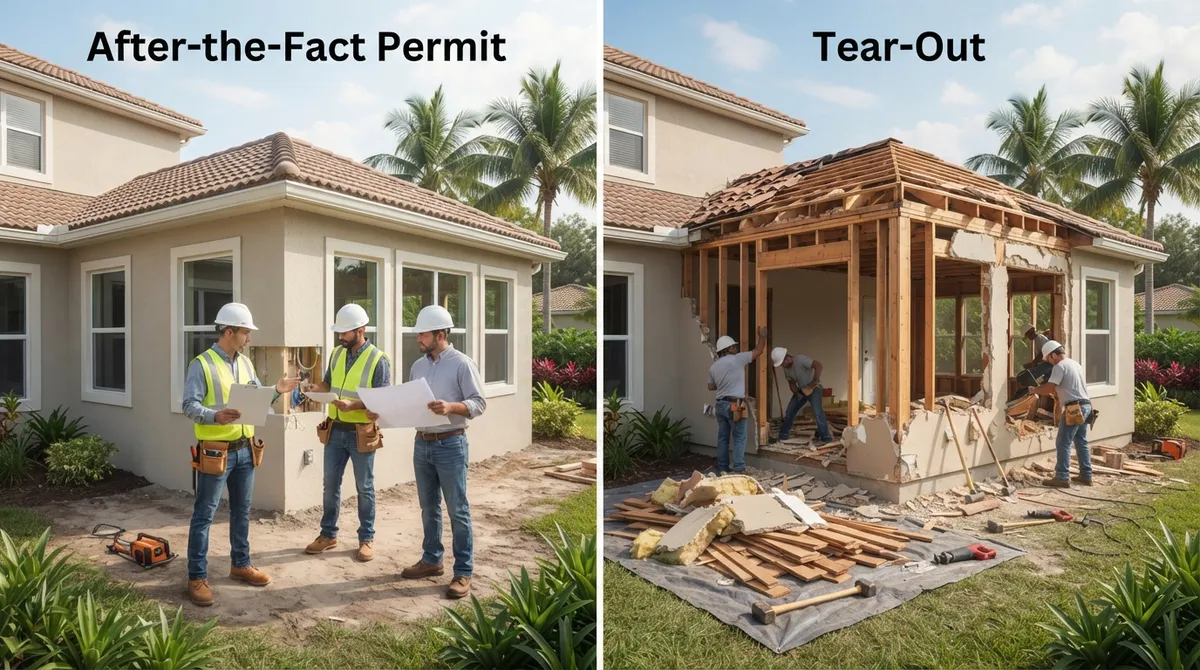
An addition built without a permit in Florida generally leaves you with two big choices: pursue an after-the-fact permit to legalize what's already there, or tear out some or all of the work. Each path has real costs, timelines, and risks, and the right answer depends on your jurisdiction, the quality of the construction, and what the inspector can verify.
In this friendly guide, we'll compare both options side by side, explain what Florida law says, walk through what building departments typically ask for, and help you decide your next move. Whether you're a homeowner, a buyer, a real estate agent, or a contractor cleaning up someone else's mess, you'll find clear, practical answers here.
What Florida Law Says About Building Additions
Under Florida Statutes §553.79, a permit is generally required from the appropriate enforcing agency before you construct, enlarge, alter, modify, repair, or demolish a building, unless a specific exemption applies. A room addition almost never qualifies for an exemption. It changes the footprint, structure, and often the electrical, plumbing, and mechanical systems.
The statute sets the general rule, but your local building department decides how it plays out on the ground. That means requirements, fees, and enforcement approaches differ between, say, Hillsborough County and Miami-Dade County. The statute does not set one statewide after-the-fact fee or penalty, so beware of anyone quoting a single universal number.
It also helps to know that a building permit is only one layer of approval. Zoning, setbacks, lot coverage, floodplain rules, easements, and HOA restrictions may apply separately. An addition can be structurally sound and still violate a setback.
Your Two Main Options at a Glance
Before we dig into the details, here's a quick comparison of the two paths homeowners typically weigh.
| Factor | After-the-Fact (Retroactive) Permit | Tear-Out / Removal |
|---|---|---|
| Goal | Legalize the existing addition | Remove some or all of the work |
| Typical outcome | Permit approved, inspections passed, possible CO or closeout | Structure removed or reduced to a compliant state |
| Documentation | As-built drawings, site survey, photos, engineering as needed | Demolition permit may still be required |
| Main risk | Inspector requires corrections or exposure of concealed work | Losing the added living space and the money invested |
| Cost drivers | Permit and review fees, local surcharge, drawings, corrections | Demolition, debris removal, restoring the original structure |
| Best for | Work that is code-compliant or correctable | Work that violates zoning or cannot be made safe |
Notice that tear-out is not automatically the "clean" option. Demolition itself can require a demolition permit, and you lose the square footage you paid for. That's why most owners start by exploring whether legalization is realistic.
Option One: The After-the-Fact Permit
An after-the-fact permit, sometimes called a retroactive or as-built permit, is how many Florida owners bring an existing addition into compliance. You apply to the authority with jurisdiction and demonstrate that the work meets applicable code. Approval is not automatic, but it is often achievable.
If you want a deeper dive, our guide on how to get an after-the-fact permit in Florida walks through the process in detail. You can also explore our after-the-fact and expired permit services to see how we handle these files.
What Building Departments Usually Ask For
Exact submittals vary by jurisdiction and project, but for an existing addition you can expect requests like these:
- As-built drawings showing the floor plan, elevations, and structural details of what actually exists
- A site plan or survey showing setbacks, lot coverage, and property lines
- Photographs documenting framing, foundation, roofing, and finishes
- Structural information, sometimes an engineer's letter or sealed drawings
- Electrical, plumbing, and mechanical details for any systems added or altered
- Contractor or owner-builder information depending on who performed the work
This is where in-house drafting and engineering pays off. Our team prepares as-built drawings and coordinates structural engineering and engineer letters under one roof, so plan reviewer comments get answered quickly instead of bouncing between outside consultants.
Will Inspectors Make You Open Walls?
This is the question that keeps homeowners up at night, and the honest answer is: sometimes. Inspectors may require concealed work to be exposed so they can verify construction. If framing, insulation, wiring, or plumbing is hidden behind finished drywall, the department may ask for selective openings.
If the addition does not meet code, or the work cannot be verified, you may need to make corrections, open walls or ceilings, or in some cases remove portions of the work before approval. Engineering documentation, photos taken during construction, and field verification by a licensed professional can sometimes reduce how much has to be opened.
What Does an After-the-Fact Permit Cost?
Here's where we have to be careful and honest: there is no single statewide price. An after-the-fact application may involve ordinary permit and review fees, plus a local surcharge in some jurisdictions. Separate code-enforcement penalties may also apply. Fees depend on the size of the addition, the valuation of the work, and the local fee schedule.
Our breakdown on after-the-fact permit costs in Florida explains the typical cost categories. And if you're specifically curious about additions, see what it costs to legalize a Florida addition.
Option Two: Tear-Out or Partial Removal
Sometimes legalization simply isn't possible. Maybe the addition encroaches into a required setback, exceeds lot coverage limits, sits in an easement, or was built so poorly that making it code-compliant would cost more than rebuilding. In those cases, removal of some or all of the work may be the only route.
When Removal Makes Sense
- Zoning violations that a building permit cannot cure, such as a setback encroachment with no variance available
- Structural deficiencies that cannot be verified or corrected at reasonable cost
- Floodplain or substantial-improvement conflicts that trigger stricter requirements
- HOA or easement conflicts that block approval no matter what the county says
Keep in mind that a partial tear-out can sometimes pair with an after-the-fact permit. For example, you might remove a non-compliant portion and legalize the rest. We cover related scenarios in will you really have to demolish unpermitted work.
Side-by-Side: Which Path Fits Your Situation?
Use this table as a gut-check. It's not a substitute for a jurisdiction-specific review, but it helps frame the conversation.
| Your Situation | Likely Better Path | Why |
|---|---|---|
| Work looks solid, setbacks are fine | After-the-fact permit | Documentation and inspections may be enough |
| Concealed work, unknown framing quality | After-the-fact permit with engineering and field verification | Engineer letters can help verify what you can't see |
| Addition violates setbacks or lot coverage | Partial or full removal, or explore variance | A permit cannot fix a zoning problem |
| Closing is scheduled and a lender flagged the work | After-the-fact permit on an urgent timeline | Speed and coordination matter |
| Structure is unsafe and uncorrectable | Removal | Safety first, and cost to correct may exceed rebuild |
Step-by-Step: How to Legalize an Unpermitted Addition
If legalization looks like the right fit, here is the general sequence we follow for owners across Florida:
- Identify the authority having jurisdiction. Near city lines this isn't always obvious. Our building department lookup tool can help you start.
- Check permit and violation records. Run an open permit search to see whether any prior permits, expired permits, or open violations exist.
- Gather evidence of what was built. Photos, receipts, contractor information, and any original plans help.
- Prepare as-built drawings and engineering. A licensed design professional documents the existing addition and addresses structural and systems questions.
- Submit the application. Include drawings, survey, and any required forms and fees.
- Respond to plan review comments. Reviewers often ask for clarifications or revisions.
- Schedule inspections and make corrections. Expose concealed work if required and fix any deficiencies.
- Close out the permit. Final approval and, where applicable, a certificate of completion or occupancy.
Remember that the local agency, not any service provider, decides whether to approve the work. A good permitting partner organizes the paperwork and advocates efficiently, but cannot promise an outcome.
Why Unpermitted Additions Matter for Buyers, Sellers, and Agents
For real estate professionals, an unpermitted addition can derail a deal fast. Appraisers, home inspectors, lenders, and insurers may all flag it. Sellers have disclosure considerations, and buyers may inherit the problem along with the house.
If you're facing a closing with a permit problem, our realtor and closing support and urgent permit rescue services are built for exactly that pressure. For more context, read about whether a home sale can close with unpermitted work in Florida.
Tips for Contractors and Design Professionals
General contractors, architects, and designers sometimes inherit unpermitted additions mid-project, especially during renovations. A few friendly pointers:
- Verify permit history before you quote. Discovering unpermitted work after demolition begins is expensive.
- Document existing conditions early with photos and measurements before you cover anything.
- Loop in engineering early when load paths or foundations are unclear.
- Confirm licensing and registration for the municipality involved. Our contractor registration checklist can help.
If you need outsourced drafting, engineering, or permit administration, our general contractor services keep your crews moving while we handle the paperwork.
Avoiding the Next Surprise
Once your addition is legalized, you'll want to avoid repeating the cycle. The simplest habits are the most powerful:
- Never start work until the permit is issued and posted
- Confirm who is pulling the permit, and get proof in writing
- Keep your approved plans, inspection records, and final sign-offs in one folder
- Call before you build, because a quick consultation costs far less than a retroactive cleanup
If a contractor told you they'd pull the permit and didn't, that situation is more common than you'd think. See our article on what happens when someone says they'll pull the permit for next steps.
Let's Get Your Addition Sorted
An addition built without a permit in Florida is a solvable problem more often than not. The key is understanding whether your situation points toward legalization, partial correction, or removal, and then acting before a sale, an insurance claim, or a code-enforcement notice forces your hand.
At 1 Contractor Solutions, we act as Florida's outsourced permitting department. We identify the right jurisdiction, prepare as-built drawings with our in-house engineering team, file the application, work every reviewer comment, and carry your project through to closeout across all 67 counties. If you'd like to see what our customers say, visit us on Google — 1 Contractor Solutions, and you can also follow us on LinkedIn or follow us on Facebook.
For official statutory language, you can read Florida Statutes §553.79 directly on the Florida Senate website.
Ready to find out where you stand? Get a free quote and tell us your address and your problem. We respond within 30 minutes, day or night, and we'll help you map out the fastest, cleanest path forward.
FAQs
Can I get an after-the-fact permit for an addition built without a permit in Florida?
Often, yes, but approval is never automatic. You apply to the local authority with jurisdiction and show the addition meets applicable code, usually with as-built drawings, a survey, photos, and engineering where needed. The building department makes the final call.
Will Florida inspectors make me open walls to inspect an unpermitted addition?
They might. Inspectors can require concealed work to be exposed so they can verify the construction. Photos, engineering letters, and field verification can sometimes limit how much needs to be opened, but it depends on your jurisdiction and the project.
How much does an after-the-fact permit cost in Florida?
There is no single statewide number. Costs typically include normal permit and review fees, possibly a local surcharge, plus drawings and any corrections. Separate code-enforcement penalties may also apply, so check with your local building department.
Can an unpermitted addition be grandfathered in?
Generally, no. Unpermitted work isn't automatically grandfathered just because it has been there a long time. The building department will typically review it against current requirements, so it's smart to have it evaluated before you sell or refinance.
Can I sell a Florida home that has an unpermitted addition?
It's possible, but it can complicate things. Appraisers, lenders, insurers, and buyers may flag the work, and sellers have disclosure considerations. Many owners legalize the addition first, or work with a permitting team to clear the issue before closing.
We do this work every day across all 67 Florida counties. Call (866) 314-6931 and we will tell you what your situation actually requires — including when you do not need us.
Related services
Permit Facilitation & Filing
You have a crew scheduled, a client asking for dates, and a permit sitting somewhere in a queue you cannot see. We file it, w…
See the servicePlan Review Coordination
A permit in plan review is not one queue. On a commercial project it can be six queues, each with its own reviewer, its own c…
See the serviceReady to get your permit moving?
One call tells you which jurisdiction controls your project, what it will take, and what it will cost. Most of the time we can scope it on the phone.