
Blog
How to File a Solar Permit in Broward County, Step by Step
Learn how solar permit filing in Broward County works, from jurisdiction and plans to sealed drawings, NOC, fees, and inspections.
Key Takeaways
-
Solar permits in Broward County are reviewed by the building department of the specific city or jurisdiction where the property sits, not a single countywide office, so confirm the jurisdiction first.
-
Most solar permit kickbacks come from plans that don't match equipment specs, outdated forms, or missing structural details on uplift, connections, and added dead load.
-
Structural documentation must address wind loads and roof attachment, since Broward is a high-wind region; older or modified roof framing may need an engineer letter.
-
Verify whether your city requires plans signed and sealed by a Florida-licensed PE or FSEC certification, as this depends on the system and local rules.
-
A Notice of Commencement is generally required for construction over $5,000 under Florida law and must be recorded, so many solar jobs need one from the start.
-
Fees and review times are city-specific and can change, so always verify them with the municipality handling your property rather than assuming a countywide figure.
So you've signed the solar contract, the panels are on order, and the crew is circling a date on the calendar. Then comes the part nobody gets excited about: the permit. If you've ever stared at a municipal portal wondering which checklist applies to you, you're in good company.
Here's the good news. Solar permit filing in Broward County is very doable once you understand how the process is built. It's local, it's jurisdiction-specific, and it rewards people who show up with a complete package. Whether you're a solar company filing dozens of jobs a month, a general contractor adding PV to a build, or a homeowner trying to understand what your installer is doing, this guide walks you through each step in plain English.
We'll cover how to find the right building department, what documents reviewers expect, how sealed plans fit in, what the Notice of Commencement is all about, and how to avoid the correction notices that stall projects. Grab a coffee, and let's get your system one step closer to producing power.
Why Solar Permit Filing in Broward County Is Local
One of the first surprises for newcomers is that there is no single countywide counter where every solar application lands. In Broward County, the building department for the city or jurisdiction where the property sits reviews the application. A home in Miramar and a home in Pompano Beach can follow different portals, forms, fees, and timelines.
That doesn't mean the rules are random. Broward County's Board of Rules and Appeals publishes a uniform permit matrix (Policy 09-02) and solar guidance that municipalities lean on. Think of the county guidance as the shared playbook and each city as the coach who adds a few house rules.
What reviewers actually look at
A rooftop photovoltaic (PV) installation generally triggers two lanes of review:
- Electrical review: the PV components, wiring, disconnects, grounding, and point of interconnection.
- Building and structural review: the panels, racking, roof attachments, added weight, and wind resistance.
- Other reviews as needed: plumbing for solar thermal systems, plus possible zoning, fire, or HOA-awareness items depending on the site.
Knowing which lanes apply to your project up front keeps you from filing half a package and waiting on a rejection.
How to File a Solar Permit in Broward County: 8 Steps
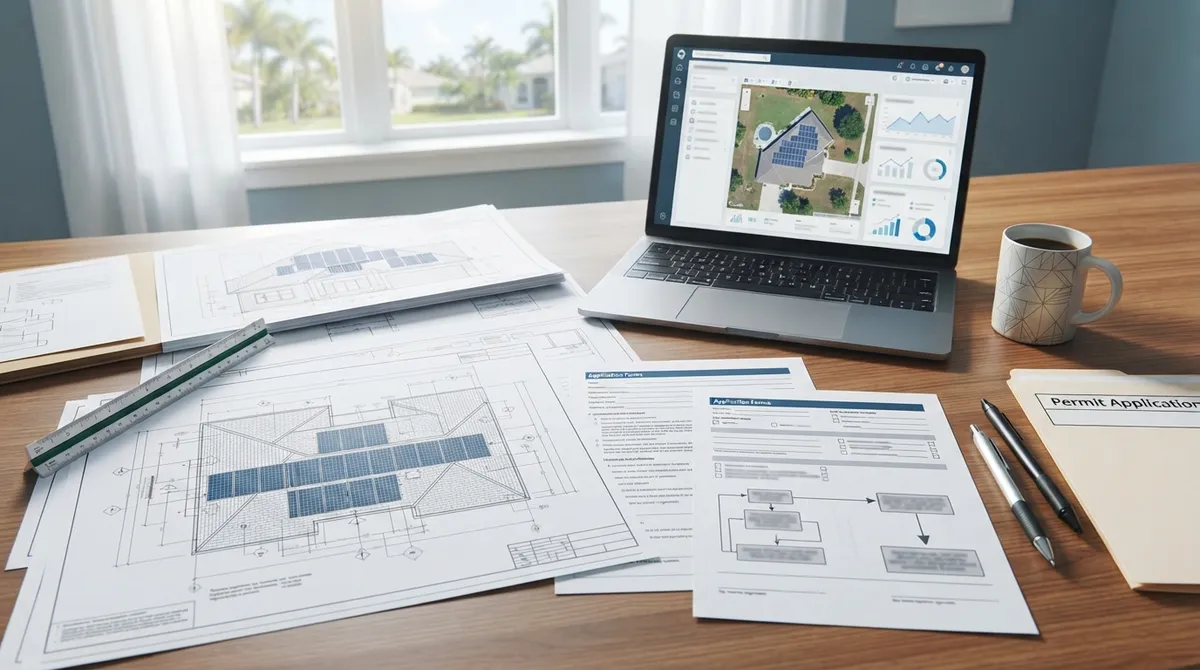
Every city has its quirks, but the overall flow is consistent. Here's the process in the order that tends to save the most time.
- Confirm the permitting jurisdiction. Don't assume the mailing address tells you who reviews the permit. Near city lines, unincorporated pockets, or special districts, the real authority can surprise you. Our building department lookup tool is a handy starting point.
- Download the current local checklist. Pull the solar checklist or application package directly from that jurisdiction's website. Forms get updated, so use today's version rather than one saved from last year's job.
- Gather site and owner information. You'll need the property address, folio or parcel details, owner information, and contractor license details.
- Prepare electrical plans. Include a system schematic, component specs, conductor and conduit sizing, disconnects, overcurrent protection, grounding, and rapid-shutdown information.
- Prepare structural documentation. Show that the array, racking, and roof attachments meet wind and roof requirements.
- Get plans signed, sealed, or certified as required. We'll unpack this below.
- Submit and pay fees. Use the portal or counter process your city requires and keep your confirmation.
- Track review, answer comments, and schedule inspections. Reviewer comments are normal. A fast, accurate response is what keeps the clock moving.
The Documents Reviewers Expect
The most common reason a solar permit stalls is a missing or mismatched document. Here's a quick reference for what a complete Broward package typically includes. Always confirm against your city's current checklist.
| Document | What It Shows | Why It Matters |
|---|---|---|
| Permit application | Owner, contractor, scope, valuation | Starts the file and sets fees |
| Electrical plans / one-line diagram | PV components, conductors, disconnects, interconnection | Electrical reviewer's main reference |
| Equipment specifications | Panels, inverters, racking data sheets | Confirms listed, compatible equipment |
| Structural documentation | Wind loads, uplift, connections, added dead load, flashing | Proves the roof can carry the system |
| Signed and sealed plans or certification | Professional engineer seal or FSEC certification where applicable | Required by many jurisdictions for PV |
| Contractor information | License, insurance, registration | Verifies authority to pull the permit |
| Notice of Commencement | Recorded notice for qualifying work | Often needed before first inspection |
Some jurisdictions add survey, zoning, fire, or special-inspector items depending on the site and scope. City examples like Miramar's solar application package and Davie's checklist show how much the details can vary.
Electrical Plans: Getting the Details Right
Electrical reviewers want to follow the power from the panels all the way to the point of interconnection. If they can trace that path without guessing, you're in great shape.
Items to include on your electrical sheet
- Number, model, and rating of modules and inverters or microinverters
- Conductor types and sizes, plus conduit types and sizes
- Locations and ratings of all disconnects
- Overcurrent protection and grounding details
- Rapid-shutdown information
- The point of interconnection and any service or panel upgrades
A clean, consistent drawing prevents the classic comment that reads, "Plans do not match equipment specifications." Make sure model numbers on the schematic, the data sheets, and the application all agree.
Structural Documentation and Wind Requirements
Broward sits in a high-wind region, so structural review isn't a formality. County solar guidance calls for documentation that addresses wind loads, uplift and lateral forces, connections, added dead load, and roof-penetration flashing, as applicable.
In practice, that means reviewers want to see how the array attaches to the roof, what the attachment spacing is, and how the existing structure handles the extra weight. Broward guidance references the Florida Building Code 8th Edition (2023), so confirm the code edition and any amendments in force on your submittal date.
If the roof framing is unknown, old, or modified, a structural letter or deeper analysis may be the difference between approval and a correction notice. Our structural engineering and engineer letters services are built for exactly these situations.
Do Broward Solar Plans Need to Be Signed and Sealed?
This is one of the most common questions, and the honest answer is: it depends on the system and the local review rules. Broward guidance describes plans signed and sealed by a Florida-licensed professional engineer, or certified by the Florida Solar Energy Center (FSEC) for applicable PV systems.
Rather than guess, verify the current checklist for your specific project. Here's a simple way to think about it.
| Scenario | Typical Documentation Path | Best Move |
|---|---|---|
| Standard residential PV on a known roof | Electrical plans plus structural documentation; seal or FSEC certification per local rules | Confirm the city checklist before drafting |
| Older or modified roof framing | Added structural analysis or engineer letter | Involve an engineer early |
| Commercial or larger-scale PV | Sealed electrical and structural plans | Plan for full engineering package |
| Solar thermal or mixed scope | Electrical, building, and possibly plumbing review | Check which trades review your scope |
Notice of Commencement: Don't Skip It
A Notice of Commencement (NOC) is generally required for construction valued over $5,000 under Florida law, and it must be recorded. Local checklists spell out when it must be provided, which is often before the first inspection. Because thresholds and instructions can change, confirm the current statutory language and your city's filing steps.
Many solar jobs cross that $5,000 line easily, so build the NOC into your timeline from day one. For a deeper walkthrough, see our guide on the Notice of Commencement in Florida.
Timelines and Fees: What to Expect (and What Not to Assume)
Everyone wants a number here, and numbers do exist, but they're city-specific. A few real examples help set expectations without overpromising:
- Pompano Beach's solar checklist states that standalone solar systems are reviewed within 3 business days through its Quick Service program. That's a city-specific target, not a countywide guarantee.
- A Broward County interlocal agreement describes a $552 rooftop-PV permit payment ($500 basic fee plus $52 in surcharges) for the Go SOLAR process. That figure is agreement-specific and may be outdated or inapplicable to your city.
The takeaway: always verify current fees and review times with the municipality handling your property. For more context on statewide patterns, our article on Florida solar permit timelines is worth a look.
Common Reasons Solar Permits Get Kicked Back
After handling thousands of Florida permits, we see the same handful of issues again and again. The good news is that every one of them is preventable.
- Plans that don't match the equipment specifications
- Missing or outdated forms from the wrong checklist version
- Structural documentation that skips uplift, connections, or added dead load
- Incomplete rapid-shutdown or grounding information
- Missing contractor registration or license details
- No Notice of Commencement when one is required
If you do get a correction notice, don't panic. It's a conversation, not a verdict. Respond point by point, resubmit cleanly, and keep notes. Our revisions and resubmittals support exists for precisely this moment.
Inspections After Your Permit Is Issued
Once the permit is in hand, the work begins and inspections follow. Specific inspection sequences vary by city, but you can generally expect electrical and building inspections tied to the installation, with a final inspection before the system is approved to operate. Keep the permit card accessible on site, have the approved plans available, and make sure the installed system matches what was approved.
If the field conditions change, such as a different inverter location or a changed array layout, talk to the building department before the inspector arrives. A quick revision beats a failed inspection every time. Our inspections page explains how we support this stage.
When It Makes Sense to Get Help
You can absolutely file on your own, but there are moments when professional help pays for itself in saved weeks. Different readers feel this in different ways:
- Solar companies filing at volume benefit from standardized, code-compliant packages and a team that tracks every file. See our page for solar contractors.
- General contractors adding PV to larger scopes want one team coordinating permits, plans, and engineering. Explore services for general contractors.
- Homeowners who want to understand what's happening, or who are working through an owner-builder path, can start with our homeowner resources.
- Realtors and buyers dealing with an existing system that was never permitted can look into after-the-fact and expired permits.
A permitting service helps identify the correct jurisdiction, assemble and quality-check applications and plans, coordinate structural and electrical review, respond to correction notices, and track inspections. What it doesn't do is replace your licensed contractor, your engineer, or the authority having jurisdiction. Think of it as the outsourced permitting department that keeps everyone's work flowing.
At 1 Contractor Solutions, our in-house drafting and engineering team, with our own engineer sealing the work, means reviewer comments get fixed fast rather than bouncing between outside consultants. We also work across all 67 Florida counties, so we know how the details shift from one jurisdiction to the next. You can follow us on LinkedIn or follow us on Facebook for Florida permitting updates, and you can read what customers say when you visit us on Google — 1 Contractor Solutions.
A Quick Pre-Submission Checklist
Before you hit submit on any Broward solar permit, run through this short list:
- Jurisdiction confirmed and current checklist downloaded
- Electrical plans consistent with equipment data sheets
- Structural documentation covers wind, uplift, connections, and flashing
- Seal or FSEC certification confirmed against local requirements
- Contractor license and registration details complete
- Notice of Commencement plan in place for jobs over $5,000
- Fees verified with the city, not assumed
For a county-level overview of how we support filings here, visit our Broward County page, and for city-specific help, see Fort Lauderdale.
Wrapping Up: Your Next Move
Solar permit filing in Broward County comes down to three things: finding the right jurisdiction, submitting a complete and consistent package, and responding quickly when reviewers have questions. Get those right, and the permit becomes a checkpoint instead of a roadblock.
If you'd rather hand the paperwork to a team that lives in this world every day, we'd love to help. Get a free quote and tell us your address and your timeline, and we'll tell you which jurisdiction controls it and what it will take to get it approved. We respond within 30 minutes, day or night, and se habla español.
FAQs
Do I need a permit to install solar panels in Broward County, Florida?
Yes, rooftop solar installations generally need permits, including electrical and building or structural review. The exact process is handled by the city or jurisdiction where your property sits, so confirm the right department before you file. We're happy to help you sort that out!
Which building department should receive my Broward County solar permit application?
It's the building department for the city or jurisdiction where the property is located, and requirements, portals, and fees can differ from one municipality to the next. Near city lines the answer isn't always obvious, so verify it first. A jurisdiction lookup can save you a lot of back-and-forth.
Do Broward County solar plans need to be signed and sealed by a Florida engineer?
Broward guidance describes plans signed and sealed by a Florida-licensed professional engineer, or certified by the Florida Solar Energy Center (FSEC) for applicable PV systems. Requirements depend on the system and local review rules, so check your city's current checklist before drafting.
Is a Notice of Commencement required for a solar installation in Broward County?
A Notice of Commencement is generally required for construction valued over $5,000 under Florida law, and it must be recorded. Many solar jobs cross that threshold, so plan for it early and confirm your city's timing, which is often before the first inspection.
How long does solar permit approval take in Broward County?
It varies by city. For example, Pompano Beach states a 3-business-day review target for standalone solar through its Quick Service program, but that's not a countywide guarantee. Complete, accurate submittals tend to move fastest everywhere.
We do this work every day across all 67 Florida counties. Call (866) 314-6931 and we will tell you what your situation actually requires — including when you do not need us.
Related services
Permit Facilitation & Filing
You have a crew scheduled, a client asking for dates, and a permit sitting somewhere in a queue you cannot see. We file it, w…
See the servicePlan Review Coordination
A permit in plan review is not one queue. On a commercial project it can be six queues, each with its own reviewer, its own c…
See the serviceReady to get your permit moving?
One call tells you which jurisdiction controls your project, what it will take, and what it will cost. Most of the time we can scope it on the phone.