
Blog
8 Mistakes to Avoid After a Florida Stop Work Order
Hit with a stop-work order in Florida? Learn 8 costly mistakes to avoid and the smarter steps to legalize unpermitted construction and get moving again.
Key Takeaways
-
Stop all work immediately when a stop-work order is posted; continuing to build risks citations, fines, liens, and damage to your credibility with reviewers who control resolution.
-
Confirm which specific city or county jurisdiction issued the order before calling anyone, as Florida's permitting is administered locally with varying procedures and penalties that differ significantly between jurisdictions.
-
An after-the-fact permit is not automatic approval; it requires proving compliance through plans, inspections, exposed concealed work, and engineering analysis—not a rubber stamp for what was already built.
-
Each Florida jurisdiction sets its own fees and penalties with no statewide standard; St. Lucie County and Miami Beach charge double permit fees, so always confirm current costs directly with your building department.
-
Prepare comprehensive documentation including as-built drawings, structural calculations, and sealed engineer letters before submission, as reviewers cannot approve unpermitted work without evidence it meets code.
-
Be ready to expose concealed work for inspection when required; cooperating early to open walls and verify framing, electrical, and plumbing is far cheaper than fighting requirements later or removing non-compliant work.
Getting a red or orange notice taped to your door or job site fence is a gut punch. One minute your crew is framing, your solar install is humming along, or your closing is on track. The next, a building official is telling you to stop. If you are dealing with a stop work for unpermitted construction in Florida, take a breath. You are not the first person to land here, and it is very fixable when you handle it the right way.
The tricky part is that the mistakes people make in the first few days often cost more than the violation itself. A rushed phone call, a quiet "just finish it" decision, or a permit application filed with the wrong jurisdiction can turn a manageable problem into weeks of delay and extra fees.
Here at 1 Contractor Solutions, we spend our days helping general contractors, solar companies, realtors, and homeowners untangle exactly this situation. In this guide, we walk through eight common mistakes and the friendlier, smarter path for each one. Let's get you moving again.
What a Florida Stop Work Order Actually Means
A stop-work order is a written directive that explains why work must stop and what conditions must be met before work can resume. Florida Statutes §553.791 defines the term in the context of private providers, and local building officials also hold stop-work authority under applicable law.
The foundation is Florida Building Code §105.1, which generally requires a permit before regulated construction, alteration, repair, demolition, occupancy changes, or work on regulated electrical, gas, mechanical, or plumbing systems. Exemptions exist, but they are limited and depend on both the work and your local rules.
Permitting in Florida is administered locally. That means your city or county, not a single statewide office, decides how your order gets resolved. Penalties, fees, and procedures vary from place to place.
| Item | What It Means for You |
|---|---|
| Stop-work order | Written directive to halt work and meet stated conditions |
| Issuing authority | Usually the city or county building department with jurisdiction |
| Legal basis | Florida Building Code §105.1 and local ordinances |
| Resolution path | After-the-fact permit, documentation, inspections, corrections |
| Penalties | Vary by jurisdiction; no single statewide amount |
Mistake 1: Ignoring the Order and Working Anyway
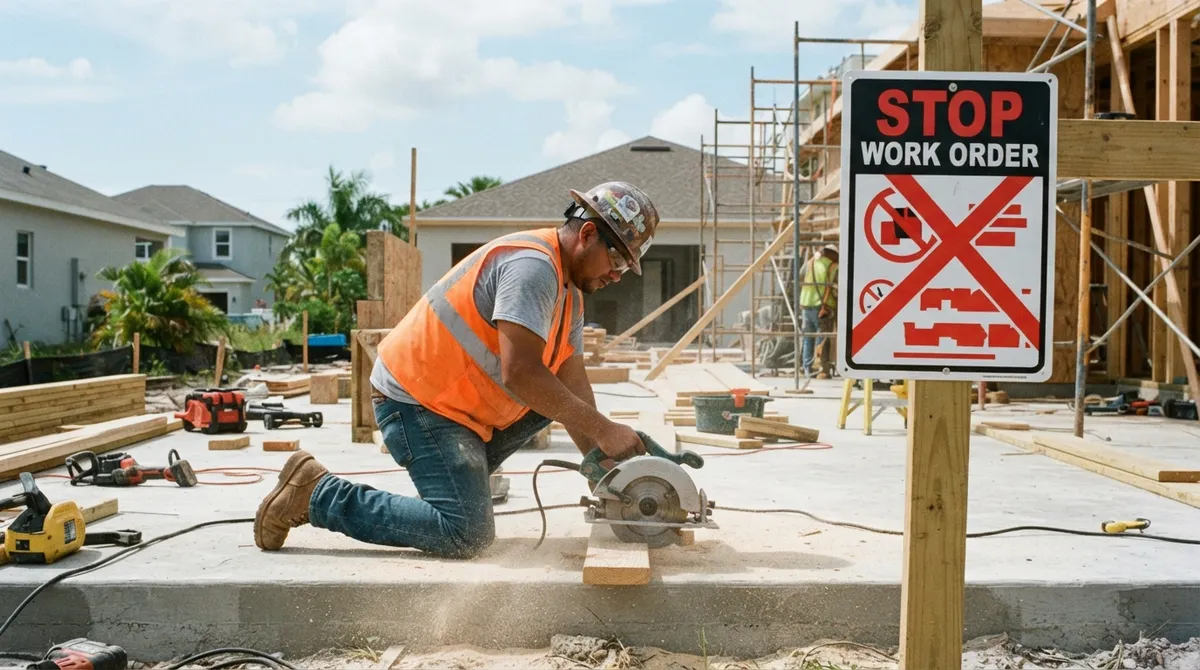
This is the big one. It is tempting to think, "We are almost done, so let's just finish." Please don't. A stop-work order should be followed until the issuing authority confirms in writing that the conditions for resuming work are met.
Continuing to build can lead to notices of violation, citations, fines, liens, or orders to correct or remove work, depending on local rules. It also damages your credibility with the very reviewers you need on your side.
Instead, do this right away:
- Stop all work at the site, including "small" finishing tasks
- Photograph the posted notice and the current state of the work
- Secure the site so weather and safety hazards do not worsen
- Keep a copy of every document the inspector hands you
Stopping promptly shows good faith, and good faith goes a long way when you sit down with a plans examiner.
Mistake 2: Calling the Wrong Office
Florida has 67 counties and hundreds of municipalities, and the line between them is not always obvious. A property that mailing-addresses as one city may actually sit inside unincorporated county jurisdiction, or the reverse. Phoning the wrong building department wastes days.
Before you call anyone, confirm which authority actually issued the order and which one controls your parcel. Our building department lookup tool is a handy first step, and you can check for existing records with the open permit search.
If you are in a larger market, local knowledge matters. Our teams regularly work in places like Hillsborough County, Miami-Dade County, and Orange County, where procedures differ noticeably from one another.
Mistake 3: Assuming an After-the-Fact Permit Is Automatic Approval
Here is a common misunderstanding. Applying for a permit after work has started does not legalize the work. An after-the-fact permit is not a guarantee that what you built can stay.
The authority may require plans, supporting documentation, inspections, exposure of concealed work, corrections, or even removal of work that cannot be shown to comply. St. Lucie County's building FAQ, for example, notes that concealed work may require a third-party engineering analysis.
Think of an after-the-fact permit as a chance to prove compliance, not a rubber stamp. The better your documentation, the smoother the review. If you want a deeper walkthrough, read our guide on how to get an after-the-fact permit in Florida.
Mistake 4: Underestimating Fees and Penalties
Nobody enjoys talking about money, but surprises are worse. There is no single statewide fee or penalty for unpermitted construction. Each jurisdiction sets its own rules, and the differences can be significant.
| Jurisdiction Example | Reported Local Policy |
|---|---|
| St. Lucie County | After-the-fact permits may carry double permit fees (page updated June 18, 2026) |
| City of Miami Beach | $500 plus double the permit fee for work started before obtaining a required permit |
| Other jurisdictions | Vary; confirm directly with the building department |
These are local examples, not statewide rates, so please do not assume your city follows the same pattern. Always confirm current numbers with the department that issued your order. For a closer look at the dollars involved, see our breakdown of the after-the-fact permit cost in Florida and the penalty for building without a permit in Florida.
Mistake 5: Relying on the Exemption Loophole
Some owners hear that small jobs do not need permits and assume they are covered. Exemptions do exist, but they are narrow. Hillsborough County's work-exempt guidance, for instance, describes a limited exemption for certain nonstructural work on a single-family residence valued under $7,500, subject to conditions and an exemption application.
That same guidance excludes electrical, plumbing, structural, mechanical, or gas work, along with properties in flood hazard areas. In other words, plenty of everyday projects fall outside the exemption.
Before you rely on any exemption, verify the current local rules and, when in doubt, ask for written confirmation. If you are unsure whether your project even needed a permit, a quick conversation with a permitting professional can save you a lot of heartache.
Mistake 6: Skipping Engineering and Documentation
When work is already in place, reviewers cannot simply take your word that it meets code. They want evidence. That often means as-built drawings, structural calculations, and sometimes a sealed engineer letter confirming the work is sound.
The documents commonly requested include:
- As-built or existing-condition drawings of what was actually constructed
- Site plans showing setbacks and property lines
- Structural details, such as truss, connection, or load-path information
- Electrical, plumbing, and mechanical documentation for MEP work
- Sealed engineer letters where verification of concealed work is needed
Our in-house drafting and engineering team prepares these packages, which keeps things moving when a reviewer flags a comment. Explore our as-built drawings and engineer letters services to see how that works.
Mistake 7: Letting Concealed Work Stay Hidden
Walls get closed, ceilings get hung, and suddenly the inspector cannot see the framing, wiring, or plumbing. If concealed work cannot be verified, the building official can require you to open walls or expose the work for inspection. In some cases, work that cannot be shown to comply may need to be corrected or removed.
It feels like a headache, but cooperating early is far cheaper than arguing later. Plan ahead for inspections and be ready to expose what is needed.
Here is a simple order of operations most owners follow:
- Stop work and secure the site
- Identify the jurisdiction and obtain a copy of the order
- Ask the department what documentation and inspections are required
- Prepare plans, as-builts, and any engineering letters
- Submit the after-the-fact application and pay applicable fees
- Schedule inspections and expose concealed work as directed
- Complete corrections and request written release of the order
For another angle on this process, check out 8 steps after a stop work order in Broward and our overview of how to legalize unpermitted work in Florida.
Mistake 8: Going It Alone Without a Guide
You can absolutely work through a stop-work order yourself, but the learning curve is steep and the clock is ticking. Missed comments, wrong forms, and unclear scopes of work stretch timelines and frustrate everyone involved.
A Florida permitting service can help identify the correct jurisdiction, determine permit scope, assemble applications and plans, coordinate licensed professionals where needed, respond to plan-review comments, and arrange inspections. To be clear, no service can guarantee approval or replace the authority having jurisdiction, but good support shortens the path considerably.
| Who You Are | What Usually Helps Most |
|---|---|
| General contractor | Fast jurisdiction research, plan revisions, resubmittal tracking |
| Solar company | Code-compliant electrical and structural documentation |
| Realtor or investor | Permit history research and closing-focused cleanup |
| Homeowner | Clear guidance, drawings, and inspection coordination |
| Architect or trade pro | Outsourced drafting, engineering, and permit administration |
If your situation is urgent, our urgent permit rescue service is built for stop-work orders, denials, and closings on the line. We also support general contractors, solar contractors, and homeowners every day.
How a Stop-Work Order Connects to Closings and Code Violations
Stop-work orders rarely live alone. They often travel with code compliance cases, open permits, and, for sellers, a looming closing date. An unresolved violation can follow a property and surface during an appraisal, inspection, or title search.
If you are selling, buying, or refinancing, resolving the order cleanly protects your timeline. Our code compliance violations and realtor closing support teams work on exactly these overlaps. And if you need a pulse check on how others feel about working with us, see what folks say on Google: Visit us on Google — 1 Contractor Solutions.
We would also love to stay connected, so feel free to follow us on LinkedIn or follow us on Facebook for Florida permitting updates.
For an authoritative reference on the statute itself, you can review Florida Statutes §553.791 directly on the Florida Senate website.
The Takeaway: Stop, Verify, Then Document
The pattern behind all eight mistakes is the same. People act before they understand who has authority, what the order requires, and what proof the reviewer needs. If you remember one thing, make it this: stop the work, confirm the jurisdiction, and ask what permit, documentation, inspections, and corrections are required.
A stop-work order is stressful, but it is also a clear starting line. With the right plan, you can move from a posted notice to a closed permit and a project that is back on schedule.
Ready to get unstuck? Reach out today to get a free quote, and let our team handle the filing, plans, engineering, and tracking while you get back to what you do best. Permits approved. Projects moving.
FAQs
What should I do if I receive a stop-work order for unpermitted construction in Florida?
Stop all work right away, photograph the notice and site, and keep copies of every document. Then confirm which city or county issued the order and ask that building department what permit, documentation, and inspections are needed to resume work.
Can I keep building while an after-the-fact permit is being reviewed?
No, work should remain stopped until the issuing authority confirms in writing that the conditions for resuming are met. Continuing early can trigger citations, fines, or orders to correct or remove work.
What penalties or fees apply for building without a permit in Florida?
There is no single statewide amount, because each jurisdiction sets its own rules. For example, St. Lucie County notes double permit fees may apply, and Miami Beach describes $500 plus double the permit fee, so always confirm current figures locally.
Can a Florida building department make me open walls or remove unpermitted work?
Yes, it can. Officials may require you to expose concealed work, supply engineering analysis, make corrections, or remove work that cannot be shown to comply with code.
How can a Florida permitting service help resolve a stop-work order?
A permitting service can identify the correct jurisdiction, define the permit scope, prepare plans and applications, respond to plan-review comments, and coordinate inspections. It cannot guarantee approval or replace the authority having jurisdiction, but it can make the process faster and far less stressful.
We do this work every day across all 67 Florida counties. Call (866) 314-6931 and we will tell you what your situation actually requires — including when you do not need us.
Related services
Permit Facilitation & Filing
You have a crew scheduled, a client asking for dates, and a permit sitting somewhere in a queue you cannot see. We file it, w…
See the servicePlan Review Coordination
A permit in plan review is not one queue. On a commercial project it can be six queues, each with its own reviewer, its own c…
See the serviceReady to get your permit moving?
One call tells you which jurisdiction controls your project, what it will take, and what it will cost. Most of the time we can scope it on the phone.