
Blog
Kitchen Remodel Without a Permit in Florida: What to Know
Wondering if your Florida kitchen remodel needs a permit? Learn what's exempt, what isn't, the risks of skipping one, and how to fix unpermitted work.
Key Takeaways
-
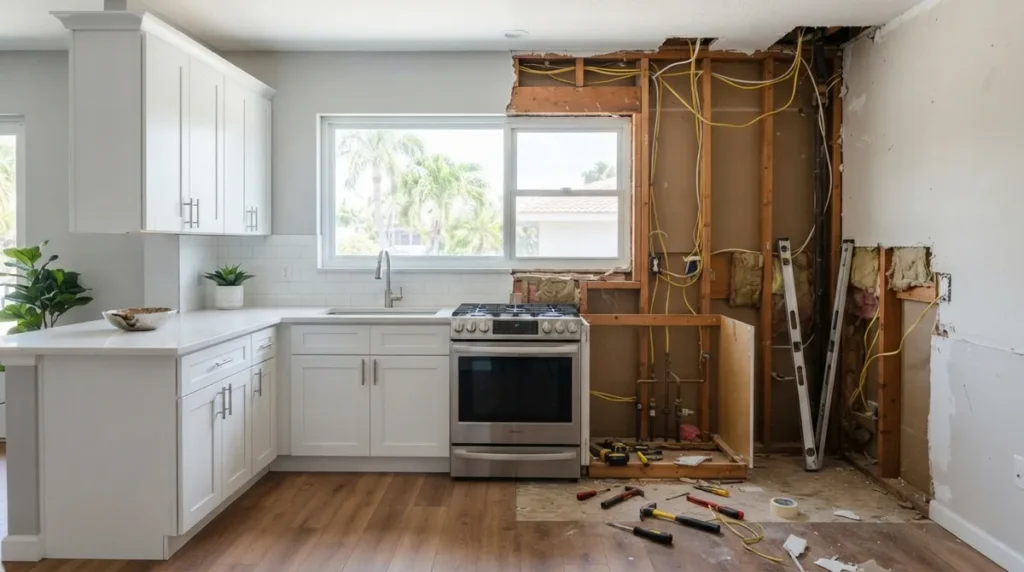
Kitchen work touching electrical, plumbing, gas, or structural systems requires a permit in Florida; cosmetic-only projects like painting, flooring, and cabinet replacement without system changes often don't.
-
Florida's $7,500 exemption rarely applies to kitchen remodels because it explicitly excludes electrical, plumbing, mechanical, and gas work—the systems most kitchens contain.
-
Unpermitted kitchen work can derail home sales, trigger insurance claim denials, fail appraisals, and invite code enforcement action; permits exist to catch safety hazards before they become dangerous.
-
Each Florida jurisdiction sets its own permit rules, so a project exempt in one county may require permits across a city line; always contact your local building department in writing before starting work.
-
If you've already completed unpermitted kitchen work, contact your building department about after-the-fact permitting; most jurisdictions have processes to legalize existing work with as-built drawings and inspections.
-
Moving a sink, stove, dishwasher, or outlet always requires a permit and inspections because it alters plumbing, gas, or electrical systems; only like-for-like replacements in the same spot may qualify as minor repairs.
Picture this: you've picked out the quartz, the cabinets are on order, and your contractor says, "Don't worry, we won't need a permit for this." It sounds like a time-saver. But a kitchen remodel without a permit in Florida can turn into a headache that shows up months or years later, usually right when you're trying to sell, refinance, or file an insurance claim.
Here's the good news. Some kitchen work really can be done without one. The trick is knowing which work falls into that bucket and which doesn't, because Florida leaves a lot of the details to your local building department.
In this guide, we'll walk through what Florida law actually says, which kitchen projects usually need permits, what the risks are if you skip one, and how to fix things if the work is already done. Whether you're a homeowner, a general contractor, or a real estate pro evaluating a property, you'll leave with a clear plan. Let's dig in!
What Florida Law Says About Permits for Remodels
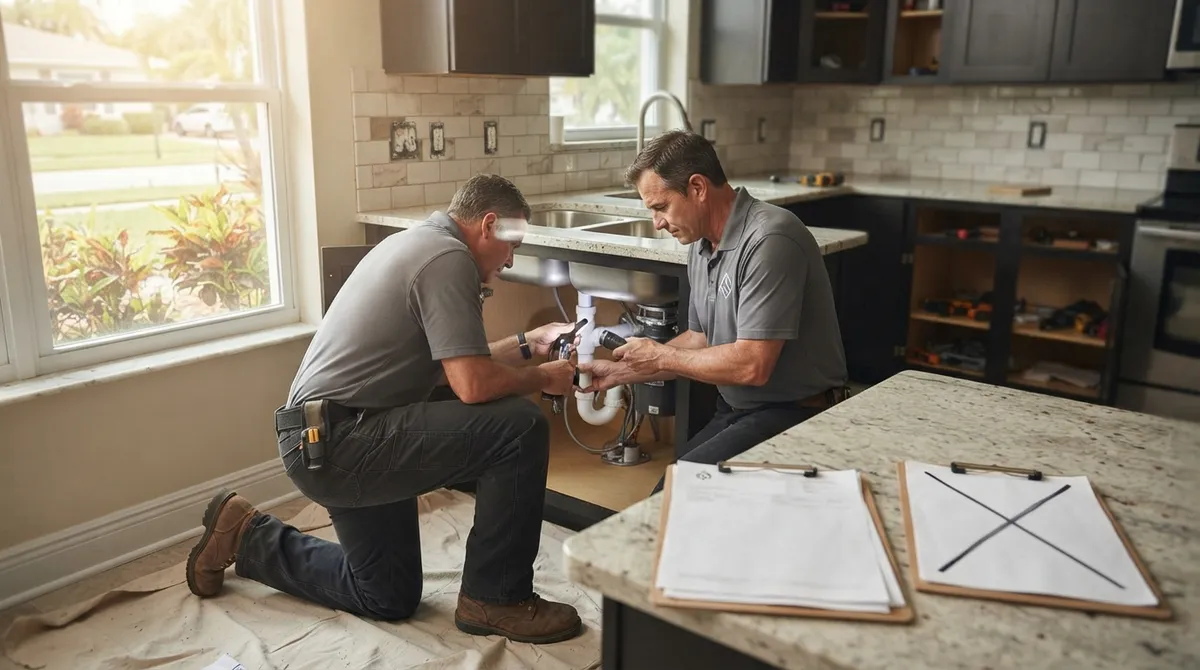
Florida Statutes §553.79 generally requires a permit before regulated construction, alteration, repair, or demolition begins. The permit isn't issued by the state, though. It's issued by the local enforcing agency, which means your city or county sets the application process and the specific rules.
That's why a friend in one county may tell you, "I never needed a permit for my kitchen," while your neighbor across a city line needed three. Both can be right.
If you're not sure who actually reviews your address, our building department lookup tool can point you in the right direction. We also explain the jurisdiction question in Which Florida Jurisdiction Reviews My Project.
Kitchen Work That Usually Does Not Need a Permit
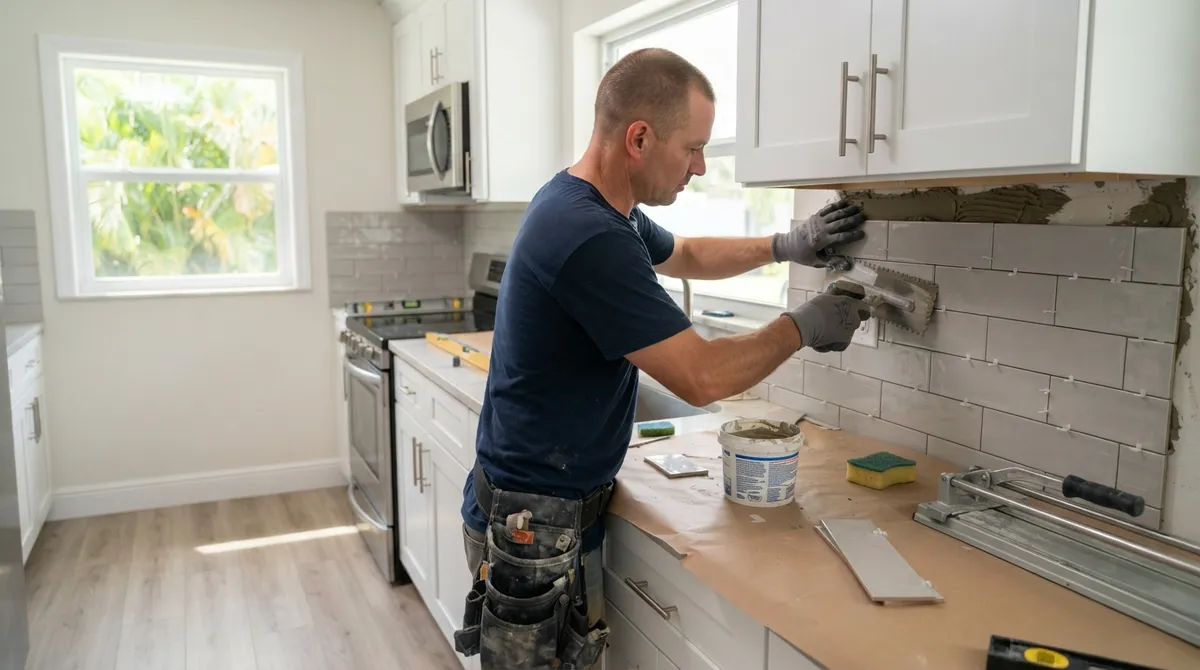
Cosmetic updates are the most common category that can skip the permit line. Local authorities across Florida often treat these as minor repairs, as long as nothing behind the walls changes:
- Painting walls and ceilings
- Installing new flooring over an existing subfloor
- Minor drywall patching
- Replacing cabinets or countertops without touching plumbing, gas, or electrical fixtures
- Swapping a faucet or dishwasher in the exact same location (in many jurisdictions)
For example, Rockledge treats cabinet and countertop replacement and certain like-for-like fixture replacements as minor repairs. But even there, new fixture locations, altered piping or wiring, and moved interior walls call for permits.
Notice the pattern? The moment a project touches a system, the answer flips.
Kitchen Work That Usually Does Need a Permit
A kitchen is one of the most system-packed rooms in your house. Electrical, plumbing, gas, and sometimes structural elements all meet in one place. That's why a full gut remodel almost always requires permits.
Fort Walton Beach, for instance, says alteration permits are required when all cabinets and plumbing, gas, or electrical fixtures are removed, or when drywall is removed or walls are added or removed.
| Kitchen Project | Permit Likely Needed? | Why |
|---|---|---|
| Painting, flooring, minor drywall repair | Usually no | Cosmetic, no system changes |
| Cabinet or countertop replacement only | Often no | Fixtures and systems untouched |
| Replacing a sink or dishwasher in place | Varies by jurisdiction | Like-for-like swaps are sometimes minor repairs |
| Moving a sink, range, or dishwasher | Yes | Alters plumbing, gas, or electrical |
| Adding circuits or relocating outlets | Yes | Electrical work |
| Removing or moving a wall | Yes | Structural and possibly MEP changes |
| Full gut remodel | Yes | Multiple systems affected |
| New range hood venting or gas line | Yes | Mechanical and gas work |
If you're taking out a wall to open the kitchen to the living room, you're also in structural territory. That often means sealed drawings. Our structural engineering team handles exactly that, with in-house sealed work.
What About the Under-$7,500 Exemption?
You may have heard that Florida lets you skip permits on small jobs. There's a kernel of truth here, but it's narrower than most people think.
Florida Statutes §553.79 provides a limited exemption for qualifying work valued under $7,500 on a single-family dwelling. Here's where it gets tricky:
- It excludes properties partly or wholly in a flood hazard area
- It excludes any electrical, plumbing, structural, mechanical, or gas work
- The owner or contractor must submit a written exemption request with documentation, such as a contract showing the nature and value of the work
- Projects cannot be split into smaller pieces to dodge the threshold
Hillsborough County publishes similar guidance, including an exemption application and supporting scope and value documentation. So the exemption isn't automatic. You have to ask for it.
Since most kitchen remodels involve at least some electrical or plumbing work, this exemption rarely fits a real kitchen project. It's more likely to apply to something like a purely cosmetic refresh. Always verify the current statute text and your local rules, because they can change.
Why Skipping the Permit Is Risky
Let's be real: a missing permit doesn't usually cause problems on day one. It causes problems later. Here's where it tends to bite:
- Home sales and closings. Buyers, lenders, and title companies increasingly flag unpermitted work. It can stall or sink a deal.
- Insurance claims. If a kitchen fire starts from unpermitted wiring, an insurer may push back. We cover that in Expired Permits and Insurance Claims Florida.
- Safety. Permits trigger inspections. Those inspections catch loose gas connections, undersized circuits, and improper venting before they become dangers.
- Code enforcement. A neighbor's complaint or a visible dumpster can lead to a notice of violation.
- Resale value and appraisals. Appraisers may exclude unpermitted square footage or upgrades.
We go deeper on consequences in Penalty for Building Without a Permit Florida. One note: the available state-level sources don't set out a single, uniform penalty schedule. Fines and fees depend on your local jurisdiction.
Who Is Responsible: Homeowner or Contractor?
Many homeowners assume the contractor will handle it. Many contractors assume the homeowner will. Then nobody does.
In Florida, licensed contractors are generally the ones who pull permits, and pulling permits under someone else's license is a serious issue. If you're curious who is allowed to do it, read Who Can Pull a Permit in Florida. And if you've ever heard "I'll pull the permit" and then watched weeks pass, you'll relate to Homeowner Said They Would Pull the Permit.
Homeowners who want to do the work themselves may qualify for an owner-builder permit. Our owner-builder permit service walks you through that path, including the responsibilities that come with it.
For contractors, getting permits right is also a matter of protecting your license and your reputation. Our general contractor support covers filing, tracking, and revisions so your crew isn't left waiting.
How to Check Your Kitchen Remodel Requirements
Before you start demolition, take a few minutes to confirm the rules. It beats guessing, and it's free.
- Write down your exact scope. List every change: cabinets, sink location, outlets, appliances, walls, venting, flooring.
- Identify your jurisdiction. Near city lines, it's not always obvious whether the city or county controls your address.
- Call or visit the building department. Ask whether your scope needs a building, electrical, plumbing, gas, or mechanical permit.
- Ask about plans and inspections. Find out whether drawings are required and which inspections you'll need.
- Get the answer in writing. An email or a posted guideline protects you if questions come up later.
A permit exemption is not a blanket green light. It doesn't mean regulated work can happen without review. It only means a specific, limited scope doesn't need one.
Quick Reference: Common Kitchen Questions
| Question | Typical Answer |
|---|---|
| Can I swap cabinets without a permit? | Often yes, if nothing else changes. Confirm locally. |
| Can I move my stove or sink? | Expect to need a permit. |
| Can I add outlets or new circuits? | Yes, electrical permit typically required. |
| Can I take out a wall? | Yes, permit and likely sealed plans needed. |
| Does the $7,500 exemption cover my kitchen? | Rarely, since it excludes system and structural work. |
What to Do If You Already Remodeled Without a Permit
First, take a breath. This happens more often than you'd think, and it is fixable. Many Florida owners inherit unpermitted work from a previous owner and never knew until a buyer's inspector spotted it.
Here's a practical path forward:
- Contact the local building department. Ask about their process for unpermitted or after-the-fact work. There is no single statewide retroactive process, so procedures vary.
- Document what exists. Photos, receipts, and a description of the work help.
- Prepare as-built drawings. Many jurisdictions want plans showing what was actually built. See our as-built drawings service.
- Get an engineer's review if needed. Structural or electrical changes may require an engineer letter.
- File for the after-the-fact permit. Then complete the required inspections and close it out.
We lay out the whole process in How to Fix an Unpermitted Kitchen Remodel in Florida and Unpermitted Work Florida How to Legalize. If cost is on your mind, check After the Fact Permit Florida Cost too.
If the permit was opened but never finished, that's a different problem. Read How to Close an Expired Permit in Florida, or see our after-the-fact and expired permits service.
Tips for Real Estate Pros and Investors
If you're buying or selling, kitchens are the number one place unpermitted work hides. Flippers love a fast kitchen refresh, but a missing permit can resurface at inspection, appraisal, or closing.
- Run an open permit search early in your due diligence.
- Compare the kitchen's current layout to permit records. Moved plumbing or a missing wall is a clue.
- Build time into your timeline for after-the-fact permitting if something turns up.
When a deal is on the line, our realtor and closing support and urgent permit rescue services are built for speed. See also Open Permit Found at Closing.
How 1 Contractor Solutions Can Help
We're Florida's outsourced permitting department. We're not a construction contractor. We handle the permit side so your project can keep moving: preparing plans, filing applications, tracking reviews, working every comment, and carrying it through closeout.
Our drafting and engineering are in-house, and our own engineer seals the work. That means when a reviewer flags something, we fix it without waiting on an outside consultant. We serve all 67 Florida counties, including Hillsborough County, Sarasota County, Miami-Dade County, and many more. See our full list of services if you'd like to explore.
Curious what other owners say? Visit us on Google — 1 Contractor Solutions to read reviews, and you can also follow us on LinkedIn or follow us on Facebook for permitting tips.
For the official statute language, you can read Florida Statutes §553.79 on the Florida Senate website.
Final Thoughts
A kitchen remodel without a permit in Florida isn't automatically illegal, because genuinely cosmetic work can be exempt. But the moment you move a sink, add a circuit, open a wall, or touch gas lines, you're in permit territory. The safest approach is to define your scope, ask your local building department, and get the answer in writing.
If you've already finished a remodel and aren't sure the permits were handled, don't panic. There's a clear path to fix it. Whether you're planning ahead or cleaning up after the fact, we're happy to help. Get a free quote and let's make the permit the easy part of your kitchen project.
FAQs
Do I need a permit to remodel a kitchen in Florida?
It depends on your scope and your local building department. Purely cosmetic work like painting or flooring often doesn't, but changes to electrical, plumbing, gas, mechanical, or structural systems usually do. The best move is to ask your city or county before you start.
Do I need a permit to replace kitchen cabinets or countertops in Florida?
In many Florida jurisdictions, replacing cabinets or countertops alone is treated as a minor repair. That changes if you're also moving plumbing, gas, or electrical fixtures, or removing drywall or walls. Always confirm with your local building department first.
Can I use Florida's under-$7,500 exemption for a kitchen remodel?
Only in limited cases. The exemption excludes flood hazard areas and any electrical, plumbing, structural, mechanical, or gas work, and you must submit a written request with documentation. Since most kitchen remodels involve those systems, it rarely applies.
What should I do if I remodeled my kitchen without a permit in Florida?
Contact your local building department and ask about their process for unpermitted or after-the-fact work, since procedures vary by jurisdiction. You'll typically need as-built drawings, possibly an engineer's letter, and inspections. A permitting team can handle the paperwork and keep things moving.
Do I need a permit to move a kitchen sink, stove, or outlet?
Yes, in most cases. Relocating a sink, range, or electrical outlet changes plumbing, gas, or electrical systems, which generally require permits and inspections. Like-for-like swaps in the same spot are treated differently in some areas, so check locally.
We do this work every day across all 67 Florida counties. Call (866) 314-6931 and we will tell you what your situation actually requires — including when you do not need us.
Related services
Permit Facilitation & Filing
You have a crew scheduled, a client asking for dates, and a permit sitting somewhere in a queue you cannot see. We file it, w…
See the servicePlan Review Coordination
A permit in plan review is not one queue. On a commercial project it can be six queues, each with its own reviewer, its own c…
See the serviceReady to get your permit moving?
One call tells you which jurisdiction controls your project, what it will take, and what it will cost. Most of the time we can scope it on the phone.