
Blog
7 Steps to Get an After-the-Fact Permit in Florida (2026)
Unpermitted work in Florida? Learn 7 clear steps to get an after-the-fact permit through your local building department, from documents to final inspection.
Key Takeaways
-
Unpermitted work is usually fixable: contact the correct local building department early and disclose the work honestly, since Florida has no single statewide after-the-fact permit process.
-
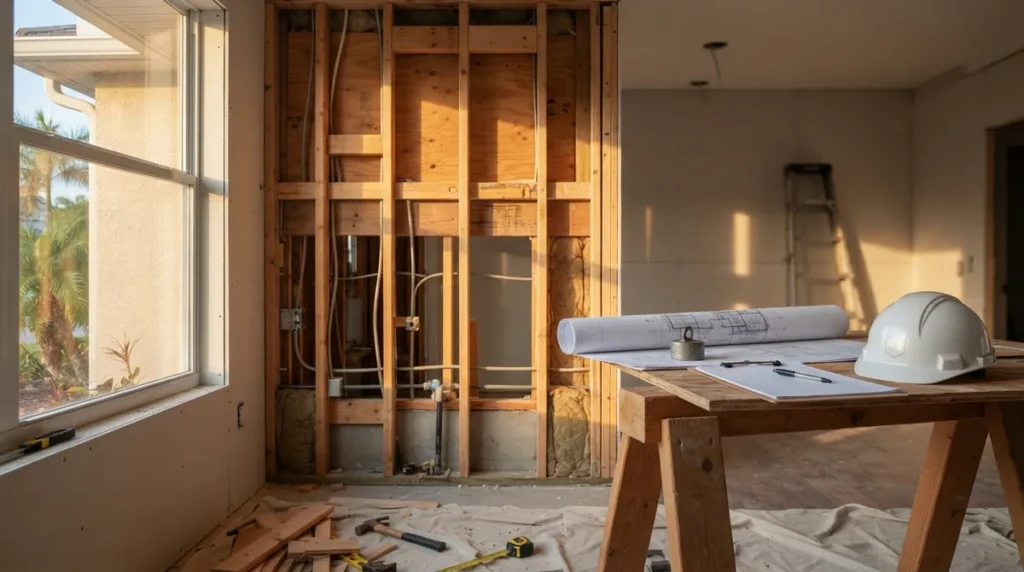
Do not cover, alter, or finish any open or concealed work until the department tells you how it wants it inspected, as they may require exposure or an engineer's evaluation.
-
An after-the-fact permit does not automatically legalize noncompliant work; the building official may require corrections or even removal and reconstruction.
-
Build a documentation package matching what is actually built, including as-built drawings, site plans, product approvals, and sealed engineering where concealed work is involved.
-
Fees vary widely by jurisdiction; some counties charge double the normal fee, so request the current fee schedule and budget for trade permits, drafting, and possible repairs.
-
Finish all inspections and close the permit, since an open or expired permit can surface during a sale, insurance claim, or refinance.
So you found out that a deck, a reroof, a pool cage, or a bathroom remodel never got a permit. Maybe the previous owner skipped it. Maybe a contractor said "don't worry about it." Maybe it was you, years ago, trying to save a few weeks. Take a breath. You are far from alone, and in most cases there is a path forward.
That path usually runs straight through your local building department. An after the fact permit Florida building department process is how cities and counties handle work that was started or finished without the required permit. It is not one statewide program with one set of forms. Each jurisdiction sets its own application steps, fees, inspections, and evidence requirements.
In this guide, we walk you through seven practical steps, from confirming who actually controls your property to closing out the permit with a final inspection. We also cover what can go wrong, what it may cost, and where an experienced permitting team can save you time. Let's get you moving.

What an After-the-Fact Permit Actually Is
An after-the-fact (ATF) permit is a local building permit sought after regulated work has already begun or been completed without the required permit. Florida Statutes §553.79 generally requires a permit before covered building work starts, and §489.127 prohibits commencing or performing work that requires a permit while no permit is in effect.
Here is the important part. There is no single statewide ATF category. A city may call it an after-the-fact permit, a retroactive permit, or a permit for work without permit. The label changes, but the idea is the same: you ask the building department to review work that already exists.
Approval is not guaranteed. An ATF permit does not automatically legalize noncompliant work. The building official may require corrections, extra documentation, or even removal and reconstruction before signing off.
7 Steps to Get an After-the-Fact Permit in Florida
Step 1: Confirm Which Jurisdiction Controls Your Property
This sounds simple, but it trips up a lot of owners. A mailing address that says "Tampa" may sit in unincorporated Hillsborough County. A home that feels like it is in a city may be under county review. Near city lines, the answer is not always obvious.
Before you call anyone, confirm the correct building department. Our building department lookup tool can point you in the right direction, and our guide on which Florida jurisdiction reviews your project explains the common pitfalls.
Step 2: Contact the Building Department and Disclose the Work
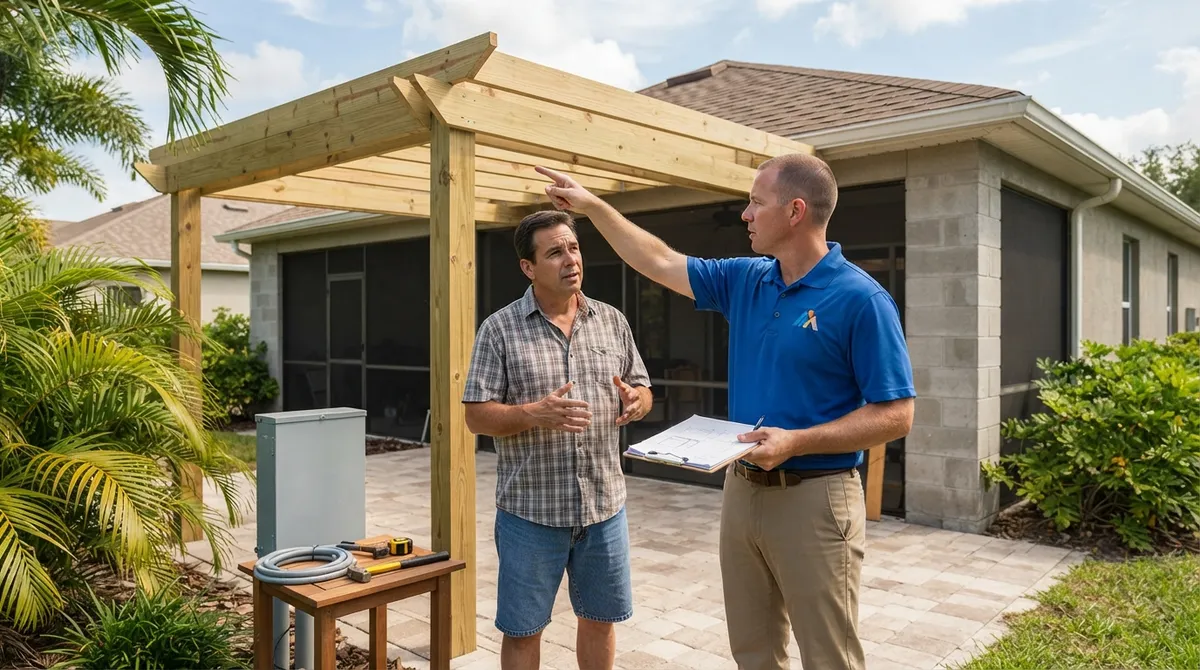
Contact the building department for your property's jurisdiction promptly and be honest about what was done. Ask for their ATF application, documentation checklist, fee schedule, and inspection process. Some departments will also send you to code enforcement first, especially if there is already an open violation.
A few friendly tips for that first call:
- Have your parcel number or folio number ready.
- Describe the scope of work clearly: what, where, and roughly when.
- Ask whether an open code case, stop work order, or notice of violation exists.
- Ask which trades (structural, electrical, plumbing, mechanical, roofing) will need separate permits.
- Write down the name of the person you spoke with and the date.
Honesty matters here. Trying to hide or minimize the work usually makes the process harder, not easier.
Step 3: Do Not Cover Up, Alter, or Finish Anything Yet
This one is easy to overlook. If the work is partly open, such as exposed framing, wiring, or plumbing, do not close it up before asking the department how they want it inspected. If work is already concealed behind drywall, ceilings, or flooring, the department may ask you to expose it.
Some jurisdictions go further. For example, St. Lucie County states that concealed work may require a third-party engineering analysis at the owner's cost. That is county-specific guidance, not a statewide rule, so always verify what your local department requires.
Step 4: Gather Your Documentation Package
The department may require applications, plans, product approvals, contractor information, and other documents appropriate to the work. The exact package depends on the project and the jurisdiction, but most ATF submittals draw from the same toolbox.
| Document | What It Does | Often Needed For |
|---|---|---|
| As-built drawings | Show the work as it actually exists | Additions, enclosures, remodels |
| Site plan or survey | Shows setbacks, lot coverage, and location | Sheds, pools, patios, additions |
| Engineer letter or sealed evaluation | Verifies structural or system compliance | Concealed work, framing, trusses |
| Product approvals | Confirms products meet Florida code | Roofing, windows, doors |
| Contractor or owner information | Identifies who is responsible for the work | All applications |
| Photos and receipts | Supports timeline and materials used | Concealed or older work |
If you need plans, our team handles as-built drawings, site plans, and engineer letters in house, with sealed drawings from our own engineer.
Step 5: Submit the Application and Expect Possible Review Comments
Once your package is ready, submit it according to the department's process. Many Florida jurisdictions use online portals, while others still accept paper or in-person submittals.
Do not be surprised by reviewer comments. They are common, even on well-prepared packages, and they are part of the process rather than a sign of failure. Respond clearly, revise the drawings if needed, and resubmit. If comments start piling up, revisions and resubmittals support can keep things moving.
One more detail worth knowing: under Florida Statutes §553.73, the Florida Building Code edition in effect on the permit application date generally governs the permitted work. Confirm the applicable code edition and any local amendments with your department.
Step 6: Pass Inspections to Verify the Existing Work
Inspections are commonly required to verify that existing work complies with code. Inspectors may check framing, electrical, plumbing, mechanical systems, tie-downs, product labels, and more.
If the inspector finds something that does not meet code, the building official may require corrections. Sometimes that is a simple fix. Sometimes, if the work cannot be verified or brought into compliance, it may require removal or reconstruction. That is exactly why upfront engineering evidence matters so much.
Wondering what inspection day looks like? Our article on what happens during a Florida ATF site inspection walks through it.
Step 7: Pay Fees, Resolve Violations, and Close the Permit
Fees and penalties are jurisdiction-specific. To give you one example, St. Lucie County states that its after-the-fact permit fee is double the normal fee and warns that unresolved violations may lead to a notice of violation, fines, or a property lien. Do not assume your jurisdiction uses the same rule. Always ask for the current fee schedule.
Separately, Florida Statutes §489.127(5)(f) allows a local enforcement or licensing board or special magistrate, in the circumstances the statute describes, to impose a civil penalty of up to $2,500 per day for each violation. That is not an automatic ATF charge and should not be confused with a permit fee, but it shows why resolving things early is wise.
Finally, make sure the permit gets closed. An approved ATF permit with a passed final inspection is what you want in your file. Without it, an open or expired permit can surface at closing, in an insurance claim, or during a refinance. See our guide on how to close an expired permit in Florida for the next layer of cleanup.
Common Costs and Variables to Expect
Owners often ask for a single price. The honest answer is that it depends on your jurisdiction and your project. Here is what typically drives the total:
- The local permit fee, which may be higher than a standard permit in some jurisdictions
- Separate trade permits for electrical, plumbing, or mechanical work
- Drafting costs for as-built plans and site plans
- Engineering fees for structural evaluations or sealed letters
- Exposure and repair costs if concealed work must be opened up
- Correction costs if the work does not meet code
- Possible fines or lien-related costs if a violation is already open
For a deeper look at budgeting, check out our breakdown of after-the-fact permit costs in Florida.
Quick Reference: What Is Statewide vs. Local
One of the biggest sources of confusion is knowing which rules come from the state and which come from your city or county. This table helps separate them.
| Topic | Statewide Rule | Set Locally |
|---|---|---|
| Permit required before covered work | Yes (Fla. Stat. §553.79) | Administration and procedures |
| Work without a permit prohibited | Yes (Fla. Stat. §489.127) | Enforcement approach |
| Governing code edition | Tied to application date (§553.73) | Local amendments |
| ATF application steps | No uniform process | Yes |
| ATF fee amount | No statewide amount | Yes |
| Exposure or engineering requirements | No uniform rule | Yes |
Who Needs This Most, and Why
Different readers come to this topic with different worries. Here is how it tends to show up:
- Homeowners: You bought a house with an unpermitted addition, or a past contractor never closed a permit. You want to protect your insurance, resale value, and peace of mind. Our homeowner services are built for exactly this.
- Realtors and investors: A closing is delayed because a buyer's inspection or title search flagged unpermitted work. Speed and clear documentation matter. See our realtor and closing support.
- General contractors: A client's property has legacy work that must be legalized before your scope can proceed. Our general contractor permitting support keeps your crew schedule intact.
- Solar and roofing companies: An older roof or electrical panel without permits may block your install. Coordinating the ATF process first avoids rejected solar applications.
- Architects, designers, and trades: You need dependable as-built drafting or sealed engineering without adding in-house headcount.
Mistakes That Slow Down After-the-Fact Permits
Most delays are avoidable. Watch out for these common missteps:
- Calling the wrong building department because of an unclear jurisdiction boundary.
- Covering or altering the work before the department decides how to inspect it.
- Submitting drawings that do not match what is actually built.
- Ignoring a notice of violation while trying to "get the permit first."
- Assuming a neighbor's experience or a county's fee applies to your property.
- Letting the permit expire after approval instead of finishing inspections.
If you have already received a notice, our guide on code compliance violation help in Florida is a good next read.
How 1 Contractor Solutions Helps
Navigating an after the fact permit Florida building department process is much easier with a team that does it every day. 1 Contractor Solutions acts as Florida's outsourced permitting department. We confirm the correct jurisdiction, prepare as-built plans and site plans, provide sealed engineering from our in-house engineer, file the application, track it, and work through reviewer comments until closeout.
We serve all 67 Florida counties and have filed in more than 400 municipalities. Whether you need after-the-fact and expired permit help, permit facilitation and filing, or urgent permit rescue for a stop work order or a stalled closing, we can step in. You can also see what customers say by reading Visit us on Google — 1 Contractor Solutions.
Want to stay in the loop on Florida permitting news and tips? You can follow us on LinkedIn or follow us on Facebook. For official statutory language, the Florida Legislature publishes Florida Statutes §553.79 online.
Ready to Fix It and Move On?
Unpermitted work feels stressful, but it is usually a solvable problem when you tackle it early and honestly. Start by confirming the right jurisdiction, talk to the building department, protect any concealed work, and build a documentation package that matches reality. Then follow through on inspections and close the permit.
If you would rather hand the whole process to a team that handles it every day, get a free quote from 1 Contractor Solutions. Give us an address and a problem, and we will tell you which jurisdiction controls it, what it will take, and then go do it. We respond within 30 minutes, day or night, and se habla español.
FAQs
What is an after-the-fact building permit in Florida?
It is a local building permit you request after regulated work has already started or been completed without the required permit. There is no single statewide process, so the steps, fees, and inspections are set by your city or county building department.
Can I get a permit for work that has already been completed?
Often, yes, but approval is not guaranteed. The building department will usually require plans, inspections, and sometimes engineering evidence, and it may require corrections or removal if the work does not meet code.
How much does an after-the-fact permit cost in Florida?
Costs vary by jurisdiction. Some departments charge a higher fee, and St. Lucie County, for example, lists a double fee, but there is no statewide ATF fee amount. You may also pay for drafting, engineering, trade permits, and any needed repairs, so ask your local department for its current fee schedule.
What happens if unpermitted work is hidden behind walls or ceilings?
The department may require the work to be exposed for inspection or ask for an engineer's evaluation or other evidence. Requirements differ by jurisdiction, so ask before you cover up or alter anything.
Will an after-the-fact permit clear a code violation or lien?
Not automatically. If a violation is already open, you typically need to resolve it with the local code enforcement process in addition to getting the permit approved and closed, so confirm the exact steps with your jurisdiction.
We do this work every day across all 67 Florida counties. Call (866) 314-6931 and we will tell you what your situation actually requires — including when you do not need us.
Related services
Permit Facilitation & Filing
You have a crew scheduled, a client asking for dates, and a permit sitting somewhere in a queue you cannot see. We file it, w…
See the servicePlan Review Coordination
A permit in plan review is not one queue. On a commercial project it can be six queues, each with its own reviewer, its own c…
See the serviceReady to get your permit moving?
One call tells you which jurisdiction controls your project, what it will take, and what it will cost. Most of the time we can scope it on the phone.