
Blog
11 Expired Permit After the Fact Florida Mistakes to Skip
Expired permit after the fact in Florida? Avoid 11 costly mistakes and learn the clear steps to renew, close out, or legalize work in 2026.
Key Takeaways
-
Under Florida Statutes §553.79, a local authority may close an expired permit without a new one if the permit requirements were substantially completed, though this is discretionary, not automatic.
-
Check the permit status with the controlling city or county first, since your jurisdiction determines the forms, fees, and renewal or closeout options available.
-
Pause work once a permit has lapsed; continuing construction may be treated as unpermitted, risking stop-work orders, fines, and tougher review.
-
Watch the expiration clock: a local government may send a notice 30 days before expiration, but many don't, so request an extension before the permit lapses.
-
Gather documentation early, including as-builts, engineer letters, photos, and invoices, to prove concealed work was built correctly and avoid a second trip.
-
Address expired permits early when a sale, refinance, insurance claim, or code notice is involved, since lenders, insurers, and title companies increasingly scrutinize permit history.
Picture this: you're about to close on a house, finish a remodel, or hand a project back to a happy client, and suddenly someone mentions an "expired permit." Or maybe worse, a permit that was never pulled at all. Your stomach drops. We get it, and we promise you're not alone. Florida's building departments see this situation every single day.
The good news? An expired permit after the fact in Florida is usually fixable. The bad news? Plenty of well-meaning owners, contractors, and agents make avoidable mistakes that turn a manageable cleanup into a months-long headache. In 2026, with lenders, insurers, and title companies paying closer attention to permit history, those mistakes cost more than ever.
In this friendly guide, we'll walk through 11 common missteps, explain how expired and after-the-fact permits differ, and show you what a smart path forward looks like. Whether you're a general contractor, solar installer, realtor, or homeowner, you'll leave with a clear plan. Let's dive in.
Expired Permit vs. After-the-Fact Permit: What's the Difference?
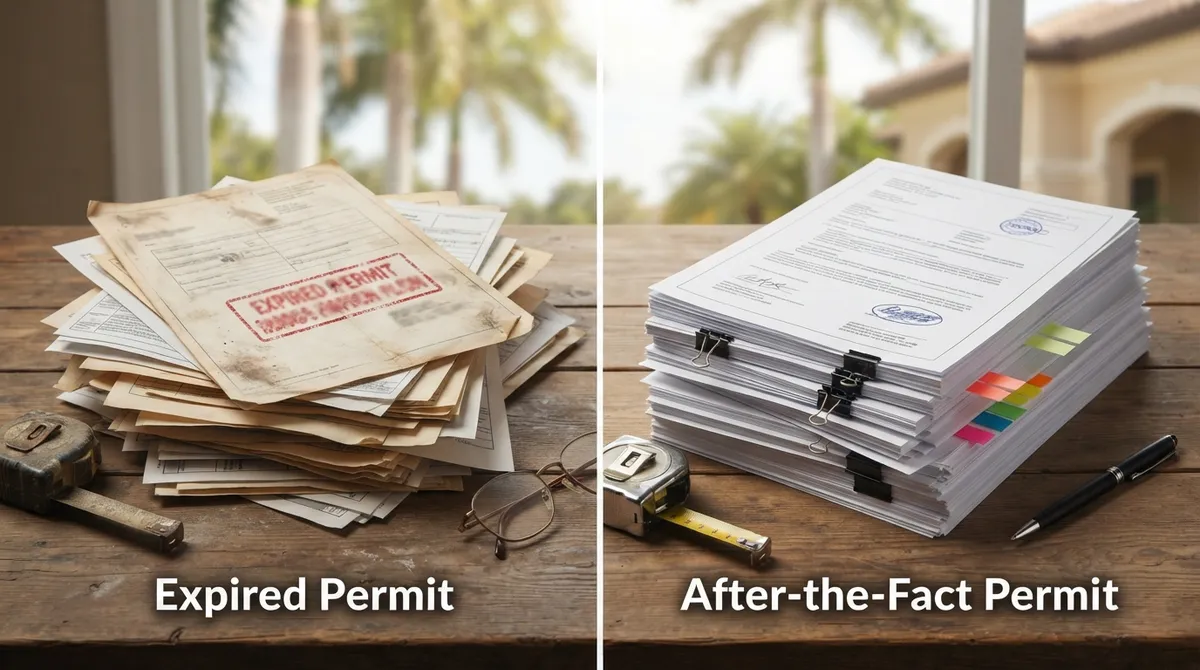
These two terms get tossed around like they're the same thing, but they're cousins, not twins. Understanding the difference is mistake number one to avoid, so let's clear it up right away.
| Situation | What It Means | Typical Path Forward |
|---|---|---|
| Expired permit | A permit was issued, but it lapsed before the work was finished or finaled | Extension, renewal, reissuance, closeout, or sometimes a new permit |
| After-the-fact permit | Work was done with no permit at all | Plans, documentation, inspections, and local review under current requirements |
| Expired permit after the fact | Work is done (or mostly done) and the permit lapsed without a final inspection | Confirm status, then decide between closeout, renewal, or a new permit |
Florida Statutes §553.79 gives local building departments real discretion here. If the permit requirements were substantially completed, the agency may close the permit without requiring a brand-new one. That's a big deal, and it's why the first step is always finding out exactly where your permit stands. If you're not sure which bucket you're in, our guide on expired permit vs. after-the-fact: which fix do you need breaks it down further.
Mistake 1: Assuming an Expired Permit Means Starting Over
Here's the myth that scares people the most. Many owners hear "expired" and assume they must pay for an entirely new project, redraw everything, and start from scratch.
Not necessarily. Under §553.79, a local enforcement agency can allow an expired permit to be closed without a new permit when it determines the permit requirements were substantially completed. That decision belongs to the local authority, and it is discretionary, not automatic. But it means a nearly finished job may only need a few remaining inspections.
Even better, the statute lets remaining closeout work proceed under the building code that was in effect when the agency received the original application, subject to statutory conditions. That can save you from expensive redesigns to meet newer code editions.
Mistake 2: Not Checking the Permit Status First
Before you spend a dime, find out what you're actually dealing with. We've seen people pay for after-the-fact drawings when their permit was simply open and eligible for extension. We've also seen the reverse.
Start by pulling the permit record from the city or county. Our open permit search tool and building department lookup help you figure out who controls your address, which isn't always obvious near city lines.
When you review the record, note these details:
- The permit number, type, and issue date
- Which inspections passed, failed, or were never requested
- The listed contractor or owner-builder of record
- Any extensions, holds, or notes from the department
Mistake 3: Ignoring the Expiration Clock
Time matters. Under §553.79, a local government may send an expiration notice at least 30 days before a permit expires. Notice the word "may." Many departments don't send one, so you can't count on a friendly reminder.
For a single-family dwelling, a local permit generally expires one year after issuance or on the effective date of the next Florida Building Code edition, whichever is later, subject to local extensions. Other permit types follow different rules. If your project is rolling toward that date, ask for an extension before it lapses. Extensions are often far simpler than reviving a dead permit.
Mistake 4: Letting the Work Continue After the Permit Lapsed
This one hurts. A crew keeps building because "the permit is already in the system," but the permit is expired. Now the new work may be considered unpermitted, which can trigger stop-work orders, fines, or a tougher review.
Pause work until you've confirmed what the department requires. It feels counterintuitive to stop a moving job, but a short pause beats a violation. If a stop-work order has already landed, our steps after a stop work order can help you steady the ship.
Mistake 5: Treating Every Florida County the Same
Florida has 67 counties and hundreds of municipalities, and each one runs its own show. What works in one office might be rejected in the next.
Miami-Dade County is a perfect example of local variation. Depending on the permit and work status, an expired permit there may need renewal or extension, reissuance, an expired-permit check, completed inspections, or cancellation. The county notes that owners are responsible for addressing expired permits, and for certain older open permits issued before 1998, an expired-permit check inspection may be needed to verify scope under the applicable code. That's a county-specific rule, not a statewide one.
| Factor | Why It Varies by Jurisdiction |
|---|---|
| Fees | Set locally; often higher for work done without approval |
| Documentation | Some require as-builts, others want engineer letters or sealed plans |
| Inspections | May include exposed-work or destructive testing where work is concealed |
| Renewal limits | Number and length of extensions differ |
Working near multiple jurisdictions? Browse our county pages for Miami-Dade, Broward, Hillsborough, and more.
Mistake 6: Skipping the Documentation That Proves the Work
Inspectors can't approve what they can't verify. If concealed work, like framing, wiring, or plumbing behind finished walls, was never inspected, the department may need proof it was built correctly.
That proof often takes the form of:
- As-built drawings showing what actually exists on site
- Engineer letters certifying structural or system compliance
- Photos taken during construction, if you have them
- Product approvals, invoices, and contractor records
Gathering these up front shortens review time dramatically. Showing up empty-handed usually means a correction notice and a second trip.
Mistake 7: Hiring the Wrong Person to Fix It
Not every handyman, designer, or even licensed contractor knows how to navigate a lapsed permit. The process blends plan preparation, engineering, filing, tracking, and constant communication with reviewers. A misstep in any link can stall the whole chain.
Look for a team that can draft, engineer, and file under one roof. At 1 Contractor Solutions, our drafting and engineering are in house, and our own engineer signs and seals the work, so when a reviewer flags something, we fix it directly instead of waiting on an outside consultant. You can see how that plays out on our after-the-fact and expired permits page.
Mistake 8: Forgetting About Real Estate Deadlines
If a sale is pending, an open or expired permit can show up in a title search or appraisal at the worst possible time. Lenders and insurers frequently want clean permit history before closing.
Realtors and investors, take note: flag permit research early in your due diligence, not the week of closing. Our team supports closings through realtor and closing support, and these resources can help you prepare:
- What to do when an open permit is found at closing
- Can a permit hold delay a Florida real estate closing
- How to clear a permit hold before closing
Mistake 9: Not Planning for Exposed-Work Inspections
Some homeowners are blindsided when the department asks to see inside the walls. For an after-the-fact permit, a local authority may require concealed work to be exposed or otherwise verified so an inspector can confirm it meets code. Requirements vary by jurisdiction and project, and not every job needs this.
The smart move is to talk with the building department, or your permitting partner, about what inspection path applies before you close up or repaint anything. It's far cheaper to plan for access than to cut open fresh drywall. Our overview of a Florida ATF site inspection walks through what inspectors typically look for.
Mistake 10: Ignoring Insurance and Financing Impacts
A lapsed permit isn't only a paperwork problem. It can ripple into insurance claims, HELOC approvals, and mortgage underwriting. Insurers may question coverage on unpermitted or unfinished work, and lenders may pause a loan until things are resolved.
That's one more reason to act early instead of hoping nobody notices. Read up on expired permits and insurance claims in Florida so you know what to expect.
Mistake 11: Waiting Until a Code Violation Forces Your Hand
The most expensive mistake is procrastination. Once a code enforcement notice, stop-work order, or citation arrives, you're on the department's timeline, and fines can stack up. Voluntarily coming forward is often smoother than reacting to a complaint.
If you've already received a notice, don't panic. Our code compliance violation help and urgent permit rescue services exist for exactly this moment.
A Simple Roadmap for Fixing an Expired Permit After the Fact
Feeling a little overwhelmed? Here's a calm, step-by-step approach you can follow no matter where in Florida your project sits.
- Confirm the permit status. Pull the record and note the expiration date, inspections completed, and any holds.
- Identify the controlling jurisdiction. City or county? Get this right before you file anything.
- Assess how complete the work is. Substantially complete jobs may qualify for closeout instead of a new permit.
- Ask about renewal, extension, or reissuance. Each department has its own forms and fees.
- Gather proof of the work. Photos, invoices, as-builts, and engineer letters strengthen your case.
- Schedule required inspections. Final, expired-permit check, or exposed-work inspections as directed.
- Close the permit and get your final. Keep the documentation for future buyers, lenders, and insurers.
If it turns out no valid permit exists and you need a fresh start, the after-the-fact route applies. We cover that in depth in our guides on how to get an after-the-fact permit in Florida and how to close an expired permit in Florida.
Which Path Fits Your Situation?
| Your Situation | Likely Route | Best First Move |
|---|---|---|
| Permit expired, work substantially complete | Closeout under the original application, at the department's discretion | Ask the department about substantial completion |
| Permit expired, work only partly done | Renewal, reissuance, or new permit | Confirm status and remaining scope |
| Permit never pulled | After-the-fact permit with plans and inspections | Gather as-builts and consult an engineer |
| Stop-work order or violation issued | Compliance plan, then permit | Respond before the deadline on the notice |
Who Benefits Most From Professional Help?
Honestly, almost everyone does, but here's how it plays out for different folks:
- General contractors: A lapsed permit on a finished job delays final payment. Handing the cleanup to a dedicated team keeps your crews moving. See how we support general contractors.
- Solar companies: Expired solar permits can stall interconnection and customer activation. Our solar contractor support keeps documentation clean and approvals on track.
- Realtors and investors: Permit surprises can derail deals. Early research protects your timeline.
- Homeowners: You shouldn't need a degree in building code to sell or insure your own house. We translate the jargon and handle the legwork. Learn more on our homeowner page.
Why 1 Contractor Solutions Is a Helpful Partner
We like to think of ourselves as Florida's outsourced permitting department. We're not a construction contractor. We're the team contractors and owners call when the permit is the thing standing between them and a finished project. With 15+ years in Florida permitting, more than 5,000 permits and projects handled, and filings in over 400 municipalities across all 67 counties, we've seen nearly every flavor of expired or unpermitted scenario.
Because our drafting and engineering are in house and we're a licensed private provider, we can prepare plans, seal them, and, where appropriate, perform plan review ourselves. We respond within 30 minutes, day or night, and se habla español. Curious what customers say? Visit us on Google — 1 Contractor Solutions to read reviews, and you can also follow us on LinkedIn or follow us on Facebook for practical permitting tips.
For the statute itself, you can read the official text of Florida Statutes §553.79 straight from the Florida Senate.
Wrapping Up: You've Got This
An expired permit after the fact in Florida feels intimidating, but it's rarely the end of the road. Check the status, respect your local department's process, document the work, and don't let the clock or a violation notice push you into rushed decisions. Avoid these 11 mistakes and you'll save time, money, and plenty of stress.
Ready for a hand? Whether you need a permit closed out, plans drawn, or a stalled project rescued, get a free quote and let our team point you to the cleanest path forward.
FAQs
What should I do if my building permit expired in Florida?
Start by confirming the permit's status with your local building department, since procedures vary by county and city. Depending on how much work is done, you may be able to extend, renew, reissue, or close the permit, or you may need a new one. Don't continue work until you know what the department requires.
Can an expired permit be closed without getting a new permit?
Sometimes, yes. Under Florida Statutes §553.79, a local enforcement agency may close a permit without a new one if it determines the permit requirements were substantially completed. It's a discretionary decision, not automatic, so check with the local authority.
Do I need an after-the-fact permit if my permit expired?
Not always. An expired permit that was properly issued is handled differently than work done with no permit at all. If the permit can be renewed, reissued, or closed, you may not need an after-the-fact permit, but if no valid permit exists, that route may apply.
Will the building department make me open walls for an after-the-fact inspection?
It depends on the project and the jurisdiction. Where work is concealed, inspectors may require exposure or other verification, such as an engineer letter, to confirm code compliance. Asking the department early helps you plan and avoid surprises.
Do expired permit rules differ by Florida county or city?
Absolutely. Fees, paperwork, inspection requirements, and renewal limits all vary locally. Miami-Dade, for example, has its own expired-permit procedures, including an expired-permit check for certain older permits, so always confirm the rules for your specific jurisdiction.
We do this work every day across all 67 Florida counties. Call (866) 314-6931 and we will tell you what your situation actually requires — including when you do not need us.
Related services
Permit Facilitation & Filing
You have a crew scheduled, a client asking for dates, and a permit sitting somewhere in a queue you cannot see. We file it, w…
See the servicePlan Review Coordination
A permit in plan review is not one queue. On a commercial project it can be six queues, each with its own reviewer, its own c…
See the serviceReady to get your permit moving?
One call tells you which jurisdiction controls your project, what it will take, and what it will cost. Most of the time we can scope it on the phone.