
Blog
Who Should I Hire for Sealed Plans After the Fact in Florida?
Wondering who should you hire for sealed plans after the fact in Florida? Learn who can seal, what to ask, and how to avoid costly mistakes.
Key Takeaways
-
Hire a Florida-licensed architect or professional engineer who physically inspects the existing work, not someone who simply stamps drawings handed to them without a site visit.
-
Match the discipline to the work: architects typically handle additions, egress, and layout, while structural engineers address trusses, foundations, wind loads, and screen enclosures.
-
Call your local building department before hiring anyone, since requirements for after-the-fact submittals vary by city and county and the building official decides what is needed.
-
Verify any professional's license is active and matches your project's discipline through the Florida Department of Business and Professional Regulation before signing any contract.
-
Prefer a provider who handles inspection, sealed documents, permit filing, tracking, and reviewer comment responses together, so you avoid coordinating between separate parties.
-
Be wary of guarantees of approval or promises to skip the building department, since only the building official can approve and legalization does not waive code compliance or corrective work.
So the work is already done. Maybe you bought a house with a sunroom the last owner built over a weekend. Maybe a crew finished your addition and quietly skipped the permit. Maybe a building inspector just left a notice on your door. Take a breath. You are far from the first Florida owner or contractor in this spot, and there is a clear path out.
The big question is who should I hire for sealed plans after the fact in Florida? The short answer: a Florida-licensed architect or professional engineer who has real experience legalizing existing construction, ideally one who works with a team that can also file the permit, track it, and answer reviewer comments. Not just anyone with a stamp.
In this guide, we will walk through who can legally seal after-the-fact plans, what they actually do on site, how to compare providers, and what mistakes to avoid. Whether you are a homeowner, a general contractor, a solar company, or a real estate pro trying to save a closing, you will leave with a simple game plan for 2026.
What Are Sealed Plans After the Fact, Anyway?
After-the-fact (ATF) permitting is the process of legalizing work that was already built, usually without a required permit or after a permit expired. The building department wants proof that what exists is safe and meets the Florida Building Code. Sealed plans are the proof.
Florida Statute 553.79 generally requires a permit before covered construction, alteration, repair, or demolition begins. When work skips that step, the fix is not a quick form. It is a documented review of what was actually built. If you want a deeper walkthrough of the overall process, our guide on unpermitted work in Florida and how to legalize it is a great companion read.
Sealed plans in this context typically mean as-built drawings, calculations, and narratives that a licensed design professional has signed, dated, and sealed. Florida Statute 471.025 requires engineers' final documents to be signed, dated, and sealed, which is why the credentials of the person you hire matter so much.

Who Can Legally Seal After-the-Fact Plans in Florida?
Not every professional can seal every kind of drawing. The right discipline depends on what was built.
- Florida-licensed architects address building design, egress, occupancy, and code issues for additions, enclosures, and remodels.
- Florida-licensed professional engineers (PEs) evaluate structural systems, trusses, foundations, wind loads, and other engineered elements.
- Licensed MEP professionals and trade contractors handle electrical, plumbing, and mechanical corrections, and may need separate permits or engineering.
Here is a quick way to see who fits where:
| Type of Unpermitted Work | Most Likely Professional Needed | Typical Focus |
|---|---|---|
| Room addition or garage conversion | Architect and/or structural engineer | As-built plans, egress, framing, foundation |
| Screen enclosure, lanai, or patio cover | Structural engineer | Wind load, anchorage, connections |
| Roof replacement or truss changes | Structural engineer | Truss verification, uplift, decking |
| Electrical, plumbing, or HVAC changes | MEP engineer and licensed trade contractor | Load calcs, code compliance, inspections |
| Solar or generator installs | Structural and electrical engineer | Roof loading, interconnection, sealed documents |
| Retaining wall or pool equipment | Civil or structural engineer | Stability, drainage, site plan |
One more important note: a design professional's seal is not a substitute for a licensed contractor where contractor licensing is required. If corrective work is needed, you will still need appropriately licensed contractors to do it. You can learn more about the people who can pull permits in our article on who can pull a permit in Florida.
Do You Always Need Sealed Plans?
Here is some honest, friendly truth: not always. Sealed plans are not automatically required for every project. Florida law and the Florida Building Code contain exemptions and alternative design provisions, and Florida Statute 481.229 provides exemptions from architect licensure for certain work. Whether your project qualifies depends on its scope, building type, and conditions.
That is why the very first call should be to your local building department. Ask what they require for after-the-fact submittals on your specific project. Procedures, forms, inspections, and testing vary by city and county, and the local building official decides what is needed to legalize your work.
If you want to understand when a seal is truly needed, take a look at our article on how to know if your Florida permit needs sealed plans.
What a Good Professional Actually Does on Site
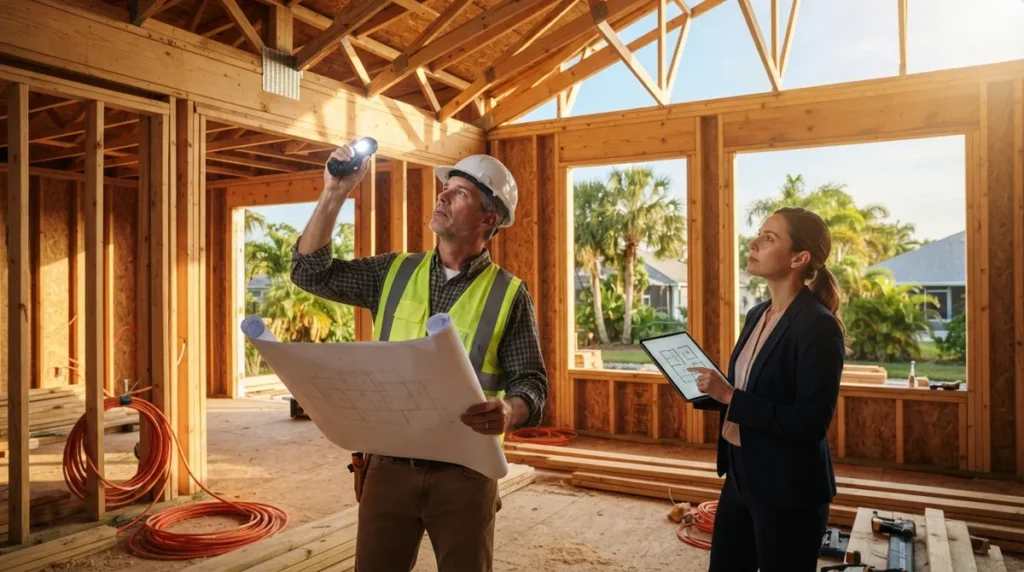
This is the part many people miss. A reputable professional does not just stamp drawings you hand over. They inspect the actual construction.
For example, a City of Tampa legalization guide calls for an as-built certificate and plans prepared, signed, and sealed by a Florida-licensed architect or engineer, based on direct inspection, with testing or destructive investigation where necessary. In plain English, that can mean opening a wall, checking fasteners, verifying truss connections, or confirming footing depth.
A solid after-the-fact process usually looks like this:
- Intake and research. Confirm the property address, the controlling jurisdiction, and what the building department wants.
- Site inspection. The licensed professional documents existing conditions, measurements, materials, and visible defects.
- Testing or investigation. If needed, they verify hidden elements like framing, anchors, or wiring.
- Preparation of sealed documents. As-built plans, calculations, narratives, and any corrective work notes.
- Permit filing and tracking. The application goes in, with fees and forms handled correctly.
- Reviewer comments and revisions. Every comment gets answered until approval.
- Inspections and closeout. Corrective work is inspected and the permit is finaled.
Our own as-built drawings and engineer letters services follow this same field-first mindset, because reviewers can tell the difference between a real evaluation and a paper exercise.
Key Qualities to Look For When Hiring
Think of this like hiring a good doctor for a second opinion. Credentials matter, but so does experience with your exact situation. Here are the qualities worth checking.
- An active Florida license in the right discipline. Verify architects and engineers through the relevant Florida licensing board before you sign anything.
- Direct after-the-fact experience. Ask how many legalization projects they have handled in your county or city.
- A site inspection and testing approach. You want someone who visits, measures, and verifies.
- Coordination with trades. Electrical, plumbing, and mechanical items may need separate licensed professionals.
- Clear deliverables and fees. Know exactly what is included, including permit revisions and responses to plan-review comments.
- Realistic timelines. A good provider will not promise approval, because approval depends on the building department.
Remember, an after-the-fact application does not guarantee approval or waive code compliance, inspections, penalties, or corrective work. Anyone promising otherwise is not being straight with you.
Comparing Your Hiring Options
There are a few common routes owners take. Each has trade-offs.
| Option | Pros | Cons |
|---|---|---|
| Independent architect or engineer only | Direct access to the sealing professional | You may still need to file, track, and respond to comments yourself |
| Contractor's in-house or referred designer | Convenient if the contractor stays involved | Quality varies; a seal on someone else's drawings is a red flag |
| Permitting firm with in-house drafting and engineering | One team for plans, seal, filing, tracking, and revisions | Choose a firm that does real field verification, not paper-only work |
| Drafting-only service plus your own engineer | Good if you already trust an engineer | Requires you to coordinate between two parties |
For many owners, the permitting-firm route is the least stressful, because one phone call covers the plans, the seal, the filing, and the back-and-forth with reviewers. That is exactly the gap 1 Contractor Solutions fills. Our drafting and engineering are in house, so when a reviewer flags something, we fix it instead of waiting on an outside consultant.
Which Audience Needs What? A Quick Guide
Every situation feels different, so here is how it often plays out.
Homeowners and Residential Property Owners
If you inherited unpermitted work, your first stop is clarity. Find out what is unpermitted, which jurisdiction controls it, and what the building department will accept. Our homeowner services are built for exactly this kind of start.
General Contractors
If a project closed out without a final or a permit lapsed, you need a partner who can move fast and keep your crew scheduled. See how we support general contractors with plans, filing, and revisions.
Solar Companies
Installations that went in without proper sealed structural or electrical documentation can stall interconnection. Sealed roof-loading and electrical documents get these back on track. Learn more on our solar contractor page.
Realtors, Investors, and Buyers
When a permit problem threatens a closing, time matters. A professional who can research, document, and file quickly can protect the deal. Our realtor and closing support exists for those moments.
Red Flags to Avoid
Most horror stories come from a handful of avoidable mistakes. Watch for these.
- Someone who offers to "just stamp" your existing drawings without visiting the property.
- A professional whose license you cannot verify on the state board's website.
- Guarantees of approval, since only the building official can approve.
- No mention of testing, inspections, or corrective work.
- Vague fees with no explanation of revisions or reviewer comments.
- Pressure to skip the building department conversation entirely.
If you are in a rush because of a stop work order or a stalled closing, our urgent permit rescue service is designed for those time-sensitive situations.
What About Cost and Timing?
This is the question everyone asks, and the honest answer is that it depends. No statewide standard after-the-fact permit fee or penalty amount was established in the sources reviewed. Fees and legalization procedures are set or administered locally, so you should request a project-specific estimate from the relevant building department and from your professional.
Costs generally come from a few buckets:
- Professional fees for site inspection, drawings, calculations, and sealing.
- Building department application and review fees, which may include additional charges for work done without a permit.
- Testing or investigation costs, such as opening walls.
- Corrective work if something does not meet code.
For more detail on budgeting, check out our breakdown of after-the-fact permit costs in Florida. If you want a sense of how the process unfolds step by step, our post on how to get an after-the-fact permit in Florida is also helpful.
You can also see what an inspector might look at in our article on what happens during a Florida ATF site inspection.
Verify Before You Hire
A few minutes of homework can save weeks of frustration. Before hiring, verify credentials through the official Florida boards. The Florida Department of Business and Professional Regulation lets you look up licenses for architects, engineers, and contractors. Confirm the license is active, the discipline matches your project, and there are no serious disciplinary issues.
It also helps to understand the underlying law. You can read the statute that generally requires permits at the Florida Legislature's page for Section 553.79. And if you want to double-check how other Florida cities handle legalization, the City of Tampa legalization requirements for work without permits are a clear, real-world example of what a building department expects from a sealing professional.
Not sure which building department even controls your address? Try our building department lookup tool, and run an open permit search to see what is already on record.
A Simple Game Plan for 2026
Feeling overwhelmed? Here is a calm, step-by-step plan you can follow this week.
- Identify exactly what was built and, if you can, roughly when.
- Confirm which city or county building department has jurisdiction.
- Call that department and ask about their after-the-fact process and requirements.
- Shortlist two or three licensed professionals or firms with legalization experience.
- Verify licenses and ask the comparison questions from earlier in this article.
- Schedule a site visit and request a written scope, fee, and timeline.
- Move forward with filing, tracking, and responding to comments until final approval.
Many owners also want to know whether the process is even allowed in their area. Our article on whether the Florida Building Code allows after-the-fact permits explains the basics, and our guide on who to hire to legalize an after-the-fact permit offers another helpful angle.
Final Thoughts: You Have Options, and You Have Help
Unpermitted work is stressful, but it is fixable more often than people think. The right hire is a Florida-licensed architect or engineer who actually inspects the work, understands your local building department, and can carry the project from sealed plans through final inspection. Add a team that files, tracks, and answers comments, and you remove most of the headaches.
If you want a partner who has handled thousands of Florida permits across all 67 counties, with in-house sealed drawings and same-day response, we would love to help. You can get a free quote and tell us your address and your problem. We will tell you which jurisdiction controls it, what it will take, and then we will go do it. You can also see what our customers say when you visit us on Google — 1 Contractor Solutions, and stay connected when you follow us on LinkedIn or follow us on Facebook.
Permits approved. Projects moving. Let's get yours there.
FAQs
Who can prepare sealed as-built plans for an after-the-fact permit in Florida?
A Florida-licensed architect or professional engineer can prepare and seal them, depending on the type of work. The best choice is someone who inspects the actual construction and has real experience with after-the-fact permitting. Always verify the license through the state board first.
Can an engineer seal plans for work completed by someone else?
Yes, but only after they have inspected and verified the work themselves. A responsible engineer will not just stamp drawings handed over by an owner or contractor. They need to confirm what was actually built, and sometimes that means testing or opening up finished areas.
Do I always need sealed plans for unpermitted work in Florida?
Not always. Florida law and the Florida Building Code include exemptions and alternative provisions, so it depends on your project's scope and your local jurisdiction. Call your building department first so you know exactly what they require before you hire anyone.
Will the building department make me open walls to inspect unpermitted work?
Sometimes, yes. If hidden work cannot be verified any other way, the building official may require testing or destructive investigation. Your sealing professional can explain what is likely in your case and plan for it ahead of time.
Is an after-the-fact permit guaranteed to be approved?
No. An after-the-fact application does not guarantee approval or waive code compliance, inspections, penalties, or corrective work. If the work does not meet the Florida Building Code, you may need repairs before the permit can be finaled.
We do this work every day across all 67 Florida counties. Call (866) 314-6931 and we will tell you what your situation actually requires — including when you do not need us.
Related services
Permit Facilitation & Filing
You have a crew scheduled, a client asking for dates, and a permit sitting somewhere in a queue you cannot see. We file it, w…
See the servicePlan Review Coordination
A permit in plan review is not one queue. On a commercial project it can be six queues, each with its own reviewer, its own c…
See the serviceReady to get your permit moving?
One call tells you which jurisdiction controls your project, what it will take, and what it will cost. Most of the time we can scope it on the phone.