
Blog
What Do You Need for a Pool Enclosure Permit in Naples?
Planning a pool enclosure permit in Naples? Learn who reviews it, what documents you need, fees, setbacks, and how to avoid common delays.
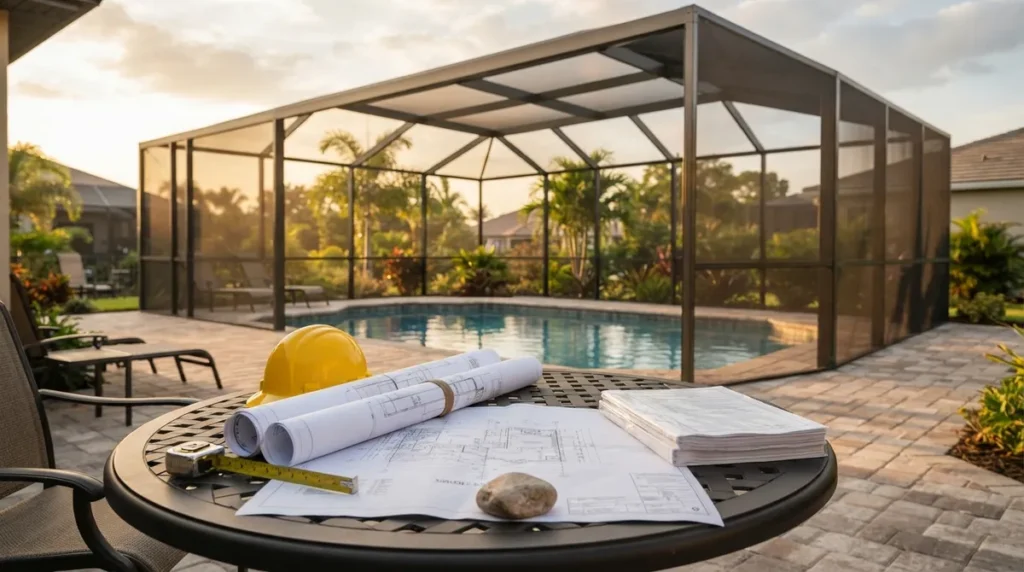
Key Takeaways
-
A permit is generally required before building or replacing a pool screen enclosure in Naples, since the aluminum frame is an engineered structure that must resist Florida wind loads.
-
Confirm jurisdiction first: a Naples mailing address does not guarantee City of Naples review, as many homes are in unincorporated Collier County with different forms and requirements.
-
The City of Naples requires a survey or site plan, signed and sealed engineering (unless already approved), and a signed and sealed Spatial Perception plan.
-
Collier County requires a new certified site plan if a project adds over 400 sq ft of impervious area; under 400 sq ft allows a site plan plus an affidavit.
-
Check HOA and deed-restriction approval, setbacks, easements, and coastal line constraints before filing, since these often stall projects more than wind engineering does.
-
Treat the screen enclosure as a possible pool safety barrier and document the barrier method, doors, and latches in the plans rather than assuming compliance.
Picture this: it is a warm Naples evening, the sun is dipping low, and you are sitting by your pool with a cold drink, finally free of the mosquitoes. That is the dream a screen enclosure sells. Then comes the less glamorous part: the permit. If you are searching for a pool enclosure permit in Naples, you are probably wondering who reviews it, what paperwork is needed, and how long you will wait before the crew can start.
Here is the good news. The process is very manageable once you know two things up front. First, which authority controls your address. Second, what that authority wants to see in the submittal package. Naples-area properties fall under either the City of Naples or unincorporated Collier County, and the two paths are not identical.
In this friendly guide, we will walk through who needs a permit, what documents to gather, how pool-barrier rules fit in, what fees to expect, and how to avoid the mistakes that stall projects. Whether you are a homeowner, a contractor, a designer, or an agent helping a client, you will leave with a clear plan.
Do You Really Need a Permit for a Pool Screen Enclosure in Naples?
In most cases, yes. A permit is generally required before you build or replace a pool screen enclosure in the Naples area. That includes new cages, full replacements, and many structural modifications. Even though the walls are "just screen," the aluminum frame is an engineered structure that has to resist Florida wind loads.
Skipping the permit is tempting when a contractor says it is routine. Please resist that urge. Unpermitted structures can surface during a sale, an insurance claim, or a code complaint. If you are already in that situation, our guide on how to fix a lanai enclosure built without a permit in FL explains the path forward.
Who Reviews Your Permit: City of Naples or Collier County?
This is the first question to settle, and it is not always obvious. A Naples mailing address does not guarantee City of Naples jurisdiction. Many homes with a Naples address sit in unincorporated Collier County, and other municipalities nearby may have their own rules.
Why does it matter? Because the application form, the review staff, the fee schedule, and the documentation requirements differ between the City and the County. Filing with the wrong authority wastes weeks. A quick jurisdiction check at the start saves that heartache.
Two Pathways at a Glance
The table below summarizes how the two main review paths compare for screen enclosures, based on published guidance. Always confirm current details with the reviewing building department before filing.
| Item | City of Naples | Unincorporated Collier County |
|---|---|---|
| Application type | Dedicated screen enclosure permit application | Processed under aluminum-structure permit requirements |
| Site documents | Survey or site plan showing enclosure, property lines, and setbacks | Construction plans and a proposed site plan; extra site-plan items depend on the project |
| Engineering | Signed and sealed engineering plans, or engineering already approved by the city | Construction plans as required by scope |
| Other submittals | Signed and sealed Spatial Perception plan | Final spot survey for an enclosure on a separately permitted deck or pool area |
| Coastal note | Work west of the Coastal Construction Control Line may need a state environmental field permit | Verify coastal and environmental constraints for the site |
What Documents Do You Need for the City of Naples?
The City of Naples publishes a screen enclosure permit application that spells out the package. In plain language, the city wants to see:
- A survey or site plan showing the enclosure, property lines, and setbacks.
- Signed and sealed engineering plans, or engineering the city has already approved for the same structure and materials.
- A signed and sealed Spatial Perception plan showing the enclosure.
City guidance also notes that enclosures must be engineered for wind loads and comply with the applicable Florida Building Code. If the structure and materials are not covered by engineering already on file with the city, original signed and sealed engineering is required. That detail trips up a lot of first-time applicants, so ask your enclosure vendor early whether their engineering is already approved.
The Spatial Perception Plan, Explained
You may not have heard of a Spatial Perception plan before. Think of it as a drawing that shows how the enclosure sits in the space around it, helping reviewers judge its visual and dimensional impact on the lot. Because the city requires it signed and sealed, plan on having a licensed design professional prepare it alongside the engineering.
What About Unincorporated Collier County?
Collier County handles screen enclosures under its aluminum-structure permit requirements. The guidance calls for construction plans and a proposed site plan. Beyond that, the site-plan documentation depends on the project, including whether it adds impervious area.
One published threshold is worth knowing. Collier County's aluminum-structure guidance uses a 400-square-foot line when a project adds impervious area. Over 400 square feet calls for a new certified site plan. Under 400 square feet calls for a site plan plus an affidavit in lieu of a certified site plan. Confirm the current bulletin and how it applies to your specific project before you draw anything.
The County also requires a final spot survey for a screen enclosure on a separately permitted deck or pool area, with a note identifying the screen-enclosed pool area. And if the property is on septic, County guidance states that a proposed structure must be at least 5 feet from the septic system, citing Florida Administrative Code 62-6.005(2). Verify site-specific septic constraints with the relevant authorities.
Does the Enclosure Count as a Pool Safety Barrier?
This is one of the most common questions we hear, and the honest answer is: it can, but do not assume it. A screen enclosure may form part of the pool's required safety barrier. However, barrier compliance should be addressed in the plans rather than taken for granted just because a cage is there.
Collier County's pool application requirements call for a Residential Swimming Pool Safety Act form and the proposed barrier-protection method. If your enclosure is part of that barrier, the details matter: doors, latches, and openings all come into play. Treat the barrier as a design item, not an afterthought.
Building the pool and the cage together? Our walkthrough on pool permit steps in Naples shows how the two permits relate.
Step-by-Step: Getting Your Naples Pool Enclosure Permitted
Here is a simple order of operations that keeps projects moving.
- Confirm your jurisdiction. Determine whether the property is in the City of Naples, unincorporated Collier County, or another municipality.
- Check private restrictions. Review deed restrictions and get HOA approval if your community requires it. Many associations want approval before the permit is filed.
- Order a survey or site plan. You will need property lines, setbacks, easements, and the footprint of the proposed enclosure.
- Secure engineering. Get signed and sealed plans that address wind loads and the Florida Building Code, or confirm the city already has approved engineering for your system.
- Address the pool barrier. Show how the enclosure and other protections meet the safety requirements.
- Assemble and submit. File the complete package with the correct authority and pay current fees.
- Answer review comments. Respond quickly and precisely to reviewer questions, then resubmit if needed.
- Schedule inspections and close out. Pass the required inspections so the permit is finaled.
What Will It Cost?
Fees change, so treat the numbers below as a snapshot and confirm with the Building Department before you file. The City of Naples' published screen enclosure application lists the following:
| Fee Item | Published Amount |
|---|---|
| Permit fee | $100 |
| Plan review fee | 20% of the permit fee |
| Zoning review fee (new or renovated square footage) | $50 or $0.05 per square foot of affected enclosed space, whichever is greater |
Remember that government fees are only part of the budget. Engineering, surveys, and the enclosure itself are separate costs. Collier County fees follow the County's own schedule, so check it directly.
Setbacks, Zoning, and HOA Rules: The Silent Project Killers
Plenty of Naples enclosure projects stall not because of wind engineering, but because of zoning and private rules. Before you submit, verify the following:
- Zoning setbacks from each property line, including rear lanai and waterfront conditions.
- Height and spatial-perception requirements that apply to the district.
- Easements that may run through the area where you want to build.
- Deed restrictions and HOA approval, which are separate from the permit.
- Coastal or environmental constraints, including the Coastal Construction Control Line.
A word of caution: do not rely on generic setback or wind-speed figures from contractor marketing pages. Requirements are specific to your property and jurisdiction. The numbers that matter are the ones in the adopted code and the reviewing authority's current guidance.
Coastal Properties and the CCCL
If your home is near the Gulf, the Coastal Construction Control Line may come into play. City of Naples guidance notes that work west of that line may require a Florida Department of Environmental Protection field permit. That is an extra approval layered on top of the building permit, so it is wise to sort it out before you sign a contract or order materials. Our article on coastal construction permit help in Florida covers what that involves.
Do You Need a Sealed Drawing?
Often, yes. Permit submittals may need to be signed and sealed by a Florida-licensed design professional when the scope and applicable rules call for it. For screen enclosures, the engineering that addresses wind loads is the main sealed document, and in the City of Naples the Spatial Perception plan must be sealed too.
Who actually seals what can confuse people. If you want a clear explanation, read who seals structural drawings for Florida permits. And if your project needs a clean site plan, our site plan services are built for exactly this kind of submittal.
What Different Readers Should Know
Every audience approaches an enclosure permit with a different pain point. Here is how to think about it from your seat.
- Homeowners: Ask your enclosure vendor who is pulling the permit and who owns the engineering. Get HOA approval in writing before work begins.
- General contractors and trades: Verify jurisdiction before quoting, and confirm whether your product engineering is already on file with the city. Missing seals are the top cause of resubmittals.
- Realtors and investors: Check for open or missing permits on any enclosure during due diligence. Our guide on open permit mistakes before closing in Naples is a handy checklist.
- Architects and designers: Coordinate setbacks, spatial perception, and barrier details early so the drawings do not need rework.
Common Mistakes That Slow a Naples Enclosure Permit
After seeing how these projects unfold, a few patterns repeat. Avoid these and you will likely move faster than the average applicant.
- Filing with the City when the property is actually in Collier County, or vice versa.
- Submitting a survey that does not show setbacks or the proposed footprint.
- Assuming the vendor's generic engineering is already approved by the reviewing authority.
- Forgetting to document how the enclosure fits into the pool barrier.
- Starting construction before HOA approval, then redoing plans to satisfy the association.
- Ignoring coastal line constraints until a reviewer flags them.
Many of these overlap with the broader problems we describe in 8 Naples permit mistakes that stall your project. A little prep work up front genuinely pays off.
When Doing It Yourself Gets Tricky
You can absolutely coordinate a permit on your own, and some owners do. But the combination of jurisdiction questions, sealed documents, barrier compliance, and reviewer comments can eat evenings and weekends. If you would rather hand off the paperwork, a dedicated team can prepare the plans, file the application, and track it through approval.
1 Contractor Solutions works as an outsourced permitting department across Florida, with in-house drafting and engineering and a licensed private provider option. If you want to see how the filing side works, check out our permit facilitation and filing services, or read what a permit expediter in Naples does to decide whether one fits your project. We also serve the Naples area directly.
Curious how other customers feel about the experience? You can read 1 Contractor Solutions reviews on Google. And if you like practical Florida permitting tips, follow us on LinkedIn or follow us on Facebook for updates.
Quick Pre-Submittal Checklist
- Jurisdiction confirmed (City of Naples, Collier County, or other).
- HOA and deed-restriction approval obtained.
- Survey or site plan showing setbacks and enclosure footprint.
- Signed and sealed wind-load engineering in hand.
- Spatial Perception plan sealed, if filing with the City.
- Pool barrier method documented in the plans.
- Coastal line and septic distances checked.
- Current fees verified with the Building Department.
Ready to Get Your Enclosure Approved?
A pool enclosure permit in Naples does not have to be intimidating. Pin down your jurisdiction, gather the right sealed documents, address the pool barrier, and confirm zoning and HOA rules before you file. Do that, and you will avoid the delays that frustrate so many homeowners and contractors.
If you would like a hand, we are glad to help. Reach out and get a free quote from the team at 1 Contractor Solutions, and let us turn your enclosure plans into an approved permit so you can get back to enjoying that Florida evening by the pool.
FAQs
Do I need a permit for a pool screen enclosure in Naples, Florida?
Generally, yes. A permit is typically required before you build or replace a pool screen enclosure in the Naples area, because the aluminum frame is an engineered structure. Confirm with your reviewing authority, since the City of Naples and Collier County each have their own process.
Is my property permitted through the City of Naples or Collier County?
It depends on where your parcel actually sits, not just your mailing address. Many homes with a Naples address are in unincorporated Collier County, so verify your jurisdiction before filing. Choosing the wrong authority is one of the easiest ways to lose weeks.
Can a screen enclosure count as a swimming pool safety barrier?
It can be part of the barrier, but you should not assume it automatically complies. Collier County's pool requirements call for a Residential Swimming Pool Safety Act form and the proposed barrier-protection method, so address it directly in your plans.
Do I need signed and sealed engineering for a pool cage in Naples?
Often, yes. The City of Naples calls for signed and sealed engineering plans, or engineering the city has already approved, plus a signed and sealed Spatial Perception plan. If your structure is not covered by engineering on file, original sealed engineering is required.
What does a pool enclosure permit cost in Naples?
The City of Naples' published application lists a $100 permit fee, a plan review fee of 20% of the permit fee, and a zoning review fee for new or renovated square footage. Fees can change, so confirm current amounts with the Building Department before you apply.
We do this work every day across all 67 Florida counties. Call (866) 314-6931 and we will tell you what your situation actually requires — including when you do not need us.
Related services
Permit Facilitation & Filing
You have a crew scheduled, a client asking for dates, and a permit sitting somewhere in a queue you cannot see. We file it, w…
See the servicePlan Review Coordination
A permit in plan review is not one queue. On a commercial project it can be six queues, each with its own reviewer, its own c…
See the serviceReady to get your permit moving?
One call tells you which jurisdiction controls your project, what it will take, and what it will cost. Most of the time we can scope it on the phone.