
Blog
7 Steps for Coastal Construction Permit Help in Florida
Seven friendly steps for coastal construction permit help in Florida, from CCCL checks and exemptions to documents, timelines, and expert support.
Key Takeaways
-
Check first whether your property is seaward of the Coastal Construction Control Line (CCCL) or a 50-foot setback from mean high water, since a few feet can determine whether a DEP permit is required.
-
Pick the correct DEP permit route (individual, general, emergency, or dune-core) before paying for plans, because general permits have eligibility limits that may not fit your scope.
-
Request a DEP exemption determination rather than assuming your work is exempt, especially for improvements to existing homes that involve foundation or structural work.
-
CCCL approval is separate from local building and zoning permits, so plan to identify and obtain every required state, local, and environmental approval up front.
-
Assemble a complete package including a current signed and sealed survey, plans, coastal engineering calculations, and a local government substantial improvement statement for repairs or additions.
-
Respond quickly to DEP information requests: applicants generally have 180 days to reply, and slow responses are a common cause of delays.
Building near the water in Florida is a dream for a lot of people, and honestly, it should be! But if you've ever stared at a beachfront lot and wondered, "Can I actually build here?" you're not alone. Between state rules, local building departments, and environmental review, coastal projects come with a few extra layers that inland jobs simply don't have.
The good news? Those layers are manageable once you know what they are. Getting coastal construction permit help in Florida early on can save you weeks of back-and-forth and a lot of headaches. Whether you're a general contractor with a crew waiting, a homeowner planning an addition, or a realtor sizing up a waterfront listing, this friendly guide walks you through seven practical steps. We'll cover the Coastal Construction Control Line (CCCL), permit types, exemptions, documents, and how to keep things moving. Think of it as a roadmap, not a rulebook, so let's dive in.
Step 1: Find Out If Your Property Falls Under the CCCL
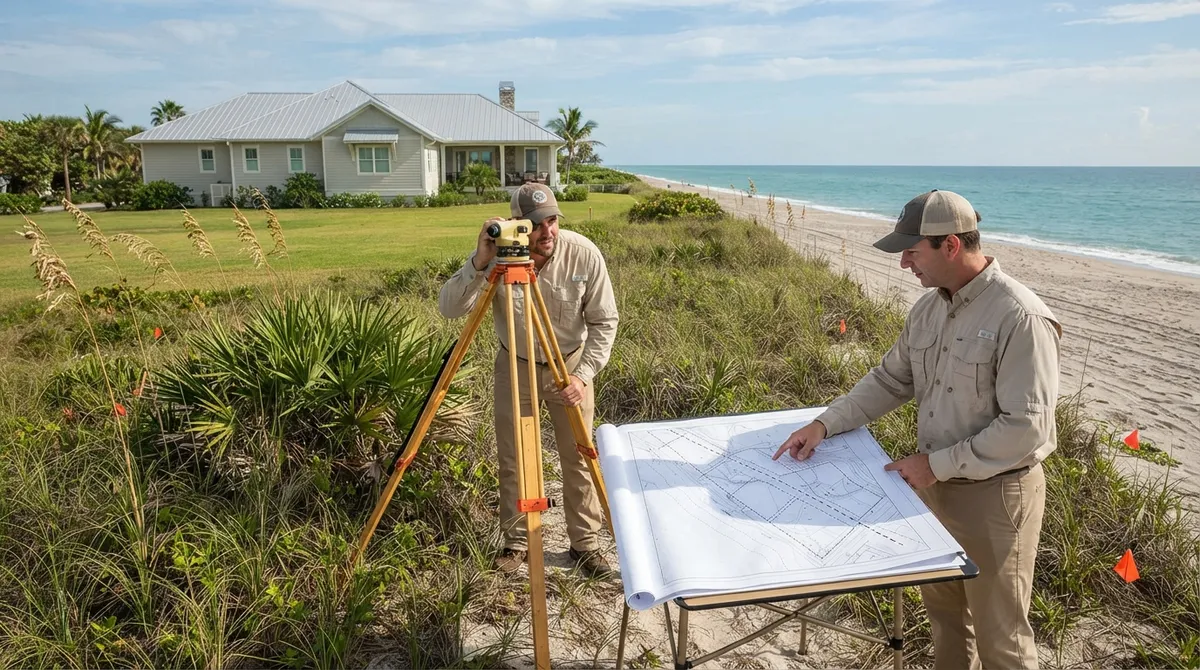
Everything starts here. Florida's Coastal Construction Control Line (CCCL) marks the landward jurisdictional limit of the state's CCCL program along designated sandy beaches. It's based on the area subject to severe fluctuations from a 100-year storm event. Importantly, it is not a blanket ban on building. It simply means the Florida Department of Environmental Protection (DEP) wants to review certain work seaward of that line.
Here's the quick version of how jurisdiction works:
- Established CCCL: Unless an exemption applies, construction and excavation seaward of the line need a DEP permit.
- No established CCCL on a sandy beach: A 50-foot setback from mean high water generally applies, and work inside it usually requires a waiver or variance.
- Not seaward of either: The CCCL program likely doesn't apply, though local rules still do.
Because a few feet can change everything, don't guess. A permitting professional can screen jurisdiction using survey data and DEP resources. If your project sits in a county like Sarasota County or Lee County, local building departments will also have their own coastal requirements layered on top.
Step 2: Understand Which Permit Route Fits Your Project
Not every coastal permit looks the same. DEP lists several routes, and picking the right one up front prevents wasted effort.
| Permit Route | Typically Used For | Key Notes |
|---|---|---|
| Individual / Areawide Permit | Larger or more complex construction seaward of the CCCL | Project-specific engineering and design review |
| General Permit | Qualifying activities with defined eligibility limits | Swimming pools are generally not included, with specified exceptions |
| Emergency Permit | Shoreline emergencies | Applies seaward of established lines or the 50-foot setback |
| Dune-Core Permit | Work involving the dune core | Extra scrutiny of beach-dune impacts |
General permits are attractive because they're often simpler, but they come with eligibility limits. If your scope doesn't squarely fit, you may need the individual route. Our team can help you sort this out before you pay for plans that don't match the right path. You can see the full range of what we handle on our services page.
Step 3: Check Whether an Exemption Might Apply
Here's a bit of cheerful news: some work may be exempt. For example, certain improvements to an existing single-family home within its existing foundation limits, when no foundation work is involved, may qualify for an exemption.
That said, exemptions are very fact-specific. Foundation work, additions, exact location, and project scope can all change the analysis. So instead of assuming your project is exempt, you can request a DEP exemption determination. It's a smart move because it gives you something official to point to if questions come up later.
Common factors that influence the exemption conversation:
- Whether the work stays within the existing foundation footprint
- Whether any foundation or structural footing work is involved
- How far the structure sits from the line or setback
- Whether the project is a repair, improvement, or true addition
If you're a homeowner, this is a great moment to ask a pro. If you're a realtor, it's also worth knowing, since an assumption that turned out wrong can complicate a closing. Our realtor and closing support team sees this often.
Step 4: Gather the Right Documents Before You File
A complete application is your best friend. A CCCL application commonly requires a site survey and project plans, with extra site-specific information or calculations as needed. For repairs, rebuilding, improvements, or additions, the rules also call for a statement from the local government on whether the work is a substantial improvement.
Here's a handy checklist to start with:
- Current signed and sealed site survey showing the CCCL or setback relationship
- Project plans (architectural, structural, and site plans as applicable)
- Engineering calculations relevant to coastal loads and foundations
- Local government statement on substantial improvement, when repairs or additions are involved
- Completed DEP application and fee worksheet (always confirm the current forms)
Quick tip: forms and checklists change, so always verify the current versions directly with DEP and your local building department. And since good drawings drive good outcomes, having plans and engineering handled in one place helps keep everything consistent, including structural engineering and site plans.
Step 5: Remember CCCL Approval Is Only One Piece
This is where many first-timers get surprised. CCCL approval is separate from local building and zoning approvals, and it may not replace other state or federal authorizations. In other words, you may need both a DEP coastal permit and a local building permit, plus possibly environmental or submerged-land approvals.
Florida law provides for coordinated review in some situations, but you still want to identify every permit up front. A simple way to think about it:
| Approval | Who Issues It | Why It Matters |
|---|---|---|
| CCCL permit or exemption | Florida DEP | Protects the beach-dune system |
| Building permit | Local building department | Code compliance and inspections |
| Zoning approval | Local planning/zoning | Setbacks, use, and height rules |
| Environmental approvals | State/federal agencies, as applicable | Wetlands, submerged lands, and more |
Our FDEP and environmental permits service exists for exactly this reason. And for the local side, permit facilitation and filing keeps your building permit moving alongside the state review.
Step 6: Plan for the Review Process and Timelines
DEP reviews applications under Florida Statutes Chapter 161 and Florida Administrative Code Chapter 62B-33. Reviewers look at project-specific engineering and design, plus potential effects on the beach-dune system, neighboring properties, native salt-resistant vegetation, marine turtles, and public beach access.
A few timeline details are worth knowing:
- Response window: Applicants generally have 180 days to respond to a timely DEP request for additional information, with a possible extension of up to 90 days if you give written notice of the circumstances.
- Permit expiration: Major-structure and coastal-armoring permits generally expire after three years (with a possible extension to five years when conditions are met); minor-structure permits expire after one year, and other-structure permits after two years.
- Submission and fees: DEP's page notes documents may be submitted by email or, for larger files, through an FTP server, while fees currently must be mailed or hand-delivered because online payment isn't available. Confirm current instructions before filing.
What commonly slows things down? Incomplete surveys, plans that don't match the survey, missing local-government statements, and slow responses to information requests. A little organization up front goes a long way. If you want to understand how long local approvals can take alongside the state review, our guide on how long a building permit takes in Florida is a helpful companion read.
Step 7: Bring In Coastal Permit Help at the Right Time
You don't have to do this alone, and the earlier you get help, the better. A Florida permitting professional can coordinate surveys, plans, agency and local reviews, and responses to DEP questions. At 1 Contractor Solutions, we act as an outsourced permitting department. We screen jurisdiction and permit type, assemble plans and supporting documents, coordinate with designers and local governments, answer requests for information, and track approvals. We can't guarantee issuance, since agencies make the final call, but we can make your application stronger and your process smoother.
Here's how different readers tend to benefit:
- General contractors: Fewer schedule surprises and a single point of contact. See our page for general contractors.
- Homeowners: Clear guidance on whether you need a permit or exemption. Visit our homeowner resources.
- Realtors and investors: Faster answers on what a coastal property can legally support.
- Architects and trades: Reliable outsourced drafting and engineering through our drafting-only service.
Because our drafting and engineering are in house and our own engineer signs and seals the work, reviewer comments get fixed fast instead of waiting on an outside consultant. And if you're working in a specific area, we have local knowledge in places like Collier County, Pinellas County, and Miami-Dade County.
Common Mistakes to Avoid on Coastal Projects
Even experienced builders trip on a few of these. Here's what to watch for:
- Assuming you're exempt without a determination from DEP
- Starting local permitting first and discovering the CCCL issue later
- Using an outdated survey that doesn't show the line or setback
- Ignoring substantial improvement rules for repairs and additions
- Letting information requests sit until deadlines creep up
Also keep in mind that work done without proper approvals can create bigger problems later, from stop-work orders to closing delays. If you're already in that situation, our urgent permit rescue and after-the-fact permit teams can help sort it out.
Wrapping Up: Your Coastal Permit Game Plan
Coastal building in Florida has a few extra steps, but none of them are mysterious once you know the order. Confirm whether you're seaward of the CCCL or 50-foot setback, choose the correct permit route, check for exemptions, gather a complete document package, remember the local approvals, respect the review timelines, and bring in help early. Do those things, and you'll be miles ahead of most applicants.
We love helping folks turn "Can I build here?" into "Permit approved!" If you'd like a hand, get a free quote and tell us your address and scope. You can also visit us on Google — 1 Contractor Solutions to see what customers say, and keep up with tips by choosing to follow us on LinkedIn or follow us on Facebook. For official program details, always double-check current requirements with the Florida DEP Coastal Construction Control Line program.
FAQs
Do I need a Florida DEP coastal construction permit for my property?
It depends on where your property sits and what you're building. Generally, construction and excavation seaward of an established CCCL need a DEP permit unless an exemption applies, and some sandy beaches without a line use a 50-foot setback from mean high water. A quick jurisdiction check is the best first move, and we're happy to help with that.
Can I repair or renovate an existing coastal home without a CCCL permit?
Sometimes, yes! Certain improvements to an existing single-family home within its existing foundation limits, with no foundation work involved, may be exempt. Because exemptions are fact-specific, it's smart to request a DEP exemption determination rather than assume.
Do I need both a CCCL permit and a local building permit?
In most cases, yes. CCCL approval is separate from local building and zoning approvals, and it may not replace other state or federal authorizations. Identifying every required permit early keeps your project from stalling later.
How long does a Florida coastal construction permit take?
Timelines vary with project complexity, how complete your application is, and how quickly questions get answered. Applicants generally have 180 days to respond to a timely DEP request for additional information, so organized, complete submissions tend to move faster.
Can a Florida permitting service help with a CCCL permit or exemption determination?
Absolutely. A permitting service can screen jurisdiction, pick the right permit route, assemble plans and documents, coordinate with designers and local government, and track responses. While no one can guarantee approval, expert help can make your application stronger and your process smoother.
We do this work every day across all 67 Florida counties. Call (866) 314-6931 and we will tell you what your situation actually requires — including when you do not need us.
Related services
Permit Facilitation & Filing
You have a crew scheduled, a client asking for dates, and a permit sitting somewhere in a queue you cannot see. We file it, w…
See the servicePlan Review Coordination
A permit in plan review is not one queue. On a commercial project it can be six queues, each with its own reviewer, its own c…
See the serviceReady to get your permit moving?
One call tells you which jurisdiction controls your project, what it will take, and what it will cost. Most of the time we can scope it on the phone.