
Blog
Statewide vs. Local ATF Permits in Florida: Which Applies?
Is after the fact permitting available statewide in Florida? Yes, but it's handled locally. Learn how rules, fees, and reviews differ by jurisdiction.
Key Takeaways
-
There is no single statewide after-the-fact permit in Florida; every city or county building department (the AHJ) runs its own application, fees, and review process.
-
Identify your authority having jurisdiction first: properties inside municipal limits typically go through the city, and all others go through the county.
-
Ask the AHJ how it handles unpermitted work before spending money on plans, since documentation requirements and inspection demands vary widely by jurisdiction.
-
Filing for an after-the-fact permit does not erase the original violation and does not guarantee approval; work must actually comply with the code.
-
Zoning, floodplain, environmental, and historic-preservation issues run on separate tracks and may require variances or modifications beyond the building permit.
-
Acting early matters: waiting lets notices of violation and stop-work orders escalate, and starting corrective work before consulting the AHJ can cover up areas inspectors need to see.
Let's start with the question you probably typed into Google: is after the fact permitting available statewide in Florida? The short, friendly answer is yes, sort of. Every part of Florida has some route for legalizing work that was built without a permit. But there is no single statewide application, no one-size-fits-all fee, and no central office that handles it for everyone.
Instead, your city or county building department runs the show. That's the big difference between a statewide program and a local process, and it's where most owners, contractors, and agents get tripped up. The good news? Once you understand how the pieces fit together, the path forward gets a lot less scary.
In this guide, we'll compare the two ideas side by side: a (non-existent) statewide system versus Florida's real local-by-local approach. We'll cover who handles your permit, what reviewers typically ask for, what it can cost, and how to avoid common mistakes in 2026. Whether you're a homeowner, general contractor, solar installer, or real estate pro, you'll find practical steps you can use today.
Short Answer: Available Everywhere, Administered Locally
After-the-fact (ATF) permitting is generally available across Florida, but it is administered by the authority having jurisdiction (AHJ) over the property. There is no single statewide ATF permit or uniform application process.
Here's the legal backbone. Florida Statutes section 553.79(1)(a) generally requires a permit before covered building work begins. The Florida Building Code gives the whole state a baseline, but local agencies administer permits and may add their own procedures, documentation requirements, fees, and enforcement rules.
It's also important to understand what a later permit does not do. It doesn't erase the original violation. It's simply a process for reviewing and, if the work is compliant, approving what's already been built.
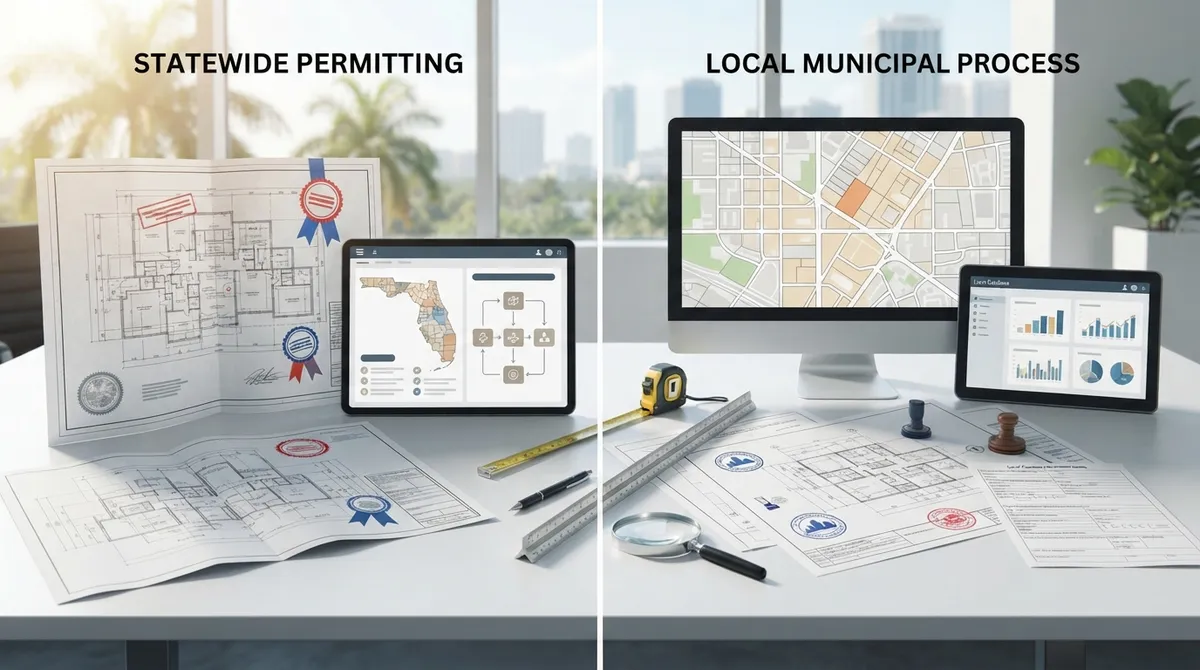
Statewide Program vs. Local Process: Side-by-Side
Many people assume Florida has one master ATF program. Here's how that assumption stacks up against reality.
| Feature | Imagined Statewide Program | How Florida Actually Works |
|---|---|---|
| Who processes it | One state agency | City or county building department (AHJ) |
| Application form | Single standard form | Varies by jurisdiction |
| Fees | One statewide schedule | Local permit fees plus possible penalties |
| Code baseline | Florida Building Code | Florida Building Code plus local amendments |
| Inspections | Uniform checklist | Set by the local authority |
| Approval guaranteed? | No | No, and the work must actually comply |
So when someone says "ATF permits are statewide," what they really mean is that the option exists everywhere, but the rulebook changes the moment you cross a city or county line.
Why Local Rules Create Such Different Outcomes
Florida has 67 counties and hundreds of municipalities, and each can approach unpermitted work a little differently. That variation shows up in a few key ways.
Fees and Penalties
Local fees and penalties can apply on top of ordinary permit and inspection charges. Pasco County's ordinance, for example, provides for an after-the-fact permit fee and states that paying it is not a defense to prosecution for starting work without a required permit. That's a local example, not a statewide fee schedule, but it illustrates how seriously some jurisdictions treat the issue.
If you're curious about typical budgets, our guide on after-the-fact permit costs in Florida breaks down what drives the price.
Documentation Requirements
Some departments want a full set of as-built drawings. Others may accept an engineer letter for certain scopes. A few may ask for photos, product approvals, or a truss and connection verification. The only way to know is to ask the AHJ before you spend money on plans.
Review Timelines
A small-town building office and a busy urban department won't move at the same pace. Staffing, backlog, and project type all play a part. For general timing context, see how long a building permit takes in Florida.
Who Actually Handles Your After-the-Fact Permit?
The first step is identifying the authority having jurisdiction. As a rule of thumb, properties inside municipal limits go through the city, and everything else goes through the county. But city lines can be surprisingly tricky, especially near borders and annexed areas.
Some work also involves other regulators. State agencies may oversee certain specialized work or properties, and environmental, floodplain, or historic-preservation rules can add layers. If you're unsure where to start, the building department lookup tool and our guide on which Florida jurisdiction reviews your project can point you in the right direction.
Here are some examples of how it breaks down across popular areas:
- Tampa Bay region: Hillsborough County, Pinellas County, and Pasco County each have their own procedures, plus individual city departments.
- Southwest Florida: Lee County, Collier County, and Charlotte County have different review paths and fee structures.
- South Florida: Miami-Dade and Broward often layer in high-velocity hurricane zone considerations and extra product approval requirements.
- Central and Northeast Florida: Orange County and Duval County each run distinct processes.
What the Process Usually Looks Like
While every jurisdiction differs, most ATF permits follow a similar rhythm. Think of it as a general roadmap rather than a guarantee.
- Confirm the AHJ. Identify whether the city or county controls your address, and ask how they handle unpermitted work before submitting anything.
- Document the existing work. Gather photos, measurements, receipts, and any prior permit history. An as-built drawing is often the foundation.
- Prepare plans and engineering. Depending on scope, you may need sealed drawings, structural calculations, or an engineer letter.
- File the application. Submit through the proper channel, pay applicable permit and penalty fees, and respond to any completeness checks.
- Work through plan review comments. Reviewers may request corrections or additional documents, which means revisions and resubmittals.
- Pass inspections. The agency may require inspections of completed work and, if needed, exposure of concealed areas.
- Close out the permit. Once final approval is issued, you can move toward a certificate of completion or occupancy if applicable.
What Inspectors May Ask For
An agency can require plans, specifications, and inspections to confirm that concealed or finished work meets code. If something can't be adequately inspected, the authority may require opening or exposing it, corrective work, or even removal. The outcome depends on the facts and local rules.
| Work Type | Common Documentation | Possible Inspector Request |
|---|---|---|
| Roof replacement | Product approval, fastening details | Exposure or verification of decking and fasteners |
| Addition or enclosure | Sealed structural plans, site plan | Foundation and framing verification |
| Electrical or plumbing | Riser or system diagrams | Opening walls or ceilings for rough-in review |
| Solar installation | Structural and electrical documentation | Roof attachment and interconnection check |
| Windows and doors | Product approvals, installation details | Anchoring and flashing review |
If you want to understand what happens in the field, read about what to expect during a Florida ATF site inspection.
Approval Is Never Guaranteed
Here's the part we always want you to hear clearly, with kindness: applying doesn't guarantee approval. If the work violates the building code, zoning, floodplain, environmental, historic-preservation, or other requirements, you may need to modify or remove it. In some cases, you might pursue a separate approval or variance where one is available.
That's why an ATF permit also doesn't automatically fix zoning, floodplain, or environmental issues. Those can run on separate tracks. A code compliance violation may need its own resolution alongside the permit.
Worried about worst-case scenarios? You're not alone, and the answer is often more hopeful than people expect. Our article on whether you'll really have to demolish unpermitted work walks through what usually happens.
Who Benefits Most From Knowing the Local Rules
Different readers feel the pain in different spots. Here's how the local-by-local reality plays out for each group.
- Homeowners: You may have inherited unpermitted work from a prior owner. Starting with a quick call to the building department, or a trusted partner, can save you from costly guesswork.
- General contractors: A client's earlier work or a subcontractor's shortcut can stall your whole schedule. Knowing each jurisdiction's ATF procedure keeps crews on track.
- Solar companies: Unpermitted or expired installs can block interconnection. Having code-compliant structural and electrical documentation ready speeds up review.
- Real estate professionals: Open or missing permits can delay closings. Early research helps you advise buyers and sellers with confidence.
- Design and trade professionals: Outsourced drafting and engineering can fill the gap when your team is stretched thin.
Agents especially may appreciate our resources on closing with unpermitted work in Florida and realtor closing support.
Common Mistakes That Slow Things Down
After helping owners and contractors across the state, a few patterns keep repeating. Avoid these, and you'll already be ahead.
- Assuming one county's process applies everywhere. What worked in Tampa may not fly in Miami.
- Starting corrective work before talking to the AHJ. You could cover up something an inspector needs to see.
- Skipping engineering when it's needed. Structural or wind-load questions often require a sealed document.
- Ignoring open or expired permits. Sometimes the fix is reopening an expired permit rather than filing a new one.
- Waiting too long. Notices of violation and stop-work orders only get more stressful with time.
Local Fees and Timelines: What to Expect
Because fees are set locally, there's no single price tag. Costs typically include the standard permit fee, plan review, inspection charges, and any penalty or after-the-fact surcharge your jurisdiction imposes. Engineering and drafting are separate, depending on the scope.
| Cost Factor | Who Sets It | Notes |
|---|---|---|
| Permit and plan review fees | Local building department | Often based on project value or scope |
| After-the-fact penalty or surcharge | City or county ordinance | Varies widely; may apply in addition to standard fees |
| Inspection fees | Local building department | May include re-inspection charges |
| Plans, as-builts, engineering | Private professionals | Depends on complexity and sealing needs |
For a deeper dive, check how to estimate after-the-fact permit costs in Florida and our article on penalties for building without a permit.
How 1 Contractor Solutions Helps Across All 67 Counties
This is exactly where a statewide partner earns its keep. Because the rules shift from one jurisdiction to the next, it helps to work with a team that has filed in hundreds of municipalities and knows which department actually controls your address.
1 Contractor Solutions acts as Florida's outsourced permitting department. We confirm the right AHJ, prepare or review plans with in-house drafting and sealed engineering, file the application, track it, handle reviewer comments, and carry the project through closeout. If you're juggling a tough case, our urgent permit rescue service and our after-the-fact and expired permit support are built for exactly that.
Want to see how other customers feel about working with us? You can visit us on Google — 1 Contractor Solutions and read their experiences. And if you'd like tips and updates, follow us on LinkedIn or follow us on Facebook.
For the legal text behind all of this, you can read Florida Statutes section 553.79 directly on the Florida Senate website.
Conclusion: Statewide Availability, Local Execution
So, is after the fact permitting available statewide in Florida? Yes, in the sense that every jurisdiction has some way to review and potentially approve work that was built without a permit. But the process is local, the fees are local, and the outcome depends on whether the work truly meets code and other applicable requirements.
The smartest first move is to identify your authority having jurisdiction and ask how it handles unpermitted work before you commit to plans or repairs. From there, accurate documentation, the right engineering, and steady follow-through make a world of difference.
Feeling a little overwhelmed? That's completely normal, and you don't have to figure it out alone. If you'd like a friendly, knowledgeable team to map out your next steps, get a free quote from 1 Contractor Solutions today. We answer fast, and we'll help you move from problem to approved permit.
FAQs
Is an after-the-fact building permit legal in Florida?
Yes, in general. Florida jurisdictions have a process to review and, if the work complies, approve construction that was done without a permit. It doesn't erase the original violation, though, and approval isn't guaranteed.
Which Florida agency handles an after-the-fact permit for my property?
It's usually your city building department if you're inside municipal limits, or the county if you're not. Certain specialized work may also involve state agencies, so confirm with your local building department first.
Will inspectors make me open up finished walls or ceilings?
Possibly. If concealed work can't be properly inspected, the authority may require it to be opened or exposed, or request engineering verification instead. What's required depends on the work and local rules.
Can I sell a Florida home with unpermitted work?
It can be done, but unpermitted work often shows up during inspections, appraisals, or lender reviews and may slow or complicate a closing. Resolving it before listing, or planning for it in the contract, usually makes things smoother.
Does an after-the-fact permit also fix zoning or floodplain violations?
Not automatically. Zoning, floodplain, environmental, and historic-preservation issues can run on separate tracks, and you may need a variance or modification in addition to the building permit.
We do this work every day across all 67 Florida counties. Call (866) 314-6931 and we will tell you what your situation actually requires — including when you do not need us.
Related services
Permit Facilitation & Filing
You have a crew scheduled, a client asking for dates, and a permit sitting somewhere in a queue you cannot see. We file it, w…
See the servicePlan Review Coordination
A permit in plan review is not one queue. On a commercial project it can be six queues, each with its own reviewer, its own c…
See the serviceReady to get your permit moving?
One call tells you which jurisdiction controls your project, what it will take, and what it will cost. Most of the time we can scope it on the phone.