
Blog
City vs. County Solar Permit in Bradenton: Which Applies?
Is your solar permit in Bradenton a City or Manatee County job? Compare both paths, documents, fees, and utility approval in this friendly 2026 guide.
Key Takeaways
-
Confirm which jurisdiction controls the property before filing: a Bradenton mailing address can be in City of Bradenton limits or unincorporated Manatee County, and filing with the wrong office costs days or weeks.
-
The City of Bradenton's published residential solar permit fee is $150, but additional charges like fire fee ($65), zoning ($300 where applicable), and subcontractor fees may apply, so don't quote the base fee alone.
-
Every submittal needs building plans and a site plan or survey; missing the site plan or survey is a guaranteed rejection.
-
A building permit does not authorize you to energize the system; utility interconnection approval and permission to operate are a separate required step.
-
Battery backup for solar PV falls under the standard solar permit in the City of Bradenton, while solar attic fans need no permit and solar roof vents do require building review.
-
Ground-mounted systems add zoning review and setback scrutiny, so they typically take longer and carry more fee risk than rooftop systems.
Here's a surprise that trips up plenty of solar installers and homeowners: a Bradenton mailing address doesn't always mean City of Bradenton permitting. Plenty of properties with a Bradenton address actually sit in unincorporated Manatee County. That one detail decides who reviews your plans, what you pay, and where you submit. Getting a solar permit in Bradenton, FL starts with answering one simple question: which jurisdiction controls my property?
Don't worry, it's a very fixable question, and we'll walk through it together. In this friendly guide, we compare the two paths side by side: the City of Bradenton process versus the Manatee County process. We'll cover documents, fees, review steps, inspections, and the often-forgotten utility approval that comes after your permit. Whether you're a solar company filing dozens of jobs, a contractor adding PV to a project, or a homeowner dreaming of lower power bills, you'll leave knowing exactly what to do next.
One quick note: fees and forms change, so always confirm current amounts with the permitting authority before you quote a total.
Step One: Figure Out Which Jurisdiction Controls Your Address
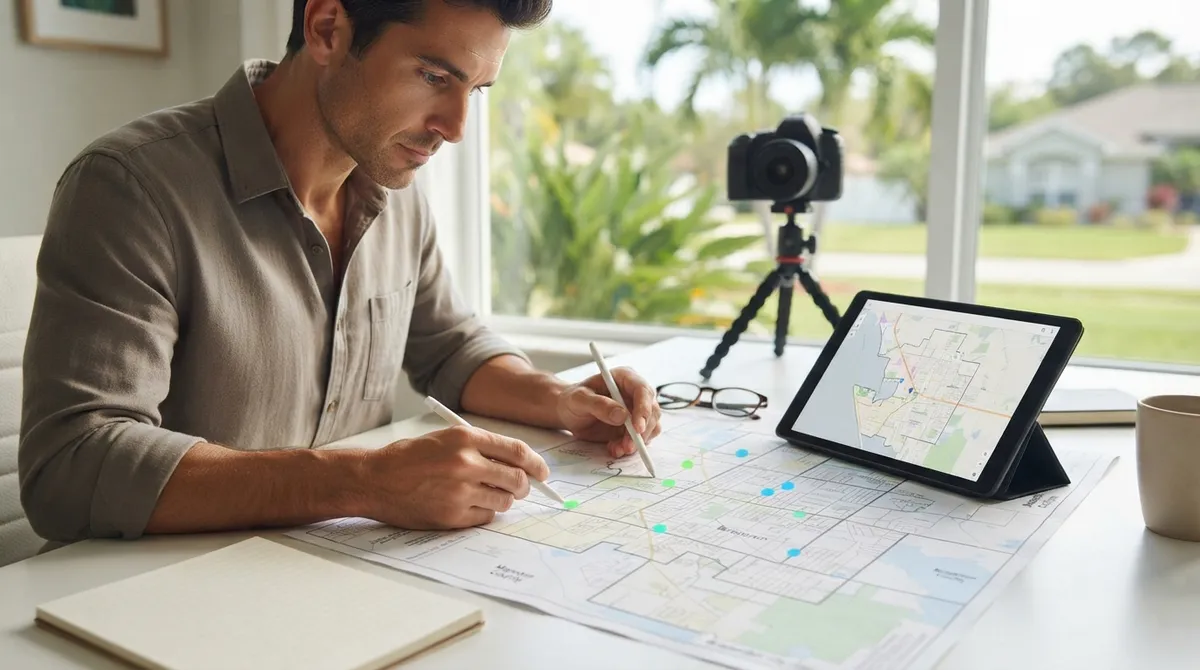
Before you gather a single document, confirm where the property sits. "Bradenton, FL" can refer to a property inside City of Bradenton limits or one in unincorporated Manatee County. The permitting authority follows the property's jurisdiction, not the postal city name.
This matters near city lines, where one side of a street can be city and the other county. If you submit to the wrong office, you lose days or weeks. You can check boundaries with the property appraiser's records, the city's GIS tools, or by asking the building department directly. If you're unsure, our team at 1 Contractor Solutions can sort it out for you, and our Bradenton permitting page shares more local detail.
- Inside City limits: You apply with the City of Bradenton building department.
- Unincorporated Manatee County: You apply through the county's online services portal.
- Unsure: Verify the parcel before you pay for plans or engineering.
City of Bradenton vs. Manatee County: A Side-by-Side Look
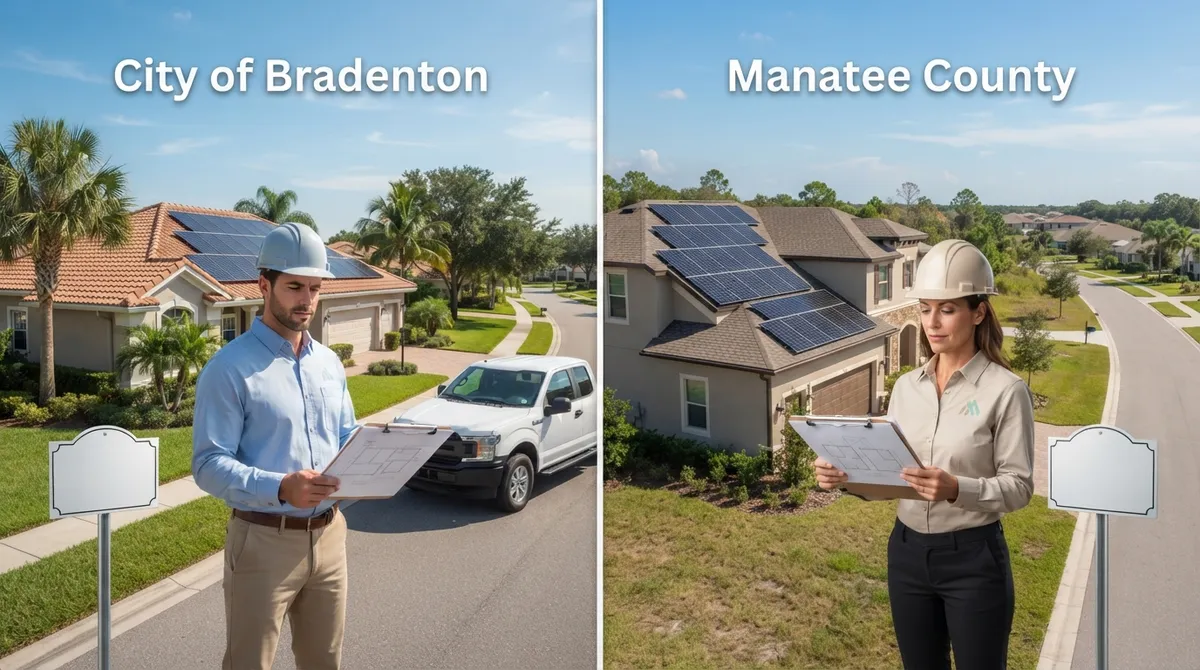
Both offices want a similar core package, but the details differ. Here's a simple comparison of what the published guidance tells us.
| Item | City of Bradenton | Manatee County |
|---|---|---|
| Where to apply | City building department | County online services portal |
| Always-required documents | Building plans and site plan or survey | Building plans and site plan or survey |
| Possible extras | Private-provider notice, owner-builder disclosure, recorded warranty deed after ownership change | Additional documents depending on the project |
| Published residential fee | $150 residential solar permit fee | Confirm with the county |
| Review routing | Building and electrical; zoning if freestanding | Confirm with the county |
The takeaway? The basics line up, but the exact paperwork and fees depend on who owns your jurisdiction. Always verify before you file.
What a Complete Rooftop PV Submittal Usually Includes
Reviewers love a clean, complete package. When a packet is missing pieces, it bounces back, and your install date slides. A solid rooftop PV submittal commonly includes the items below.
- System layout: Where panels, inverters, disconnects, and conduit run on the roof and the structure.
- Structural attachment and roof-load information: How the racking connects to the roof and whether the framing can carry the added weight.
- Electrical diagrams and calculations: A single-line diagram, conductor sizing, and overcurrent protection details.
- Equipment specifications: Panel, inverter, racking, and battery spec sheets.
- Site plan or survey: Shows the building, property lines, and any freestanding array.
Exact engineering and document requirements depend on the project and the reviewing jurisdiction, so confirm them with the applicable building department before submitting. If your structural math needs a seal, our team can help; learn more about who seals structural drawings for Florida permits.
What It Costs: The City's Published Fee Sheet
Let's talk dollars, because that's usually the next question. The City of Bradenton's published solar permit sheet lists a $150 residential solar permit fee and a $420 commercial solar permit fee. Those figures are real, but they aren't the whole story.
The same sheet lists additional charges that may apply, so a quote built only on the base fee can come up short.
| Listed Charge | Amount | Notes |
|---|---|---|
| Residential solar permit | $150 | Base fee |
| Commercial solar permit | $420 | Base fee |
| Fire fee | $65 | Listed additional charge |
| Zoning fee | $300 | Where applicable |
| Subcontractor fee | $100 each | Per subcontractor |
| DBPR tax | 1.5% (minimum $2) | State surcharge |
| DCA tax | 1% (minimum $2) | State surcharge |
Verify applicability and current amounts with the City before relying on any of these numbers. Fee schedules get updated, and what applies to a rooftop job may differ from a freestanding one.
How the Review Actually Flows
The City routes residential solar applications for building and electrical review. If the system is freestanding, such as a ground-mount array, zoning review gets added to the mix. That's where the extra zoning fee can come into play.
A few handy details from the City's published sheet can save you a surprise:
- Battery backup: For solar PV, it's handled under the standard solar permit rather than a separate one.
- Solar attic fans: These do not require a permit.
- Solar roof vents: These do require building review.
- Private-provider review: Some applicants file a Notice to Building Official to use a private provider instead of the standard queue.
If you're curious about the private-provider route, our guide to using private provider plan review in Florida explains how it works and when it saves time.
Rooftop vs. Ground-Mount: Which Path Is Faster?
Not every system takes the same road. Here's how the two most common setups compare in a Bradenton permit.
| Factor | Rooftop PV | Freestanding / Ground-Mount |
|---|---|---|
| Main reviews | Building and electrical | Building, electrical, and zoning |
| Extra fee risk | Lower | Zoning fee may apply |
| Site plan detail | Basic building footprint | Setbacks and placement matter |
| Structural focus | Roof attachments and load | Foundation and wind loading |
Rooftop systems tend to move more simply, while ground-mounts invite closer scrutiny on setbacks and placement. Neither is hard, but each rewards a well-prepared packet.
Permit Approval Is Not Permission to Operate
Here's the part folks often miss, and it deserves a friendly heads-up. A building permit is separate from utility interconnection approval and permission to operate. Your permit issuance does not authorize you to energize the system.
You'll need to coordinate with your utility and your installer in addition to the local permitting authority. Think of it as two lanes on the same road: the permit lane covers code compliance and safety, and the utility lane covers connecting to the grid. Finish both before you flip the switch.
- Confirm your jurisdiction (City or County).
- Submit plans and your site plan or survey.
- Clear building, electrical, and any zoning review.
- Receive the permit and install the system.
- Pass the required inspections.
- Get utility interconnection approval and permission to operate.
Skipping that last step is a classic and costly mistake. If you've already installed without the right sign-offs, there's a path forward, and our article on after-the-fact solar installation in Florida walks you through it.
Common Snags That Slow Bradenton Solar Permits
After years of Florida permitting, we see the same hiccups pop up again and again. The good news: they're all avoidable.
- Wrong jurisdiction: Filing with the county when the property is in the city, or the reverse.
- Missing site plan or survey: This is always required, so leaving it out guarantees a rejection.
- Thin structural documentation: Reviewers want clear attachment and roof-load information.
- Unclear ownership paperwork: A recently changed deed may require a recorded warranty deed.
- Assuming permit equals power-on: Utility approval is its own step.
Solar companies juggling many jobs will recognize these patterns. If that's you, our resources on solar permit filing mistakes and how to speed up solar permit expediting in Florida apply well beyond Orange County.
Inspections and What Comes After the Permit
Once your permit is issued and the system is installed, inspections confirm the work matches the approved plans. Typically that includes an electrical inspection and a building or structural check on the mounting. The specific inspection list can vary, so confirm the required sequence with your building department when you pick up the permit.
Schedule inspections only when the work is truly ready. A failed inspection costs time, and nobody wants a reinspection fee. Keep your approved plan set on site, because inspectors compare the installation against it. If something changes in the field, such as a different panel count or moved equipment, ask about a revision before you build.
Who Benefits Most From Professional Permit Help
Every audience we serve feels these pain points a little differently, so here's how professional support fits each one.
- Solar companies: Faster approvals and code-compliant documentation across many addresses and jurisdictions.
- General contractors: Reliable filing and tracking so a PV scope doesn't hold up the whole job.
- Homeowners and residential owners: Clear guidance without having to learn the process from scratch.
- Real estate professionals: Permit research when evaluating a property with existing solar, including confirming a past install was permitted.
- Designers and trades: Dependable outsourced drafting and engineering without a bigger in-house team.
At 1 Contractor Solutions, we handle permit filing, tracking, plan review coordination, and sealed structural and MEP drawings from our own in-house team. We respond fast and serve all 67 Florida counties, so a Bradenton solar job gets the same care as one anywhere else in the state. You can explore our services for solar contractors or see what customers say when you visit us on Google — 1 Contractor Solutions.
Bringing It All Together
A smooth solar permit in Bradenton, FL comes down to a handful of smart moves. Confirm whether you're in the City of Bradenton or unincorporated Manatee County. Submit complete building plans and a site plan or survey. Budget for the base fee plus any listed extras. Remember that battery backup rides along with the standard solar permit, and that utility interconnection approval is a separate finish line.
Do those things and you'll skip most of the delays that frustrate people. And if you'd rather have a team handle the paperwork, the reviewer comments, and the back-and-forth, we'd be happy to help. Ready to get moving? Get a free quote and let's get your Bradenton solar project permitted and on schedule. For community updates, you can also follow us on LinkedIn.
FAQs
Do I need a permit to install solar panels in Bradenton, Florida?
Yes, a photovoltaic installation generally requires a building permit from your local jurisdiction. Whether that's the City of Bradenton or Manatee County depends on where your property sits, so confirm that first. Solar attic fans are one small exception, since they don't need a permit.
Does my Bradenton address fall under the City of Bradenton or Manatee County?
Not every Bradenton mailing address is inside city limits, and many properties sit in unincorporated Manatee County. Check your parcel with the property appraiser or ask the building department directly. It's a quick step that saves you from filing in the wrong place.
How much does a solar permit cost in the City of Bradenton?
The City's published fee sheet lists a $150 residential solar permit fee and a $420 commercial fee. Additional charges such as fire, zoning where applicable, subcontractor fees, and state taxes may apply on top. Confirm current amounts with the City before quoting a total.
Do rooftop solar panels with battery storage need a separate permit?
In the City of Bradenton, battery backup for solar PV is handled under the standard solar permit, so you don't file a separate one. Confirm the details with your building department for your specific system. Your plans should still show the battery equipment and electrical connections.
Do I need utility approval after my solar permit is issued?
Yes, and it's a big one. A building permit is separate from utility interconnection approval and permission to operate, so permit issuance doesn't authorize you to energize the system. Coordinate with your utility and installer before turning anything on.
We do this work every day across all 67 Florida counties. Call (866) 314-6931 and we will tell you what your situation actually requires — including when you do not need us.
Related services
Permit Facilitation & Filing
You have a crew scheduled, a client asking for dates, and a permit sitting somewhere in a queue you cannot see. We file it, w…
See the servicePlan Review Coordination
A permit in plan review is not one queue. On a commercial project it can be six queues, each with its own reviewer, its own c…
See the serviceReady to get your permit moving?
One call tells you which jurisdiction controls your project, what it will take, and what it will cost. Most of the time we can scope it on the phone.