
Blog
Mold Assessment vs. Building Permit in Sarasota: Which Do You Need?
Mold assessment and building permits are separate in Sarasota. Learn when each applies, Florida's mold rules, and drywall removal guidance.
Key Takeaways
-
A mold assessment documents the condition, but it is not a building permit and does not replace one; permit needs depend on the repair scope, flood zone status, and jurisdiction.
-
Under Florida Statute §468.8419, a mold assessor or its company generally cannot remediate the same property within 12 months of the assessment, with a narrow exception for certain Division I contractors.
-
The City of Sarasota's hurricane guidance allows drywall removal up to 4 feet above the finished floor to limit active mold growth, with no stated square-footage limit.
-
In special flood hazard areas, drywall removal costs must be included in the permit application costs, since these figures feed into substantial improvement calculations.
-
Confirm whether the City of Sarasota or Sarasota County controls your property before filing, since a Sarasota mailing address does not guarantee city limits.
-
Work that touches structural, electrical, plumbing, or mechanical systems usually requires a permit and possibly sealed drawings, so verify requirements with the local building department before rebuilding.
Here's a scenario we hear all the time: a Sarasota homeowner finds a musty smell behind the baseboards after a leak, calls a mold company, and then asks, "Do I need a mold assessment for my permit?" It's a great question, and the honest answer is that it mixes up two completely different things. A mold assessment and a building permit are separate processes handled by separate people, and knowing which is which can save you weeks of frustration.
In this friendly guide, we'll walk through what a mold assessment actually is, when a Sarasota building permit comes into play, and how the two connect. We'll cover Florida's rules for mold professionals, the City of Sarasota's guidance on drywall removal, and the city-versus-county question that trips up a lot of owners. Whether you're a general contractor, a realtor with a closing on the clock, or a homeowner staring at a damp wall, you'll leave with a clear roadmap. Think of this as a conversation with a neighbor who happens to live and breathe Florida permitting.

Why "Mold Assessment for Permit Sarasota" Confuses Everyone
The phrase "mold assessment for permit Sarasota" can point to two separate processes. One is a professional mold assessment, which documents the condition. The other is a local building permit for the repair or reconstruction work that follows. They often happen back to back, which is why people blur them together.
Here's the key point: a mold assessment is not a building permit. It's also not automatically a requirement to get one. Permit needs depend on the repair work itself and the jurisdiction where the property sits.
That said, an assessment can be genuinely helpful. Its findings may document the condition and help define the scope of repairs, which makes your permit application cleaner and easier for reviewers to follow.
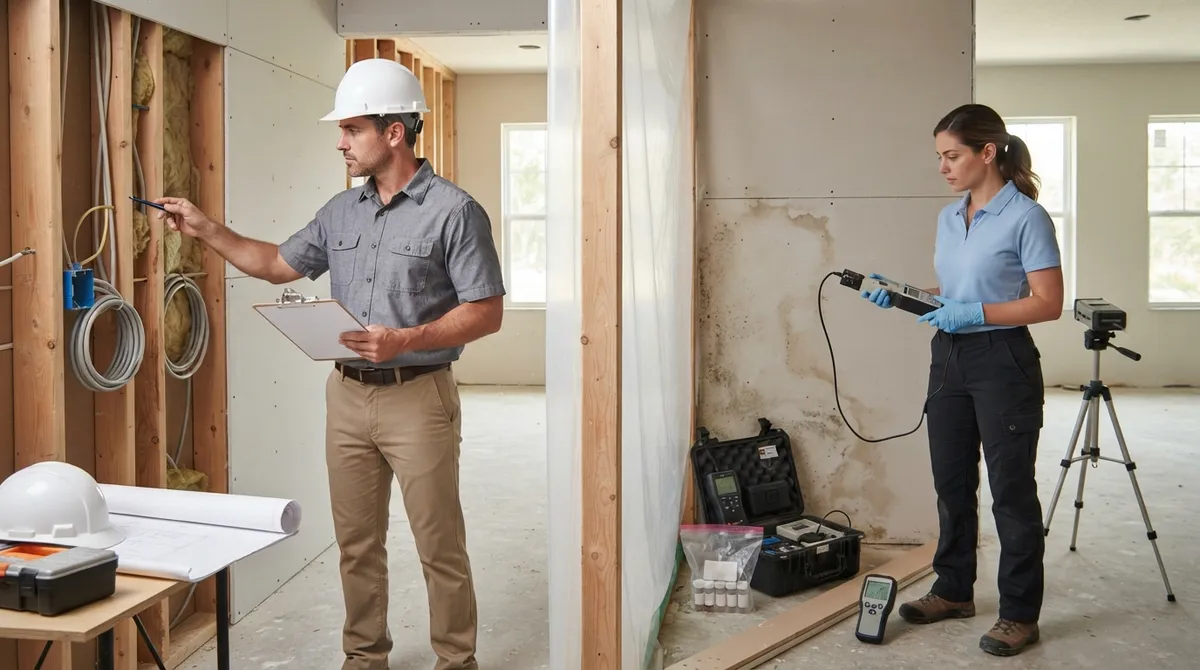
Mold Assessment vs. Building Permit: A Side-by-Side Look
Let's put the two processes next to each other so the differences jump out.
| Feature | Mold Assessment | Building Permit |
|---|---|---|
| What it is | Professional evaluation and documentation of mold conditions | Government approval to perform regulated construction or repair work |
| Who regulates it | State of Florida (Chapter 468, Part XVI) | Local building department (City or County) |
| Who performs it | Licensed mold assessor | Licensed contractor, owner-builder, or permit professional |
| Main purpose | Define the problem and scope | Authorize and inspect the work |
| Can one replace the other? | No | No |
Notice the last row. Mold assessment findings do not replace building permit applications, required plans, inspections, or approvals for regulated construction work. They simply support the story your project tells.
How Florida Regulates Mold Professionals
Florida takes mold work seriously. Under Chapter 468, Part XVI, the state regulates mold assessors and remediators. Florida Statute §468.8419 restricts who may perform or offer mold assessment and remediation. It also requires documented training in water, mold, and respiratory protection for the relevant work.
In plain English, this means you can't just hire any handyman to "assess" mold and expect the paperwork to hold up. If a lender, insurer, or building official asks for documentation, you want it to come from a properly qualified Florida professional.
The 12-Month Separation Rule
Here's a rule that surprises people. Florida law generally bars a mold assessor, or the assessor's company, from performing remediation at a property it assessed during the prior 12 months. The idea is to prevent a conflict of interest, where the same company diagnoses a problem and then profits from fixing it.
The statute provides an exception for certain Division I certified contractors. Because statutory language can change, always confirm the current wording and whether the exception applies to your situation before relying on it.
- Assessor and remediator are generally separate companies
- A 12-month separation period applies after an assessment
- A narrow exception exists for certain Division I certified contractors
- Verify current statute text before making decisions
When Does Sarasota Require a Building Permit?
This is where permitting enters the picture. Whether your repair needs a permit depends on what you're actually doing. Replacing a few stained ceiling tiles is a very different job from rebuilding a wall that involves framing, wiring, or plumbing.
Requirements can vary with the scope of work, flood-zone status, and whether structural, electrical, plumbing, or mechanical systems are affected. If your mold repair touches any of those systems, expect the building department to take an interest.
If you're unsure where your project falls, a quick call to a permitting pro can clear things up fast. You can get a free quote and have someone tell you which jurisdiction controls your address and what it will take.
The City of Sarasota's Drywall Guidance
The City of Sarasota published hurricane-related permit guidance that speaks directly to a common mold scenario. According to that guidance, drywall removal up to 4 feet above the finished floor is allowed to limit active mold growth. It states no total square-footage limit.
That's helpful, because speed matters when moisture is involved. Removing wet drywall quickly can stop mold from spreading while you sort out the rest of the paperwork.
The Flood Zone Twist
Here's the catch. For homes in special flood hazard areas, the removal activity must be included in the costs submitted with the permit application. In other words, even that quick "get the wet wall out" step counts toward your reported project cost.
Why does that matter? Flood-zone cost reporting feeds into substantial improvement calculations, which can affect what's required of your property. Skipping the line item can create headaches later. If you're curious about how those calculations work, our guide on 5 Substantial Improvement After-the-Fact Florida Facts (2026) breaks it down.
| Situation | Drywall Removal Guidance | Extra Step |
|---|---|---|
| Standard home, active mold growth | Removal up to 4 feet above finished floor allowed | Confirm with the local department |
| Home in a special flood hazard area | Same 4-foot allowance | Include removal cost in permit application costs |
| Work beyond limited removal | Likely needs a permit review | Plans may be required |
City of Sarasota or Sarasota County? Start Here
Before you do anything else, figure out who has authority over your property. The City of Sarasota and Sarasota County are separate permitting authorities. The City's Building & Permitting page offers online permit submission for building and engineering work, but only if your address falls inside city limits.
Property lines near city boundaries can be sneaky. A home with a Sarasota mailing address might sit in unincorporated county territory, or it might belong to Venice or North Port. Applying with the wrong office wastes time.
Not sure which jurisdiction you're in? Our Sarasota County page is a good starting point, and our team handles this question every day.
A Simple Roadmap: From Water Damage to Finished Repair
Let's turn all of this into a clear path you can follow. Every project is a little different, but this sequence works for most Sarasota water-damage and mold situations.
- Stop the moisture source. Fix the leak or dry out the flood water first, because mold can't be solved while the wall is still wet.
- Confirm your jurisdiction. Determine whether the City of Sarasota or Sarasota County controls the property.
- Hire a qualified Florida mold assessor. Verify their credentials under Chapter 468, Part XVI.
- Document the condition. Keep the assessment report, photos, and moisture readings together.
- Check permit requirements with the building department. Describe your planned scope honestly.
- Use a separate remediator if required. Remember the 12-month separation rule.
- File the permit and schedule inspections. Do this before rebuilding anything that needs approval.
Following these steps in order protects you from the most common mistake, which is starting rebuilding work before anyone has confirmed whether a permit is needed.
What Documents May Be Needed for a Repair Permit?
Every department has its own checklist, so treat this as a general guide rather than a promise. For a water-damage repair that goes beyond simple cleanup, you may be asked for several items.
- A completed permit application with a clear scope of work
- Contractor license and insurance information, or owner-builder paperwork
- Plans or sketches showing what's being repaired or replaced
- Cost of work, including drywall removal in flood zones
- Engineering or sealed drawings if structural elements are affected
- Supporting documentation such as the mold assessment report
If structural members, like studs or rafters, were damaged, you may need sealed drawings. Our article on who seals structural drawings for Florida permits explains who can provide them. And if your repair involves electrical or plumbing changes, the MEP engineering side may come into play.
Who Benefits Most From Getting This Right?
Different readers feel the pressure in different ways, so let's look at who tends to ask about this topic.
| Reader | Typical Concern | Why It Matters |
|---|---|---|
| Homeowner | Repairing after a leak or storm | Avoid unpermitted work that complicates a future sale |
| General contractor | Scoping repairs after remediation | Keep the crew on schedule and the permit clean |
| Realtor or investor | Closing with moisture or mold history | Open permits and unpermitted repairs can stall closings |
| Restoration company | Emergency drywall removal | Know what's allowed and what needs a permit |
Realtors and investors, in particular, should know that unpermitted repair work can surface at closing. Our resources on who pays for open permits when buying a Florida home and how to handle an open permit before closing in Sarasota are worth a read.
What If the Repair Was Already Done Without a Permit?
Life happens. Maybe a prior owner patched a mold-damaged wall without paperwork, or you rebuilt quickly after a storm and later learned a permit was needed. Don't panic, because Florida has a path for this.
After-the-fact permitting lets you bring completed work into compliance. It typically involves documenting what was built, sometimes with engineering support, and working with the building department to close it out. Our guide to 7 Steps to Legalize Unpermitted Work Florida (2026) walks through the process, and 4 Steps If a Prior Owner Skipped Permits in Florida covers the inherited-problem scenario.
Where 1 Contractor Solutions Fits In
We should be clear about what we do and don't do. 1 Contractor Solutions is not a mold assessor or remediator, and we won't pretend to be. For the mold side, you'll want a properly qualified Florida professional. What we do is the permitting side: figuring out which jurisdiction controls your project, preparing plans, filing, tracking, and working every reviewer comment through to approval.
Our drafting and engineering are in house, and our own engineer signs and seals the work, so when a reviewer flags something we fix it directly. We also cover environmental needs through our asbestos, mold and environmental service page and handle permit facilitation and filing across all 67 Florida counties. If you're a restoration company, we've built workflows just for you, and our Sarasota permit expediter overview shows how that support works locally.
You can also visit our 1 Contractor Solutions location on Google to see what customers say, and stay connected if you follow us on LinkedIn or follow us on Facebook.
Facts We Couldn't Verify (And Why That's Okay)
In the spirit of honesty, here's what we can't hand you: current Sarasota-specific permit fees, processing times, or mold-assessment prevalence statistics. Those numbers change, and nothing we reviewed offered reliable current figures. Verify them directly with the relevant permitting office before you budget or schedule around them.
That's actually good practice for any permitting question. When someone quotes you a fee or a timeline with total certainty, ask where it came from. The building department's published information is always your final authority.
Wrapping It Up
So, back to our opening question. Is a mold assessment required to get a Sarasota building permit? Not as a general rule. A mold assessment documents the condition, while a building permit authorizes the work, and whether you need the second depends on your scope, your flood zone status, and your jurisdiction. The smartest move is to confirm requirements with the applicable building department before you start repairs, and to use qualified Florida mold professionals for the assessment itself.
If you're staring at a wet wall, a stalled closing, or a pile of confusing forms, you don't have to figure it out alone. We're happy to point you to the right office and carry the permit from filing to closeout. Ready to move forward? Get a free quote and let's get your Sarasota project moving.
For more help with marketing and growth, our friends at Brain Buzz Marketing support Florida service businesses too.
FAQs
Do I need a building permit for mold remediation in Sarasota?
Not always! It depends on the repair work involved and which jurisdiction your property sits in. Limited drywall removal may be allowed without a full permit, but rebuilding that touches structural, electrical, plumbing, or mechanical systems usually needs one, so confirm with your local building department first.
Is a mold assessment required to get a Sarasota building permit?
Generally no, because a mold assessment is not a building permit and doesn't replace one. That said, the assessment report can help document the condition and define your repair scope, which makes your application clearer.
Can the same company assess and remediate mold in Florida?
Usually not. Florida Statute §468.8419 generally bars an assessor or the assessor's company from remediating a property it assessed in the prior 12 months, with an exception for certain Division I certified contractors. Double-check the current statute language before relying on that exception.
Does Sarasota allow drywall removal after water damage without extra steps?
The City of Sarasota's hurricane guidance allows drywall removal up to 4 feet above the finished floor to limit active mold growth, with no stated square-footage limit. In special flood hazard areas, that removal cost must be included in your permit application costs.
Should I apply through the City of Sarasota or Sarasota County?
It depends on where your property actually sits. The City and the County are separate permitting authorities, so confirm your jurisdiction first, since a Sarasota mailing address doesn't always mean city limits.
We do this work every day across all 67 Florida counties. Call (866) 314-6931 and we will tell you what your situation actually requires — including when you do not need us.
Related services
Permit Facilitation & Filing
You have a crew scheduled, a client asking for dates, and a permit sitting somewhere in a queue you cannot see. We file it, w…
See the servicePlan Review Coordination
A permit in plan review is not one queue. On a commercial project it can be six queues, each with its own reviewer, its own c…
See the serviceReady to get your permit moving?
One call tells you which jurisdiction controls your project, what it will take, and what it will cost. Most of the time we can scope it on the phone.