
Blog
In-House MEP Support vs. Outside Consultant: Which Wins?
Compare in-house vs. outside consultants for after-the-fact MEP permitting in Florida and learn how to pick the support that fits your project.
Key Takeaways
-
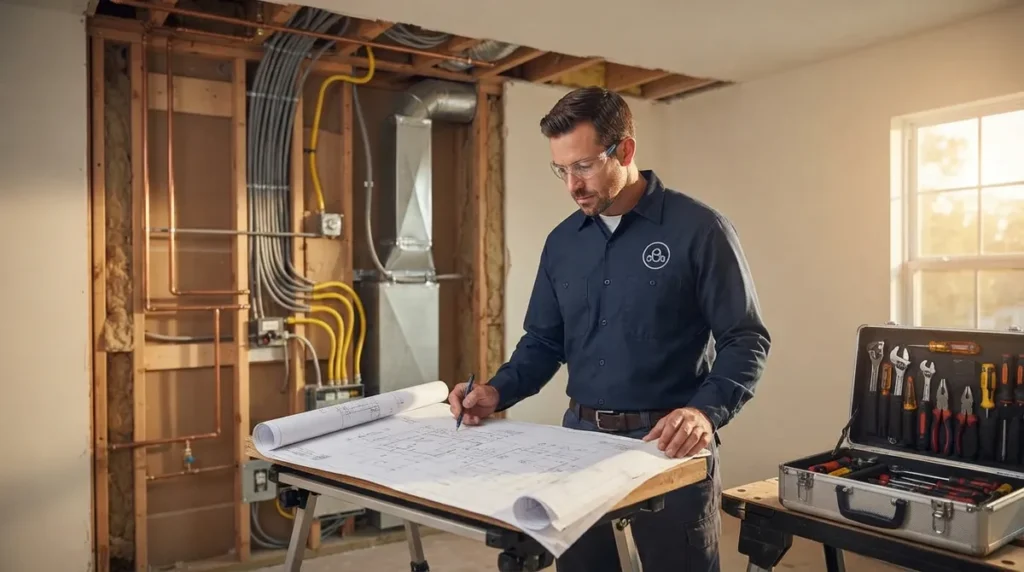
Unpermitted HVAC, electrical, or plumbing work is fixable, but approval is never automatic: building departments may require permit applications, plans, load calculations, inspections, corrections, or opened walls.
-
Permit requirements, fees, and timelines vary by city and county, so confirm which jurisdiction controls your property before filing, especially near city lines.
-
An in-house team that drafts, engineers, files, and answers reviewer comments usually reduces handoffs and revision delays compared with coordinating several separate consultants.
-
Eligibility to apply and sign is jurisdiction-specific; licensed contractors and licensed subcontractors are often required for regulated trades like electrical, plumbing, and mechanical.
-
Concealed work may require wall or ceiling openings for inspector verification, so ask your local department early what it expects for concealed installations.
-
Common pitfalls include filing with the wrong jurisdiction, submitting incomplete plans, using an ineligible signer, and leaving reviewer comments unanswered for weeks.
Picture this: you just found out the HVAC system, the panel upgrade, or the bathroom plumbing in your Florida project went in without a permit. Maybe a prior owner skipped it. Maybe a crew cut corners. Maybe an inspector or a lender spotted it first. Whatever the story, take a breath. This happens a lot, and it is fixable.
The real question is who you should lean on to fix it. Looking for the best MEP after the fact permitting support in Florida usually comes down to one big choice: work with a firm that has its drafting and engineering in house, or piece the job together with outside consultants and hope everyone calls back.
In this friendly guide, we compare both paths side by side. We cover how after-the-fact MEP permitting actually works, what Florida building departments typically expect, and how to pick the support that fits your situation. Whether you are a contractor, solar company, realtor, or homeowner, you will leave with a clear plan and a lot less stress.

What Is After-the-Fact MEP Permitting in Florida?
MEP stands for mechanical, electrical, and plumbing. After-the-fact MEP permitting means resolving permits for HVAC, electrical, or plumbing work that was installed before the required permit was obtained. In other words, the work is already in the walls, and now it needs to be brought into compliance.
Florida requires permits before regulated installation work begins. Fort Lauderdale's published guidance, for example, cites Florida Building Code section 105.1 and Florida Statutes section 553.79(1), which cover regulated electrical, gas, mechanical, and plumbing systems. When that step gets skipped, the local building department decides how to bring the work into the system.
Here is the key point that surprises many people: approval is not automatic. The jurisdiction may require:
- A permit application for the work already completed
- Plans, riser diagrams, load calculations, or other technical documentation
- Inspections of what can be seen
- Corrections where the work does not meet code
- In some cases, opening walls or ceilings so inspectors can verify concealed work
Requirements vary by city and county. That is why jurisdiction-specific experience matters so much. If you want to learn how the broader process works, our guide on how to get an after-the-fact permit in Florida is a great companion read.
Two Paths: In-House Team vs. Outside Consultants
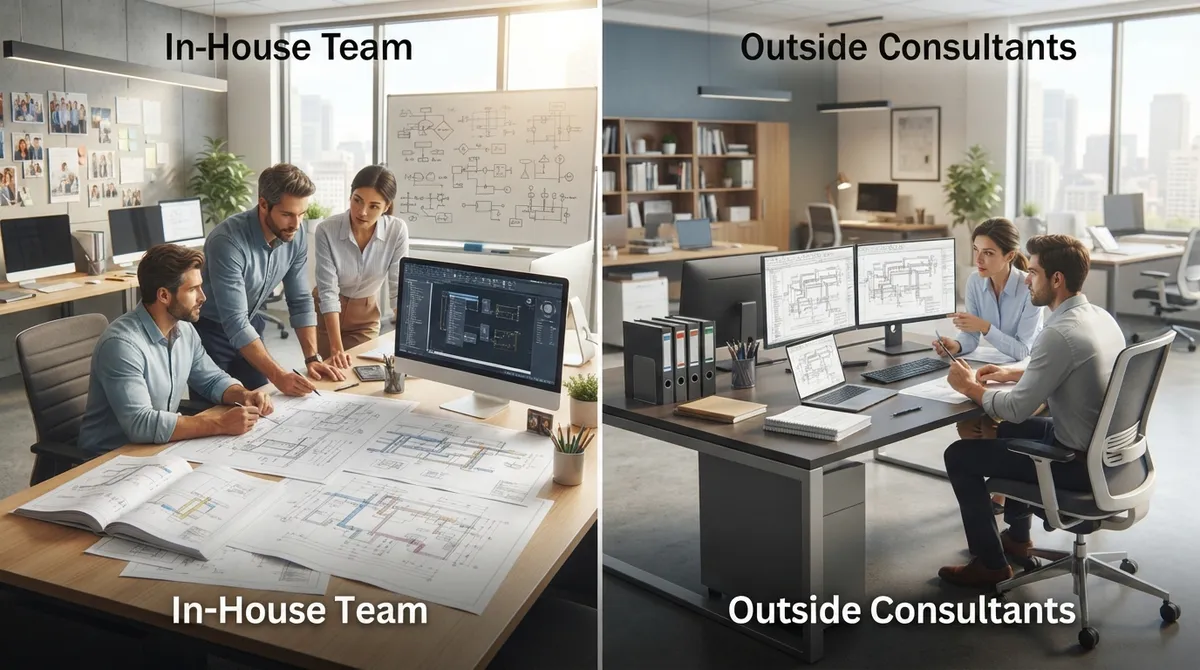
Most people hunting for after-the-fact MEP help end up choosing between two models. Let's call them what they are.
Path 1: The In-House Permitting and Engineering Firm
With this model, one team handles the whole job. They research the jurisdiction, prepare or review plans, draft the MEP documents, have their own engineer seal the work, file the application, track it, answer reviewer comments, and coordinate inspections. When a reviewer flags something, the same team fixes it.
Path 2: The Piecemeal Approach
With this model, you hire a drafter here, an engineer there, and maybe a permit runner on the side. Each party does their slice. You become the project manager, relaying comments between people who have never spoken to each other.
Neither path is evil. Plenty of small jobs get done the second way. But for after-the-fact work, where the details are fussy and the clock is often ticking, the difference shows up fast.
Side-by-Side Comparison
| Factor | In-House Firm | Outside Consultants |
|---|---|---|
| Who fixes reviewer comments? | The same team that drew the plans | You relay comments between several parties |
| Engineer sealing | Own engineer signs and seals in house | Depends on a separate engineer's availability |
| Communication | One point of contact | Multiple contacts, multiple inboxes |
| Revision speed | Usually faster, since everyone is under one roof | Often slower due to handoffs |
| Jurisdiction knowledge | Built across many counties and cities | Varies by individual provider |
| Accountability | One firm owns the outcome | Responsibility can get blurry |
| Fee clarity | Often a single scoped quote | Several invoices that can add up unexpectedly |
That table is not about picking a villain. It is about reducing friction. After-the-fact permits already come with enough uncertainty, so fewer handoffs usually means fewer surprises.
What the Best MEP After-the-Fact Support Actually Does
A strong permitting-support partner does not replace the building official's decision, and it does not replace the licensed contractor's responsibility for regulated work. What it does do is take the heavy administrative and technical lifting off your plate. Here is what that looks like step by step:
- Identify the authority having jurisdiction. Near city lines, it is not always obvious whether the city or the county controls your property. Getting this wrong wastes weeks.
- Review the situation. What was installed, when, by whom, and what is visible versus concealed?
- Prepare the technical documents. This can include MEP drawings, as-built documentation, and engineer letters where the jurisdiction accepts them.
- File the application. The right forms, the right fees, the right signatures.
- Track the review. Someone has to keep watching the portal and the reviewers.
- Work every comment. Revise and resubmit until the reviewer is satisfied.
- Coordinate inspections. Schedule them, prepare the site, and follow through to closeout.
If you want deeper detail on the engineering side, take a look at our MEP engineering service and our as-built drawings support.
The Rules Behind the Process
Understanding the code landscape helps you ask smarter questions. Here are a few facts worth knowing:
| Item | What to Know |
|---|---|
| Florida Building Code edition | 8th Edition (2023), effective December 31, 2023 |
| Update cycle | Florida updates the Building Code on a three-year cycle |
| Electrical baseline | 2020 National Electrical Code as adopted by the state |
| Notice of Commencement | Osceola County notes it is required for construction valued at $5,000 or more; confirm current rules locally |
| Local review targets | Fort Lauderdale aims for initial permit reviews in 30 days or less; this is a local goal, not a statewide guarantee |
Notice what that last row says. Timelines and procedures are local. Anyone promising the same result in every city or county is oversimplifying. A good partner tells you what your specific jurisdiction expects, then gets to work.
Who Is Allowed to Apply and Sign?
This is a spot where homeowners and even some contractors trip up. Eligibility to apply and sign for MEP permits is jurisdiction-specific. Osceola County, for instance, states that licensed contractors must have the permit application signed by the license holder, and that licensed subcontractors are required for regulated trades such as electrical, plumbing, and mechanical.
Owner-builder options exist in some places, but they come with limits and responsibilities. If you are thinking about that route, read up on who can pull a permit in Florida and our owner-builder permits page before you decide.
How Each Audience Benefits From In-House Support
General Contractors
When a client calls about unpermitted MEP work from a previous contractor, you need speed and clarity. An in-house team turns a messy situation into a clean filing and keeps your schedule moving. Our page for general contractors explains how that works.
Solar Companies
Electrical documentation is the heart of solar permitting. If an install went in without the proper paperwork, a team that drafts, engineers, and files in house can legalize it without ping-ponging between vendors. See our solar contractor support.
Realtors and Investors
Open or missing permits tend to show up right when a closing is near. A single accountable team can research the property, scope the fix, and help clear the issue. Learn more about realtor closing support.
Homeowners and Residential Owners
You do not need to become a permitting expert overnight. You need one friendly partner who explains the plan in plain English and handles the paperwork. Our homeowner page is a good starting point.
Architects, Designers, and Trade Pros
If you do not keep drafting and MEP engineering staff on payroll, outsourcing to a team with in-house capability saves you from building that bench. We also offer drafting-only support if you already have your own engineer.
How to Judge Any Provider: A Simple Checklist
Whichever route you pick, use these questions to compare your options:
- Local experience: Have they actually filed in your specific city or county?
- MEP depth: Do they handle mechanical, electrical, and plumbing, or only one trade?
- Plan capability: Can they produce the drawings the jurisdiction asks for?
- Licensed professionals: Are the right licensed people signing and sealing where required?
- Communication: How fast do they respond, and who is your contact?
- Inspection coordination: Will they help with scheduling and follow-through?
- Transparent fees: Do you understand what is included and what government fees are separate?
A government help desk or assistance program can sometimes help you navigate a local process, but it is not an endorsement of any private provider. Do your own homework and ask for specifics.
Can Walls Really Be Opened Up?
Yes, and it is worth knowing before you start. When MEP work is concealed behind drywall, under slabs, or above finished ceilings, a building department may ask for exposure so inspectors can verify what is there. In some cases, engineering documentation or other evidence may help, but that is up to the jurisdiction.
That is one more reason local knowledge matters. A seasoned team can often tell you in advance how a given department tends to handle concealed work, so you are not blindsided. If your property has an open permit issue on top of all this, try our open permit search tool to see where you stand.
Where Things Go Sideways
Here are common pitfalls we see when people go it alone or stitch together a patchwork team:
- Filing with the wrong jurisdiction near city lines
- Submitting incomplete plans that bounce on the first review
- Using a signer who is not eligible for that trade or permit type
- Losing weeks because a reviewer comment sits unanswered
- Assuming the work will simply be approved as installed
None of these are fatal, but each one costs time and money. A coordinated team protects you from most of them. For a related look at mistakes to avoid, see our article on after-the-fact permitting mistakes to avoid in Florida.
Our Take: Why In-House Tends to Win
We are a little biased, so we will be upfront. At 1 Contractor Solutions, we act as Florida's outsourced permitting department. Our drafting and engineering are in house, and our own engineer signs and seals the work. We file, track, work every comment, and carry projects through approval and closeout across all 67 Florida counties. We also respond within 30 minutes, day or night.
That setup exists because we have watched what happens when the pieces live in different places. Reviewer comments sit. Revisions stall. Everyone points at someone else. When the people who draw the plans also fix the plans, things move.
You can learn more on our after-the-fact and expired permits page, or see what clients say by following our reviews and visiting us on Google through Visit us on Google — 1 Contractor Solutions. If you like staying in the loop, follow us on LinkedIn or follow us on Facebook for tips.
When an Outside Consultant Can Still Make Sense
To be fair, the piecemeal route is not always wrong. If you already have a trusted engineer you work with regularly, and you mainly need drafting or filing help, a hybrid approach can work well. That is why we offer flexible options, including drafting-only support.
The key is knowing that you are taking on the coordination yourself. If you are a busy contractor, investor, or homeowner, ask whether you really want that job. Most people say no.
Final Thoughts: Choose Support That Lowers Your Stress
The best MEP after-the-fact permitting support in Florida is not about flashy promises. It is about local knowledge, honest scoping, a capable technical team, and one point of accountability from the first phone call to the final inspection. For most people, an in-house model makes that easier than a stack of separate consultants.
Whatever you decide, remember that only your local building department can approve the work, so make sure whoever you hire respects that and plans accordingly. If you would like a clear, friendly read on your situation, get a free quote and tell us your address and the problem. We will tell you which jurisdiction controls it, what it will take, and then we will go do it.
FAQs
How do I get an after-the-fact permit for unpermitted HVAC, electrical, or plumbing work in Florida?
Start by confirming which city or county controls your property, since each building department sets its own process. Then you will typically submit an application, any required plans or documentation, and schedule inspections. A permitting-support team can handle the filing, tracking, and comment responses so you are not guessing at each step.
Can a Florida building department require walls or ceilings to be opened for inspection?
Yes, it can. If MEP work is concealed, the jurisdiction may ask for exposure so inspectors can verify it meets code. What is required varies by city and county, so it helps to ask early what your department expects.
Does every Florida city or county have the same after-the-fact permitting process?
Nope. Applications, fees, documentation, and inspection paths differ from one jurisdiction to the next, even though the statewide baseline is the Florida Building Code 8th Edition (2023). That is why local experience is such a big deal when choosing support.
Who can apply for and sign an after-the-fact electrical, mechanical, or plumbing permit in Florida?
It depends on your jurisdiction. Osceola County, for example, says licensed contractors must have applications signed by the license holder and that regulated trades need licensed subcontractors. Owner-builder options exist in some places but come with their own rules, so confirm locally before you file.
What happens if unpermitted MEP work fails inspection?
The inspector will note what needs to be corrected, and you will fix the issue and request a re-inspection. In some cases that means revising plans or reworking the installation. Having a team that can draft, engineer, and respond to comments in house makes this loop much quicker.
We do this work every day across all 67 Florida counties. Call (866) 314-6931 and we will tell you what your situation actually requires — including when you do not need us.
Related services
Permit Facilitation & Filing
You have a crew scheduled, a client asking for dates, and a permit sitting somewhere in a queue you cannot see. We file it, w…
See the servicePlan Review Coordination
A permit in plan review is not one queue. On a commercial project it can be six queues, each with its own reviewer, its own c…
See the serviceReady to get your permit moving?
One call tells you which jurisdiction controls your project, what it will take, and what it will cost. Most of the time we can scope it on the phone.