
Blog
How to Estimate After-the-Fact Roof Permit Costs FL
After-the-fact roofing permit costs in Florida vary by city and county, combining the standard fee with a penalty that can double or quadruple it.
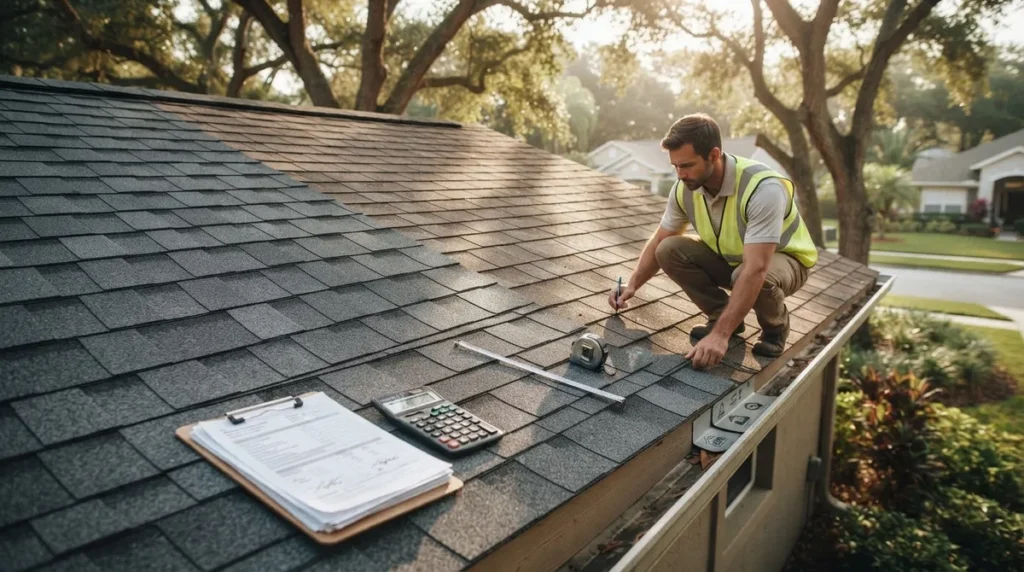
Key Takeaways
-
After-the-fact roofing permit costs in Florida vary by jurisdiction with no statewide price; fees are calculated using a two-part formula combining the standard permit fee plus a penalty multiplier that ranges from 2x to 4x depending on location.
-
Penalty multipliers differ dramatically across Florida: Orange County doubles the fee with a $103 minimum, while Miami charges 4x for non-homestead properties and Flagler Beach can impose up to 4x the building permit fee.
-
Standard roofing fees are calculated differently by jurisdiction using either project value (Orange County: $26 first $1,000 plus $5 per additional $1,000), square footage (Hialeah: $0.15-$0.20 per sq ft), or tiered structures (Homestead: $125 for first 2,000 sq ft).
-
An after-the-fact permit requires documentation including product approval numbers, roof system details, contractor records, and may require partial roof inspection or tear-off to verify code compliance, potentially adding repair costs if deficiencies are found.
-
Homestead residential properties typically receive friendlier penalty multipliers than commercial or non-homestead properties, making property classification a significant cost factor in your final after-the-fact permit bill.
-
Filing a standard permit on time costs dramatically less than after-the-fact permits: a hypothetical $8,000 residential re-roof costs ~$61 on-time versus $164-$244+ after-the-fact depending on jurisdiction and property type.
So your roofer finished the job, the new shingles look fantastic, and then someone mentions the word "permit." If your stomach just did a little flip, take a breath. You are definitely not alone, and this happens more often than you'd think across every corner of the Sunshine State. Whether you're a homeowner in Bradenton, a general contractor juggling five jobsites, or a realtor trying to close a sale before an unpermitted roof throws a wrench into everything, understanding how much an after-the-fact roofing permit costs in Florida is the first step toward fixing the problem instead of losing sleep over it.
Here's the honest answer up front: there is no single statewide price tag. Florida has 67 counties and hundreds of municipalities, and each one sets its own fee schedule, penalty multiplier, and paperwork requirements. But don't worry, we're going to walk through real numbers, real examples, and a friendly roadmap so you know exactly what to expect before you pick up the phone.

What Is an After-the-Fact Roofing Permit, Exactly?
An after-the-fact permit (sometimes called a retroactive or ATF permit) is what you apply for when roofing work happened before a permit was pulled. Maybe a contractor promised to "handle it" and didn't. Maybe a previous owner replaced the roof and skipped the paperwork entirely. Either way, the building department still needs to review and approve that work, and they charge extra for the privilege of doing it backward.
Florida building code doesn't magically forgive unpermitted work just because time has passed. If anything, waiting tends to make the process more complicated. Learn more about whether Florida building code allows after-the-fact permits before assuming your situation is unique.
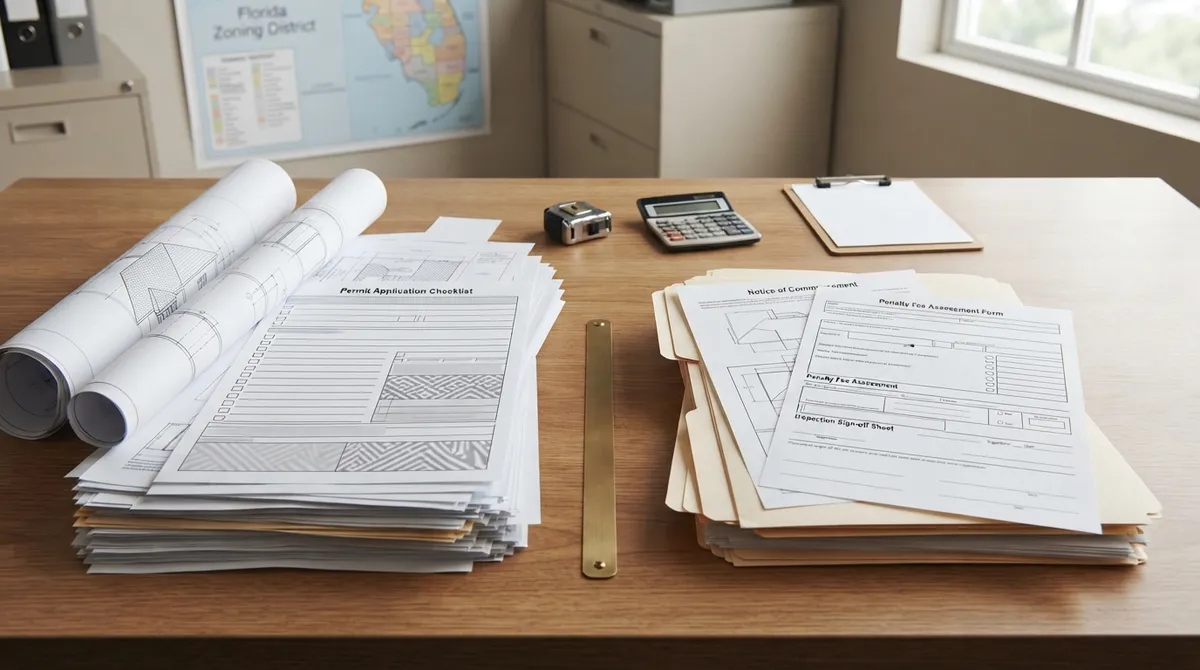
The Two-Part Cost Formula Every Jurisdiction Uses
Almost every Florida city or county calculates an after-the-fact roofing permit the same basic way:
- The standard roofing permit fee — based on project value, roof square footage, or a flat schedule.
- A penalty for starting without a permit — usually a multiplier of that base fee, sometimes with a minimum dollar amount.
Add those together, and you've got your after-the-fact total. The tricky part is that the multiplier and the base fee formula both change depending on where the roof sits.
How Standard Roofing Fees Are Calculated
Some counties use a project-value approach. Orange County, for example, charges residential re-roofing at $26 for the first $1,000 of work, plus $5 for every additional $1,000 or fraction thereof. Commercial or multifamily roofing runs $54 for the first $1,000, plus that same $5 increment.
Other cities calculate by square footage instead. Hialeah's fee schedule lists a $180 minimum for many residential roofing categories, with shingle roofing charged at $0.15 per square foot and tile roofing at a higher $0.20 per square foot. Homestead uses yet another structure, listing residential roofing at $125 for the first 2,000 square feet, with additional tiers depending on size and material.
See why we can't give you one flat number? The formula itself shifts from city to city, before you even add the penalty.
Real Penalty Examples From Florida Jurisdictions
This table pulls together a few published examples so you can see how differently the penalty math plays out depending on location.
| Jurisdiction | Standard Roofing Fee Structure | After-the-Fact Penalty |
|---|---|---|
| Orange County | $26 first $1,000 (residential) + $5 per additional $1,000 | Double the fee, or $103, whichever is greater |
| Putnam County | Standard permit, zoning, and admin fees combined | 100% penalty (fees effectively double) |
| City of Miami | Standard fee plus base charge | 2x fee + base fee (homestead) or 4x fee + base fee (non-homestead/commercial) |
| City of Homestead | $125 first 2,000 sq ft, tiered beyond that | Double the fee plus $100 |
| Flagler Beach | Standard building permit fee schedule | Up to 4x the building permit fee |
| Bradenton Beach | Standard fee plus $50 per added trade | Double the normal fee plus original fees |
Notice the spread: some places double your fee, others quadruple it, and a few tack on a flat penalty regardless of project size. This is exactly why so many homeowners and contractors reach out for after-the-fact and expired permit help rather than guessing at the number themselves.
What Actually Drives Your Final Number
Beyond the base fee and penalty multiplier, several factors nudge your total up or down:
- Roof size and material — tile typically costs more per square foot than shingle in fee calculations.
- Property classification — homestead residential properties often get a friendlier multiplier than commercial or non-homestead properties.
- Plan review requirements — some jurisdictions require engineering documentation or product approvals before they'll even process the application.
- Inspection needs — if the department wants to open up concealed work to verify it meets code, that adds time and sometimes cost.
- Administrative and zoning fees — Putnam County, for instance, folds building, zoning, administrative, and plan-review charges into its penalty calculation.
If your project checks several of these boxes at once, your final invoice can look very different from a neighbor's simple shingle repair three streets over.
Documentation the Building Department Will Likely Request
An after-the-fact permit doesn't automatically legalize whatever was installed. Departments commonly ask for:
- A completed permit application listing the contractor or owner-builder
- Product approval numbers for the roofing materials used
- Roof-system documentation, including underlayment and fastening details
- Plans or engineering calculations, depending on roof type and slope
- A scheduled inspection, sometimes requiring partial removal of finished work to verify what's underneath
- Correction of any code deficiencies found during that inspection
That last item is the one that surprises people. If the inspector finds something that doesn't meet current code, you may need repairs before you get your approval, on top of the fees you already paid.
Comparing Standard vs. After-the-Fact Costs
To make this concrete, here's a simplified comparison showing how a hypothetical $8,000 residential re-roof might play out under two different penalty structures.
| Scenario | Base Permit Fee | Penalty Applied | Estimated Total |
|---|---|---|---|
| Standard permit, filed on time | ~$61 (Orange County formula) | None | ~$61 |
| After-the-fact, double-fee jurisdiction | ~$61 | 2x, or $103 minimum | ~$164 |
| After-the-fact, 4x jurisdiction (non-homestead) | ~$61 | 4x fee + base charge | ~$244+ (plus base fee) |
These figures are illustrative, not a quote for your specific roof. But they show the pattern clearly: filing on time is almost always cheaper, sometimes dramatically so.
Why Guessing Costs You More Than Asking
We talk to homeowners and contractors every week who assumed the fine would be a small flat fee, only to discover their municipality applies a 4x multiplier plus a base charge for non-homestead properties. That surprise is avoidable. A quick lookup of your specific jurisdiction, roof classification, and project value gets you a real number instead of a guess.
This is precisely the kind of detail work 1 Contractor Solutions handles every day. As Florida's outsourced permitting department, we identify which city or county actually controls your property, calculate the applicable fees and penalties, and file the application correctly the first time. Our in-house engineering team can also produce sealed drawings on the spot if the reviewer requests documentation, so you're not stuck waiting on an outside consultant to call back.
Who Runs Into After-the-Fact Roofing Situations Most Often
This issue touches more people than you'd expect:
- General contractors who inherited a project where a previous crew skipped the permit step
- Solar companies whose panel installation is held up because the underlying roof was never permitted
- Realtors and buyers discovering an open or missing roofing permit during closing
- Homeowners who hired a handyman years ago and are now selling or refinancing
- Property managers overseeing multiple units where paperwork fell through the cracks
If you're in real estate, an unpermitted roof can absolutely delay or derail a closing. Our realtor and closing support services exist specifically to untangle these situations before they cost you the deal.
Steps to Take Before You Apply
Here's a practical sequence that keeps the process smooth:
- Confirm which building department has jurisdiction over the property (city vs. county lines can be confusing).
- Pull the current fee schedule and penalty policy for that exact jurisdiction.
- Gather roofing material information, product approval numbers, and any available contractor records.
- Calculate the base fee using square footage or project value, whichever that jurisdiction requires.
- Apply the correct penalty multiplier or flat fine.
- Submit the application and prepare for a possible inspection, including partial opening of the roof if requested.
Skipping any of these steps often leads to rejected applications and repeated fees, which is more frustrating than the original problem.
Getting Help Across Florida
Whether your property sits in Tampa, Miami, St. Petersburg, Fort Lauderdale, or Orlando, the fee structures and penalty rules genuinely differ. We work across all Florida counties, including Manatee County, Pinellas County, and Hillsborough County, and we've filed in more than 400 municipalities, so we know the quirks that catch people off guard.
Roofing contractors juggling multiple projects at once might also appreciate our Roof Permit Partnership Program, built specifically to keep permit paperwork from piling up. And if you're facing a stop-work order or a closing deadline, our urgent permit rescue service is designed for exactly that kind of pressure.
A Few Related Reads Worth Bookmarking
If you want to go deeper on nearby topics, check out our guides on the penalty for building without a permit in Florida, how to close an expired permit in Florida, and what happens when an open permit is found at closing. Each one tackles a piece of this same puzzle from a slightly different angle.
For general background on Florida's building code framework, the Florida Building Commission's official site is a solid resource, and homeowners researching insurance implications may find the Federal Emergency Management Agency's guidance on roof compliance helpful as well.
Wrapping It Up With a Little Encouragement
Discovering that your roof needs an after-the-fact permit isn't fun, but it's also not the end of the world. Florida jurisdictions handle this situation every single day, and with the right information, you can move through it calmly instead of anxiously. The fee will vary based on your city or county, your roof's size and material, and whether the property is homestead or commercial, but now you know exactly what questions to ask and what documents to gather.
Our team at 1 Contractor Solutions has spent more than 15 years helping homeowners, contractors, and realtors across the state sort out exactly this kind of situation, and we answer calls 24/7 with a response time under 30 minutes. Feel free to get a free quote and we'll tell you plainly what your jurisdiction requires and what it will cost. You can also visit us on Google — 1 Contractor Solutions to see what other Florida property owners have said about working with us, or follow us on LinkedIn and follow us on Facebook for ongoing updates on Florida permitting rules. You've got this, and we're happy to help you get there.
FAQs
How much is an after-the-fact roofing permit in my Florida city or county?
It really depends on where your roof sits, since every Florida jurisdiction sets its own base fee and penalty. Some places double the standard roofing fee, while others charge up to four times that amount plus a base charge, so it's always worth checking your specific city or county before assuming a number.
Is an after-the-fact roofing permit double the normal permit fee in Florida?
In many jurisdictions, yes, doubling is common, like Orange County's policy of charging double the fee or $103, whichever is greater. But other cities, including parts of Miami and Flagler Beach, can apply penalties up to four times the standard fee, so don't assume doubling is universal.
Can I get a roofing permit after the work has already been completed?
Absolutely, and it happens all the time. You'll need to submit an after-the-fact application with details about the roofing material, contractor information, and possibly product approvals, and the department may require an inspection to confirm everything meets code.
Will the building department require a roof inspection or partial tear-off for an unpermitted roof?
It's possible, especially if the inspector can't verify installation details from the surface alone. Some jurisdictions ask for a section of the roof to be opened up so they can confirm underlayment, fastening, and structural details before signing off.
Can an after-the-fact roofing permit affect a home sale or insurance claim?
Yes, it definitely can. Unpermitted roofing work discovered during a title search or appraisal can delay or complicate closing, and insurance companies sometimes scrutinize claims tied to work that was never properly permitted, so resolving it early really does pay off.
We do this work every day across all 67 Florida counties. Call (866) 314-6931 and we will tell you what your situation actually requires — including when you do not need us.
Related services
Permit Facilitation & Filing
You have a crew scheduled, a client asking for dates, and a permit sitting somewhere in a queue you cannot see. We file it, w…
See the servicePlan Review Coordination
A permit in plan review is not one queue. On a commercial project it can be six queues, each with its own reviewer, its own c…
See the serviceReady to get your permit moving?
One call tells you which jurisdiction controls your project, what it will take, and what it will cost. Most of the time we can scope it on the phone.