
Blog
How to Choose Who to Hire for Flood Zone ATF Permits in FL
Wondering who to hire for flood zone after-the-fact permits in Florida? Learn each pro's role, the 50% rule, and the right order to hire them.
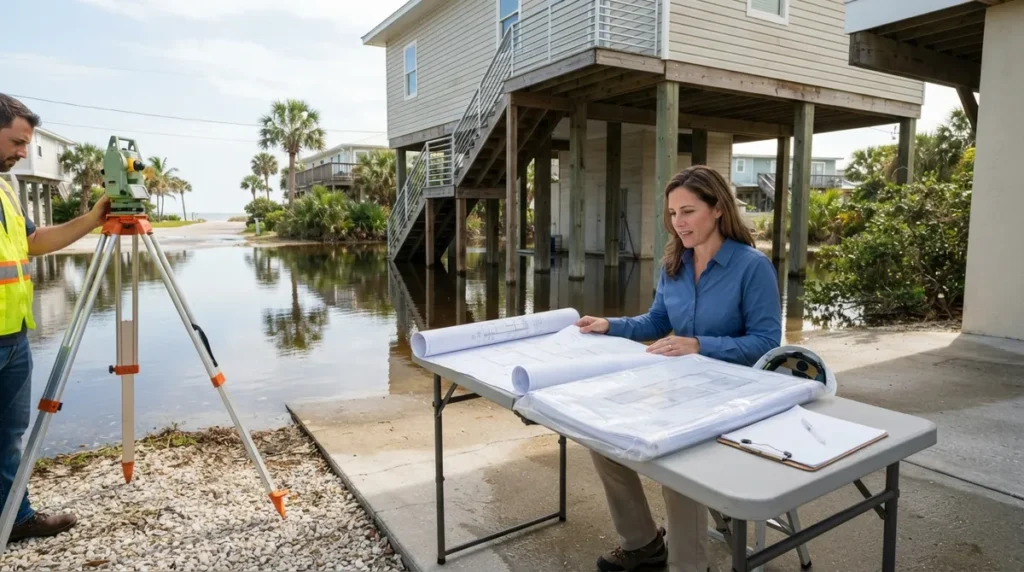
Key Takeaways
-
Start by calling the local building department and floodplain administrator, since rules vary by city and county and they determine the permit path and required documents.
-
Run the 50% test early: if repair or improvement costs reach 50% of pre-work market value, the whole structure may need current flood-resistant compliance, including possible elevation.
-
Hire a permitting firm to act as coordinator, tracking the application, answering reviewer comments, and keeping the engineer, surveyor, and contractor moving together.
-
Florida-licensed engineers or architects are typically needed for sealed plans, structural evaluations, and flood-resistant design documentation when the jurisdiction requires them.
-
Elevation certificates generally must be completed and sealed by a Florida-licensed surveyor and mapper, and you should confirm with the floodplain administrator whether one is required for finished work.
-
Avoid hiring a contractor first, skipping the floodplain administrator, or promising to simply pay a fine; flood-zone legalization depends on documentation and any required corrections.
You finished the work, and then you found out the property sits in a flood zone. Maybe a prior owner built the addition. Maybe a crew skipped the permit. Maybe a lender or an appraiser just flagged it. Whatever brought you here, take a breath. This is fixable, and you are far from the first Florida property owner to ask who should I hire for flood zone after the fact permitting Florida projects require.
Here is the honest answer: it is rarely just one person. Flood-zone after-the-fact permitting usually takes a small team. The local floodplain administrator sets the rules, a licensed contractor documents and corrects the work, and licensed design professionals produce the sealed drawings and certificates the building department wants to see. A good permitting partner keeps all of those pieces moving together.
In this guide, we will walk through who does what, in what order, and how to avoid the mistakes that stall these files for months. Whether you are a homeowner, a general contractor, a realtor, or a solar company, you will leave with a clear plan.
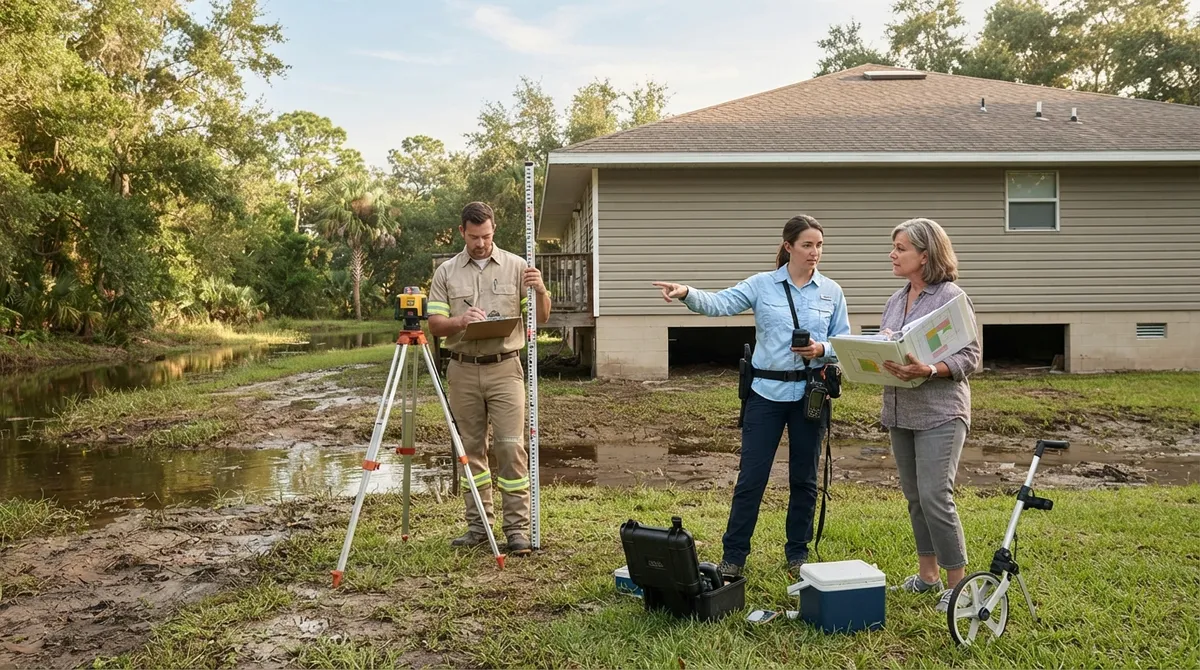
Why Flood Zones Make After-the-Fact Permits Different
A standard after-the-fact permit asks one question: does the existing work meet code? In a flood zone, the building department asks a second question: does it meet floodplain rules? That second question changes who you need.
Florida floodplain guidance says floodplain development and building permits must be obtained before work or land-disturbing activity begins in a flood zone. When work is already done, the local authority decides what documentation, inspections, engineering, or corrective work is needed before it can be legalized. Requirements vary by city and county, so there is no single statewide checklist.
If you want a broader look at the process, our guide on how to get an after-the-fact permit in Florida covers the basics before the flood-zone layer gets added.
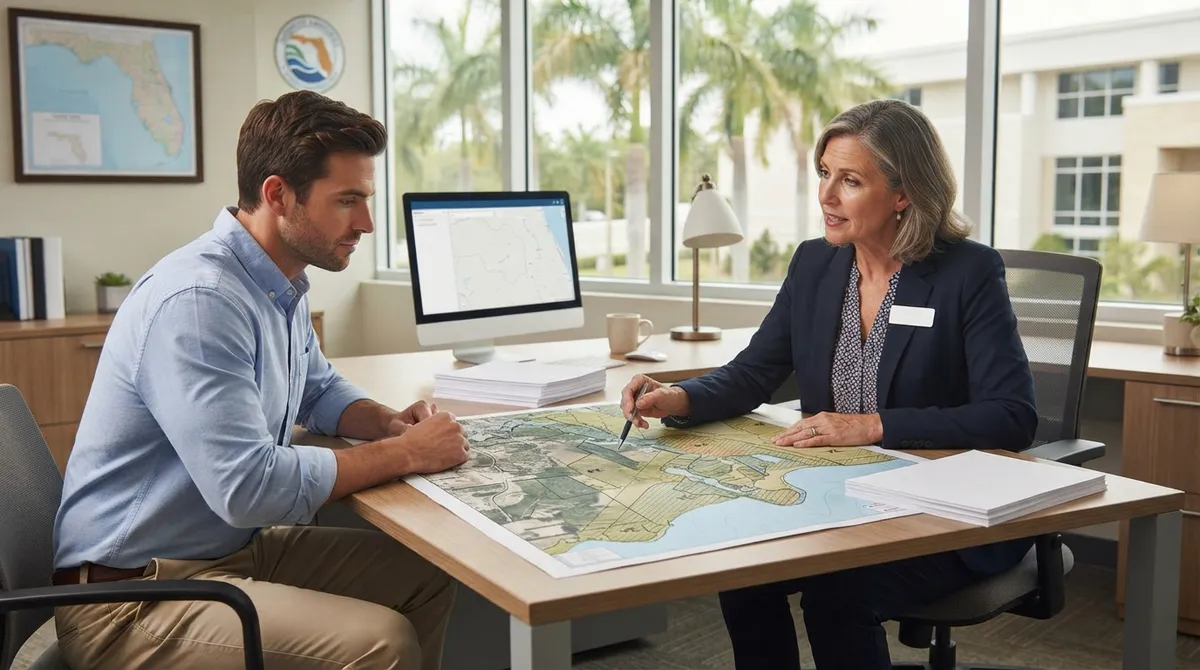
Step 1: Start With the Floodplain Administrator
Before you hire anyone, find out who actually controls your property. Your first call should go to the building department and floodplain administrator for the jurisdiction where the property sits. They determine the permit path, the documents required, and whether the work complies with local floodplain rules.
This matters because city lines are tricky. A home with a Tampa mailing address may fall under a different authority than you expect. Our building department lookup tool can help you confirm which office to contact.
When you reach out, be upfront. Disclose the scope of the work, the approximate dates, and who performed it. Then ask these questions:
- What application type applies to completed, unpermitted work?
- Is an elevation certificate required, and at what stages?
- Do you need sealed plans or an engineering evaluation?
- How does the jurisdiction calculate substantial improvement or substantial damage?
- Will inspections require opening finished walls or floors?
Write down the answers. They become your hiring brief.
Step 2: Understand the 50% Rule Before You Spend Money
The single most important number in flood-zone permitting is 50%. The commonly applied federal benchmark says that if the cost of improvements or repairs equals or exceeds 50% of the building's market value before the work (or before the damage), the structure may be treated as a substantial improvement or substantially damaged.
The local official makes that call, and local ordinances control how costs, prior work, and valuations are counted. If the threshold is met, the whole structure may need to comply with current flood-resistant construction requirements, which can include elevation.
That is why hiring decisions matter so much. We cover the details in our article on the FEMA 50 percent rule in Florida.
| Scenario | What It Could Mean | Who You Likely Need |
|---|---|---|
| Work cost is well under 50% of building value | Standard after-the-fact path with floodplain documentation | Permitting pro, contractor, possibly surveyor |
| Work cost approaches or exceeds 50% | Possible full flood-code compliance, including elevation | Engineer or architect, surveyor, permitting pro |
| Substantial damage from a storm | Repairs may trigger the same threshold | Contractor, engineer, permitting pro |
| Coastal high-hazard (Zone V) structure | Special design certification may apply | Licensed engineer or architect |
Step 3: Know Which Professionals You Actually Need
Here is where people get tripped up. Paying a penalty or collecting a contractor's letter does not legalize flood-zone work on its own. Each role below has a specific job, and a building department may require some or all of them.
A Florida-Licensed Permitting Professional
A permitting firm is the quarterback. It figures out the jurisdiction, assembles the application packet, files it, tracks it, answers reviewer comments, and coordinates everyone else. This is the role that keeps your project from stalling between professionals.
At 1 Contractor Solutions, we handle permit facilitation and filing and specialize in after-the-fact and expired permits, including the files other firms decline.
A Florida-Licensed Contractor
A general contractor experienced with after-the-fact permits and flood-zone projects can document what was built, prepare a scope and cost estimate, and coordinate any corrections. That cost estimate also feeds the 50% calculation. Keep in mind that a contractor cannot replace plans, certifications, or approvals that must come from licensed design professionals or the local authority.
A Florida-Licensed Engineer or Architect
Hire a licensed professional engineer or architect when the building department requires a structural evaluation, sealed plans, or flood-resistant design documentation. Florida's floodplain guidance specifically calls for an engineer or architect to review or prepare certain designs, including Zone V design certifications for applicable new construction, substantial improvements, or repairs of substantially damaged structures.
Our in-house team provides structural engineering, as-built drawings, and engineer letters, so a reviewer comment gets fixed instead of bounced to an outside consultant.
A Florida-Licensed Surveyor and Mapper
If the jurisdiction requires an elevation certificate, a licensed surveyor and mapper prepares it. Florida's floodplain quick guide notes that elevation certificates document building and equipment elevations and generally must be completed and sealed by a licensed surveyor, subject to stated exceptions for zones without base flood elevations.
The same guide describes elevation documentation at two construction stages where applicable: after the lowest floor or lowest horizontal structural member is placed (before further vertical construction), and an as-built elevation certificate before final inspection. For finished work, ask the floodplain administrator how they want that handled.
| Professional | Primary Role | Typical Deliverable |
|---|---|---|
| Permitting firm | Coordinates the whole process | Filed application, tracking, comment responses |
| General contractor | Documents and corrects the work | Scope, cost estimate, corrective work |
| Engineer or architect | Evaluates and designs | Sealed plans, structural letter, design certification |
| Surveyor and mapper | Measures elevations | Sealed elevation certificate |
| Floodplain administrator | Approves compliance | Permit decision, inspection sign-off |
Step 4: Follow This Order of Operations
Hiring in the right sequence saves real money. Here is a simple path that works for most flood-zone after-the-fact files:
- Confirm the jurisdiction. Identify the correct building department and floodplain administrator.
- Gather what you already have. Collect photos, receipts, contracts, old permits, prior survey, and any existing elevation certificate. Our open permit search tool can reveal prior permit history.
- Disclose and ask. Contact the local authority, describe the scope, and request the required documentation list.
- Run the 50% test. Have a contractor price the work and compare it to the pre-work market value as the jurisdiction defines it.
- Hire your team. Bring in the permitting firm, engineer or architect, and surveyor as the checklist requires.
- File and track. Submit the packet and answer reviewer comments quickly.
- Complete inspections and close out. Finish any corrective work and request final approval.
If you are not sure where to start, our urgent permit rescue service is built for exactly these situations, including stop work orders and closings held up by permits.
How to Decide What You Need Based on Who You Are
Homeowners and Residential Property Owners
If you bought a home and later discovered unpermitted work, start with the floodplain administrator, then hire a single permitting firm to coordinate the rest. Doing it yourself is possible, but juggling a surveyor, an engineer, and a contractor without a coordinator is where homeowners lose months. See our page for homeowners for how we help.
General Contractors
If your crew built the work, you may carry licensing exposure. Bring in a permitting partner early, document everything honestly, and let sealed drawings do the heavy lifting. Our general contractor services are designed for this.
Realtors, Investors, and Buyers
When a closing is on the clock, speed and clarity matter. Ask the permitting firm to research the open permit and flood-zone status first so you can decide whether to cure, credit, or walk. Our realtor and closing support and the article on clearing a permit hold before closing are good starting points.
Solar Companies and Specialty Trades
Rooftop and ground-mount systems in flood zones can raise equipment-elevation questions. If an installation went in without a permit, a permitting firm with in-house engineering can produce code-compliant structural and electrical documentation. See our solar contractor page.
What to Ask Before You Hire Anyone
Not every firm that offers permit help is equipped for flood-zone work. Use these questions to screen candidates:
- Have you handled after-the-fact permits in my specific county or city?
- Who seals the drawings, and are they a Florida-licensed engineer or architect?
- Do you coordinate the elevation certificate, or do I hire the surveyor separately?
- How do you handle the 50% substantial-improvement calculation?
- What happens if the reviewer rejects the first submittal?
- Will I get a written scope and clear communication on timing?
Be cautious of anyone who promises to simply "pay a fine and make it go away." Flood-zone compliance is about documentation and, when required, correction, not just penalties.
Common Mistakes That Stall Flood-Zone ATF Permits
- Hiring a contractor first. Without knowing the local requirements, you may pay for work that gets redone.
- Skipping the floodplain administrator. They hold the answers on elevation and cost thresholds.
- Under-documenting the work. Reviewers want photos, measurements, and proof of materials.
- Ignoring the 50% rule. A late surprise can change the entire scope.
- Using out-of-state or unlicensed professionals. Seals must come from Florida-licensed professionals.
- Assuming the answer is the same everywhere. Rules differ between cities and counties.
For more on pitfalls, read 7 flood zone permitting Florida steps to know in 2026 and how unpermitted structures can affect flood insurance.
Can Unpermitted Work in a Flood Zone Be Legalized Without Removing It?
Often, yes. Many after-the-fact projects are approved once the right documentation is submitted and any required corrections are made. But it depends on the local official's determination. If the work does not meet flood elevation or building-code requirements, you may be asked to retrofit, modify, or in some cases remove portions of it.
The more complete and honest your package is, the better your odds. That is why the combination of a permitting coordinator and sealed engineering is so valuable. Our guide on whether you will really have to demolish unpermitted work goes deeper.
Where to Find Local Help
Because every jurisdiction is a little different, local experience matters. We work in all 67 Florida counties and have filed in more than 400 municipalities. If your property is on the coast, you may find county-specific pages helpful, such as Pinellas County, Hillsborough County, and Manatee County. You can also see what clients say when you visit us on Google — 1 Contractor Solutions, and for the state's own guidance, the Florida Floodplain Management Quick Guide is a solid reference. FEMA also publishes its NFIP substantial improvement and damage guidance.
The Bottom Line: Build the Right Team
So, who should you hire for flood zone after the fact permitting in Florida? Start with a call to your local floodplain administrator, then hire a permitting firm to coordinate, a Florida-licensed engineer or architect for sealed documents when required, a licensed surveyor for the elevation certificate, and a licensed contractor for any corrective work. Each has a clear role, and the order you hire them in makes a real difference.
You do not have to figure this out alone. Our team answers 24/7, responds within 30 minutes, and puts sealed in-house drawings behind every file. If you are ready to move from stuck to approved, get a free quote and let us map your path. You can also follow us on LinkedIn for more Florida permitting tips.
FAQs
Who should I hire to get an after-the-fact permit for unpermitted work in a Florida flood zone?
Start by calling your local building department and floodplain administrator, then hire a Florida permitting firm to coordinate the process. Depending on what the jurisdiction requires, you may also need a licensed engineer or architect, a licensed surveyor, and a contractor for corrective work. A good permitting partner keeps all of those moving together.
Do I need a licensed engineer or architect for a flood-zone after-the-fact permit?
Often, yes, but it depends on what your building department requires. Sealed plans, structural evaluations, or flood-resistant design documentation, including Zone V design certifications, generally come from a Florida-licensed engineer or architect. Ask the floodplain administrator up front so you only pay for what is needed.
Who can prepare an elevation certificate in Florida, and when is one required?
A Florida-licensed surveyor and mapper generally completes and seals elevation certificates, with limited exceptions for zones without base flood elevations. Whether one is required for finished, unpermitted work is up to your local floodplain administrator, so confirm that before you hire anyone.
What is the 50% rule for flood-zone renovations in Florida?
It is the commonly applied benchmark where work or repair costs equal to or greater than 50% of the building's pre-work or pre-damage market value count as a substantial improvement or substantial damage. If your project crosses that line, the structure may need to meet current flood-resistant construction rules, which can include elevation. Your local official makes the final determination.
Can unpermitted work in a Florida flood zone be legalized without removing it?
In many cases it can, once the right documentation, inspections, and any required corrections are completed. If the work does not meet flood or building-code requirements, the local authority may require changes or removal of certain parts. Disclosing the scope early and submitting a complete, sealed package gives you the best chance of keeping it.
We do this work every day across all 67 Florida counties. Call (866) 314-6931 and we will tell you what your situation actually requires — including when you do not need us.
Related services
Permit Facilitation & Filing
You have a crew scheduled, a client asking for dates, and a permit sitting somewhere in a queue you cannot see. We file it, w…
See the servicePlan Review Coordination
A permit in plan review is not one queue. On a commercial project it can be six queues, each with its own reviewer, its own c…
See the serviceReady to get your permit moving?
One call tells you which jurisdiction controls your project, what it will take, and what it will cost. Most of the time we can scope it on the phone.