
Blog
How Long Does a Building Permit Take in Cape Coral?
Cape Coral single-family permits averaged about 110 days to issuance in FY2026 Q1. Learn what drives timelines and how to avoid delays.
Key Takeaways
-
Cape Coral's FY2026 Q1 report shows an average of about 110 calendar days from application to issuance for single-family permits, including applicant correction and resubmission time.
-
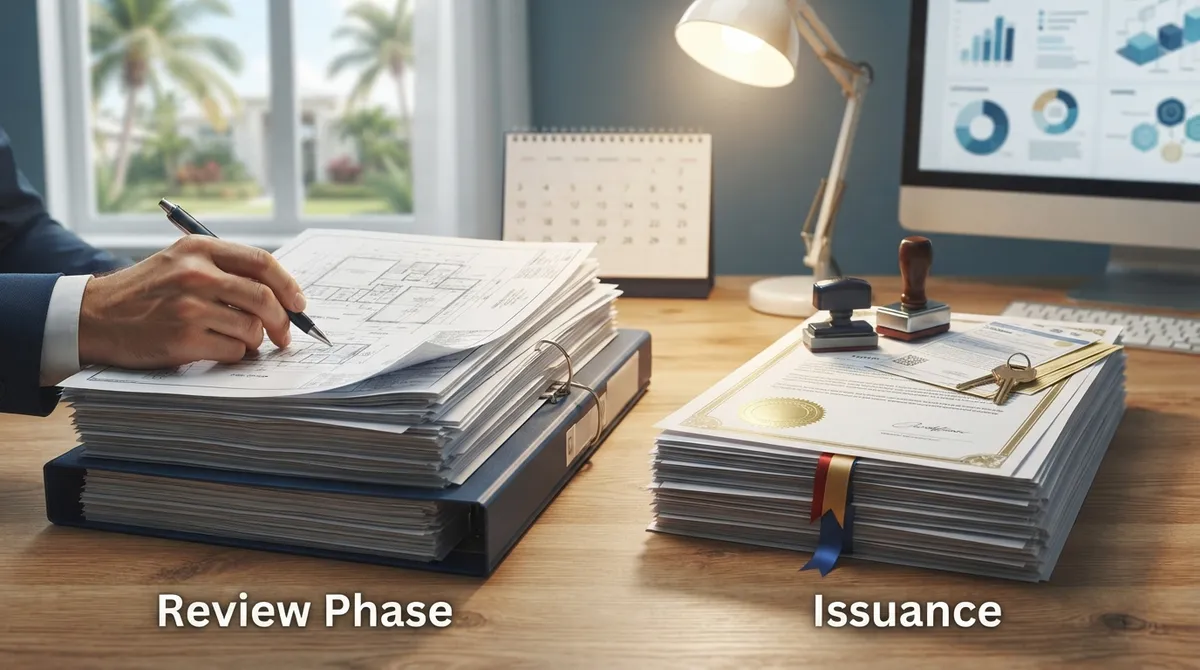
Review time and time to issuance are different: city review is only one leg, while issuance includes comments, corrections, and resubmittals that often make up most of the total.
-
Only 67.85% of applications were approved on first review in FY2026 Q2, averaging just over 3.2 review cycles, so a complete first submittal is the biggest timeline lever.
-
Florida Statute 553.792 sets decision deadlines (e.g., 30 business days for qualifying residential structures under 7,500 sq. ft.) but only after a complete and sufficient application, and they are not guaranteed issuance dates.
-
Common delay causes include mismatched flood or elevation data, unclear setbacks, undocumented structural or wind-load details, and responding to comments without revising the flagged sheet.
-
Plan in ranges with buffers, run an internal plan check before uploading, and answer each comment with a precise quote, explanation, and reference to the revised sheet.
If you have ever stood on a lot in Cape Coral with a crew scheduled, a client waiting, and no permit in hand, you know the feeling. Everyone wants one simple number. Unfortunately, the honest answer to how long does a building permit take in Cape Coral is: it depends, and the biggest variable is often you.
Here is the headline. The City of Cape Coral's FY2026 Q1 report showed an average of about 110 calendar days from application to issuance for single-family permits. That figure includes city review time and the time applicants spend fixing comments and resubmitting. It is not the same as the city's plan-review turnaround.
Florida law also sets decision deadlines for complete applications, and those get mixed up with issuance timelines all the time. In this friendly guide, we will untangle the numbers, show you where projects stall, and share practical ways general contractors, solar companies, realtors, designers, and homeowners can keep a permit moving.
The Short Answer: What the Numbers Actually Say
Let us start with the quick version, then dig into the details.
- Average single-family issuance: about 110 calendar days from application to issuance (FY2026 Q1), including applicant correction and resubmission time.
- Typical city review times by discipline: measured in business days, with several reviews often running side by side.
- First-time approval rate: 67.85% of applications (excluding push-button permits) were approved on first review in FY2026 Q2, with just over 3.2 review cycles per application on average.
- Simple permits: can move much faster than full single-family builds.
That last point matters. A like-for-like roof replacement and a new single-family home live in completely different worlds. The more disciplines involved, the more places a comment can land.
Review Time vs. Time to Issuance: The Difference That Trips Everyone Up
When people ask how long a building permit takes in Cape Coral, they usually mean one thing: how long until I can start work? But the city reports several different clocks, and they are not interchangeable.
| Measure | What it includes | Who controls the clock |
|---|---|---|
| Plan-review turnaround | City staff reviewing one submittal | The city |
| Time to issuance | Review, comments, corrections, resubmittals, and final issuance | Shared: city and applicant |
| Statutory decision deadline | Time for the city to approve, approve with conditions, or deny a complete and sufficient application | The city, once the application is complete |
Think of it like a relay race. The city carries the baton for a leg, then hands it back to you with comments. Every handoff adds time. If your handoffs are slow or incomplete, the total stretches out, even when the city's own review is quick.
Cape Coral Review Times by Discipline
For single-family permits, Cape Coral's FY2026 Q1 report listed these average review times in business days:
| Review discipline | Average review time (business days) |
|---|---|
| Building | About 17 |
| Floodplain | About 17 |
| Planning | About 13 |
| Environmental | About 9 |
| Stormwater | About 5 |
Notice that these are single-review averages. A project may go through each discipline more than once if comments come back. And since Cape Coral is a canal-heavy, flood-conscious city, floodplain and stormwater reviews are a regular part of the conversation for many residential projects.
If you want a feel for how a nearby market compares, our guide on how long a building permit takes in Fort Myers is a handy reference.
Why Total Issuance Time Is So Much Longer Than One Review
Here is the part that surprises people. In FY2026 Q2, just over two-thirds of applications cleared the first review. That means roughly one in three needed at least one round of corrections. Across all applications, the average was just over 3.2 review cycles.
Do the math with those discipline numbers. Even if each cycle takes a few weeks, three or more cycles plus the time it takes to prepare responses add up quickly. That is how a set of review times measured in days becomes an average issuance time measured in months.
Common Reasons a Cape Coral Permit Needs Another Round
- Missing or unclear site plan details, setbacks, or lot information
- Flood zone or elevation information that does not match what the plans show
- Structural or wind-load details that are not clearly documented
- Mechanical, electrical, or plumbing sheets that do not match the floor plan
- Missing product approvals, contractor information, or supporting forms
- Responding to a comment without actually revising the sheet the reviewer flagged
The good news? Nearly all of these are preventable with a careful pre-submittal check.
Florida's Statutory Deadlines: What They Mean and What They Do Not
Florida Statute §553.792 sets deadlines for local governments to act once they receive a complete and sufficient application. These are real and useful, but they are widely misunderstood.
| Project type (general) | Decision deadline after a complete and sufficient application |
|---|---|
| Qualifying residential structures under 7,500 sq. ft. | 30 business days |
| Qualifying residential structures of 7,500 sq. ft. or more | 60 business days |
| Qualifying signs and nonresidential buildings under 25,000 sq. ft. | 60 business days |
| Specified work under $15,000 on an existing single-family dwelling | 5 business days |
| Qualifying master-permit site-specific applications | 12 business days |
Two important cautions. First, eligibility and deadlines depend on the statute's conditions, so check the current text of Florida Statute 553.792 for your situation. Second, these deadlines are for the local government to approve, approve with conditions, or deny. They are not a promise that your permit will be issued by that date.
An incomplete submission, applicant-caused delay, a resubmission, or another statutory exception can all affect the clock. A denial that lists deficiencies starts a new cycle for you. So the statute protects you most when your package is complete the first time.
How Project Type Changes the Timeline
Not every permit travels the same road. Here is a general way to think about it, based on complexity rather than promises.
| Project type | Typical complexity | What tends to slow it down |
|---|---|---|
| Small like-for-like repair or replacement | Low | Missing product approvals or contractor details |
| Solar and electrical-only work | Low to moderate | Structural or electrical documentation gaps |
| Remodels and additions | Moderate | Structural details, flood compliance, multiple disciplines |
| New single-family homes | High | Floodplain, stormwater, environmental, and planning reviews plus multiple cycles |
| Commercial or nonresidential | High | Larger plan sets, more disciplines, more comments |
If you are comparing project types, our article on roof permits in Cape Coral shows how a simpler scope behaves, and our guide to a garage conversion permit in Cape Coral shows what a moderate scope looks like.
Step by Step: How a Cape Coral Permit Typically Moves
While every project is a little different, most follow this rhythm:
- Confirm the jurisdiction and scope. Verify the property is inside Cape Coral city limits and identify every permit the project requires.
- Prepare the plans and documents. Drawings, site plan, engineering, product approvals, and contractor information all need to be consistent.
- Submit a complete application. Completeness is what starts the clock that matters.
- Undergo discipline reviews. Building, floodplain, planning, environmental, and stormwater reviewers may each weigh in.
- Respond to comments. Every comment needs a clear, documented response and revised sheets where required.
- Resubmit and re-review. This is where the average of just over 3.2 cycles comes from.
- Approval and issuance. Once approved and fees are settled, the permit is issued and work can begin.
Notice that steps 5 and 6 are the ones you can influence most. Quick, accurate, complete responses shorten the loop.
What Documents Do You Usually Need?
Requirements vary by project, so always confirm with the city, but a typical residential submittal often includes:
- Completed permit application and contractor details
- Site plan showing setbacks, lot features, and proposed work
- Floor plans, elevations, sections, and construction details
- Structural calculations or engineering where required
- Flood zone and elevation information where applicable
- Mechanical, electrical, and plumbing sheets or notes as needed
- Product approvals for windows, doors, roofing, and similar items
If your plan set is not quite permit-ready, our overview of how to get permit-ready plans Florida officials approve walks through what reviewers expect. And if sealed drawings are on your checklist, see who seals structural drawings for Florida permits.
Tips for Each Type of Reader
General Contractors
Your crew schedule is only as good as your permit forecast. Build in the reality of multiple review cycles rather than the best case. Batch your questions to the reviewers, keep your plan set consistent across disciplines, and track every comment to a documented response.
Solar Companies
Solar jobs are usually simpler than new construction, but they are unforgiving about structural and electrical documentation. A mismatch between the single-line diagram, panel specs, and roof details is a classic reason for a correction. Our post on speeding up solar permit expediting in Florida has more ideas.
Realtors and Investors
If you are evaluating a property for renovation or legalizing existing work, budget extra time for research and possible corrections. Before you buy, it helps to run an open permit search in Cape Coral so there are no surprises at closing.
Homeowners and Residential Property Owners
You do not need to become a code expert, but a little preparation goes a long way. Gather your survey, any prior plans, and photos of existing conditions. Ask your contractor or designer how they plan to handle floodplain and structural documentation up front. And if you are worried about unpermitted work, read 7 steps to legalize unpermitted work in Florida.
Architects, Designers, and Specialty Trades
Coordination is your superpower. Make sure architectural, structural, and MEP sheets reference each other correctly, and that every disciplinary comment is answered on the right sheet. Outsourcing drafting or engineering can free up your team without losing quality, especially when you need drafting-only versus full-service support.
Seven Ways to Shorten Your Cape Coral Permit Timeline
- Submit complete the first time. This is the single biggest lever, and it ties directly to the statutory clock.
- Run an internal plan check. Compare every sheet against the others before you upload.
- Answer comments precisely. Quote the comment, explain the fix, and point to the revised sheet.
- Respond fast. The time you take to answer counts toward total issuance.
- Confirm flood and site details early. Cape Coral's floodplain and stormwater reviews are a regular part of residential submittals.
- Use qualified professionals. Clear, code-aware drawings reduce back-and-forth.
- Track the file actively. Do not wait for a status email; check for new comments regularly.
Can a Permitting Service Speed Things Up?
This is a fair question, and it deserves an honest answer. A Florida permitting service cannot control the city's review queue or guarantee approval. What it can do is reduce avoidable delays.
That means checking submittal completeness, coordinating required documents and reviews, tracking comments, and preparing timely, organized responses. Since only about two-thirds of applications clear on the first pass, tightening that first submittal is where the most time is saved.
1 Contractor Solutions works as an outsourced permitting department across all 67 Florida counties, with in-house drafting and sealed engineering so reviewer comments get fixed without waiting on an outside consultant. If you want a deeper look at how this kind of help works, see permit runner versus full-service expediter, and our permit facilitation and filing page for the full picture.
You can also see what customers say by reading Visit us on Google — 1 Contractor Solutions.
What If You Get a Denial, Corrections, or a Stop Work Order?
It happens, and it is not the end of the world. A comment letter is a to-do list, not a verdict. Read each item, fix the underlying issue, and resubmit with a clear response. If a denial or stop work order has you stuck, our guides on who can rescue a denied building permit in Florida and what to do after a Cape Coral stop work order can help you take the next step. For urgent situations, our urgent permit rescue team can step in.
A Realistic Way to Plan Your Schedule
So, how should you actually plan? Rather than betting on a single number, plan in ranges and build in buffers.
- For simple permits, plan for faster movement but still allow time for a correction.
- For remodels, additions, and new homes, assume multiple review cycles and plan accordingly.
- Use the roughly 110-day single-family average as a reality check, not a promise.
- Keep your own response time as short as possible, because that portion is entirely yours.
- Confirm current timelines with the city or a permitting professional before committing dates to clients or crews.
Numbers change quarter to quarter, so treat any figure as a snapshot. The city's quarterly reports are the best place to see the latest data.
Ready to Get Your Cape Coral Permit Moving?
Permit timelines are frustrating, but they are far more manageable when you know what is driving them. Complete submittals, consistent plans, and fast, precise responses are your best tools. If you would rather hand the paperwork to people who live in this world every day, get a free quote and we will tell you which jurisdiction controls your project and what it will take.
For more tips and updates, you can follow us on LinkedIn or follow us on Facebook. Our website and content partner is Brain Buzz Marketing.
FAQs
How long does a building permit take in Cape Coral, Florida?
It varies by project, but the City of Cape Coral's FY2026 Q1 report showed an average of about 110 calendar days from application to issuance for single-family permits. That figure includes city review plus the time applicants spend correcting and resubmitting, so simpler projects can move faster and complex ones can take longer.
What is the difference between permit review time and time to permit issuance?
Review time is how long city staff spend on a single submittal, while time to issuance covers the whole journey, including comments, corrections, resubmittals, and final approval. Since the average application goes through just over 3.2 review cycles, issuance takes much longer than one review.
What are Florida's statutory deadlines for building permit reviews?
Under Florida Statute 553.792, local governments generally have 30 business days for qualifying residential structures under 7,500 square feet and 60 business days for larger ones and certain nonresidential projects. These deadlines apply only after a complete and sufficient application and are for a decision, not a guarantee of issuance.
Can a permitting service speed up a Cape Coral permit?
A permitting service cannot control the city's review queue or guarantee approval, but it can help you avoid avoidable delays. By checking completeness, coordinating documents, tracking comments, and preparing timely responses, it can help shorten the back-and-forth that stretches out timelines.
What happens if Cape Coral requests corrections or additional documents?
You will receive comments that need a documented response and, usually, revised plan sheets or added documents. Responding quickly and completely helps, because the time you take counts toward your total time to issuance and each new round restarts a review.
We do this work every day across all 67 Florida counties. Call (866) 314-6931 and we will tell you what your situation actually requires — including when you do not need us.
Related services
Permit Facilitation & Filing
You have a crew scheduled, a client asking for dates, and a permit sitting somewhere in a queue you cannot see. We file it, w…
See the servicePlan Review Coordination
A permit in plan review is not one queue. On a commercial project it can be six queues, each with its own reviewer, its own c…
See the serviceReady to get your permit moving?
One call tells you which jurisdiction controls your project, what it will take, and what it will cost. Most of the time we can scope it on the phone.