
Blog
How Do I Legalize an Unpermitted Shed in Florida?
Learn how to legalize an unpermitted shed in Florida: after-the-fact permits, zoning checks, inspections, documents, and when to get help.
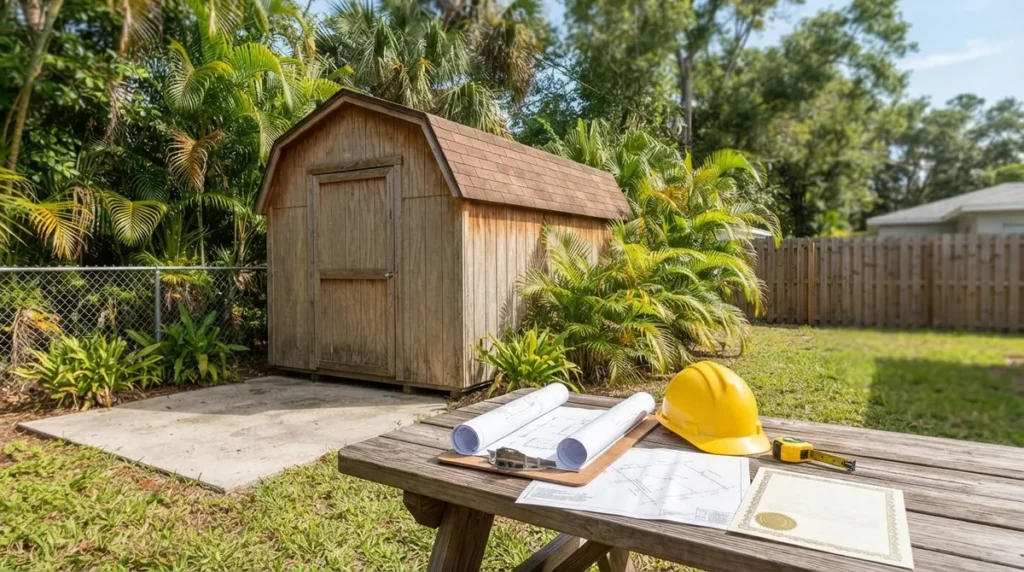
Key Takeaways
-
Florida has no single statewide shed rule; local building departments and zoning offices set their own permit thresholds, so always confirm with the agency controlling your address.
-
The usual path to legalize an unpermitted shed is an after-the-fact (retroactive) permit filed with the local building department, starting with an honest conversation about the shed's size, use, and installation date.
-
A code exemption for sheds up to 200 sq ft does not waive zoning review, so check setbacks, easements, lot coverage, height, and flood-zone limits even if no building permit is required.
-
Expect inspectors to ask for proof that concealed framing, anchoring, and foundation work meets code; a sealed engineer's letter can sometimes verify construction without opening walls.
-
Electrical, plumbing, or mechanical work in a shed, such as lights, outlets, or a mini-split, typically needs separate trade permits and inspections.
-
Unresolved unpermitted sheds can delay property sales, complicate insurance claims, and hold up future permits like pools or additions, so addressing them early is worthwhile.
So you have a shed in your backyard, and you just realized it never got a permit. First, take a breath. You are far from the first Florida homeowner to find themselves in this spot. Maybe the previous owner built it. Maybe a handyman said it was "too small to need one." Or maybe you assembled a kit shed on a long weekend and never gave the paperwork a thought.
The good news is that how to legalize an unpermitted shed in Florida is a question with a real, workable answer. In most cases, the path runs through your local building department and something called an after-the-fact permit. The not-so-good news is that Florida has no single statewide shed rule. What works in Charlotte County may not work in Pasco County, and your city may have its own twist on top of that.
In this guide, we will walk through the process in plain English. You will learn what to ask your building department, what documents to gather, what inspectors look for, and what can go wrong. Whether you are a homeowner, a realtor facing a closing, or a contractor helping a client, you will leave with a clear game plan.
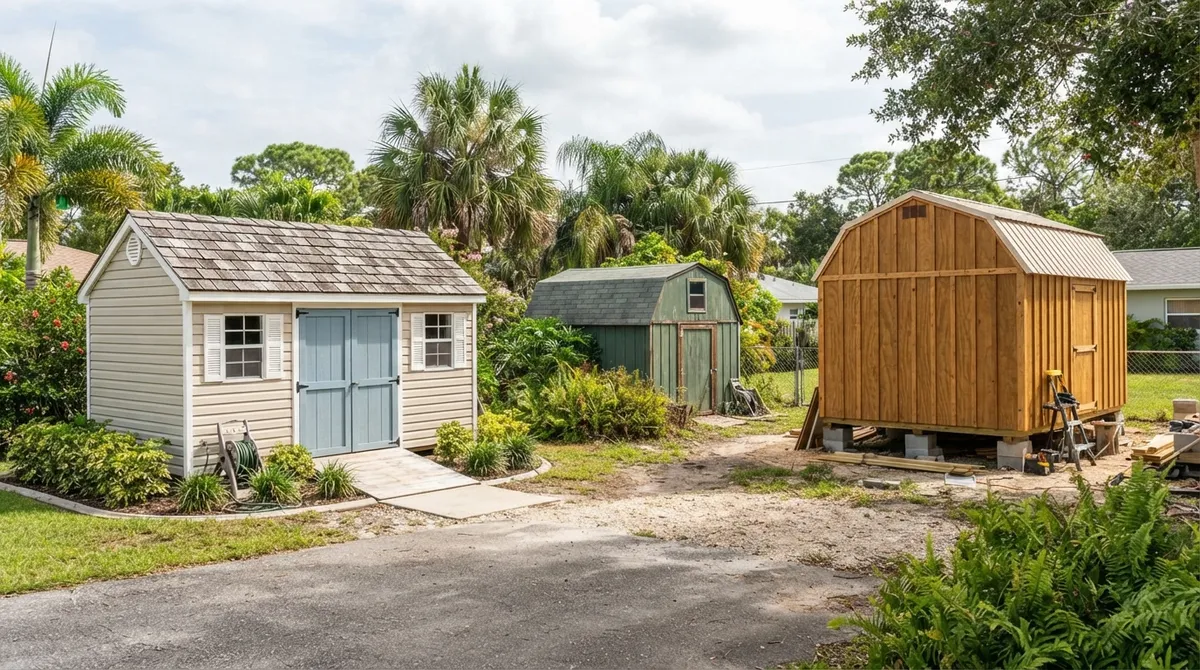
Why Florida Shed Rules Are Not One-Size-Fits-All
Many people assume Florida has one simple rule, like "sheds under 200 square feet do not need a permit." It is a popular belief, and it is only partly true. Here is why it causes trouble.
The Florida Building Code Residential section R105.2 includes a model-code exemption for certain one-story detached accessory structures not exceeding 200 square feet. But local governments can adopt their own permitting, zoning, and floodplain rules on top of that. Some jurisdictions require permits for sheds regardless of size.
Here are a few real examples of how much local rules differ:
- Charlotte County: Guidance distinguishes sheds of 100 square feet or less from larger sheds for plan-review purposes. Plastic or rubber manufactured sheds of 68 square feet or less do not need a building permit there, though zoning setbacks still apply.
- Pasco County: The county code states that sheds require building permits regardless of size.
- Other counties and cities: Each sets its own thresholds, forms, and review steps.
The takeaway? Never rely on a statewide number. Always confirm with the building department that actually controls your address. If you are not sure which agency that is, our building department lookup tool can point you in the right direction.
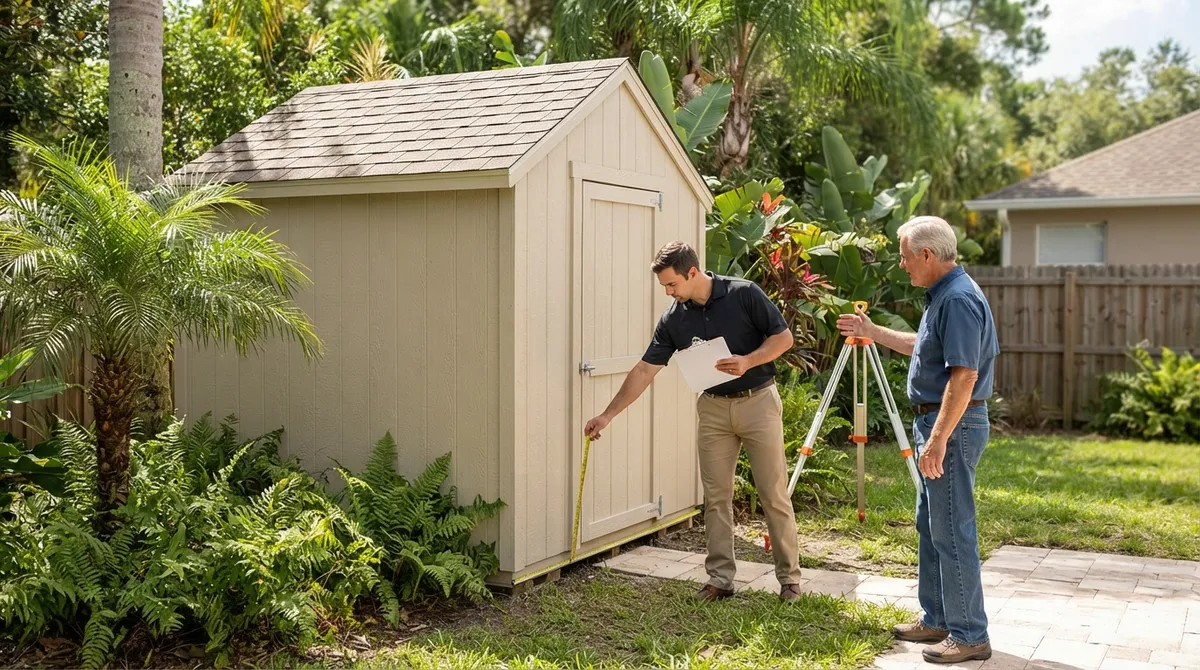
Statewide Exemptions vs. Local Permit Requirements
Part of the confusion comes from the fact that Florida law does include some shed-related exemptions. They just do not mean what many people think they mean. Take a look at this comparison.
| Provision | What It Actually Covers | What It Does Not Do |
|---|---|---|
| FBC Residential R105.2 (model code) | Exempts certain one-story detached accessory structures up to 200 sq ft from building permit requirements | Does not override local zoning, setbacks, or floodplain rules; local adoption varies |
| Florida Statute 553.73 (windborne debris) | Exempts qualifying storage sheds of 720 sq ft or less, not designed for human habitation, from windborne-debris-impact standards | Is a construction-standard exemption, not a statewide permit waiver |
| Florida Statute 553.73 (door dimensions) | Exempts qualifying buildings of 400 sq ft or less used with a one- or two-family residence from certain door-dimension requirements | Does not exempt the structure from permitting or zoning review |
In short, a code exemption can reduce what the shed must meet. It does not automatically grant permission to keep an unpermitted structure. That decision belongs to your local building official.
Step-by-Step: How to Legalize an Unpermitted Shed in Florida
Ready to get moving? Here is the general roadmap. Your local department may tweak the order or add steps, so treat this as your starting framework.
- Identify the correct authority. Find out whether your property falls under a city or county building department. Properties near city lines are sometimes trickier than they look.
- Contact the building department. Ask specifically about the process for an after-the-fact (retroactive) permit for an existing shed. Be honest about the situation. Departments see this all the time.
- Share the basic facts. Have your property address, shed size, intended use, approximate installation date, and any utility or foundation details ready.
- Gather the application package. This usually includes an application, a site plan or survey, shed dimensions and location, construction details, product approvals, and proof of ownership.
- Pass zoning review. Officials check setbacks, easements, lot coverage, height, flood-zone restrictions, and whether the shed fits your zoning and use.
- Complete inspections. The building official will likely inspect the shed and may ask for proof that concealed work meets code.
- Make corrections if needed. Respond to any correction notices, make required changes, and get the final sign-off.
That might sound like a lot, but each step is manageable once you know what to expect. And if the paperwork feels like a maze, you do not have to walk it alone. Our after-the-fact permit services exist for exactly this situation.
What Documents Do You Need for an After-the-Fact Shed Permit?
Requirements depend on the jurisdiction and the shed, but most departments ask for a similar core set of items. Pulling these together early will save you real time.
| Document | Why It Is Needed |
|---|---|
| Permit application | Starts the formal review and identifies the owner and property |
| Site plan or survey | Shows shed location, setbacks, easements, and lot coverage |
| Shed dimensions and height | Confirms size thresholds and zoning compliance |
| Construction details | Documents framing, anchoring, and foundation type |
| Product approvals | Verifies manufactured components, such as doors, meet Florida requirements |
| Proof of ownership | Confirms the applicant can legally apply for the property |
| Photos of the shed | Helps reviewers understand existing conditions |
If a survey is missing, or the shed was built long ago, you may need an updated site plan. Our team can prepare site plans and as-built drawings that match what local reviewers expect to see.
Zoning: The Step Many Owners Overlook
Here is a surprise for a lot of homeowners. Even if your shed qualifies for a building-permit exemption, you may still need zoning approval. Zoning rules look at where and how a structure sits on your lot, not just how it was built.
Common zoning questions include:
- Is the shed too close to a property line or rear setback?
- Is it sitting on a utility or drainage easement?
- Does it push your lot past its maximum coverage?
- Is it taller than the zoning district allows?
- Is the property in a flood zone with special restrictions?
- Is a shed even allowed for your property's zoning and use?
If the answer to any of these is a problem, you may need to relocate the shed, alter it, or pursue a variance. That is why confirming zoning early is so valuable. It is better to learn about a setback issue before you pay for plans.
Inspections and Concealed Work: What If They Cannot See Inside?
This is where after-the-fact permits get interesting. With a normal permit, inspectors see the framing and anchoring before everything gets closed up. With an unpermitted shed, that window is long gone.
The building official may require evidence that concealed work complies with code. If framing, anchoring, foundation, or other components cannot be verified, you may be asked to:
- Open up sections of wall or flooring for inspection
- Provide an engineer's letter or other documentation
- Make corrections to meet code
- In some cases, remove and rebuild portions of the shed
This is one of the best reasons to bring in technical support. A sealed engineer letter can sometimes help verify construction details without tearing everything apart. Not every jurisdiction accepts the same documentation, but it is a conversation worth having early.
Do Electrical or Plumbing in a Shed Need Separate Permits?
Absolutely worth asking about. If your shed has lights, outlets, a mini-split, a utility sink, or any wiring run from the house, do not assume the small size or a state exemption covers it.
Electrical, plumbing, and mechanical work often require separate trade permits and inspections. A plain storage shed with no utilities is a much simpler case than a "she shed," workshop, or office with power and air conditioning.
Also keep in mind that a shed used for living, sleeping, or business purposes can trigger entirely different code and zoning rules. Be upfront with the department about how the structure is used. If you need MEP drawings, our MEP engineering team handles that in house.
What Happens If the Shed Cannot Be Brought Into Compliance?
Let us be honest about the less pleasant possibilities. Most sheds can be legalized with some paperwork and minor fixes. But not every one can.
If the shed does not meet code or is not allowed where it sits, the jurisdiction may require relocation, alteration, or removal. Unresolved violations can also create bigger headaches down the road:
- Property sales: Open violations or unpermitted structures can surface during inspections and delay closings.
- Insurance: Claims involving unpermitted structures can get complicated.
- Future permits: Unresolved issues may hold up later projects, like a pool, addition, or re-roof.
If you have already received a notice, our guide to code compliance violations explains how to respond. And for a broader view of the process, see our article on how to legalize unpermitted work in Florida.
Special Situations: Old Sheds, Prior Owners, and Closings
Not every shed story starts with "I built it myself." Here are a few common scenarios, and how they tend to play out.
The Shed Was There When You Bought the Home
Inherited unpermitted structures are very common. Legally, the current owner is typically the one responsible for resolving them. The good news is that the process is the same, and you can start it any time. Pasco County's code, for example, mentions limited historical exceptions for sheds under 250 square feet erected before January 1, 1995, so the age of a shed can sometimes matter. Always verify the current ordinance directly with the county, since rules change.
You Are Selling and the Shed Came Up
Realtors and sellers, this one is for you. A permit issue discovered during due diligence can slow things down fast. The sooner the shed is addressed, the smoother the closing. Our realtor closing support helps agents and sellers clear permit-related roadblocks before they become deal-breakers.
You Are a Contractor Helping a Client
If you build or install sheds, accessory structures, or outdoor spaces, an organized permit workflow protects your reputation and your schedule. Our team works with general contractors across Florida to handle filing, tracking, and revisions so crews are not left waiting.
DIY vs. Hiring a Florida Permitting Service
Can you do this yourself? Yes, in many cases. Homeowners successfully pull after-the-fact shed permits all the time. But it helps to know where the effort and risk sit. Here is a quick comparison.
| Factor | Doing It Yourself | Working With a Permitting Service |
|---|---|---|
| Finding the right authority | You research it and call around | Handled up front |
| Preparing site plans and drawings | You hire or create them separately | Drafting and sealed engineering available in house |
| Filing and tracking | You submit and check status yourself | Filing, tracking, and follow-up handled for you |
| Correction notices | You interpret and respond on your own | Comments reviewed and answered by a team that knows reviewers |
| Time commitment | Can be significant | Much lighter on your schedule |
| Approval guarantee | None | None, since the local building official decides |
That last row matters. No service can promise approval, and you should be wary of anyone who does. What a good permitting partner can do is identify the correct local authority, assemble complete documents, coordinate plan review and inspections, and respond to correction notices efficiently.
If you are a homeowner who would rather not decode forms and codes, our homeowner services are built for you. Prefer to pull the permit yourself? Our overview of owner-builder permits explains how that works.
How 1 Contractor Solutions Can Help
At 1 Contractor Solutions, we act as Florida's outsourced permitting department. We are not a construction contractor. We are the team people call when a permit stands between them and the next step. We work across all 67 Florida counties and have filed in more than 400 municipalities, so we know how much shed rules can vary from one place to the next.
For an unpermitted shed, that can mean confirming which jurisdiction controls your lot, preparing the site plan and drawings, coordinating plan review, scheduling inspections, and working through reviewer comments until the permit is closed out. Our drafting and engineering are in house, and our own engineer signs and seals the work, so fixes do not wait on an outside consultant. We respond within 30 minutes, day or night, and se habla español.
You can also see what our customers say by reading Visit us on Google — 1 Contractor Solutions reviews, and you can follow us on LinkedIn or follow us on Facebook for Florida permitting tips as codes and county processes evolve in 2026.
Smart Tips Before You Call the Building Department
A little preparation makes the first conversation go much more smoothly. Keep these points in mind:
- Measure the shed accurately. Length, width, and height all matter for thresholds.
- Locate your survey. Your closing documents likely include one.
- Note the foundation type. Slab, pavers, skids, or piers can all change requirements.
- List any utilities. Power, water, and air conditioning change the permit picture.
- Check for open permits. Our open permit search can help you spot other issues on the property.
- Ask for instructions in writing. A written checklist from the department keeps everyone on the same page.
It is also smart to ask about fees. Costs vary by jurisdiction, and some departments charge extra penalties or double fees for work done without a permit. Asking early helps you plan your budget.
Ready to Legalize Your Shed?
Legalizing an unpermitted shed in Florida is rarely as scary as it first seems. The core recipe is simple: contact the right building department, ask about an after-the-fact permit, pass zoning review, complete inspections, and fix whatever needs fixing. The details just change from place to place, which is why checking local rules matters so much.
Whether you are a homeowner cleaning up a loose end, a realtor protecting a closing, or a contractor helping a client, you do not have to figure it all out by yourself. Our friendly team is ready to help you find the right authority, build the right documents, and move the process along. When you are ready, get a free quote and tell us about your shed. We will take it from there.
FAQs
Do I need a permit for a shed in my Florida county or city?
It depends on where you live. Florida has no single statewide shed-permit threshold, and some places, like Pasco County, require a permit regardless of size. Your local building department can give you the definitive answer for your address.
How do I apply for an after-the-fact shed permit in Florida?
Start by contacting your city or county building department and asking about their retroactive permit process. You will typically submit an application, a site plan or survey, shed details, and proof of ownership, then pass zoning review and inspections.
Can I legalize a shed that is too close to a property line or in a flood zone?
Sometimes, but it is not guaranteed. Setback and flood-zone rules are reviewed during zoning, and you may need to relocate or alter the shed, or seek a variance. It is best to confirm your options with the local authority before spending money on plans.
Can a Florida permitting service help me get a retroactive shed permit?
Yes! A permitting service can identify the right authority, prepare drawings and documents, coordinate reviews and inspections, and respond to correction notices. The local building official still makes the final approval decision, so no one can honestly guarantee the outcome.
We do this work every day across all 67 Florida counties. Call (866) 314-6931 and we will tell you what your situation actually requires — including when you do not need us.
Related services
Permit Facilitation & Filing
You have a crew scheduled, a client asking for dates, and a permit sitting somewhere in a queue you cannot see. We file it, w…
See the servicePlan Review Coordination
A permit in plan review is not one queue. On a commercial project it can be six queues, each with its own reviewer, its own c…
See the serviceReady to get your permit moving?
One call tells you which jurisdiction controls your project, what it will take, and what it will cost. Most of the time we can scope it on the phone.