
Blog
EV Charger Permit Sarasota FL: A Friendly 2026 Guide
Need an EV charger permit in Sarasota, FL? Learn who issues it, what the code requires, and how to avoid delays with this friendly 2026 guide.
Key Takeaways
-
Most Level 2 EV charger installs add a dedicated 240-volt circuit, which generally triggers an electrical permit and inspection in Sarasota, even for plug-in units that may seem exempt.
-
Confirm your jurisdiction first: City of Sarasota, unincorporated Sarasota County, North Port, and Venice each run separate permitting, and a Sarasota mailing address does not guarantee city limits.
-
Verify the load: a charger draws significant continuous power, so a load calculation is needed, and a panel upgrade adds its own review and inspection steps.
-
A licensed electrical contractor typically pulls the permit and performs the work, and clean, complete diagrams with equipment specs help avoid reviewer comment rounds that delay approval.
-
Do not start work before the permit is issued, since unpermitted electrical work can lead to fines and can complicate insurance claims or a home sale.
-
Fees and timelines vary by jurisdiction, so check the current fee schedule and portal status, and ask whether inspection approval is required before the charger goes into service.
You finally brought home the EV of your dreams, and now you are staring at the garage wall wondering how to get a charger up there. Here is the good news: the process is very doable. Here is the part nobody mentions at the dealership: an ev charger permit sarasota fl projects need is usually an electrical permit, and skipping it can cause headaches down the road.
Most Level 2 charger installs add a dedicated 240-volt circuit, and that kind of work generally triggers a permit and an inspection. The right office depends on where your address sits. The City of Sarasota and unincorporated Sarasota County run separate permitting systems, and the line between them is not always obvious.
In this guide, we will walk through who issues the permit, what the code expects, what to prepare, and how to avoid common delays. We will keep it friendly and practical, so you can move from "I have a car" to "I have a charger" with confidence.
Do You Need an EV Charger Permit in Sarasota, FL?
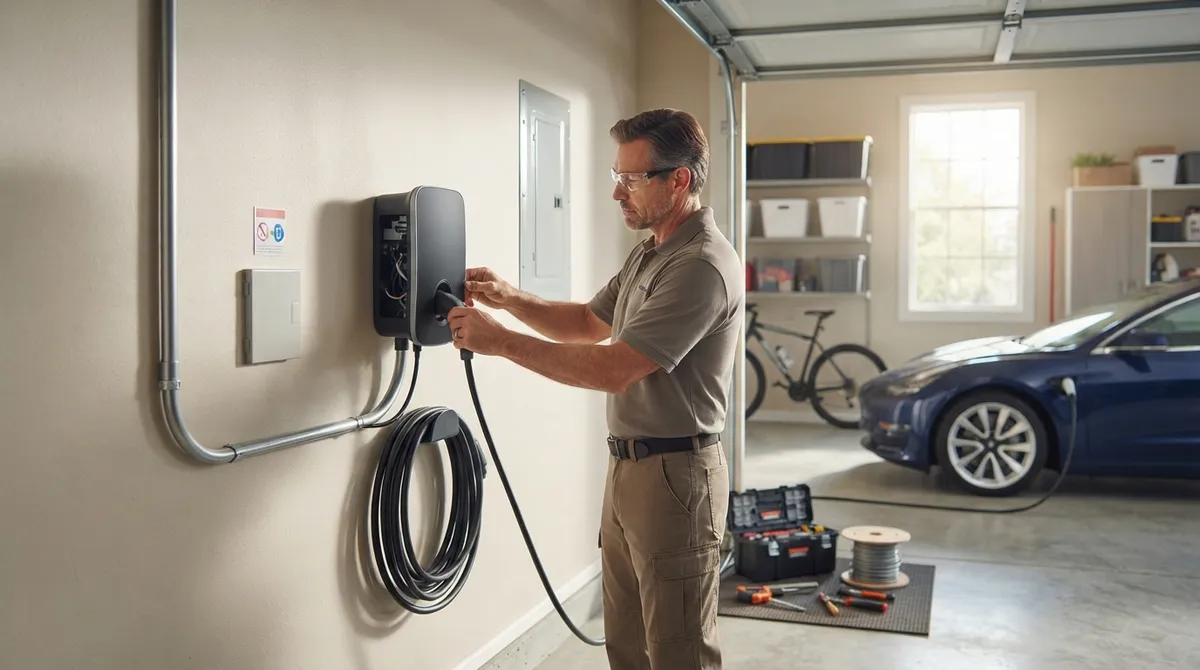
In most cases, yes. An EV charger permit in Sarasota, FL is generally an electrical permit. It covers work like adding a dedicated circuit, installing a hardwired Level 2 charger, or modifying a panel.
Many homeowners assume a plug-in charger is automatically exempt. Please do not assume that. Even a receptacle-based setup may involve new wiring, and the local authority having jurisdiction (AHJ) decides what is exempt and what is not. A quick call or portal check before you buy anything can save you real money.
Here are the types of work that commonly call for a permit:
- Adding a new dedicated 240-volt circuit for the charger
- Installing a new receptacle for a plug-in Level 2 unit
- Hardwiring a wall-mounted charger
- Modifying or upgrading the electrical panel
- Service changes, such as increasing amperage
- Trenching to a detached garage or outdoor charging location
Florida Statute 366.94 addresses local permitting of EV charging stations and limits local regulation in specific ways. However, it does not erase building, electrical, or safety requirements. Confirm how it applies to your project with the AHJ.
City of Sarasota vs. Sarasota County: Which Office Is Yours?
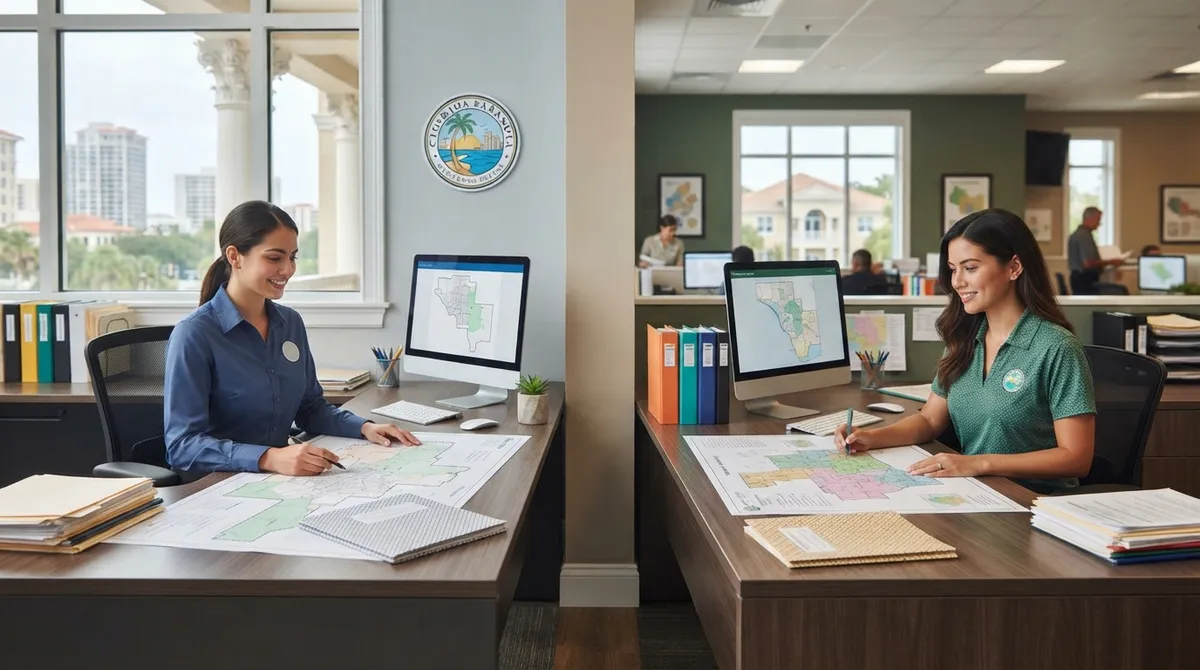
This is the first fork in the road, and it trips up more people than you would expect. Addresses inside the City of Sarasota generally go through the City's building department. Properties in unincorporated Sarasota County go through Sarasota County.
A mailing address that says "Sarasota" does not guarantee city jurisdiction. Plenty of homes with a Sarasota mailing address sit in the unincorporated county. Others sit in nearby municipalities, such as North Port or Venice, which run their own permitting. Always confirm the jurisdiction by address before applying.
| Property Location | Who Typically Handles Permits | What to Verify |
|---|---|---|
| Inside City of Sarasota limits | City of Sarasota building department | Current submittal rules and portal process |
| Unincorporated Sarasota County | Sarasota County permitting | Current fee schedule and required documents |
| Venice or North Port | That city's building department | Local registration and application steps |
If you are unsure, our building department lookup tool can help point you in the right direction. You can also read our guide on Sarasota County permitting for more local context.
What the Florida Building Code and NEC Say
Florida uses a statewide building code framework, while local city and county departments issue permits and conduct inspections. Current research identifies the 8th Edition (2023) Florida Building Code as the edition in effect during 2026, with the 9th Edition scheduled to take effect December 31, 2026. Because that transition is close, confirm the edition in force on the day you apply.
EV charging equipment and its wiring fall under the applicable electrical provisions and the adopted National Electrical Code. NEC Article 625 is the main article for EV charging equipment. The applicable NEC edition and any Florida amendments should be confirmed with your local permitting authority.
A compliant design generally needs to account for:
- Equipment that is listed and labeled for EV charging
- Correct circuit and conductor sizing for the charger load
- Proper overcurrent protection
- Grounding and bonding
- Applicable GFCI and disconnect requirements
- Panel capacity to handle the added load
That last point is where many projects get interesting. A charger can draw a lot of continuous power, so your panel needs room for it. Sometimes a load calculation shows the panel is fine. Other times it points toward a panel upgrade, which adds scope and review steps.
Who Pulls the Permit?
In most cases, a licensed electrical contractor prepares and submits the application and performs the installation. That is the standard path in Florida, and it keeps the project tied to a licensed professional who is accountable for code compliance.
You may wonder whether you can install a charger yourself. Florida does have owner-builder provisions, but electrical work involves safety risks, and the AHJ determines what an owner may do on their own property. Always confirm the rules for your address before taking on any wiring yourself. If you are weighing both approaches, our comparison of owner-filed vs. pro-filed EV charger permits in North Port walks through the tradeoffs in a nearby jurisdiction.
This is also where a permitting partner earns their keep. A contractor may be great with wiring but stretched thin on paperwork. At 1 Contractor Solutions, we act as Florida's outsourced permitting department. We handle the filing, tracking, and reviewer comments so the crew can stay focused on the install.
What You Will Need to Apply
Submittal requirements vary, and the AHJ makes the final call. Still, most applications ask for a similar set of basics.
- Project details. Address, owner information, contractor license information, and a clear scope of work.
- Equipment specifications. Charger make and model, amperage, voltage, and listing information.
- Electrical plans or a wiring diagram. A single-line diagram is common for residential installs.
- Load information. Panel capacity and the added load, when the office requests it.
- Site information. Charger location, and trenching or conduit routes if applicable.
Clean drawings make a real difference. A vague diagram can trigger reviewer comments and push your approval back by days. If you need help with the paperwork, our team provides MEP engineering and permit facilitation and filing support, backed by in-house drafting and sealed drawings.
Step-by-Step: How the Permit Process Works
Every jurisdiction has its own quirks, but the overall path looks like this:
- Confirm your jurisdiction. Decide whether your address falls under the City of Sarasota or Sarasota County.
- Plan the installation. Choose the charger, location, and circuit size, and check panel capacity.
- Prepare the documents. Gather the application, equipment specs, and wiring diagram.
- Submit the application. Your licensed electrical contractor, or a permitting partner, files through the local portal or office.
- Respond to review comments. If the reviewer asks for changes, revise and resubmit.
- Receive the permit. Work begins only after the permit is issued.
- Install the equipment. The contractor completes the work to code.
- Pass inspection. The inspector checks the installation against the approved permit and the applicable code.
- Close out the permit. Confirm the final approval is recorded.
Ask your contractor or the permitting department whether inspection approval is required before the charger goes into service. Some offices expect final approval first, and it is much easier to ask early than to disconnect a charger later.
When the Project Gets Bigger
A simple garage-wall install is the easy case. Certain add-ons can change the permitting picture, and it helps to know them in advance.
| Project Element | Why It Can Add Steps |
|---|---|
| Panel upgrade or service change | Usually requires its own electrical review and inspection, and may involve the utility |
| Trenching to a detached garage or driveway | Adds conduit, depth, and routing requirements |
| Multiple chargers | Increases load calculations and panel demands |
| Commercial or multifamily installs | May need engineered plans, accessibility review, and other permits |
| Outdoor or wet-location mounting | Requires equipment rated for the environment |
Commercial charging stations deserve extra planning. Parking layout, accessibility, signage, and site plans can all come into play. In those cases, site plans and engineered drawings often become part of the package, so budget extra time.
Costs and Timelines: What to Expect
Everyone wants a number, and we wish we could hand you one. Permit fees, review times, and required documents depend on the jurisdiction and the project scope. We were unable to confirm a reliable, current Sarasota-specific fee or turnaround figure, and we would rather be honest than guess.
Instead, here is a practical approach:
- Check the current fee schedule on the City of Sarasota or Sarasota County website.
- Look at the online permit portal for typical review status times.
- Ask your contractor for an itemized estimate that separates the permit fee from labor and materials.
- Build in buffer time for reviewer comments, especially for panel work.
For a broader sense of how local review timing works, our article on how long a building permit takes in Sarasota offers helpful context.
Common Mistakes That Slow Things Down
After years of helping Florida contractors and homeowners, we see the same few stumbling blocks again and again. The good news is that they are easy to avoid once you know about them.
- Applying to the wrong office. City and county lines cause real confusion.
- Assuming a plug-in charger needs no permit. Always verify with the AHJ.
- Skipping the load calculation. An overloaded panel can stop a project cold.
- Submitting incomplete diagrams. Missing equipment specs lead to comment rounds.
- Starting work before the permit is issued. This can lead to violations and fines.
If work was already done without a permit, do not panic. Florida has a path to fix it. Read our guide to after-the-fact electrical permits in Florida to see how that process works, and our overview of legalizing unpermitted work in Florida for the bigger picture.
Why Permitting Matters Beyond the Inspection Sticker
A permit is not just paperwork. It protects you in practical ways. A permitted, inspected installation gives you confidence that the wiring is safe, the breaker is sized correctly, and the equipment is installed as intended.
It can also protect your home sale. Unpermitted electrical work often surfaces during inspections or title review, and it can stall a closing. If you are thinking about future resale, a closed permit is a quiet asset. Our guide on selling a Florida house with unpermitted additions shows how much easier life gets when the permits are in order.
Insurance matters too. A charger that causes damage and was installed without a permit may complicate a claim. Doing it right the first time keeps those conversations simple.
Who Benefits From Professional Permitting Help?
Different readers need different kinds of support, so here is how this plays out in the real world:
- General contractors juggling several jobs benefit from reliable permit filing and tracking across jurisdictions.
- Solar companies adding chargers alongside panels or batteries need code-compliant electrical documentation and coordinated submittals.
- Realtors and investors can use permitting research to evaluate a property before committing.
- Homeowners get a clear path through an unfamiliar process without guessing at requirements.
- Design and trade professionals can outsource drafting and engineering rather than staffing it in-house.
We built 1CS for exactly these situations. Our drafting and engineering are in house, and our own engineer signs and seals the work. If you want to see how others feel about working with us, read what 1 Contractor Solutions customers say on Google. You can also follow us on LinkedIn or follow us on Facebook for permitting tips and updates.
A Quick Checklist Before You Start
Before you order a charger or call an electrician, run through this short list:
- Confirm whether your address is in the City of Sarasota or unincorporated Sarasota County.
- Check your panel capacity and available breaker space.
- Choose a listed Level 2 charger and note its amperage requirements.
- Hire a licensed electrical contractor, or loop in a permitting partner.
- Verify the current code edition and submittal requirements with the AHJ.
- Ask whether inspection approval is required before using the charger.
That simple routine prevents most of the surprises we see.
Ready to Plug In With Confidence?
Getting an EV charger permit in Sarasota does not have to feel like a maze. Identify the right jurisdiction, design the circuit to code, submit clean documents, and pass inspection. Do those things, and you will be charging at home in no time.
If you would rather hand off the paperwork, we would love to help. Whether you are a contractor with a full schedule or a homeowner who just wants it done right, get a free quote from our team. We respond within 30 minutes, day or night, and we work across all 67 Florida counties. Permits approved. Projects moving.
This article is for general information. Permit rules, fees, and code editions change, so always confirm current requirements with the City of Sarasota or Sarasota County before you apply. Website design and marketing by Brain Buzz Marketing.
FAQs
Do I need a permit to install a Level 2 EV charger in Sarasota, Florida?
In most cases, yes. A Level 2 charger usually means a new dedicated 240-volt circuit, and that kind of electrical work generally needs a permit and inspection. Confirm the exact rules with the local authority for your address so there are no surprises.
Is my property in the City of Sarasota or unincorporated Sarasota County?
A Sarasota mailing address does not guarantee city limits, so it is worth checking by your exact address. City addresses go through the City's building department, while unincorporated addresses go through Sarasota County. A permitting partner or the local office can confirm this quickly.
Who applies for the EV charger electrical permit?
A licensed electrical contractor typically prepares the application, submits it, and performs the installation. Many contractors also bring in a permitting partner to handle filing, tracking, and reviewer comments. That way the crew can focus on the work itself.
How long does an EV charger permit take in Sarasota?
Timing depends on the jurisdiction and the project scope, so there is no single reliable number. Simple installs tend to move faster, while panel upgrades or trenching can add review time. Check the current portal status and ask your contractor for a realistic estimate.
Do I need a separate permit for a panel upgrade or a commercial charging station?
Often, yes. Panel upgrades, service changes, trenching, and commercial installations can add their own review and permitting steps. Planning for these early helps you avoid mid-project delays.
We do this work every day across all 67 Florida counties. Call (866) 314-6931 and we will tell you what your situation actually requires — including when you do not need us.
Related services
Permit Facilitation & Filing
You have a crew scheduled, a client asking for dates, and a permit sitting somewhere in a queue you cannot see. We file it, w…
See the servicePlan Review Coordination
A permit in plan review is not one queue. On a commercial project it can be six queues, each with its own reviewer, its own c…
See the serviceReady to get your permit moving?
One call tells you which jurisdiction controls your project, what it will take, and what it will cost. Most of the time we can scope it on the phone.