
Blog
8 After-the-Fact Permitting Facts Every FL Owner Needs
Learn how after-the-fact permitting works in Florida, what it costs, and how to legalize unpermitted work before it becomes a bigger problem.
Key Takeaways
-
After-the-fact permitting in Florida is handled locally by each county and municipality with different requirements, fees, and processes—there is no statewide amnesty program, so you must work directly with your specific building department.
-
After-the-fact permit fees are typically 2-4 times higher than standard permits depending on jurisdiction, with St. Lucie County doubling fees and Palm Beach County charging up to four times the normal rate.
-
Unresolved code violations can result in formal fines and liens placed against your property that follow it through sale and closing, making prompt action essential to avoid escalating enforcement consequences.
-
Concealed unpermitted work hidden behind drywall or flooring may require inspection exposure or third-party engineering analysis to verify code compliance, which can be minimized by submitting strong documentation upfront.
-
Simply filing an after-the-fact permit application doesn't automatically legalize the work—the completed work must still satisfy current Florida Building Code, local zoning rules, and floodplain regulations or face correction demands.
-
If unpermitted work was performed by an unlicensed contractor, that creates a separate legal violation under Florida Statutes §489.13 layered on top of the permitting issue, potentially complicating the resolution process.
Discovering that your Florida property has unpermitted work can feel like a punch to the gut. Maybe you're a homeowner who just found out that sunroom your last contractor built never got a permit. Maybe you're a realtor whose closing just hit a wall because of an open code violation. Or maybe you're a general contractor who inherited someone else's mess mid-project. Whatever brought you here, take a breath. After-the-fact permitting in Florida is a well-established process, and thousands of property owners work through it successfully every year.
We know the ins and outs of this process because we live in it every single day. In this friendly, no-nonsense guide, we're walking through eight essential facts about after-the-fact permitting in Florida so you know exactly what to expect, what it might cost, and how to get your property back into good standing. Let's get you unstuck.
1. After-the-Fact Permitting Is a Local Fix, Not a Statewide Amnesty
Here's the first thing to understand, and it's an important one: there is no single, statewide "forgiveness" program for unpermitted work in Florida. Florida Statutes §553.79 generally requires that a permit be obtained before covered construction, alteration, repair, or demolition begins. If that didn't happen, the fix runs through your local building department, not through some blanket state waiver.
Each of Florida's 67 counties, along with hundreds of individual municipalities, handles after-the-fact applications a little differently. That means the paperwork, fees, and required inspections in Tampa might look nothing like what you'd encounter in Sarasota or Fort Lauderdale. This is exactly why so many owners feel overwhelmed. If you're not sure which office actually has jurisdiction over your property, our building department lookup tool is a great place to start sorting that out.

2. You'll Likely Need Plans, Documents, or Engineering Support
Simply filling out an application and hoping for the best won't cut it. Depending on the scope of the unpermitted work, your local building department may require submitted plans, engineering documentation, or other supporting paperwork before they'll even consider approval.
This is where things get technical fast, and it's also where a lot of DIY attempts stall out. If the original work involved structural changes, electrical upgrades, or plumbing modifications, you'll typically need structural engineering review or MEP engineering documentation to prove the work meets code. Having in-house sealed drawings ready to go, rather than waiting weeks on an outside consultant, can shave real time off this stage.
Common Documents Requested During Review
- As-built drawings showing the work as it currently exists
- Structural calculations or engineer letters certifying safety
- Site plans if the footprint or setbacks are in question
- MEP plans for electrical, plumbing, or mechanical work
- Photos or affidavits documenting the scope of completed work
3. Concealed Work May Need to Be Opened Up for Inspection
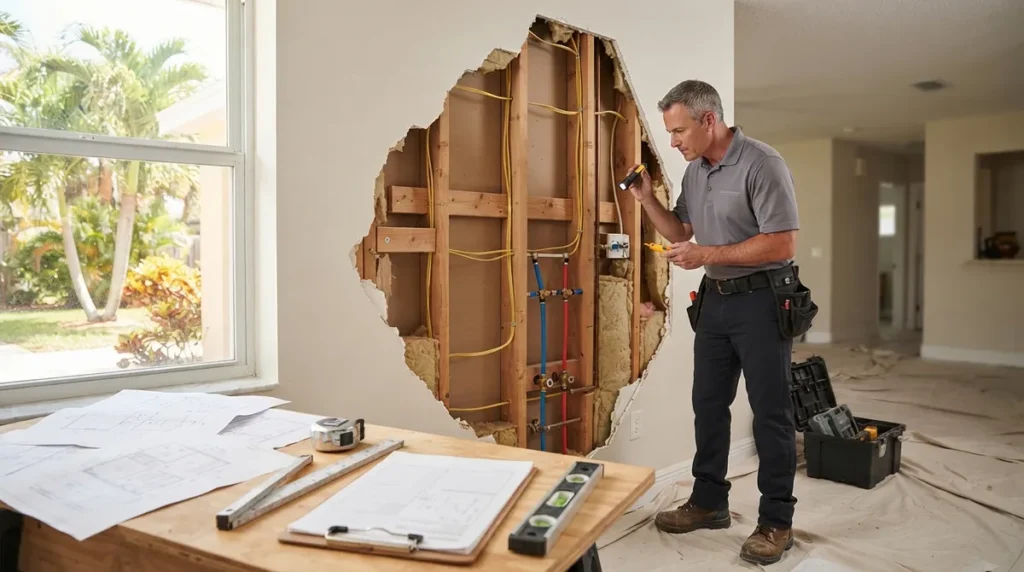
This is the part nobody enjoys hearing, but it's honest: if the unpermitted work is hidden behind drywall, flooring, or other finishes, inspectors may require you to expose it. St. Lucie County's building department, for example, notes that a third-party engineering analysis may be required specifically when work areas are concealed and can't be visually verified.
Nobody wants to cut into a freshly finished wall. But building departments need to physically confirm that wiring, framing, or plumbing meets current code, and there's often no way around it. A good permitting partner can help you minimize how much needs to be opened by presenting strong documentation upfront, which is one reason our inspections coordination service exists in the first place.
4. Fees Are Often Higher Than a Standard Permit
Let's talk money, because this is usually the first question everyone has. After-the-fact permit fees are almost always more expensive than pulling a permit the normal way, before work begins. The exact multiplier varies wildly by jurisdiction.
| Jurisdiction Example | After-the-Fact Fee Structure |
|---|---|
| St. Lucie County | Double the regular permit fee |
| Palm Beach County (Code Violation Process) | Four times the standard permit fee |
| Other Florida Counties | Varies; confirm directly with local building department |
These numbers are county-specific examples, not a statewide fee schedule, so don't assume your county charges the same rate. If you want a clearer picture before you commit to anything, you can always get a free quote from our team based on your specific address and situation.
5. Unresolved Violations Can Snowball Into Fines and Liens
Ignoring the problem is never the answer, tempting as it might be. St. Lucie County's building FAQ explicitly warns that unresolved code violations can result in formal fines and even a lien placed against the property. That lien doesn't just disappear when you sell; it follows the property and can seriously complicate a closing.
If you're a realtor or investor and you've just discovered an open permit found at closing, time is genuinely of the essence. The longer a violation sits, the more enforcement action tends to escalate, and the harder it becomes to negotiate a smooth resolution.
Steps to Take If You Receive a Violation Notice
- Read the notice carefully and note any response deadlines
- Contact the building department to confirm exactly what's required
- Gather any existing documentation about the work in question
- Bring in a licensed engineer or drafting professional if plans are needed
- Submit the after-the-fact application promptly to avoid further penalties
- Schedule and complete any required inspections
6. A Permit Application Doesn't Automatically Legalize the Work
This one surprises a lot of people. Filing the paperwork is just the starting line, not the finish line. The completed work still has to satisfy applicable Florida Building Code requirements, local zoning rules, and, in some coastal or low-lying areas, floodplain regulations too.
If the work doesn't meet code, you may be asked to make corrections, or in more serious cases, remove the noncompliant portions entirely. This is precisely why having a qualified team review the situation before you submit anything is so valuable. Our after-the-fact and expired permits service exists specifically to help owners navigate these situations, including cases where prior owners are the ones who skipped the permit in the first place.
7. Contractor Licensing Is a Separate but Related Issue
Here's a wrinkle that trips up a lot of homeowners and even some contractors. Florida Statutes §489.13 addresses unlicensed contracting as its own legal matter, separate from the permitting violation itself. Local building departments generally cannot issue permits to contractors who lack active state certification or registration.
So if the original unpermitted work was done by someone unlicensed, that's a second issue layered on top of the permitting problem. Confirming a contractor's status before hiring anyone to help with corrections or after-the-fact filings is smart practice. Our contractor registration checklist is a handy resource if you want to double-check credentials before signing any agreements.
8. Working With Experienced Permitting Professionals Speeds Things Up
We won't pretend after-the-fact permitting is simple, because it's genuinely not. It involves layers of code review, documentation, engineering, and back-and-forth with local officials who each have their own preferences and pet peeves. That said, having someone in your corner who's done this thousands of times makes an enormous difference.
At 1 Contractor Solutions, our team handles permit facilitation, sealed engineering drawings, and plan review coordination across all 67 Florida counties. We're a licensed private provider, which means in many cases we can perform your plan review ourselves rather than leaving you stuck in a county queue for months. Whether you're a general contractor managing a complicated job, a solar company needing fast electrical documentation, or a homeowner just trying to sell your house without drama, we've likely seen your exact scenario before. You can browse our full range of permitting and engineering services to see how we might fit into your situation, or check out projects in areas like Tampa, St. Petersburg, and Bradenton for regional context.
Who Runs Into After-the-Fact Permit Issues Most Often
You might be surprised how common this problem really is across such a wide range of property types and professions. Here's a quick look at who typically comes to us for help:
- Homeowners who bought a property with unpermitted additions from a previous owner
- Real estate professionals trying to clear violations before a closing deadline
- General contractors who inherited an incomplete or unpermitted job site
- Solar installation companies needing to correct documentation on completed systems
- Investors renovating properties who discover surprises during due diligence
- Design professionals whose clients need retroactive engineering sign-off
If any of these sound familiar, know that you're absolutely not alone, and there is a clear path forward. We've helped folks across Miami-Dade, Broward, and Orlando resolve everything from a single unpermitted shed to full-scale unlicensed renovations.
A Quick Look at the After-the-Fact Permit Timeline
| Stage | What Typically Happens |
|---|---|
| Initial Discovery | Violation notice, self-report, or discovery during a sale or refinance |
| Documentation Gathering | Plans, engineering letters, or as-built drawings prepared |
| Application Submission | Filed with the local building department, fees paid |
| Plan Review | Department checks against current Florida Building Code and zoning |
| Inspection | Site visit, possibly requiring exposed work for verification |
| Approval or Correction | Permit closed out, or corrections required before final sign-off |
Wrapping It Up: You've Got Options, and We've Got Your Back
Unpermitted work is stressful, but it's also incredibly fixable when you approach it with the right information and the right team. Florida's after-the-fact permitting process exists precisely so property owners have a legitimate path to bring past work into compliance, rather than living under a cloud of uncertainty forever. Whether your issue is a small residential addition or a complex commercial retrofit, the same core principle applies: good documentation and a proactive attitude go a long way.
We'd genuinely love to help you sort this out. Our team responds fast, works across every corner of the state, and keeps our engineering and drafting in house so there's no waiting on outside consultants. Feel free to reach out for a free quote and let's talk through your specific situation together. You can also see what our neighbors and clients have to say by checking out reviews on our Facebook page, connecting with us on LinkedIn, or taking a peek at what our customers say on Google. For more general guidance, the Florida Building Commission also offers helpful background on statewide code requirements. You've got this, and we're happy to walk it with you.
FAQs
How do I get an after-the-fact building permit in Florida?
You'll apply directly through your local building department, since after-the-fact permitting is handled at the county or municipal level rather than through a statewide process. Typically you'll need to document the completed work with plans, photos, or engineering support, then go through plan review and inspection just like a standard permit. It sounds like a lot, but working with a permitting team who knows your specific jurisdiction can make the whole thing feel a lot less intimidating.
How much does an after-the-fact permit cost in Florida?
It really depends on your county, since there's no single statewide fee. Some jurisdictions, like St. Lucie County, double the standard permit fee, while others, like Palm Beach County's code violation process, can charge up to four times the normal rate. The best move is to confirm directly with your local building department or ask a permitting professional to pull that number for you.
What happens if I build without a permit in Florida?
Unpermitted work is technically a code violation, and if it's discovered, you'll typically need to go through the after-the-fact permitting process to bring it into compliance. Left unresolved, violations can lead to formal notices, fines, and even a lien on your property, so it's really best to address it sooner rather than later. The good news is that most situations are absolutely fixable with the right documentation and a little patience.
Can Florida require me to open walls for an inspection of unpermitted work?
Yes, if the work was concealed behind finishes like drywall or flooring, inspectors may need it exposed so they can verify it meets code. Some counties, like St. Lucie, even note that a third-party engineering analysis might be required when the work can't be visually confirmed otherwise. It's not the most fun part of the process, but it's a normal step toward getting everything properly signed off.
Do after-the-fact permits apply to work done by a previous owner?
Yes, unfortunately the current owner is generally responsible for resolving unpermitted work, even if a previous owner is the one who actually did it. It's a frustrating situation to inherit, but it's incredibly common, especially with older homes or properties that changed hands a few times. A good permitting team can help you figure out exactly what's needed and get it resolved without too much added stress.
We do this work every day across all 67 Florida counties. Call (866) 314-6931 and we will tell you what your situation actually requires — including when you do not need us.
Related services
Permit Facilitation & Filing
You have a crew scheduled, a client asking for dates, and a permit sitting somewhere in a queue you cannot see. We file it, w…
See the servicePlan Review Coordination
A permit in plan review is not one queue. On a commercial project it can be six queues, each with its own reviewer, its own c…
See the serviceReady to get your permit moving?
One call tells you which jurisdiction controls your project, what it will take, and what it will cost. Most of the time we can scope it on the phone.