
Blog
Why Does High-Volume Solar Permitting Florida Feel So Hard?
Discover how solar companies scale permitting across Florida's 67 counties with standardized packages, engineering, and expert tracking.

If you run a solar company in Florida, you already know the feeling: the sales team is closing deals faster than your permitting desk can process them, and every county seems to want something different. You're not imagining it. Florida doesn't have one statewide solar-permitting office, which means every city and county building department gets to write its own rules, its own portal, and its own checklist. When you're filing five permits a week, that's manageable. When you're filing fifty, it becomes a full-time operational headache that can quietly stall installs, delay Permission to Operate, and eat into your crew's schedule.
The good news is that high volume solar permitting in Florida is a solvable problem, and it doesn't require you to hire an army of coordinators. With the right standardized plan templates, jurisdiction-specific checklists, and a team that already knows the quirks of Hillsborough versus Pinellas versus Miami-Dade, you can scale your submissions without scaling your headaches. This guide walks through what actually goes into a Florida solar permit package, why so many applications get bounced back, and how a dedicated permitting partner like 1 Contractor Solutions helps solar contractors keep pace with demand instead of drowning in paperwork.
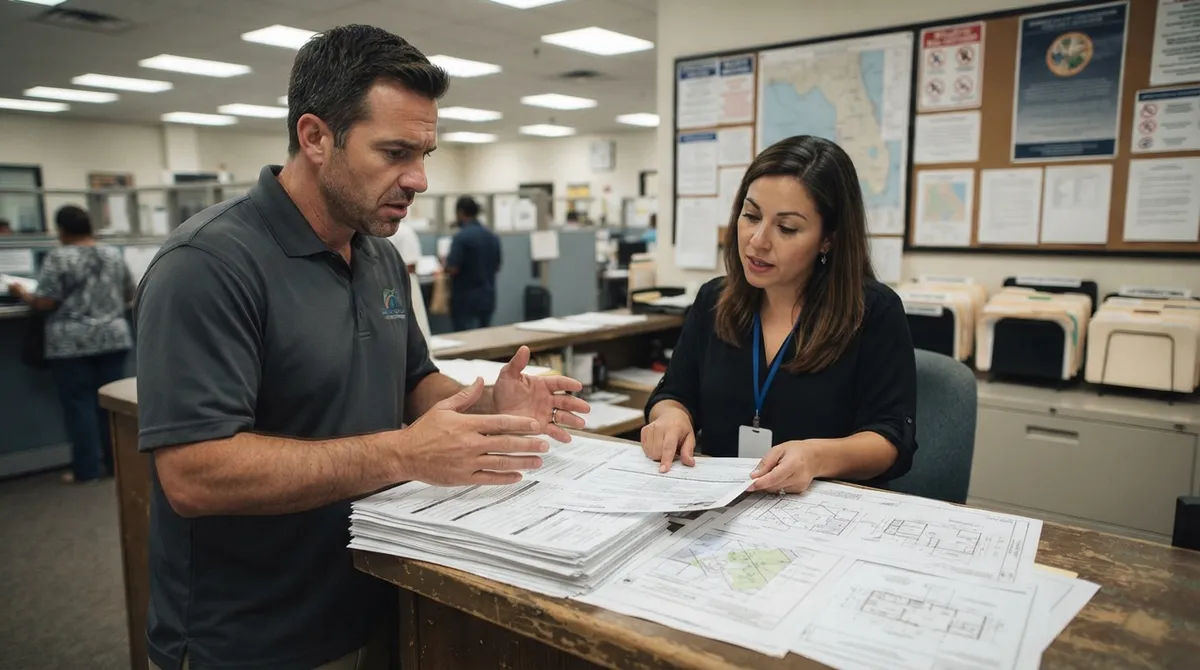
What Makes Florida Solar Permitting So Fragmented
Because there's no single statewide solar authority, your applications go to whichever local building department or Authority Having Jurisdiction (AHJ) covers that address. That means the same rooftop PV system might need a combined solar-PV permit in one county and two entirely separate building and electrical permits in another. If you're installing across Hillsborough County, Pinellas County, and Manatee County in the same month, your team needs to track three different submission portals, three different fee schedules, and three different sets of documentation preferences.
This is exactly where volume becomes risky. A single missing detail on one application doesn't just slow that project down — it can reset your review clock and push your crew's install date back weeks. That's why so many solar companies eventually look for outside help managing the jurisdictional maze, especially when they're trying to grow into new counties without growing their internal permitting headcount at the same pace.
Rooftop vs. Ground-Mounted: Different Rules, Different Risks
Not every solar project is a simple rooftop install. Ground-mounted systems can trigger zoning review, setback requirements, foundation and structural review, and sometimes floodplain or stormwater review that a rooftop system never touches. Charlotte County's published solar guidance is a great real-world example: rooftop systems get building and electrical review, while ground-mounted systems may also need zoning sign-off. If your team treats every application the same way, you're going to run into avoidable rejections.
- Rooftop PV: building/structural review plus electrical review, sometimes combined into one solar-PV permit
- Ground-mounted PV: added zoning, setback, and foundation review, occasionally floodplain or environmental review
- Battery storage: frequently reviewed as a separate scope with its own fire and electrical requirements
- Main panel upgrades: may require a standalone electrical permit tied to the solar application
- Solar thermal systems: can trigger plumbing review and inspection on top of electrical
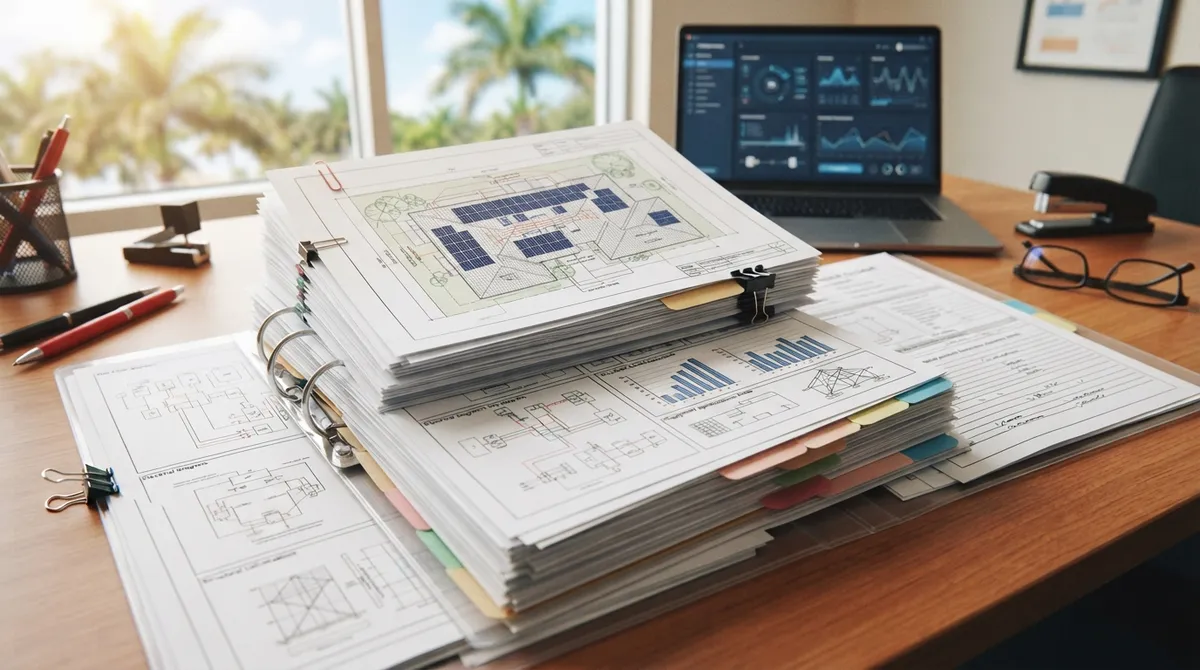
What Goes Into a Florida Solar Permit Package
Every jurisdiction has its own quirks, but most Florida solar permit applications ask for a similar core set of documents. Getting these right the first time is the single biggest lever for keeping your review timeline predictable.
- Site or roof plan showing panel layout and equipment locations
- Electrical one-line diagram detailing the system's wiring path
- Equipment specification sheets for panels, inverters, and racking
- Structural attachment details and wind-load calculations
- Roof information, including age, material, and load calculations
- Florida Product Approval or Miami-Dade Notice of Acceptance documentation, where applicable
- Contractor licensing and municipality registration details
Given Florida's hurricane exposure, wind-load documentation deserves special attention. Plans generally need to address roof attachment methods, uplift forces, equipment setbacks, and disconnect locations in a way that satisfies both the Florida Building Code and the National Electrical Code. This is precisely the kind of technical documentation that benefits from in-house structural engineering and MEP engineering support, rather than piecing together drawings from multiple outside consultants who may not answer the phone when a reviewer has a question.
Common Reasons Applications Get Rejected
When you're filing at high volume, small inconsistencies compound quickly. The most frequent culprits behind rejected or delayed solar applications include:
- Missing or outdated Florida Product Approval documentation
- Wind-load calculations that don't match the specific roof type or jurisdiction's wind zone
- Submitting to the wrong jurisdiction near a city/county boundary line
- Incomplete contractor licensing or municipality registration on file
- Failing to distinguish rooftop, ground-mounted, battery, or panel-upgrade scopes on the application
- Inconsistent equipment specs between the one-line diagram and the equipment cut sheets
Confirming exactly which Florida jurisdiction reviews your project before you file is one of the simplest ways to avoid a wasted submission. Tools like a building department lookup can help confirm the correct AHJ before your team spends hours preparing a package for the wrong desk.
How Florida's 2025 Permitting Reforms Changed the Timeline
Florida's permitting reforms, which took effect July 1, 2025, introduced a five-business-day review target for qualifying single-trade residential projects. According to industry coverage of the reforms, a missed deadline can result in deemed approval and issuance on the next business day, and the reforms also opened the door to private providers, virtual inspections, and software-based plan review. That's a meaningful shift for solar companies chasing volume, but it comes with an important caveat: eligibility and local implementation vary. Not every AHJ treats "qualifying single-trade" the same way, and incomplete applications generally don't get the benefit of the accelerated clock. Before you build your production schedule around a five-day turnaround, it's worth confirming current procedures with the specific building permit timeline in Florida for each county you operate in.
| Permit Element | Typical Timeline | Notes |
|---|---|---|
| Single-trade residential PV review (qualifying) | ~5 business days | Target under 2025 reforms; verify AHJ eligibility |
| Standard local review (non-qualifying) | Varies by county | Depends on completeness and local workload |
| Utility interconnection & Permission to Operate | ~2-8 weeks post-inspection | Separate from local permit; varies by utility |
| Ground-mounted with zoning review | Longer than rooftop-only | Additional review layers required |
Permitting Fees You Should Expect to Budget For
Residential solar permit fees in Florida commonly fall in the $250 to $800 range, though the broader statewide range runs from roughly $100 to $1,000 depending on the municipality, project valuation, and scope. As a real-world data point, one county's residential solar-PV permit lists a flat $90 fee, in addition to possible valuation-based building fees and surcharges. That kind of variance is exactly why relying on a single "average fee" figure across dozens of jurisdictions can throw off your project budgeting — jurisdiction-specific research matters far more than a statewide estimate.
Building a System for High-Volume Solar Permitting
Scaling your permitting operation isn't about working faster on each individual file — it's about designing a repeatable process so your team isn't reinventing the wheel every time. Solar companies that handle high volume well tend to rely on a few core practices:
- Standardized plan templates that only need jurisdiction-specific tweaks, not full redraws
- A master checklist per AHJ covering document requirements, fee schedules, and portal quirks
- Centralized document control so revisions don't create version-control confusion
- Automated completeness checks before submission, catching missing product approvals or mismatched specs
- Batch tracking dashboards showing every application's status across multiple counties at once
- Parallel handling of local permitting and utility interconnection paperwork, since one doesn't replace the other
It's worth repeating that important last point: utility interconnection approval is not the same thing as your local building permit. A system generally can't export power or receive Permission to Operate until the serving utility signs off, required inspections are complete, and any meter work is finished. Treating these as two parallel tracks — rather than a single linear process — is one of the biggest efficiency gains a growing solar company can make.
Why Outsourcing Permitting Makes Sense at Scale
This is where a dedicated Florida permitting partner earns its keep. 1 Contractor Solutions works with solar contractors across the state to handle exactly this kind of multi-jurisdiction volume — preparing sealed structural and electrical documentation in-house, filing directly with each AHJ, and tracking every application status in real time so your team isn't stuck refreshing a portal. Because plan drafting and engineering happen under one roof, when a reviewer flags a wind-load detail or asks for a revised one-line diagram, the fix happens fast instead of waiting on an outside consultant's callback.
1 Contractor Solutions also operates as a licensed private provider, meaning plan review can happen outside the county queue entirely in jurisdictions where that option applies — a real advantage when you're trying to hit installation deadlines in Miami-Dade County, Broward County, or Orange County without waiting weeks for a reviewer to reach your file. If your team already has an engineer of record but just needs the drawing package produced, drafting-only services can fill that gap without duplicating engineering costs.
Special Scopes That Add Complexity
Not every solar project is a straightforward rooftop install with no complications. A few scopes deserve extra planning time in your permitting workflow:
- Battery storage systems, which often require separate fire and electrical review
- Main electrical panel upgrades needed to accommodate new solar capacity
- Reroofing performed alongside or before solar installation
- Structural repairs identified during roof or attachment inspection
- Multifamily properties with multiple units or shared roof structures
- Historic district properties with additional design review requirements
- Flood-zone properties requiring additional documentation
- Commercial or utility-scale installations with more complex MEP and structural review
For commercial-scale projects specifically, coordinating commercial plans alongside plan review coordination from the outset can prevent a lot of back-and-forth once the application lands on a reviewer's desk. And if a permit does get flagged for revisions, having a team experienced in revisions and resubmittals means those comments get addressed quickly instead of sitting in a queue.
Looking Ahead: Demand Isn't Slowing Down
Regional solar capacity across the Southeast is projected to exceed 30 GW by 2030, according to a recent Southeast solar market report — which means the pressure on Florida's permitting pipelines is only going to grow. Solar companies that build scalable, repeatable permitting processes now will be far better positioned to handle that growth than those still treating every application as a one-off project.
Whether you're a solar contractor filing across a dozen counties or a homeowner just trying to understand your Florida solar permit timeline, having a knowledgeable partner in your corner makes the process feel a whole lot less overwhelming. You can also follow us on LinkedIn or follow us on Facebook for ongoing updates on Florida permitting changes, and check out what local clients have to say by visiting Visit us on Google — 1 Contractor Solutions.
Ready to Simplify Your Solar Permitting Volume?
Managing high-volume solar permitting across Florida's 67 counties doesn't have to mean chaos, missed deadlines, or frustrated crews waiting on approvals. With in-house sealed engineering, private provider plan review, and a team that already knows the local quirks of every AHJ from Tampa to Fort Lauderdale, 1 Contractor Solutions helps solar companies keep projects moving instead of stacking up in a queue. If you're ready to streamline your permitting pipeline, get a free quote and let's talk about how we can support your next batch of installs.
FAQs
How do I obtain a solar permit in Florida?
You'll submit your application to the specific city or county building department that has jurisdiction over the property, not a statewide office. Each AHJ has its own portal and checklist, so the fastest path is confirming the right jurisdiction first and preparing a complete package with structural, electrical, and product approval documentation from the start.
How long does solar permitting take in Florida?
Under Florida's 2025 reforms, qualifying single-trade residential solar projects have a five-business-day review target, but that depends on the application being complete and the AHJ treating it as eligible. Non-qualifying or more complex projects, like ground-mounted or commercial systems, typically take longer depending on local review capacity.
Does Florida require separate building and electrical permits for solar?
It depends on the jurisdiction! Some counties combine everything into one solar-PV permit with multiple review disciplines, while others issue separate building and electrical permits for the same project. This is exactly why checking the specific requirements for your AHJ before filing saves so much back-and-forth.
What causes Florida solar permit applications to get rejected?
The most common culprits are missing Florida Product Approval documentation, wind-load calculations that don't match the roof type, submitting to the wrong jurisdiction near a boundary line, or mismatched specs between the one-line diagram and equipment cut sheets. Catching these before submission is the biggest time-saver for high-volume filers.
Is utility interconnection the same as a solar building permit?
Nope, they're two completely separate approvals! Your local building permit covers structural and electrical code compliance, while utility interconnection approval and Permission to Operate come from the serving utility company, often taking an additional two to eight weeks after final inspections are complete.
We do this work every day across all 67 Florida counties. Call (866) 314-6931 and we will tell you what your situation actually requires — including when you do not need us.
Related services
Permit Facilitation & Filing
You have a crew scheduled, a client asking for dates, and a permit sitting somewhere in a queue you cannot see. We file it, w…
See the servicePlan Review Coordination
A permit in plan review is not one queue. On a commercial project it can be six queues, each with its own reviewer, its own c…
See the serviceReady to get your permit moving?
One call tells you which jurisdiction controls your project, what it will take, and what it will cost. Most of the time we can scope it on the phone.