
Blog
General Contractor Permitting Florida: A 2026 Roadmap
A friendly, practical guide to general contractor permitting in Florida, covering 2026 rule changes, timelines, and how permitting services help.
Key Takeaways
-
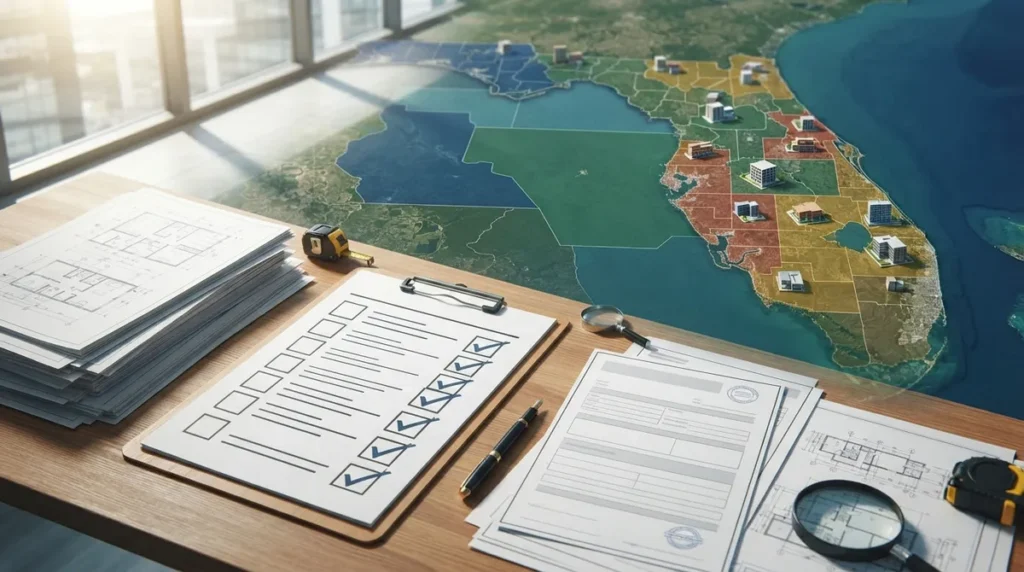
Florida permitting is administered locally by each county and city, not statewide, meaning contractors face different portals, fee schedules, and review timelines even for similar projects under the same building code.
-
Complete and accurate permit applications submitted the first time are the single biggest predictor of fast approval; missing even one document can cause weeks of delay as applications bounce back for resubmission.
-
Starting July 1, 2026, HB 803 creates a limited exemption for non-structural work under $7,500 on single-family homes, but structural, electrical, mechanical, plumbing, and gas work still require permits regardless of value.
-
Licensed general contractors can practice statewide with state certification, but local registration, business-tax receipts, and insurance documentation are still required before permits are issued in each jurisdiction.
-
Private provider review and master permit programs under Florida law can dramatically accelerate approvals by bypassing county queues or reducing repeat review for approved residential models.
-
Working without a required permit triggers stop-work orders, code enforcement action, and after-the-fact permitting complications that can derail real estate sales, refinancing, and insurance claims.
If you've ever pulled a Florida building permit only to watch it sit untouched in a reviewer's queue for weeks, you already know that general contractor permitting Florida requires is not a one-size-fits-all process. Every county, and often every city within that county, runs its own portal, fee schedule, and review timeline. That's not a flaw in the system, it's just how Florida does things, and once you understand the pattern, it stops feeling like chaos and starts feeling manageable.
Whether you're a general contractor juggling five jobsites, a solar installer racing seasonal incentives, a realtor trying to close a sale with an open permit hanging over it, or a homeowner adding a lanai, this guide walks through what Florida law actually requires, what documents you'll need, and how a permitting partner like 1 Contractor Solutions can keep your project from stalling. We'll also cover the 2026 changes you need to know about, including the new limited exemption under HB 803. Grab a coffee, and let's make sense of this together.
Why General Contractor Permitting in Florida Feels So Complicated
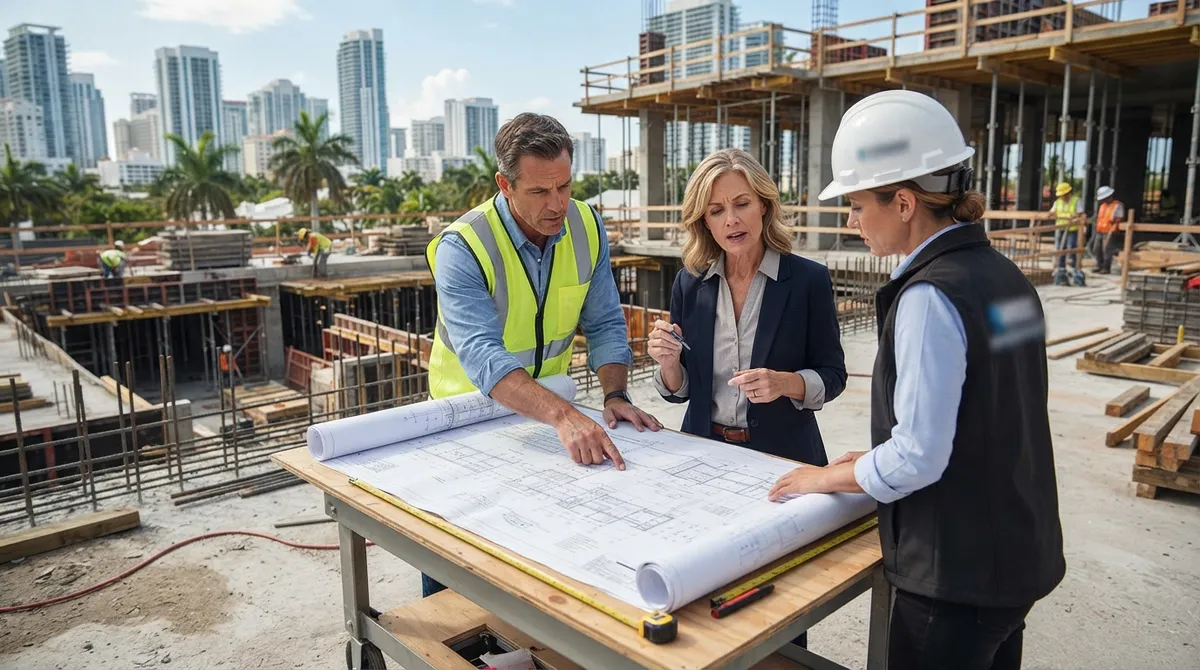
Florida Statutes §553.79 sets the baseline rule: you generally need a building permit before you construct, alter, repair, modify, or demolish a structure. Simple enough, right? The catch is that permitting is administered locally, not statewide. That means a contractor working in Tampa one week and St. Petersburg the next could face two completely different application portals, plan-submittal standards, and fee structures, even though both projects fall under the same Florida Building Code.
This is exactly the kind of friction that trips up busy contractors. You know your trade inside and out, but figuring out which jurisdiction actually controls your project, and what that jurisdiction wants on day one, can eat hours you don't have. That's where a dedicated permitting service earns its keep, by knowing the local quirks before you even submit.
Who Is Actually Responsible for Pulling the Permit
In most cases, the licensed contractor of record pulls the permit, not the homeowner. There are exceptions, like owner-builder permits, but those come with real legal responsibility attached. If a homeowner tells you they'll "handle the permit themselves," it's worth pausing and reviewing what that actually means for liability and inspections down the road.
- Licensed general, building, or residential contractors typically pull permits tied to their scope of work
- Property owners may pull owner-builder permits under specific statutory conditions
- Subcontractors may need their own permits for specialty trades like electrical or plumbing
- A permitting service can file on behalf of the contractor but does not replace the contractor's licensing responsibility
What a Florida Building Permit Application Actually Requires
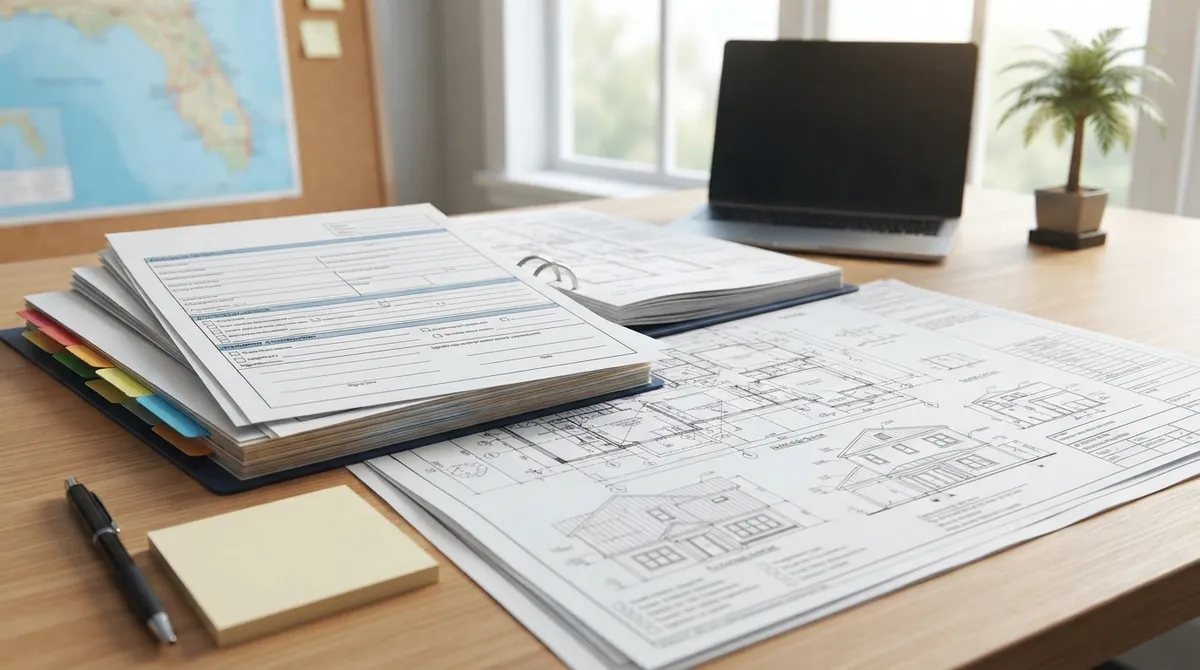
Most Florida permit applications ask for a similar core packet, even though the exact forms vary by jurisdiction. Missing even one item is one of the most common reasons applications bounce back, costing you days or weeks of delay.
- A completed permit application with accurate scope of work and project value
- Contractor license information and proof of local registration where required
- Notice of Commencement, when the project value exceeds the statutory threshold
- Signed and sealed construction plans, including structural, MEP, or site plans as applicable
- Energy calculations and product approvals for windows, doors, and other assemblies
- Site plans or surveys, plus flood zone, zoning, and utility documentation when relevant
This is precisely where in-house drafting and engineering make a difference. When your plans and engineering come from the same team handling your filing, revisions get resolved fast because there's no third-party consultant to chase down. That single detail can shave real time off a project timeline.
Comparing Statewide Rules to Local Administration
| Aspect | Statewide Rule | Local Variation |
|---|---|---|
| Legal basis for permits | Florida Statutes §553.79 requires a permit for covered work | Local building department enforces and administers the process |
| Building code | Florida Building Code applies statewide | Local amendments and zoning overlays may add requirements |
| Contractor licensing | State certification allows statewide practice | Local registration, business tax receipt, insurance proof still required |
| Review timelines | §553.792 sets 5 or 10 business day targets for qualifying applications | Actual queue times vary widely by county workload |
| Fees | No single statewide fee schedule | Each municipality sets its own fee, for example a $105 minimum combined fee in West Palm Beach for low-value projects |
Statewide Certification vs. Local Registration
A common question we hear from out-of-town contractors and even experienced Florida GCs relocating to a new market: does my state certification let me work anywhere? The short answer is yes, mostly. A Florida-certified general contractor can present an active certificate of competency to any local permitting authority and pay the applicable local fees. But local registration, business-tax receipts, and insurance documentation may still be required before that permit gets issued.
Our contractor registration checklist is a handy starting point if you're expanding into a new county for the first time. And if you're not sure which building department actually has jurisdiction over your project address, our building department lookup tool can save you a confusing phone call or two.
Municipality Registration Made Simple
Registering with each municipality where you plan to pull permits is one of those administrative tasks that's easy to overlook until it stalls a job. We handle municipality registration and DBPR licensee processes for contractors expanding across counties like Manatee, Lee, and Broward, so you can focus on the actual construction work.
Timelines: How Long Does Florida Permitting Really Take
Under Florida Statutes §553.792, certain complete and sufficient applications for existing single-family residences with work valued below $15,000 may receive local review within 5 business days, provided statutory conditions are met. Applications tied to Community Development Block Grant–Disaster Recovery programs get a 10 business day target. These are meaningful benchmarks, but they only apply when the application is complete and sufficient from the start, which is a big "if" for anyone unfamiliar with a specific jurisdiction's checklist.
Larger commercial projects, threshold buildings, or anything requiring multiple department sign-offs will naturally take longer. Our own team has tracked thousands of applications across more than 400 municipalities, and we can tell you honestly: the single biggest predictor of a fast approval is a clean, complete submission the first time. That's a big part of why plan review coordination and proactive revisions and resubmittals management matter so much.
Speeding Things Up: Private Provider Review and Master Permits
Florida law offers a few paths to faster approvals for the right projects. Private provider review, authorized under Florida law, lets a licensed private provider perform plan review and inspections instead of waiting in the county queue. 1 Contractor Solutions operates as a licensed private provider, which means we can review your plans directly rather than sending you back to stand in line.
Master building permit programs, addressed under Florida Statutes §553.794, are another option worth knowing about if you're a builder using repeatable residential models. As of 2026, local governments must establish a master permit program within six months of receiving a qualifying written request from a licensed contractor. This can dramatically cut repetitive review time, though site-specific items like lot grading, drainage, and HVAC placement still require individual review.
- Private provider review shifts plan review and inspections to a licensed third party
- Master permit programs reduce repeat review for approved residential models under §553.794
- Qualifying residential subdivisions may use certified technical review for up to 75% of permits under §177.073
- Eligibility depends heavily on project type and the local government's adopted procedures
The 2026 HB 803 Exemption: What Actually Changed
Starting July 1, 2026, HB 803 creates a limited residential permit exemption for certain work valued under $7,500 on single-family residential property. This sounds like a big deal, and it is, but the exclusions matter just as much as the exemption itself.
| Exemption Detail | What It Means |
|---|---|
| Value threshold | Work valued below $7,500 may qualify |
| Property type | Applies to single-family residential property only |
| Excluded work | Structural, electrical, mechanical, plumbing, and gas work still require permits |
| Flood hazard areas | Exemption does not apply if the property is wholly or partly in a flood hazard area |
| Effective date | July 1, 2026 |
Given how narrow this exemption really is, we always recommend verifying eligibility in writing with the local building department before skipping a permit application. Getting this wrong can lead to stop-work orders and after-the-fact permitting headaches, which brings us to our next section.
What Happens When Work Proceeds Without a Permit
Working without a required permit isn't just a paperwork problem. It can trigger stop-work orders, code enforcement action, mandatory after-the-fact permitting, and real complications when you try to sell, refinance, or insure the property. We see this constantly in real estate transactions, where an open permit found at closing derails a deal that was otherwise ready to sign.
If you're a realtor or investor evaluating a property with unpermitted work, our realtor closing support and after-the-fact and expired permits teams specialize in untangling exactly this kind of situation before it costs you the sale.
Common Reasons Applications Get Rejected
- Incomplete or inconsistent scope of work descriptions
- Missing signed and sealed structural or MEP documents
- Outdated or incorrect energy calculations
- Failure to address flood zone or zoning overlay requirements
- Notice of Commencement not filed or improperly recorded
Permitting Support for Every Type of Florida Project
General contractor permitting Florida projects require isn't limited to residential remodels. Solar companies need structural load calculations and electrical documentation that pass muster quickly, especially with net metering deadlines on the line. Design professionals often need dependable outsourced drafting so they can focus on client relationships instead of code research. And commercial GCs managing threshold buildings need coordinated structural engineering and MEP engineering that can withstand enhanced inspection requirements.
- Solar contractors benefit from streamlined structural and electrical permit packages
- Real estate professionals rely on permitting research before closing on renovated or flipped properties
- Homeowners need guidance preparing drawings for additions, pools, or accessory structures
- Architects and designers outsource drafting and engineering to avoid maintaining in-house staff
We work across markets from Miami and Fort Lauderdale to Orlando and Jacksonville, so no matter where your next project sits, chances are we've already filed there before. If you're local to the Gulf Coast, our team frequently supports projects around Sarasota and Bradenton as well.
How a Permitting Partner Fits Into Your Workflow
Here's the honest truth: a permitting service doesn't replace your license or your design professional's sealed drawings. What it does is remove the administrative weight so those responsibilities can be executed properly, on time. We prepare or review plans, submit applications, respond to reviewer comments, track status across portals, coordinate inspections, and carry the project through to Certificate of Occupancy or Certificate of Use.
Because our drafting and engineering happen in-house, our own engineer signs and seals the work, and when a reviewer flags an issue, we fix it without routing you through a third-party consultant's schedule. That single structural difference is often what separates a two-week resubmittal from a two-month one. You can browse our full range of permitting and engineering services to see everything that falls under one roof.
A Quick Checklist Before You Submit
- Confirm which jurisdiction actually controls your project address
- Verify whether your project qualifies for the HB 803 exemption or still requires a permit
- Gather signed and sealed plans, site plans, and energy calculations
- File a Notice of Commencement if required for your project value
- Track review comments closely and respond quickly to avoid falling out of the queue
Curious what other contractors and homeowners think of working with us? You can visit us on Google — 1 Contractor Solutions to read real feedback, or connect with our team on follow us on LinkedIn and follow us on Facebook for ongoing updates on Florida permitting changes like HB 803.
Bringing It All Together
General contractor permitting Florida requires isn't something you master overnight, and honestly, that's okay. The rules shift by county, the forms differ by city, and the law itself keeps evolving, just look at the 2026 changes under HB 803 and the master permit provisions. What matters most is having a clear process and, ideally, a team that's already walked this road in the jurisdiction you're working in.
If you're ready to stop guessing which building department controls your project or which forms you're missing, our team is here to help you move forward with confidence. Feel free to get a free quote and let's talk through your next Florida permit together.
FAQs
Does a general contractor need a permit in Florida?
Yes, in almost every case! Florida Statutes §553.79 requires a permit before you construct, alter, repair, or demolish covered structures, and that permit gets filed with the local building department. There are a few narrow exemptions, like the new HB 803 rule for work under $7,500 starting July 1, 2026, but structural, electrical, mechanical, plumbing, and gas work always need a permit regardless of value.
Who is responsible for pulling a building permit in Florida, the contractor or the property owner?
Typically it's the licensed contractor of record who pulls the permit, since they're taking on the legal responsibility for the work. Homeowners can pursue owner-builder permits under specific conditions, but that comes with its own set of responsibilities worth understanding before signing on.
Can a Florida-certified general contractor pull permits anywhere in the state?
Pretty much, yes! A state-certified contractor can present their active certificate of competency to any local building department and pay applicable local fees to pull permits statewide. That said, local registration, business-tax receipts, and insurance documentation may still be required, so it's smart to check with each jurisdiction before you start a project there.
How long does it take to get a building permit in Florida?
It really depends on your project and jurisdiction, but Florida Statutes §553.792 sets a 5 business day target for certain complete, low-value single-family applications, and 10 business days for qualifying CDBG-Disaster Recovery projects. Larger or more complex projects can take considerably longer, especially if the initial submission is missing documents, which is exactly why a clean first submission matters so much.
What work is exempt from permits in Florida after HB 803?
Starting July 1, 2026, HB 803 creates a limited exemption for certain residential work valued under $7,500 on single-family properties. But don't get too excited just yet, because structural, electrical, mechanical, plumbing, and gas work are all excluded, and the exemption doesn't apply if your property sits in a flood hazard area. When in doubt, it's always worth confirming with your local building department in writing.
We do this work every day across all 67 Florida counties. Call (866) 314-6931 and we will tell you what your situation actually requires — including when you do not need us.
Related services
Permit Facilitation & Filing
You have a crew scheduled, a client asking for dates, and a permit sitting somewhere in a queue you cannot see. We file it, w…
See the servicePlan Review Coordination
A permit in plan review is not one queue. On a commercial project it can be six queues, each with its own reviewer, its own c…
See the serviceReady to get your permit moving?
One call tells you which jurisdiction controls your project, what it will take, and what it will cost. Most of the time we can scope it on the phone.