
Blog
What Permits Do You Need for a Restaurant in Cape Coral?
A friendly 2026 guide to the DBPR license, plan review, zoning, building, fire, and other approvals behind a Cape Coral restaurant permit.
Key Takeaways
-
A DBPR public food service license does not replace Cape Coral local permits, and local permits do not replace the DBPR license; most restaurant projects need both tracks.
-
Verify zoning and land-use suitability for your exact address before signing a lease, including whether the building can support a commercial kitchen's electrical and plumbing loads.
-
DBPR plan review is generally required for new builds, conversions, remodels, and reopenings after 18+ months closed, and approval must be obtained before construction begins.
-
Buying an existing restaurant still requires the new owner to hold the appropriate DBPR license before operating, though plan review may not apply if there is no construction or conversion.
-
A restaurant on septic must obtain approval from the Florida Department of Health or DEP, so check septic and utility capacity early to avoid costly design changes.
-
Gather building, electrical, fire, and plumbing sign-offs in one folder before the DBPR opening inspection, since missing local approvals can stall the state inspection.
Picture this: you have found the perfect corner spot in Cape Coral, the lease is almost signed, and you can already smell the garlic and butter. Then someone asks, "Do you have your permits lined up?" Suddenly the dream gets a little foggy. Don't worry, you are in good company, and the fog clears quickly once you see how the pieces fit together.
Getting a restaurant permit in Cape Coral, FL is really a two-track journey. One track is the state: the Florida Department of Business and Professional Regulation (DBPR) licenses public food service establishments. The other track is local: zoning, building, electrical, plumbing, fire, and other approvals handled by Cape Coral and Lee County authorities. Both tracks matter, and they have to line up.
In this friendly 2026 guide, we will walk through each approval, show you what order to tackle things in, and point out the traps that trip up first-time owners, contractors, designers, and the real estate pros who advise them. Grab a coffee, and let's get you from lease to ribbon-cutting.
The Big Picture: State License Plus Local Approvals
Here is the single most useful idea in this whole article: a DBPR food service license does not replace local permits, and local permits do not replace the DBPR license. You need both for most restaurant projects.
A restaurant serving food to the public in Cape Coral generally needs a public food service establishment license from DBPR's Division of Hotels and Restaurants. This applies to dine-in, takeout, and delivery operations, and the license type depends on your service model. Meanwhile, the city and county side covers whether your location can legally be a restaurant, whether the space is built safely, and whether it meets fire and utility requirements.
DBPR itself advises operators to contact local occupational-license, zoning, and building authorities, because requirements vary by municipality and county. In other words, the state will not tell you everything the city needs, so plan to ask both.
Quick comparison: who handles what
| Approval | Who Handles It | What It Covers |
|---|---|---|
| Public food service license | Florida DBPR, Division of Hotels and Restaurants | Sanitation and safety licensing to serve food to the public |
| DBPR plan review | Florida DBPR | Equipment, layout, and menu review for qualifying projects |
| Zoning and land-use suitability | Cape Coral local authorities | Whether the site can operate as a restaurant |
| Building permit | Cape Coral building authorities | Construction, remodeling, and structural work |
| Electrical, plumbing, fire approvals | Local authorities as applicable | Safe systems and life-safety compliance |
| Septic approval, if applicable | Florida Department of Health or DEP | Wastewater handling for septic-served sites |

Step 1: Check Zoning Before You Sign the Lease
If you take only one tip from this guide, make it this one: verify zoning and land-use suitability before you commit to a site. We have seen excited owners pay deposits on a space only to learn the use is not allowed there, or that the building cannot support a commercial kitchen without major changes.
Ask the local authorities questions like these:
- Is a restaurant a permitted use at this address?
- Does the property's current use differ from restaurant use (a retail shop or office, for example)?
- Are there parking, signage, or outdoor seating considerations?
- Will the building's existing electrical, plumbing, and utility capacity handle a commercial kitchen?
A change of use is a big flag. If the space was previously something else, you may be looking at both local change-of-use steps and DBPR plan review. If you want a deeper look at how business openings connect to local use approvals, our guide on whether you need a Certificate of Use to open a business in FL is a handy companion read.
Step 2: Understand When DBPR Plan Review Applies
DBPR plan review is generally required in these situations:
- The restaurant is newly built.
- The space is converted from another use.
- The restaurant is being remodeled.
- The establishment is reopening after being closed for at least 18 months.
Plans should identify your equipment, and DBPR's guide calls for a sample menu so reviewers can see what you plan to prepare and serve. Importantly, you should obtain required DBPR plan approval before construction or remodeling begins. Building first and asking questions later is one of the costliest mistakes a new owner can make.
What if you are simply buying an existing restaurant? A change of ownership may not require plan review when operations continue without interruption and there is no construction, remodeling, or conversion. However, the new owner still needs the appropriate DBPR license before operating. Because details vary, confirm the specifics with DBPR and local authorities before closing.
Step 3: The DBPR Licensing Sequence, Step by Step
DBPR's usual licensing sequence is refreshingly logical. Here is how it generally flows:
- Create an online account with DBPR.
- Complete plan review if your project requires it.
- Apply for and pay for the license that matches your service model.
- Schedule your opening inspection.
- Pass the sanitation and safety inspection before you serve a single customer.
New licensees must pass that opening inspection before operating. The inspection may also require evidence of other approvals, including building, electrical, fire, and plumbing sign-offs. That is why local permitting and state licensing have to move in step: a missing local approval can stall your state inspection, and vice versa.
Also keep in mind that seating capacity is not determined by the DBPR food license alone. Local building and fire requirements, your design, and utility capacity can all affect how many guests you can seat.
Step 4: Local Building, Electrical, Plumbing, and Fire Permits
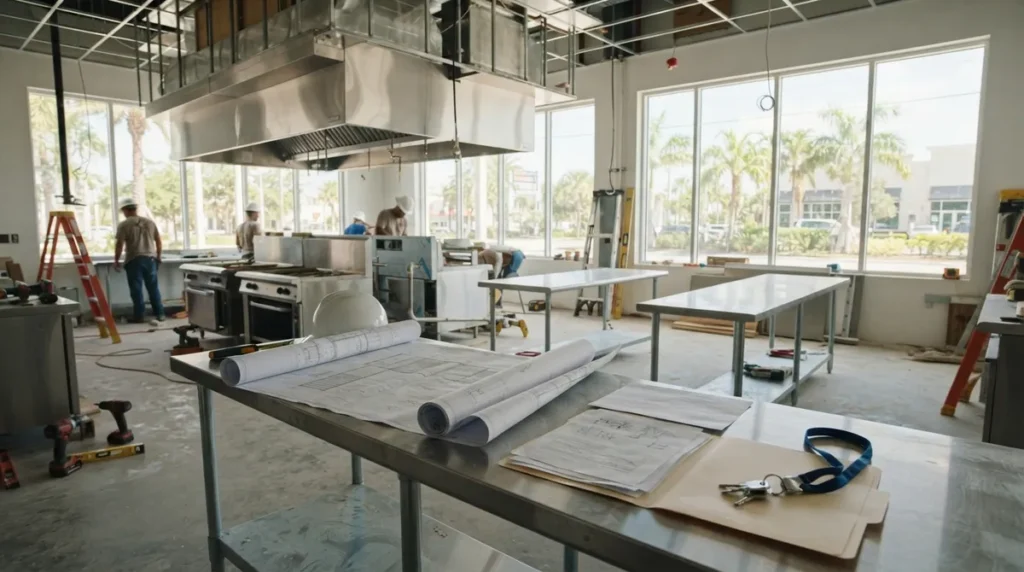
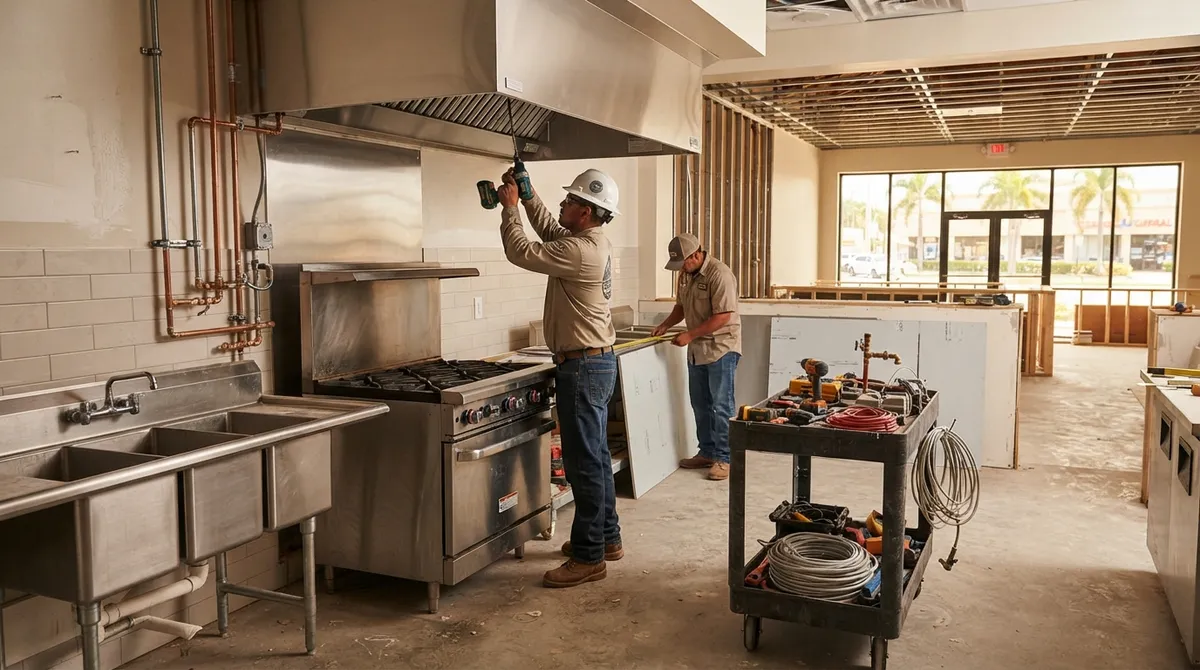
Once you know the site works, the build-out begins, and that is where most of the permitting action happens. A restaurant is a demanding building type. Think commercial kitchen exhaust, grease management, gas lines, higher electrical loads, restroom fixtures, and exit and fire-protection requirements.
Depending on your project, you may need local permits for:
- General building or tenant improvement work
- Electrical upgrades for kitchen equipment and lighting
- Plumbing, including grease-handling and fixture counts
- Mechanical and hood or exhaust systems
- Fire protection and life-safety systems
- Signage and other site items
Many of these require professional drawings, sometimes with engineer-sealed plans. If you are curious about who stamps what, read who seals structural drawings for Florida permits. For MEP-heavy kitchens, MEP engineering for permits is often the make-or-break piece.
What a typical restaurant project timeline looks like
| Phase | Typical Activities | Common Pitfall |
|---|---|---|
| Site selection | Zoning check, use verification, utility capacity review | Signing a lease before confirming allowed use |
| Design and plans | Layout, equipment schedule, sample menu, MEP and structural drawings | Incomplete equipment lists |
| Plan review | DBPR review and local plan review | Starting construction before approvals |
| Construction | Permitted build-out with inspections | Skipped or failed inspections |
| Opening | DBPR opening inspection, local sign-offs | Missing proof of building, fire, or plumbing approvals |
We deliberately do not promise exact review times here. Timelines depend on the property, the scope, and reviewer workload, so confirm current expectations with DBPR and Cape Coral authorities. For a general sense of how local timing works in this part of Southwest Florida, see how long a building permit takes in Cape Coral.
Step 5: Don't Forget Septic and Utility Questions
Here is a detail that surprises plenty of people: a restaurant on a septic system must obtain the applicable approval from the Florida Department of Health or the Department of Environmental Protection, according to DBPR's permanent food-service guide. A commercial kitchen produces far more wastewater than a typical home, so septic-served properties deserve early attention.
Even for sites on city sewer and water, ask about capacity. Utility capacity can influence your design and even your seating. Raising these questions during site selection, not after you have bought the hood system, saves real money.
Step 6: Plan Your Opening Inspection Like a Pro
The DBPR opening inspection is the finish line for the licensing track, so treat it like a final exam you want to ace. A few friendly habits go a long way:
- Gather your approvals in one folder: building, electrical, fire, and plumbing sign-offs.
- Walk the space with your plans in hand to confirm the build matches what was approved.
- Make sure equipment is installed as shown on the approved plans.
- Confirm your DBPR application and fees are complete before scheduling.
- Keep your sample menu and equipment list accessible.
If your local final inspections or a certificate of occupancy are part of the picture, our walkthrough on how to get a certificate of occupancy in Florida explains how that closeout piece works.
Common Mistakes (and How to Dodge Them)
Every restaurant project is a little different, yet the same stumbling blocks show up again and again. Here are the big ones:
- Building before approval. Remodeling or constructing before DBPR plan approval can force costly rework.
- Skipping the zoning check. A lease is hard to undo if the use is not allowed.
- Underestimating MEP. Kitchens need properly sized electrical, plumbing, and exhaust, and weak drawings draw reviewer comments.
- Forgetting separate approvals. The state license and the local permits are different things.
- Ignoring septic. If you are not on sewer, the Department of Health or DEP approval is part of your critical path.
- Assuming a purchase means no paperwork. A new owner still needs the appropriate DBPR license before operating.
And if a remodel already happened without the right sign-offs, take a breath. It is fixable. Our guide to fixing an unpermitted restaurant remodel in FL lays out a calm path forward, and 9 mistakes to avoid with a Florida restaurant remodel can help you steer clear in the first place.
Who Should Care About This Guide?
Opening a restaurant is a team sport, so it helps to know how each player fits in:
- General contractors need accurate plans, clean submittals, and tracked reviews so crews are not sitting idle.
- Real estate professionals and investors benefit from permitting research before a lease or purchase, especially around use and prior work.
- Architects, designers, and specialty trades often want dependable outsourced drafting, engineering, and permit administration.
- Property owners and landlords want to understand what a restaurant tenant will need so the space is lease-ready.
If your role is on the contractor side, our page for general contractors explains how we plug in, and our realtor and title support page covers the property-side view.
How 1 Contractor Solutions Can Help
Think of 1 Contractor Solutions as Florida's outsourced permitting department. We are not a construction contractor. We are the team contractors and owners call when the permit is the thing standing between them and a scheduled crew. We handle permit facilitation and filing, prepare or review plans, work reviewer comments, manage revisions, and carry the project through approval and closeout.
Because our drafting and engineering are in house, with sealed work coming from our own engineer, a reviewer comment gets fixed rather than passed around. For restaurant projects, that can mean coordinated commercial plans, MEP and structural drawings, and steady plan review coordination. We also support small business CO, CU, and permitting needs, and we serve all 67 Florida counties, including Cape Coral. If you want to hear what others say, you can read 1 Contractor Solutions reviews on Google.
One honest note: we can help organize and move your paperwork, but final requirements and approvals always come from DBPR and the local authorities, so please confirm specifics with them directly.
A Few Friendly Local Touches
Opening day is a celebration, and a great Cape Coral restaurant becomes part of the neighborhood. While you are polishing the dining room, you might also think about the details that guests notice, like the exterior. Teams such as Wayne & Sons Landscaping & Junk Removal can help with curb appeal and clearing out leftover debris from a build-out. And since a big grand-opening smile never hurts, even a quick trip to Charming Smiles of Ocoee might be on the pre-launch checklist for the team. For marketing your new spot once the doors open, Brain Buzz Marketing is another resource worth exploring.
Your Quick-Start Checklist
Before you do anything else, run through this list:
- Confirm zoning and land-use suitability for your exact address.
- Decide your service model so you know which DBPR license type applies.
- Find out whether your project triggers DBPR plan review.
- Prepare equipment details and a sample menu.
- Line up local building, electrical, plumbing, and fire permits.
- Check whether septic approval is needed.
- Create your DBPR online account and schedule your opening inspection.
Ready to Open Your Cape Coral Restaurant?
Permits can feel like a maze, but with the right order of operations they become a checklist you can actually finish. Start with zoning, get your plans approved before building, keep the state and local tracks in sync, and treat the opening inspection as the final polish. Do that, and your next big moment will be the first order coming out of the kitchen.
If you would rather hand the paperwork to people who do this every day, we would love to help. Get a free quote and tell us about your Cape Coral restaurant. You can also follow us on LinkedIn or follow us on Facebook for more Florida permitting tips. Permits approved. Projects moving.
FAQs
What permits do I need to open a restaurant in Cape Coral, Florida?
Most restaurants need a Florida DBPR public food service license plus separate local approvals, such as zoning, building, and applicable electrical, plumbing, and fire permits. Requirements depend on your property and project, so confirm them with DBPR and Cape Coral authorities before signing a lease or starting work.
Does a Cape Coral restaurant need DBPR plan review before remodeling?
Generally, yes, plan review applies when a restaurant is newly built, converted from another use, remodeled, or reopened after being closed for at least 18 months. Get the required DBPR plan approval before construction begins so you avoid costly rework.
Do I need a new restaurant license if I buy an existing restaurant?
Yes, the new owner still needs the appropriate DBPR license before operating. Plan review may not be required if operations continue without interruption and there is no construction, remodeling, or conversion, but confirm your situation with DBPR and local authorities.
What approvals does a restaurant on a septic system need?
A restaurant on septic must obtain the applicable approval from the Florida Department of Health or the Department of Environmental Protection, per DBPR's permanent food-service guide. Raise this early, since it can affect your timeline and design.
What happens at the DBPR opening inspection?
DBPR performs a sanitation and safety inspection that new licensees must pass before operating. You may also need to show evidence of other approvals, including building, electrical, fire, and plumbing sign-offs, so gather those documents ahead of time.
We do this work every day across all 67 Florida counties. Call (866) 314-6931 and we will tell you what your situation actually requires — including when you do not need us.
Related services
Permit Facilitation & Filing
You have a crew scheduled, a client asking for dates, and a permit sitting somewhere in a queue you cannot see. We file it, w…
See the servicePlan Review Coordination
A permit in plan review is not one queue. On a commercial project it can be six queues, each with its own reviewer, its own c…
See the serviceReady to get your permit moving?
One call tells you which jurisdiction controls your project, what it will take, and what it will cost. Most of the time we can scope it on the phone.