
Blog
How to Estimate Your Roof Permit Cost in Clearwater, FL
Wondering what a Clearwater roof permit costs? Learn how fees are calculated, what extras apply, and how to build a reliable estimate.
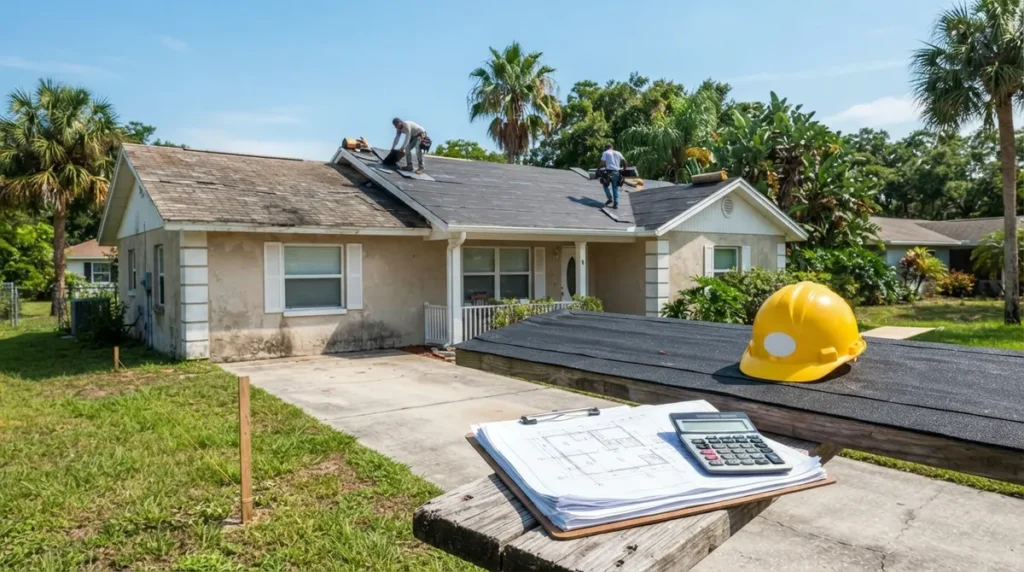
Key Takeaways
-
Clearwater roof permit fees are based on project valuation, so a small repair and a large reroof will cost very different amounts; there is no single flat price.
-
The general formula cited is $33 plus $7.25 per $1,000 of valuation for work up to $100,000, but the schedule was current as of February 2, 2022, so verify it before quoting.
-
Expect extras beyond the base fee: plan-review charges due at application, a 3% state fee on permit, plan, and trade fees ($2 minimum), and $30 per additional trade on combination permits.
-
The city's online estimator excludes fire, impact, right-of-way, and tree-related fees, so ask the city which of these apply to your parcel to avoid a higher final invoice.
-
Verify whether your property is inside City of Clearwater limits, since unincorporated Pinellas County uses different fees and a Clearwater mailing address does not guarantee city jurisdiction.
-
A permit is required for roof component replacement; the only stated exception is a minor roof-leak repair under $500, so check with the city before starting any work.
Replacing a roof is one of those projects where everything feels exciting until someone asks, "Who's pulling the permit, and what's it going to cost?" If you've been searching for the roof permit cost in Clearwater, you've probably noticed that nobody gives you a single, tidy number. There's a good reason for that, and it's not because anyone is hiding the ball.
In the City of Clearwater, permit charges are generally tied to the valuation of your project, and the final total can include a few other line items on top. That means a small repair-scale reroof and a large tile-to-tile replacement won't land at the same price. The good news? Once you understand the pieces, you can build a solid estimate yourself, and avoid unpleasant surprises when the invoice shows up.
In this friendly walkthrough, we'll cover how Clearwater calculates roofing permit fees, which extra charges can appear, who's allowed to apply, and how to use the city's own estimator. We'll also point out a few jurisdiction traps that trip up even experienced pros. Grab a coffee, and let's get you a number you can trust.
What You're Actually Paying For When You Pull a Roof Permit
A roof permit isn't just a piece of paper. It covers the city's review of your scope and materials, the permit issuance itself, and the inspections that confirm the work meets the Florida Building Code. Clearwater says a permit is required for installation or replacement of roofing components, so a full reroof almost always lands in permit territory.
The city's published fee schedule generally bases permit charges on construction valuation, meaning the stated value of the work. So the roof permit cost in Clearwater scales with the size and price of your job rather than being one flat fee.
Here's a quick snapshot of the typical components that can make up your total:
- Base permit fee: calculated from your project valuation.
- Plan-review fee: due at application for online submissions.
- State surcharge: a percentage-based state fee added to permit, plan, and trade fees.
- Combination permit add-ons: extra per-trade charges if multiple trades share one permit.
- Other applicable fees: such as fire, impact, right-of-way, or tree-related fees on certain projects.
How Clearwater Calculates Permit Fees: The Formula in Plain English
Let's talk numbers, with a big friendly caveat: always confirm against the live fee schedule before you quote anyone. Clearwater's published general permit-fee formula lists $33 plus $7.25 per $1,000 of valuation (or fraction thereof) for work valued at $100,000 or less. Higher valuation tiers use different formulas.
The version of the schedule we reviewed indicates costs current as of February 2, 2022, so treat the math below as an illustration, not a quote. Rates can change, and how the formula applies to a roofing permit specifically should be verified with the city.
A Worked Example (For Illustration Only)
Say your roofing contract is valued at $18,000. Using the general formula above, the base calculation would look like this:
- Start with the flat amount: $33.
- Divide your valuation by $1,000: $18,000 ÷ 1,000 = 18 units.
- Multiply by $7.25: 18 × $7.25 = $130.50.
- Add them together: $33 + $130.50 = $163.50 base permit fee.
From there, you'd layer on plan-review charges and the state fee. Clearwater's estimator describes the state fee as 3% of permit, plan, and trade fees, with a $2 minimum. That's why your all-in total will be higher than the base number alone.
| Fee Component | How It Works | Applies To |
|---|---|---|
| Base permit fee | $33 + $7.25 per $1,000 of valuation (up to $100,000) | Most permitted projects |
| Plan review | Due at application; amount set by city schedule | Online submissions |
| State fee | 3% of permit, plan, and trade fees ($2 minimum) | Permit totals |
| Combination permit add-on | $30 per additional trade or permit type | Multi-trade permits |
| Other fees | Fire, impact, right-of-way, tree, etc. | Project-specific |
Remember, this table summarizes what the city has published. Your specific total depends on your scope, valuation, and whatever the current schedule says on the day you apply.
Step-by-Step: How to Get a Reliable Roof Permit Estimate
Instead of guessing, follow this simple process. It takes about fifteen minutes and saves you from sticker shock later.
- Confirm your jurisdiction. Make sure your property is actually inside the City of Clearwater and not unincorporated Pinellas County. Fee schedules differ, and you shouldn't use one as a quote for the other.
- Pin down your valuation. Use your signed contract price or a documented material-and-labor estimate. Valuation drives the fee.
- Use the city's online fee estimator. It's the best starting point for a project-specific number.
- Add the items the estimator may leave out. The city warns that fire, impact, right-of-way, and tree-related fees aren't included in its estimate.
- Verify with the city if anything is unclear. Building and Development Services lists (727) 562-4567 and epermit@myclearwater.com for questions.
That fifth step is underrated. A two-minute phone call can confirm whether your scope triggers anything unusual, which is far cheaper than a rejected application.
Do You Always Need a Permit? The Small-Repair Exception
Here's a question we hear constantly: "Can I skip the permit for a small fix?" Clearwater identifies a narrow exception for a very small, minor roof-leak repair costing less than $500. If your project is bigger than that, or you're replacing components rather than patching a leak, plan on a permit.
If you're not sure whether your scope qualifies, contact the city before work starts. Skipping a required permit can create bigger headaches down the road, from stop-work orders to trouble at resale. If you've already been down that road, our guide on how to legalize an existing roof in Florida walks through the recovery process, and you can also read about whether fixing a few shingles needs a permit.
Who Can Apply? Contractors, Homeowners, and Online Filing
Clearwater says licensed contractors must submit roof permit applications online. Plan-review fees are due at application, and the remaining permit fees are generally paid after reviews are approved and before the permit is issued.
Different readers will care about this in different ways:
- General and roofing contractors: Build permit time and fees into your bid, and keep your registration and licensing paperwork current for the city.
- Homeowners: Ask your roofer to confirm in writing who is pulling the permit and whether the fee is included in your contract price.
- Real estate professionals and investors: Pull permit history before closing so an open or missing roof permit doesn't derail a deal.
- Solar companies: If a roof replacement precedes your install, confirm the reroof permit is closed out so your structural documentation lines up.
Registration requirements can vary by city, so if you're expanding into new territory, see how to register your contractor license in a new Florida county.
The Jurisdiction Trap: City of Clearwater vs. Unincorporated Pinellas
This is where a surprising number of estimates go sideways. Pinellas County's permitting department serves unincorporated areas and partner communities, while the City of Clearwater runs its own building permitting. Addresses near city lines can be confusing, and a Clearwater mailing address doesn't automatically mean you're inside city limits.
Always check your property by address before you rely on any fee schedule. Using the county's unincorporated-area fees as a Clearwater quote (or vice versa) can leave you off by a meaningful amount, and could even send your application to the wrong office. If you're comparing neighboring markets, our breakdown of reroof permit requirements in Clearwater is a helpful companion read.
Ways to Keep Your Roof Permit Costs Predictable
You can't change the city's fee schedule, but you can avoid the add-on costs that come from mistakes. Here are habits that save real money:
- State your valuation accurately. Underreporting can trigger corrections and delays.
- Submit a complete package the first time. Missing product approvals or documentation lead to resubmittals. See how to read a Florida product approval number for roofing to get that part right.
- Bundle thoughtfully. Combination permits can add per-trade charges, so confirm whether combining trades helps or hurts your total.
- Don't let permits expire. An expired permit creates a separate cleanup project.
- Keep your documentation organized. Contracts, material specs, and inspection records all matter at closeout.
If your roofing company handles volume, avoiding repeat errors is even more important. Here are seven permit facilitation mistakes Florida roofers make and how to dodge them.
Common Cost Surprises to Watch For
| Surprise | Why It Happens | How to Avoid It |
|---|---|---|
| Estimate lower than final invoice | Estimator excludes some fees (fire, impact, right-of-way, tree) | Ask the city which extra fees apply to your parcel |
| Wrong fee schedule used | Property is in unincorporated Pinellas, not the city | Verify jurisdiction by address first |
| Resubmittal delays | Incomplete or inconsistent plan package | Review the checklist before filing |
| Outdated rate quoted | Fee schedule changed since last published version | Confirm the live schedule on the day you apply |
When It's Worth Getting Professional Help
Plenty of straightforward reroofs go smoothly with a good licensed roofer. But if your project involves a denied application, an expired permit, work that was completed without one, or a closing deadline, an experienced permitting partner can save time and stress.
That's exactly the kind of work 1 Contractor Solutions does every day across all 67 Florida counties. Our team handles permit filing, tracking, reviewer comments, revisions, and closeout, and our in-house drafting and engineering means sealed drawings or engineer letters don't depend on an outside consultant. Roofers who move a lot of jobs can also look at our Roof Permit Partnership Program, and you can explore our roof permit services for more detail.
Facing a hold-up right now? These resources may help: who can rescue a denied building permit in Florida and what reopens an expired Florida permit fastest. And for neighboring-market comparisons, see what a roof permit costs in Bradenton.
Wrapping Up: Your Clearwater Roof Permit Game Plan
The roof permit cost in Clearwater isn't a mystery once you know the moving parts: valuation-based permit fees, plan-review charges due at application, a state surcharge, possible combination-permit add-ons, and project-specific extras. Confirm your jurisdiction, use the city's estimator, double-check the live fee schedule, and call the city if anything feels unclear.
And if you'd rather hand the paperwork to people who live and breathe Florida permitting, we're happy to help. Get a free quote and tell us your address and your timeline; we'll tell you what controls your project and take it from there. You can also visit us on Google — 1 Contractor Solutions to see what our customers say, follow us on LinkedIn and follow us on Facebook for more Florida permitting tips. Our marketing partner, Brain Buzz Marketing, helps us share them.
Permits approved. Projects moving. We can't wait to help you get yours across the finish line.
FAQs
How much does a roof permit cost in Clearwater, Florida?
There's no single flat price. Clearwater's fee schedule generally bases permit charges on construction valuation, and the total can also include plan-review, state, and other applicable fees. The city's online fee estimator is the best way to get a project-specific number.
Does Clearwater require a permit to replace a roof?
Yes, the city says a permit is required for installation or replacement of roofing components. The only stated exception is a very small, minor roof-leak repair costing under $500, so when in doubt, check with the city before starting.
Can a homeowner apply for a Clearwater roofing permit?
Clearwater states that licensed contractors must submit roof permit applications online. Homeowners should confirm with the city or their contractor who will file, and make sure the permit fee is addressed in the contract.
What fees besides the base permit fee might I owe?
You may see plan-review fees due at application, a state fee described as 3% of permit, plan, and trade fees (with a $2 minimum), and $30 per trade for combination permits. Fire, impact, right-of-way, and tree-related fees may also apply and aren't included in the city's estimator.
How do I know if my property is in Clearwater or unincorporated Pinellas County?
Check your property by address with the city and county, since a Clearwater mailing address doesn't guarantee city limits. Pinellas County permitting serves unincorporated areas and partner communities, so using the wrong fee schedule can throw off your estimate.
We do this work every day across all 67 Florida counties. Call (866) 314-6931 and we will tell you what your situation actually requires — including when you do not need us.
Related services
Permit Facilitation & Filing
You have a crew scheduled, a client asking for dates, and a permit sitting somewhere in a queue you cannot see. We file it, w…
See the servicePlan Review Coordination
A permit in plan review is not one queue. On a commercial project it can be six queues, each with its own reviewer, its own c…
See the serviceReady to get your permit moving?
One call tells you which jurisdiction controls your project, what it will take, and what it will cost. Most of the time we can scope it on the phone.