
Blog
How to Choose Who to Hire for Unpermitted Storm Repairs in FL
Not sure who to hire for unpermitted storm repairs in Florida? Learn which pros you need, the steps to follow, and how to avoid costly mistakes in 2026.
Key Takeaways
-
Storm damage does not automatically waive permit requirements in Florida; roofing, structural, window/door, electrical, plumbing, HVAC, and some drywall or enclosure work commonly still need permits.
-
Start by confirming which building department has jurisdiction over your property (county or city), since the local office makes the final call on after-the-fact permits.
-
Verify any contractor's Florida license for the specific type of work through DBPR, checking both the individual and the business entity, and get proof of insurance.
-
Put in writing who will pull the after-the-fact permit and schedule inspections, since a contractor who skipped the permit the first time may not be reliable on paperwork.
-
Bring in a licensed engineer when repairs are structural or concealed, since departments may require proof of wind-load compliance or exposure of covered work.
-
Check floodplain status early: in some Pinellas-type cases, repairs costing 49% or more of a structure's actual cash value may trigger elevation or rebuilding requirements.
The wind has died down, the tarp is on the roof, and a friendly crew helped you get your home dry again. Then a neighbor mentions the word "permit," and your stomach drops. If your storm repairs were finished without one, take a breath. You are far from alone, and this is a very fixable problem.
The big question is simple: who should I hire for storm damage unpermitted repairs in Florida? The honest answer is that it takes a small team, not one hero. You need a properly licensed contractor for the work itself, your local building department as the final decision-maker, and often a permitting professional to keep the paperwork moving. This guide walks you through each role, the steps in order, and the traps to avoid in 2026. Whether you are a homeowner, a general contractor, a solar company, or a real estate pro helping a client, you will find a clear path below.
Why Unpermitted Storm Repairs Are So Common in Florida
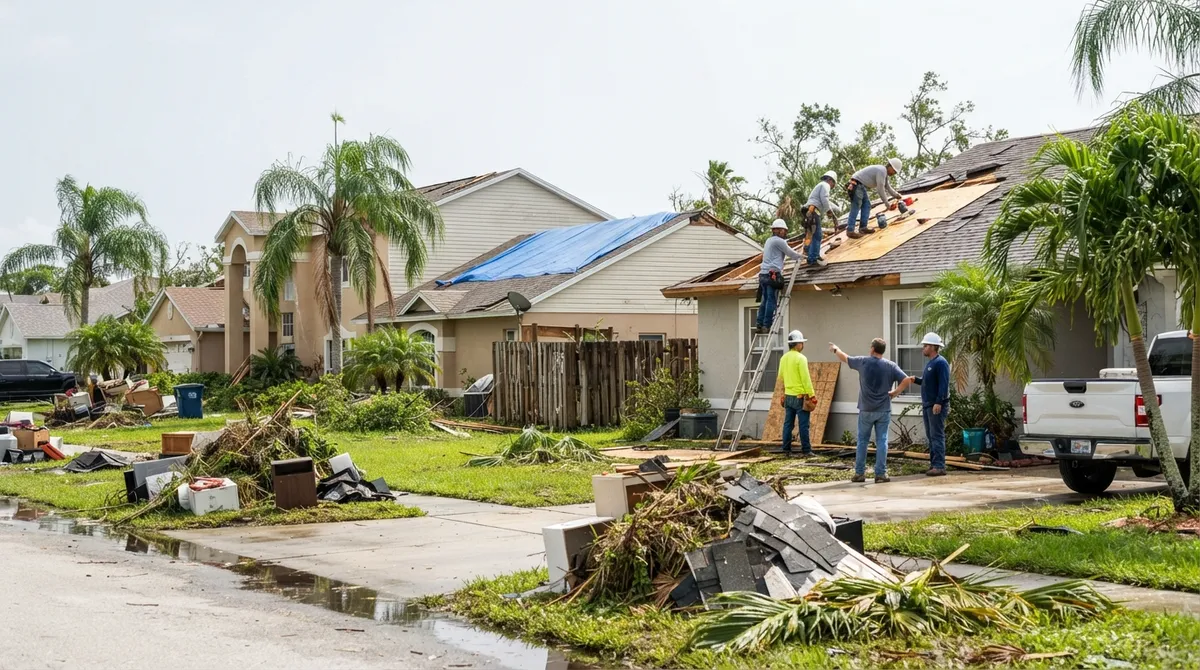
After a hurricane or tropical storm, everyone is in a hurry. Roofers are booked solid, insurance adjusters are stretched thin, and homeowners just want a dry house. Some crews skip permits to move faster. Other times, owners simply assume that storm damage waives the usual rules.
It does not. Storm damage does not automatically waive ordinary permit requirements. Local guidance commonly identifies these repairs as permit-triggering:
- Roofing and structural repairs
- Windows and exterior doors
- Electrical, plumbing, and HVAC work
- Some drywall and enclosure work
Exact thresholds and exceptions differ by city and county. For example, Seminole County's storm-repair guidance lists roof repairs exceeding 100 square feet as an example requiring a permit, while smaller repairs may not. Always confirm with the local office.
The Short Answer: Who You Actually Need
Here is the quick version, so you can see the whole picture before we dig in.
| Role | What They Do | When You Need Them |
|---|---|---|
| Building department | Decides if an after-the-fact permit is required and what proof is needed | Always. They have the final say |
| Florida-licensed contractor | Performs or corrects the construction work and stands behind it | Any repair that needs fixing, finishing, or verifying |
| Licensed engineer or architect | Verifies structural or design compliance and seals documents | Roof framing, structural, or flood-related questions |
| Permitting consultant | Organizes applications, records, and tracking with the department | When you want the paperwork handled and coordinated |
A permitting consultant can help organize applications and documentation, but does not replace the contractor, design professional, or building official. Think of the consultant as your project manager for the paper side.
Step 1: Find Out Which Building Department Controls Your Property
Before you hire anyone, figure out who has jurisdiction. This sounds easy, but it trips up a lot of owners. County rules may apply in unincorporated areas, while a city may run its own permits. Near city lines, the answer is not always obvious.
- Look up your address on your county property appraiser site to confirm whether you are inside city limits.
- Call or visit the building department for that jurisdiction and ask how they handle after-the-fact storm repair permits.
- Ask about current storm notices. Some places announce special recovery procedures.
- Write down the name of the person you spoke with, the date, and what they told you.
You can save time with the building department lookup tool, and you can check for lingering problems with the open permit search. If you want a deeper explanation, this guide on which Florida jurisdiction reviews my project is a helpful read.
Step 2: Hire a Properly Licensed Florida Contractor
For any construction or corrective work, you need a contractor whose license is active and whose scope covers the job. A roofing license does not cover electrical work, and a handyman cannot take on structural repairs.
Florida's Department of Business and Professional Regulation (DBPR) advises checking both the individual license and the business entity in its license-verification system. Do not stop at a business card or a truck magnet.
Your Contractor Vetting Checklist
- Active Florida license that matches the type of work
- License verified for both the individual and the company
- Proof of general liability and workers' compensation insurance
- Written scope of work and a clear price
- References from recent Florida jobs
- A plain answer to this question: who is responsible for permits and inspections?
That last point matters most. If a contractor skipped the permit the first time, ask why, and make sure the new agreement spells out exactly who pulls the permit and schedules inspections. General contractors who want a reliable partner for the paperwork can explore permitting support for general contractors. If you need to confirm who is even allowed to apply, see who can pull a permit in Florida.
Step 3: Bring In an Engineer or Architect When the Work Is Structural
Some storm repairs cannot be judged by eye. A building official may want proof that a roof deck, truss connection, or wall frame can handle Florida wind loads, especially when the work is already covered up.
That is where a licensed engineer comes in. An engineer can inspect the work, document what is there, and prepare sealed drawings or a letter for the department. You can learn more about how these letters work in who writes engineer letters for Florida permits and who seals structural drawings for Florida permits.
Common engineering and drafting needs after an unpermitted storm repair include:
- As-built drawings that show what was actually built
- Structural engineer letters for roofs, trusses, and framing
- Site plans when the repair touches setbacks or lot coverage
- MEP documentation for electrical, plumbing, or mechanical work
If you want to see what these services look like, check out structural engineering, as-built drawings, and engineer letters.
Step 4: Consider a Permitting Consultant to Keep Everything Moving
A permitting service is useful when you need help identifying permit types, assembling records, coordinating with the building department, or tracking review. For busy contractors and out-of-state owners, this can save weeks of phone tag.
Before you hire one, ask a few direct questions:
- Are you acting only as an administrative consultant, or do you also provide licensed contracting, architecture, or engineering services?
- Which credentials can you show me, and can I verify them?
- Do you work in my county and with my specific building department?
- How do you handle reviewer comments and resubmittals?
- How will you keep me updated?
A firm like 1 Contractor Solutions works as an outsourced permitting department across all 67 Florida counties. Because drafting and sealed engineering are handled in house, reviewer comments can be fixed without waiting on an outside consultant to return a call. If you would like to see how this works for after-the-fact situations, explore after-the-fact and expired permits or permit facilitation and filing.
What an After-the-Fact Permit Actually Involves
An after-the-fact permit documents completed work and allows the building department to review it for applicable building and floodplain requirements. It is not a punishment ritual. It is a way to prove the repair is safe and legal.
Here is what the department may ask for:
- Plans or as-built drawings
- Photos taken before, during, and after the work
- Product approvals for windows, doors, and roofing materials
- Receipts, invoices, and contractor information
- Inspections of the finished work
- Exposure of concealed work if it cannot otherwise be verified
If the work cannot be verified or does not comply, the department may require corrections. That is why hiring a licensed contractor early is so valuable. For a full walkthrough, read how to get an after-the-fact permit in Florida, and for typical document lists, see how to gather the documents for an after-the-fact permit in FL.
Do Not Assume a Waiver or Fast Lane Applies to You
You may hear that post-storm fees are waived or that permits are issued in a day. Sometimes that is true locally, but it is rarely true everywhere.
| Example | What Was Announced | Important Limit |
|---|---|---|
| Pinellas County | Limited after-the-fact penalty waiver for eligible storm repairs in specified jurisdictions through June 30, 2026 | Covered penalties only, standard permit fees still applied, and it was not statewide |
| Orange County | Certain storm permit types, including roofing, mechanical, electrical, and plumbing, may be issued within 24 hours when applications are compliant | A county-specific service statement, not a statewide guarantee |
| Seminole County | Roof repairs over 100 square feet listed as an example needing a permit | Local rules and project details can change the answer |
The lesson is simple: check current notices for your exact jurisdiction before relying on any waiver. Programs expire, and eligibility rules vary. You can learn more about typical costs in after-the-fact permit Florida cost.
Watch Out for the Floodplain Rule
This one catches many owners by surprise. Floodplain rules can materially affect repair decisions. Pinellas County's published guidance says that in covered floodplain cases, repairs costing 49% or more of a structure's actual cash value may trigger elevation or rebuilding requirements under local rules.
Your storm repairs, combined with any earlier work, can push a project over that line. Before you spend more money, confirm three things with the building and floodplain officials:
- Your property's flood zone
- How the department values the damage and repair costs
- Which local standard governs your case
For a clear explanation of how this works, see the FEMA 50 percent rule in Florida. If you are in Pinellas, our Pinellas County page offers local context.
Who to Hire Based on Your Situation
Every storm story is a little different. Here is a quick guide to the best starting point for each reader.
| Your Situation | Best First Hire | Why |
|---|---|---|
| Homeowner with an unpermitted roof or window repair | Licensed contractor plus a permitting consultant | You need the work verified and the paperwork handled |
| General contractor cleaning up a past job | Permitting consultant with in-house engineering | Speeds up resubmittals across counties |
| Solar company with an unpermitted install | Permitting consultant and structural engineer | Roof loading and electrical documentation are key |
| Realtor or investor facing a closing | Permitting consultant first | Research and timeline help protect the sale |
| Owner worried about structure or flood status | Engineer, then the building official | Facts about the building drive every decision |
Real estate pros can find tailored help through realtor permitting support, and homeowners can start at our homeowner resources. If a closing deadline is looming, take a look at urgent permit rescue.
Red Flags When Hiring Storm Repair Help
Scams spike after every major storm. Stay alert for these warning signs:
- Pressure to sign immediately or pay a large deposit upfront
- No Florida license number, or a number that does not match the person
- A suggestion that "permits are not needed because of the storm"
- No written contract or a vague scope of work
- Refusal to show insurance
- An offer to have you pull the permit as the owner so the contractor avoids responsibility
That last one deserves extra caution. Owner-builder rules come with legal obligations, and they are not a loophole. Learn more about owner-builder permits before agreeing to anything like that.
Will Unpermitted Storm Repairs Affect Insurance or a Sale?
They can. Open or missing permits may complicate insurance claims, appraisals, refinancing, and closings. Buyers' inspectors and title companies often catch them. For more detail, see expired permits and insurance claims in Florida and what happens when an open permit is found at closing.
The good news is that fixing the permit situation early almost always costs less than fixing it under pressure.
A Simple Action Plan You Can Start Today
- Gather your records: contracts, invoices, photos, insurance claim files, and the contractor's license information.
- Confirm your jurisdiction and ask the building department how they handle after-the-fact storm permits.
- Verify any contractor through DBPR before you sign anything.
- Get your structure evaluated by an engineer if the work is structural or concealed.
- Bring in a permitting consultant to assemble the packet, file it, and track reviewer comments.
- Schedule inspections and complete any corrections the department requests.
- Keep the final approval documents in a safe place for future sales or insurance questions.
Let Us Help You Take the Stress Out of This
You do not have to solve a permit puzzle on your own while you are still recovering from a storm. 1 Contractor Solutions handles permit filing, tracking, plan review coordination, and sealed engineering across Florida, with same-day response and in-house drawings. If you want to see what other customers say, Visit us on Google — 1 Contractor Solutions, and you can also follow us on LinkedIn or follow us on Facebook for helpful Florida permitting updates.
Ready to move forward? Get a free quote today, and let's turn your unpermitted storm repair into a clean, approved, worry-free project. You have already done the hard part by asking the right question. We will help with the rest.
FAQs
Who should I hire to get an after-the-fact permit for storm repairs in Florida?
Start with a Florida-licensed contractor qualified for the work, and consider a permitting consultant to organize the application and keep it moving. The local building department makes the final call, so contact them first. If the repair is structural, a licensed engineer may also be needed.
Can a Florida permitting consultant get permits for repairs that are already finished?
A consultant can prepare and coordinate an after-the-fact application, gather your records, and track the review. They do not replace the contractor, design professional, or building official, so the work may still need inspections or corrections.
Can the building department make me open walls or redo the repairs?
Yes, it is possible. If concealed work cannot be verified through plans, photos, or documentation, the department may require exposure or corrections. Clear records and an engineer's letter can often reduce how much has to be opened up.
How do I check that a storm repair contractor is licensed and insured in Florida?
Use the DBPR license-verification system to confirm both the individual's license and the business entity. Then ask for proof of insurance and a written scope that names who is responsible for permits and inspections.
We do this work every day across all 67 Florida counties. Call (866) 314-6931 and we will tell you what your situation actually requires — including when you do not need us.
Related services
Permit Facilitation & Filing
You have a crew scheduled, a client asking for dates, and a permit sitting somewhere in a queue you cannot see. We file it, w…
See the servicePlan Review Coordination
A permit in plan review is not one queue. On a commercial project it can be six queues, each with its own reviewer, its own c…
See the serviceReady to get your permit moving?
One call tells you which jurisdiction controls your project, what it will take, and what it will cost. Most of the time we can scope it on the phone.