
Blog
HELOC vs. Unpermitted Work: Which One Wins in FL?
Learn whether a HELOC can be approved with unpermitted work in Florida, how lenders assess risk, and steps to legalize work before closing.
Key Takeaways
-
Unpermitted work in Florida doesn't automatically deny HELOC approval, but approval depends on the lender's underwriting policies, appraisal results, and severity of the violation—making it a case-by-case decision rather than a blanket rule.
-
Appraisers typically exclude unpermitted square footage from valuation or lower the home's appraised value, which directly reduces your available HELOC credit limit since borrowing capacity ties directly to appraised value.
-
Florida Statutes §162.09 allows local governments to fine homeowners up to $250 per day for violations and $500 for repeat violations; unpermitted work can generate open code enforcement liens that halt HELOC closing entirely.
-
Resolving unpermitted work through after-the-fact permitting before applying for a HELOC is typically faster and cheaper than dealing with denied applications, reduced loan amounts, or failed closings.
-
Lenders commonly request sealed engineering drawings, certificates of occupancy, proof of permit resolution, and code violation documentation when unpermitted work is discovered during underwriting.
-
A title search revealing open code enforcement liens or unresolved violations can stop HELOC closing even if the lender approves the application, making early title status verification essential.
If you've ever tried to tap into your home's equity, you know the drill: appraisal, paperwork, and a lender combing through every detail of your property. But what happens when your Florida home has a sunroom, garage conversion, or electrical upgrade that never got a permit? Can you still get approved for a HELOC, or does unpermitted work automatically slam the door shut? Grab a cup of coffee, because we're going to walk through this together, and by the end you'll know exactly where you stand and what to do next.
The short answer is: sometimes, yes, but it's complicated. Lenders don't have a single Florida-wide rule that says "unpermitted work equals automatic denial." Instead, it comes down to underwriting policies, the appraisal, the title search, and how serious the unpermitted work actually is. Let's break it all down so you can walk into your lender's office (or upload your documents online) feeling confident instead of confused.
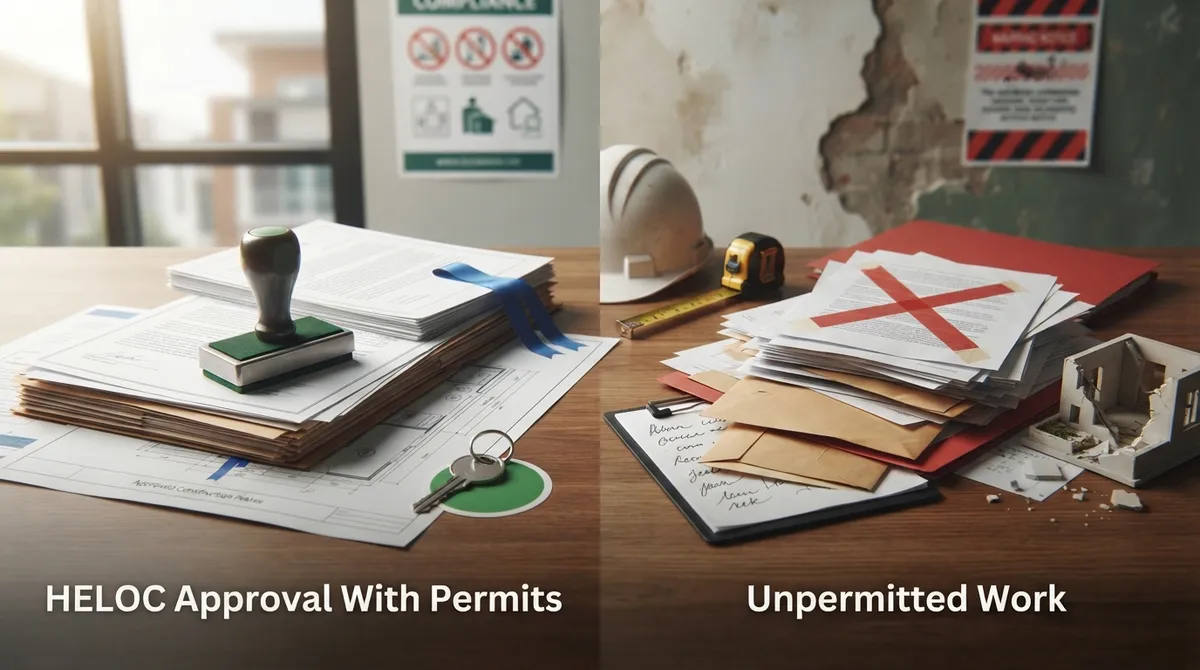
HELOC Approval With Permits vs. Without: What Really Changes
Think of a HELOC application as a puzzle with several pieces: your credit, your income, your existing mortgage balance, and the appraised value of your home. Unpermitted work throws a wrench into that last piece because it makes the appraiser's job harder and riskier.
Here's a side-by-side look at how a typical HELOC review differs when a home has clean permit history versus when it has unpermitted alterations.
| Factor | Home With Full Permit History | Home With Unpermitted Work |
|---|---|---|
| Appraisal Value | Full square footage and improvements counted | Unpermitted areas may be excluded or valued lower |
| Loan Amount | Based on full appraised value | Often reduced to reflect discounted value |
| Underwriting Conditions | Standard documentation | May require proof of permitting or repair before closing |
| Title Review | Typically clean | May reveal code violations or liens that delay closing |
| Insurance Impact | Usually straightforward | Insurer may require disclosure or exclude coverage for unpermitted areas |
| Approval Odds | Higher, assuming other criteria are met | Case-by-case, depends on lender risk tolerance |
Notice that word "case-by-case" in that last row? That's really the theme here. Some lenders will approve a HELOC on a home with a small, cosmetic unpermitted change, like a converted patio that isn't used as living space. Others will pump the brakes the moment their appraiser flags anything questionable.
Why Florida Lenders Care So Much About Permits
Florida has specific statutory language around permitting that lenders and appraisers are well aware of. Florida Statutes §553.79 generally requires a permit before you build, alter, repair, or demolish most structures, with a few statutory exceptions for lower-value work on owner-occupied single-family homes. When a lender sees unpermitted square footage, they're essentially looking at a legal question mark, not just a construction question mark.
On top of that, Florida Statutes §489.127 identifies starting permit-required work without an effective permit as a prohibited act, and it carries potential criminal penalties for certain violations. That's serious enough that most lenders would rather ask questions upfront than get surprised later.
And then there's code enforcement. Florida Statutes §162.09 allows local governments to fine property owners up to $250 per day for an initial violation and up to $500 per day for repeat violations, with higher amounts possible in certain situations. If a lender's title search turns up an open code enforcement case or a recorded lien from unresolved violations, that can stop your HELOC from closing entirely, even if your credit score is fantastic.
The Appraisal Factor
Appraisers are trained to spot the tell-tale signs of unpermitted work: mismatched electrical panels, garage conversions with no visible permit card, additions that don't quite match the original roofline. When they find something suspicious, they typically either:
- Exclude the unpermitted square footage from the home's reported living area
- Note the discrepancy in their report and let the lender decide how to proceed
- Recommend a lower overall value to account for risk
- Suggest the borrower obtain permits or documentation before the loan moves forward
Since your HELOC's available credit limit is directly tied to your home's appraised value, any downward adjustment here shrinks the amount you can borrow. That's the practical, dollars-and-cents reason so many Florida homeowners choose to resolve permitting issues before they apply.
Steps to Take Before You Apply for a HELOC
Rather than gambling on whether an underwriter will notice (spoiler: they usually do), it's smarter to get ahead of the issue. Here's a simple roadmap that works well for homeowners across Florida, whether you're in Tampa, St. Petersburg, or Sarasota.
- Pull your permit history. Contact your local building department, or use a resource like the open permit search tool, to see what's on file for your address.
- Identify gaps. Compare what's permitted against what actually exists on the property. That extra bathroom or converted garage might be the culprit.
- Check for open violations or liens. A quick call to code enforcement, or a title search, can reveal issues that need resolving before any lender will move forward.
- Get professional help with retroactive permitting. This is where a Florida permitting specialist earns their keep, coordinating plans, inspections, and paperwork with the local building department.
- Request updated sealed drawings if needed. Many after-the-fact permits require engineering documentation showing the work meets current code.
- Schedule your final inspection. Once everything checks out, you'll want a certificate of completion or occupancy on record before your appraisal.
This process might feel like homework, but trust us, it's a lot less stressful than having your HELOC application stall two weeks before closing.
How Different Florida Property Owners Are Affected
Unpermitted work doesn't just impact homeowners looking for a HELOC. It ripples out to almost everyone involved in Florida real estate and construction.
General Contractors and Renovation Projects
If you're managing a renovation for a client who's counting on a HELOC to fund the next phase, unpermitted work from a previous owner or a past contractor can freeze the whole project. Reliable permit filing and tracking from the start prevents this headache from ever forming.
Solar Companies
Many homeowners plan to finance solar installations with a HELOC. If the home already has unpermitted electrical or structural work, that can complicate both the loan and the solar permit itself. Solar companies benefit from working with a team that understands solar contractor permitting requirements across Florida jurisdictions.
Real Estate Professionals
Realtors and investors often discover unpermitted work during a listing prep or due diligence period. Getting ahead of it with realtor and closing support services can prevent a HELOC or purchase loan from falling apart at the last minute.
Homeowners and Residential Property Owners
For everyday homeowners, this is often the first time they've ever dealt with permitting at all. It can feel overwhelming, but resources built specifically for homeowners make the process far less intimidating.
What Documents Lenders Typically Want to See
Every lender is a little different, but most will ask for some combination of the following when unpermitted work is discovered:
- Proof of an active or closed permit for the work in question
- An engineer's letter confirming structural safety, if applicable
- A certificate of occupancy or certificate of completion
- Updated as-built drawings reflecting current conditions
- Documentation that any open code violations have been resolved
This is exactly the kind of paperwork a permitting professional prepares every day. In-house engineering and architectural drafting teams can turn around sealed drawings quickly, which matters a lot when a closing date is looming.
Legalizing Unpermitted Work: A Quick Overview
Retroactive, or "after-the-fact," permitting is the process of legalizing work that was done without the proper approvals. It typically involves submitting plans for what was built, allowing inspectors to open walls or ceilings if needed, correcting any code violations, and paying additional fees. The Florida Building Code often adds a penalty fee when work started before a permit was pulled, on top of standard permit costs.
It sounds like a hassle, and honestly, it can be. But it's almost always faster and less expensive than dealing with a denied HELOC, a failed home sale, or an insurance claim dispute down the road. Teams like 1 Contractor Solutions specialize in exactly this kind of after-the-fact permitting work across all 67 Florida counties, handling everything from plan drafting to final inspection coordination.
| Common Unpermitted Item | Typical Resolution Path |
|---|---|
| Converted garage or Florida room | After-the-fact permit with engineering review |
| DIY electrical panel upgrade | Retroactive electrical permit and inspection |
| Roof replaced without permit | Roof permit application plus inspection |
| Pool or spa installed without permit | After-the-fact permit through pool/spa contractor process |
| Structural addition (room, second story) | Full plan review, sealed engineering, inspections |
If you're not sure where to start, a building department lookup tool can point you to the right local office in minutes rather than hours.
When a Title Issue Can Stop Your HELOC Cold
Even if your lender is perfectly comfortable with your unpermitted work situation, a title company might not be. Open code enforcement liens, unresolved violations, or pending litigation tied to the property can all show up during a title search and put a hard stop on closing. This is why it pays to check both permit history and title status before you ever submit a HELOC application, rather than being blindsided at the closing table.
Our friends and neighbors throughout Manatee, Hillsborough, and Pinellas counties run into this scenario more often than you'd think, especially with older homes that have changed hands several times. If you'd like a second set of eyes on your situation, you can always get a free quote and talk through your specific address and history with a permitting specialist who knows the local rules inside and out.
Bringing It All Together
So, can a HELOC be approved with unpermitted work in Florida? Yes, it's possible, but it's far from guaranteed, and the path to approval usually runs straight through your local building department. Lenders, appraisers, and title companies are all trained to spot red flags, and unresolved permitting issues tend to shrink your loan amount at best and stop your closing entirely at worst.
The good news is that you don't have to untangle this alone. Whether you need help pulling permit history, preparing sealed engineering drawings, or filing an after-the-fact permit application, a dedicated Florida permitting team can move things along a lot faster than trying to navigate county offices on your own. We'd love to help you sort out your situation, whether you're in Bradenton, Tampa, St. Petersburg, or anywhere else across the state. Feel free to get a free quote today and let's get your permits, and your HELOC application, back on solid ground.
You can also visit us on Google — 1 Contractor Solutions to see how we've helped homeowners and contractors across Florida resolve these exact issues, or connect with us and follow us on LinkedIn and follow us on Facebook for ongoing permitting tips and updates. For general guidance on Florida's building regulations, the Florida Building Commission's official resources are also worth a look.
FAQs
Can I get a HELOC in Florida if my home has an unpermitted addition?
It's possible, but it really depends on your lender's underwriting rules and how significant the addition is. Some lenders will move forward with conditions, like requiring you to legalize the work first, while others may reduce your loan amount or decline it. The friendliest path forward is usually resolving the permit before you apply.
Will a Florida lender require me to legalize unpermitted work before approving a HELOC?
Many lenders do ask for this, especially if the unpermitted work is structural, electrical, or affects the home's overall value. It's not a universal rule, but it's common enough that it's worth planning for. Getting ahead of it with an after-the-fact permit can save you a lot of back-and-forth.
How does unpermitted work affect a Florida home appraisal?
Appraisers often exclude unpermitted square footage from your home's valuation or note the issue in their report, which can lower your appraised value. Since your HELOC amount is tied to that value, this can shrink how much you're able to borrow. It's one of the biggest reasons homeowners choose to permit the work before applying.
Can a title lien or code violation stop a HELOC from closing in Florida?
Yes, absolutely. Even if your lender is comfortable with the unpermitted work itself, an open code enforcement lien or unresolved violation found during a title search can halt closing entirely. It's smart to check your title status early so there are no last-minute surprises.
Should I fix unpermitted work before applying for a home-equity loan?
In most cases, yes, it's the smoother and often faster route in the long run. Legalizing the work upfront avoids appraisal reductions, underwriting delays, and the risk of denial altogether. Plus, you'll have peace of mind knowing your home is fully compliant, which matters for insurance and future resale too.
We do this work every day across all 67 Florida counties. Call (866) 314-6931 and we will tell you what your situation actually requires — including when you do not need us.
Related services
Permit Facilitation & Filing
You have a crew scheduled, a client asking for dates, and a permit sitting somewhere in a queue you cannot see. We file it, w…
See the servicePlan Review Coordination
A permit in plan review is not one queue. On a commercial project it can be six queues, each with its own reviewer, its own c…
See the serviceReady to get your permit moving?
One call tells you which jurisdiction controls your project, what it will take, and what it will cost. Most of the time we can scope it on the phone.