
Blog
After-the-Fact Permit vs. Tear-Out: Which Legalizes Work?
Compare after-the-fact permits and tear-outs to legalize existing construction in Florida, with costs, documents, and tips for choosing the right path.
Key Takeaways
-
Florida has no single statewide after-the-fact permit application or fee schedule; the local county or municipality with jurisdiction over the property sets the forms, documents, inspections, and fees, so identify it first.
-
An after-the-fact permit is a review of finished work, not an amnesty; approval is not guaranteed and corrections may be required before the permit can be closed.
-
Typical after-the-fact packages include a completed application, as-built drawings, a site plan or survey, photos of the work, and sometimes engineering letters or sealed drawings.
-
Concealed work may require extra verification such as opening select areas, so ask your building department early what evaluation method it would accept.
-
Tearing out unpermitted work still often requires a demolition permit, and any rebuild needs its own permit, so the removal route can be costlier than it first appears.
-
An after-the-fact permit does not automatically resolve an open code-enforcement case; ask how the two connect and track any deadlines separately.
Here is a moment plenty of Florida property owners know well. You are buying a house, selling one, or finally getting around to a refinance, and someone mentions the dreaded phrase: "That addition doesn't show up in the permit records." Suddenly your calm Tuesday has turned into a puzzle. Do you try to legalize existing construction in Florida, or do you rip the work out and start over?
Take a breath. You are in good company, and you have more options than you might think. In 2026, thousands of Florida owners, investors, and contractors sort through this exact question. The good news is that the path is usually clearer once you know how it works.
In this friendly guide, we compare the two main routes head to head: seeking an after-the-fact permit versus removing the unpermitted work. We will walk through what each involves, what documents you may need, where the surprises tend to hide, and how to choose. We will also be honest about what no one can promise: approval is never automatic, and every jurisdiction does things its own way.
Why Legalizing Existing Construction Matters in Florida
Florida Statutes §553.79 sets the baseline: covered construction, alteration, repair, or demolition generally requires a permit from the local enforcing agency before work begins. Certain exemptions exist, so it is smart to check your scope of work against current law and local rules.
When work gets built without a permit, it does not just sit quietly. It tends to resurface at predictable moments:
- Real estate closings when a title search, appraisal, or buyer inspection flags a mismatch
- Insurance claims when an adjuster asks about unpermitted improvements
- Code enforcement notices triggered by a neighbor complaint or a drive-by observation
- Refinancing or HELOC applications where a lender wants clean records
If you are staring down one of these, our urgent permit rescue team handles denials, stop work orders, and closings held up by permit problems.
The Two Paths at a Glance
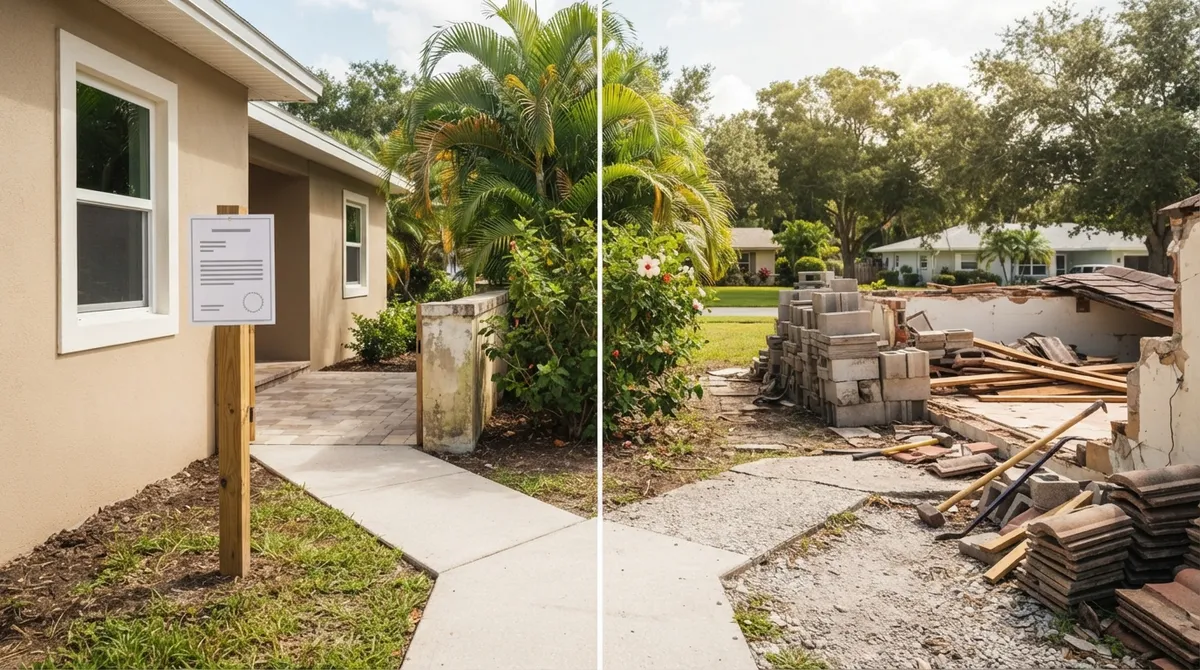
Before we dig in, here is a quick side-by-side so you can see how the routes compare.
| Factor | After-the-Fact Permit | Tear-Out and Rebuild |
|---|---|---|
| Goal | Document and legalize the work as built | Remove the work, often to start fresh with a permit |
| Cost drivers | Plans, engineering, fees, possible corrections | Demolition, disposal, new permit, rebuild costs |
| Timeline | Depends on jurisdiction, review, and corrections | Demolition plus a full permit and construction cycle |
| Disruption | Usually lower unless walls must be opened | High, since you lose finished work |
| Risk | Approval is not guaranteed; fixes may be required | Still needs a permit for the replacement work |
| Best for | Work that can be shown to meet code | Work that cannot be brought into compliance |
Notice that even the tear-out path often leads back to a permit. Removing something does not always erase the paperwork problem, and demolition itself may require approval. That is worth a quick conversation with your local building department. If you do need one, our demolition permit service can help.
Path One: The After-the-Fact Permit
An after-the-fact permit is the process of asking your local building department to review work that is already finished. It is a review, not an amnesty. The department decides whether the work meets the applicable requirements, and corrections may come with the territory.
One important point: there is no single statewide after-the-fact application or fee schedule. Florida has 67 counties, and permitting authority may also belong to a municipality. The authority for your property determines the forms, documents, inspections, and fees. That is why identifying your jurisdiction is always step one. If you are unsure, try our building department lookup tool, or read about which Florida jurisdiction reviews your project.
What Reviewers May Ask For
Requirements differ by department and by type of work, but applicants are often asked for some combination of the following:
- A completed permit application describing the work accurately
- As-built drawings or plans showing what actually exists
- Site information, such as a survey or site plan
- Photographs of the completed work
- Supporting engineering or other professional documentation
Drawings are often the heart of the package. Professionally prepared as-built drawings document the real conditions, and an engineer letter can verify structural or other elements where the department wants a professional opinion.
What About Concealed Work?
This is the question that makes homeowners nervous: will they make me open my walls? It depends. Work hidden behind finished surfaces may require additional verification, such as opening select areas or another approved method of evaluation. Departments vary, so it is smart to ask early what they would accept for your situation rather than guessing.
Inspections and Corrections
Expect the local authority to inspect the completed work. If something falls short of the applicable code or local requirements, you may be asked to correct it before the permit can be closed. Zoning, setbacks, floodplain rules, and other approvals can also come into play. A building permit alone does not necessarily solve every land-use issue.
If the property sits in a flood zone, take a peek at our explainer on the FEMA 50 percent rule in Florida, since substantial improvement calculations can matter.
Path Two: Removing the Unpermitted Work
Sometimes tearing out the work really is the right call. If an addition violates setbacks, or a structural element cannot be shown to meet code, the practical answer may be to remove it. That path comes with its own checklist:
- Confirm what actually needs to go. Sometimes only part of the work is the problem.
- Ask whether demolition needs a permit. Many jurisdictions require one for removing structures.
- Handle utilities safely. Disconnect and cap electrical, plumbing, and gas properly.
- Document the restored condition. Photos and, where needed, inspection sign-off help close the loop.
- Permit any replacement work. If you rebuild, do it with a proper permit this time.
The cost of this route is easy to underestimate. You lose the value of finished work, pay for demolition, and often still pay for a new permit and construction. For that reason, many owners find the after-the-fact route worth exploring first, as long as the work can plausibly be brought into compliance.
Cost and Fees: What Is Realistic to Say
Everyone wants a number, and we wish we could hand you one. The honest answer is that fees and penalties vary by jurisdiction and circumstance. Some localities charge increased or additional fees for work begun without a permit, but there is no statewide penalty formula. Always get the current fee schedule directly from your building department. For more background, read our guides on after-the-fact permit costs in Florida and the penalty for building without a permit in Florida.
| Cost Category | After-the-Fact Route | Tear-Out Route |
|---|---|---|
| Plans and drafting | As-built drawings, possible site plan | New plans if rebuilding |
| Engineering | Letters or sealed drawings where required | Often needed for any rebuild |
| Government fees | Permit fees, possibly increased for unpermitted work | Demolition and new permit fees |
| Physical work | Corrections or opened walls, if required | Demolition, disposal, reconstruction |
| Hidden costs | Re-inspections, resubmittals | Lost finished work, extended disruption |
How to Decide: A Simple Framework
Not sure which way to lean? Walk through these questions. They will not replace a professional review, but they will help you organize your thinking.
- Who has jurisdiction? Confirm the county or municipality using the property address.
- What exactly was built? Describe the work accurately, including dates, materials, and who did it if known.
- Is there an open notice or case? If so, ask how permit review relates to it and what deadlines apply.
- Can the work likely meet code and zoning? Setbacks, structural capacity, and flood rules often decide this.
- What is your timeline? A closing date may push you to act quickly and strategically.
Whether you are a homeowner, a real estate investor, or a contractor inheriting a mess, the order of operations is the same: identify the authority, describe the work, request the current after-the-fact checklist, and go from there. If you want a deeper walkthrough, our guide on how to legalize unpermitted work in Florida covers the process in detail.
Special Situations Worth Knowing
Buying or Selling a Property
Real estate professionals know that a permit surprise can derail a closing. Early research helps. Our open permit search tool is a handy starting point, and our realtor closing support helps keep deals moving. If you are an agent, see how we work with realtors and title companies.
Contractors and Solar Companies
If a crew skipped a permit, or a prior contractor left a file hanging, cleaning it up protects your license and your reputation. General contractors can learn more on our general contractor page, and solar teams can see how we support solar contractors with documentation and filing.
Active Code Enforcement Cases
A permit application does not automatically resolve a code-enforcement violation. Ask the department how the two relate and keep an eye on any deadlines. Our code compliance and violations service is built for exactly this, and our after-the-fact and expired permits team takes the files other people decline.
Where a Permitting Partner Helps
You can absolutely navigate this process on your own, but it helps to know where the friction usually appears. Reviewers want complete, consistent packages. Drawings that do not match the field conditions, missing engineering, or the wrong jurisdiction can each add weeks.
1 Contractor Solutions acts as Florida's outsourced permitting department. Our drafting and engineering are in house, and our own engineer signs and seals the work, so when a reviewer flags something we can fix it directly rather than waiting on an outside consultant. We handle permit filing and tracking, work every reviewer comment through revisions and resubmittals, and carry projects through approval and closeout across all 67 Florida counties. Want to hear what clients say? Visit us on Google — 1 Contractor Solutions to read reviews.
Curious about our crew and our approach? You can follow us on LinkedIn or follow us on Facebook for updates. For the statute itself, the Florida Legislature publishes the full text of Florida Statutes §553.79, which is the statewide baseline for building permits and inspections.
A Realistic Look at the Outcome
Let us close this section with some gentle honesty. An after-the-fact permit can solve a lot, but it cannot be promised in advance. The work must be documented and accepted by the building department, and deficiencies may need correction before the permit closes. If the work cannot meet current requirements, the department may require modification or removal.
That is exactly why a quick, professional review at the start is so valuable. Knowing early whether your project leans toward legalization or removal saves money, time, and a few sleepless nights.
Conclusion: Pick the Path With Eyes Wide Open
So, which wins in the after-the-fact permit versus tear-out matchup? For work that can reasonably be shown to meet code, legalizing it through an after-the-fact permit is often the more practical and less disruptive route. For work that cannot, removal may be the cleaner answer. Either way, the smartest first move is the same: identify your jurisdiction, describe the work honestly, and get the current checklist from the people who will review it.
You do not have to figure this out alone. If you are ready to legalize existing construction in Florida and want a team that handles the drafting, engineering, filing, and follow-through, get a free quote and we will help you map the quickest, cleanest path forward. We answer around the clock, and se habla español.
FAQs
How do I legalize unpermitted construction in Florida?
In most cases you apply to the local building department for an after-the-fact permit and show that the work complies with applicable requirements. That usually means as-built drawings, photos, and sometimes engineering, followed by inspections and any needed corrections. Approval is never automatic, so confirm your jurisdiction and its current checklist first.
Will Florida make me open walls to inspect unpermitted work?
Sometimes, yes. Concealed work may require extra verification, such as opening select areas or another approved evaluation method, but it varies by department and type of work. Ask your building department early what they would accept so you are not caught off guard.
How much does an after-the-fact permit cost in Florida?
There is no single statewide fee schedule or penalty formula. Costs depend on your county or city, the scope of work, and what plans or engineering are needed, and some localities charge increased fees for work started without a permit. Request the current fee schedule directly from the authority having jurisdiction.
Can unpermitted work be approved if it does not meet current code?
It depends on the specific deficiency and what your local department requires. Often the work can be corrected and then approved, but if it cannot be brought into compliance, modification or removal may be required. A professional review early on helps you see which way your project is likely to go.
Does an after-the-fact permit resolve a code-enforcement violation?
Not automatically. A permit review and an open code-enforcement case are related but separate, so ask the department how they connect and what deadlines apply. Keeping both moving at the same time is usually the smoothest approach.
We do this work every day across all 67 Florida counties. Call (866) 314-6931 and we will tell you what your situation actually requires — including when you do not need us.
Related services
Permit Facilitation & Filing
You have a crew scheduled, a client asking for dates, and a permit sitting somewhere in a queue you cannot see. We file it, w…
See the servicePlan Review Coordination
A permit in plan review is not one queue. On a commercial project it can be six queues, each with its own reviewer, its own c…
See the serviceReady to get your permit moving?
One call tells you which jurisdiction controls your project, what it will take, and what it will cost. Most of the time we can scope it on the phone.