
Blog
8 Mistakes to Avoid When You Reopen an Expired Permit in FL
Avoid 8 common mistakes when you reopen an expired permit in Florida. Learn local rules, windows, fees, and smart next steps.
Key Takeaways
-
Florida has no statewide reinstatement process; the city or county that issued the permit sets the rules, fees, reinstatement windows, and paperwork, so confirm your jurisdiction first.
-
Request an extension in writing before the permit expires, since extensions are usually cheaper and easier than reinstating a lapsed permit (e.g., Polk's $15 extension vs. $50 review fee after lapse).
-
Do not resume permitted work until the building department confirms in writing that the permit is active, because work under an expired permit may be treated as unpermitted.
-
Act within the reinstatement window, often around 180 days; missing it usually means a new application that must meet current code, and old plans and inspections may not carry over.
-
Prepare a complete reinstatement package up front: permit number, address, contractor info, written reason for the lapse, signed request, inspection history, and the administrative fee.
Here's a story we hear almost weekly: a contractor finishes 90% of a job, a few inspections slip through the cracks, life gets busy, and suddenly the permit is expired. Now the final inspection is blocked, the client is asking questions, and nobody is quite sure what to do next. Sound familiar? Take a breath. You are far from alone, and in many cases there is a clear path forward.
The catch is that trying to reopen an expired permit in Florida is not a single statewide form you can fill out and forget. The city or county that issued your permit decides whether it can be reinstated, how long you have, what it costs, and what paperwork they want. That is where well-meaning contractors, homeowners, and realtors tend to trip up.
In this friendly guide, we walk through eight common mistakes that cost people time and money, plus a few handy tables so you can see how the rules really work. Whether you are a general contractor juggling ten jobs, a solar company chasing a final, or a homeowner staring at a half-finished remodel, you will walk away knowing what to do next.
First, What Does It Mean to Reopen an Expired Permit?
When people say they want to "reopen" a permit, they usually mean asking the local building department to reinstate or renew a permit that has lapsed. It is not a guaranteed right, and it is not handled by the state. The department that issued your permit sets the rules, and those rules vary from one jurisdiction to the next.
The general framework comes from the Florida Building Code. Under Section 105.4.1, a permit generally becomes invalid if work does not begin within six months of issuance, or if work is suspended or abandoned for six months after it starts. Approved inspections at least every 180 days are the usual way to show active progress. Always check the code edition and any local amendments that apply to your permit.
There is also a special rule for single-family homes. Under Florida Statutes Section 553.79, a building permit for a single-family dwelling expires one year after issuance or on the effective date of the next Florida Building Code edition, whichever is later. Local governments may still extend permits beyond that date, so confirm what applies to you.
Mistake #1: Assuming There Is One Statewide Process
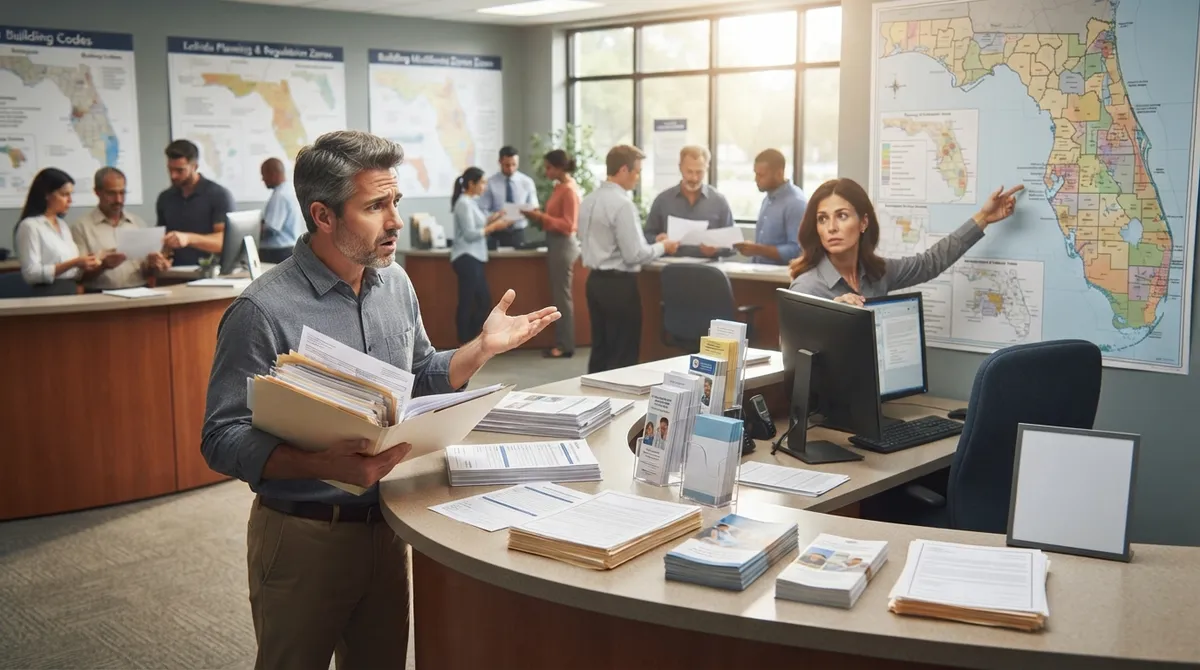
This is the biggest misunderstanding out there. Florida has 67 counties and hundreds of municipalities, and each one handles reinstatement a little differently. What works in one county may be flatly refused in the next.
Here are a few published examples to show just how much the rules differ:
| Jurisdiction | Reinstatement Window | Published Fee Example |
|---|---|---|
| Polk County | Permits expired up to 180 days may be reopened with written justification | $50 administrative review fee; $15 for an extension while still active |
| Lake County | Reissue possible if expired less than 180 days; new permit after that | Verify current fee schedule directly |
| Charlotte County | Up to two 90-day extensions, requested before expiration | $63 first extension; $100 second extension |
Notice the pattern? These are examples, not statewide rates. Before you do anything, find out exactly which building department controls your permit. Our building department lookup tool can help you sort that out, which is not always obvious near city lines.
Mistake #2: Waiting Until After Expiration to Ask for an Extension
Here is a little secret that saves a lot of headaches: it is almost always easier (and cheaper) to extend a permit before it expires than to reinstate it afterward. Charlotte County's guidance, for instance, describes extensions that must be requested before expiration. Polk County lists a $15 extension fee for active permits versus a $50 review fee once a permit has lapsed.
If you can see a permit sliding toward its deadline, act now:
- Check the expiration date in your jurisdiction's online portal.
- Schedule any pending inspection to show active progress.
- Submit an extension request in writing before the date passes.
- Keep copies of everything, including confirmation emails.
A small fee and a quick form today can spare you a much bigger project tomorrow. If your project is already past that point, our team can help through after-the-fact and expired permit services.
Mistake #3: Continuing Work Before Getting Written Confirmation
We get it. The crew is scheduled, the materials are on site, and the permit "should" be fine. But picking up the tools before the building department confirms the permit is active can create a much bigger problem than the one you started with.
Work done under an expired permit may be treated as unpermitted work. That can lead to stop work orders, fines, failed inspections, and trouble at closing. The safest approach is simple: do not continue permitted work until the department confirms in writing that the permit is active or otherwise authorizes you to proceed.
If you have already run into trouble, see our guide on how to close an expired permit in Florida for what comes next.
Mistake #4: Showing Up With an Incomplete Request
A reinstatement request that arrives missing key details usually gets bounced back, and every round trip costs you days. Most departments want a clear, complete package the first time.
Here is a typical checklist of what to gather before you submit:
- Permit number and property address. The basics, but you would be surprised how often one is missing.
- Applicant or contractor details. Include current license and insurance information.
- The reason for the lapse. Be honest and specific. Written justification matters in many jurisdictions.
- A signed (sometimes notarized) request. Check whether your department requires notarization.
- Proof of inspection history. Gather approved inspection records and any outstanding corrections.
- Payment for the administrative fee. Confirm the current amount in the fee schedule.
The department may also require outstanding inspections, corrections, or updated contractor information before work can resume. Having these ready up front makes the whole process smoother.
Mistake #5: Missing the Reinstatement Window
Time is not on your side once a permit lapses. Many jurisdictions give you a limited window, often around 180 days, to request reinstatement. Miss it, and you are generally looking at a brand-new permit application.
Here is how the two paths typically compare:
| Factor | Reinstating Within the Window | Starting a New Permit |
|---|---|---|
| Typical cost | Administrative review fee, often modest | New application and permit fees |
| Plan review | Often limited or waived | May require full review |
| Code requirements | Depends on local policy | Current code and local requirements apply |
| Approval | Discretionary, not guaranteed | Standard review process |
| Inspection history | May carry forward if approved | Generally must be confirmed with the department |
Some building officials will approve an exception for older expired permits, but you should never count on it. The sooner you act, the more options you keep on the table.
Mistake #6: Assuming Old Plans and Inspections Automatically Carry Over
This one catches a lot of people off guard. Just because your plans were approved and a few inspections passed does not mean you can pick up right where you left off. If reinstatement is unavailable and you need a new permit, you may have to meet current code and local requirements, not the rules from when you first applied.
Ask the building department directly: what can be carried forward, and what must be redone? Do not assume. Sometimes revised drawings, updated engineering, or an engineer letter can bridge the gap and save you from starting from scratch.
If your plans are out of date or the original drawings are missing, professional as-built drawings can document what is actually on site and give the reviewer something solid to work with.
Mistake #7: Overlooking Who Is Pulling the Permit
Contractor changes are one of the sneakiest reasons permits stall. A contractor leaves the job, a license lapses, or a homeowner takes over, and suddenly the permit is tied to someone who is no longer involved. Reinstating it may require updated contractor information, a new qualifier, or a change of contractor form.
Not sure who is allowed to take over? Our article on who can pull a permit in Florida breaks it down. Homeowners who plan to handle the work themselves should also look into owner-builder permits.
And if a contractor has simply disappeared mid-project, do not panic. It happens more than anyone likes to admit, and there are real solutions.
Mistake #8: Trying to Go It Alone When Time Is Tight
Look, many people reopen their own permits successfully, and we cheer for every one of them. But when a closing date, a stop work order, or an angry client is in the picture, doing it solo can cost far more than it saves.
Here is who tends to benefit most from professional help:
- General contractors managing multiple jobs and jurisdictions at once.
- Solar companies that need a final inspection to get a system turned on.
- Realtors and investors facing an open permit discovered at closing.
- Homeowners who inherited a half-finished project from a prior owner or contractor.
- Design and trade professionals who need drawings, engineering, and administration without adding staff.
At 1 Contractor Solutions, we act as Florida's outsourced permitting department. We handle filing, tracking, reviewer comments, revisions, and closeout, backed by in-house drafting and sealed engineering. Our team works across all 67 counties and answers fast, day or night. If a permit is the only thing standing between you and a scheduled crew, our urgent permit rescue service was built for exactly that moment.
Your Step-by-Step Game Plan
Ready to get moving? Here is a simple, friendly roadmap you can follow:
- Confirm the permit's status. Look it up in the issuing jurisdiction's portal or call the building department. You can also try our open permit search tool.
- Note the expiration date. This tells you which reinstatement window you are in.
- Ask what is allowed. Reinstatement, extension, or new permit? Get the answer from the department.
- Gather your documents. Permit number, address, contractor details, justification, and inspection records.
- Submit the request and fee. Keep proof of submission.
- Wait for written approval. Do not resume work until you have it.
- Schedule remaining inspections. Finish the job and request your final.
Delays also matter beyond the job site. Expired permits can complicate sales and financing, and they can even affect coverage. Learn more in our piece on expired permits and insurance claims in Florida, and see whether Florida expired building permits can be reinstated in 2026 for more detail.
Quick Reference: Reopen, Extend, or Start Over?
| Your Situation | Most Likely Path | Smart First Step |
|---|---|---|
| Permit still active, deadline approaching | Extension | Request in writing before it expires |
| Expired recently (often under 180 days) | Reinstatement or reissue | Submit written justification and fee |
| Expired long ago | New permit, possibly with current code | Ask the Building Official about exceptions |
| Work done after expiration | After-the-fact permitting | Stop work and get professional guidance |
Want to compare your options further? Our guide on reopening versus reapplying for expired Florida permits goes deeper, and what reopens an expired Florida permit fastest is worth a read if the clock is ticking.
Stay Connected and Keep Learning
Permitting rules change, and staying informed makes every project easier. You can follow us on LinkedIn or follow us on Facebook for practical Florida permitting tips. Curious how other customers feel about working with us? See what folks say when you visit us on Google — 1 Contractor Solutions.
You can also browse our full list of permitting and engineering services to see everything we handle, from filing to final inspection.
Wrapping Up
Trying to reopen an expired permit in Florida does not have to be stressful. The key is knowing that local rules rule: confirm your jurisdiction, check your window, gather complete paperwork, and never resume work until you have written confirmation. Avoid these eight mistakes, and you will save yourself weeks of frustration and a good chunk of money.
And if you would rather hand the headache to someone who does this every day, we are here for it. Whether it is a quick reinstatement or a full rescue, get a free quote and let our team get your project moving again.
FAQs
How do I reopen an expired building permit in Florida?
Start by contacting the city or county building department that issued the permit and asking whether reinstatement is available. You will typically submit a written request with your permit number, property address, contractor details, and the reason for the lapse, plus any required fee. Don't resume work until you have written confirmation that the permit is active.
How long can a Florida permit be expired before I need a new one?
It depends on your jurisdiction, but many local departments use roughly a 180-day window. For example, Polk and Lake counties describe reinstatement or reissue for permits expired under 180 days, with a new permit generally required after that. Always confirm the current rule with your issuing building department.
How much does it cost to reinstate an expired permit in Florida?
Costs vary widely by location. Polk County's published form lists a $50 administrative review fee for eligible expired permits, while Charlotte County lists $63 and $100 for up to two extensions requested before expiration. These are examples only, so check your local fee schedule.
Will I have to meet current code if I need a new permit?
In most cases, yes. If reinstatement isn't available and you apply for a new permit, current Florida Building Code and local requirements generally apply. Ask the building department what, if anything, can be carried forward from your old plans and inspections.
Can a new contractor take over an expired Florida permit?
Often it is possible, but the department may require updated contractor information, a change-of-contractor form, or other documentation before approving it. Requirements differ by jurisdiction, so confirm the process with the building department before the new contractor starts work.
We do this work every day across all 67 Florida counties. Call (866) 314-6931 and we will tell you what your situation actually requires — including when you do not need us.
Related services
Permit Facilitation & Filing
You have a crew scheduled, a client asking for dates, and a permit sitting somewhere in a queue you cannot see. We file it, w…
See the servicePlan Review Coordination
A permit in plan review is not one queue. On a commercial project it can be six queues, each with its own reviewer, its own c…
See the serviceReady to get your permit moving?
One call tells you which jurisdiction controls your project, what it will take, and what it will cost. Most of the time we can scope it on the phone.