
Blog
7 Steps If Only Part of the Job Skipped a Permit in FL
Only part of your Florida job skipped a permit? Learn 7 practical steps to resolve it, from after-the-fact permits to inspections and costs.
Key Takeaways
-
A permit for one part of a Florida project does not cover the rest; the unpermitted portion can still be a violation on its own under Florida Statutes §553.79.
-
Stop work on the affected portion immediately and avoid covering concealed work with drywall or insulation, since that can make verification harder and more expensive later.
-
Gather existing permit records, contracts, receipts, dated photos (especially of concealed wiring and framing), and the names and license numbers of everyone who did the work.
-
Confirm with your local building department which tasks required a permit, since requirements vary by city and county and neighboring jurisdictions may answer differently.
-
Ask the building department about its after-the-fact permit process, and be ready to provide as-built drawings, engineering letters, and possibly expose concealed work for inspection.
-
Do not assume approval is guaranteed or that fines are automatic; permit fees, after-the-fact surcharges, and code-enforcement fines are separate costs, so resolve the issue before selling or refinancing.
Picture this: your Florida remodel is humming along. The kitchen permit is pulled, inspections are scheduled, and everything feels on track. Then you realize the new electrical subpanel, or the wall that came down last Tuesday, was never covered by that permit. Now what?
First, take a breath. You are far from the first owner, contractor, or buyer to land in this spot, and it is usually fixable. The question of what if only part of the job was done without a permit in Florida comes up constantly, because partial permitting happens for all kinds of ordinary reasons. A crew assumed a task was exempt. A scope grew mid-project. A prior owner pulled one permit and skipped the rest.
Here is the key point up front: a permit for one part of a project does not automatically cover everything else. The unpermitted portion can still be a violation on its own. The good news is that there is a clear path forward, and the steps below walk you through it in a friendly, practical way, whether you are a general contractor, solar company, realtor, or homeowner.
Why Partial Permitting Still Counts as a Violation
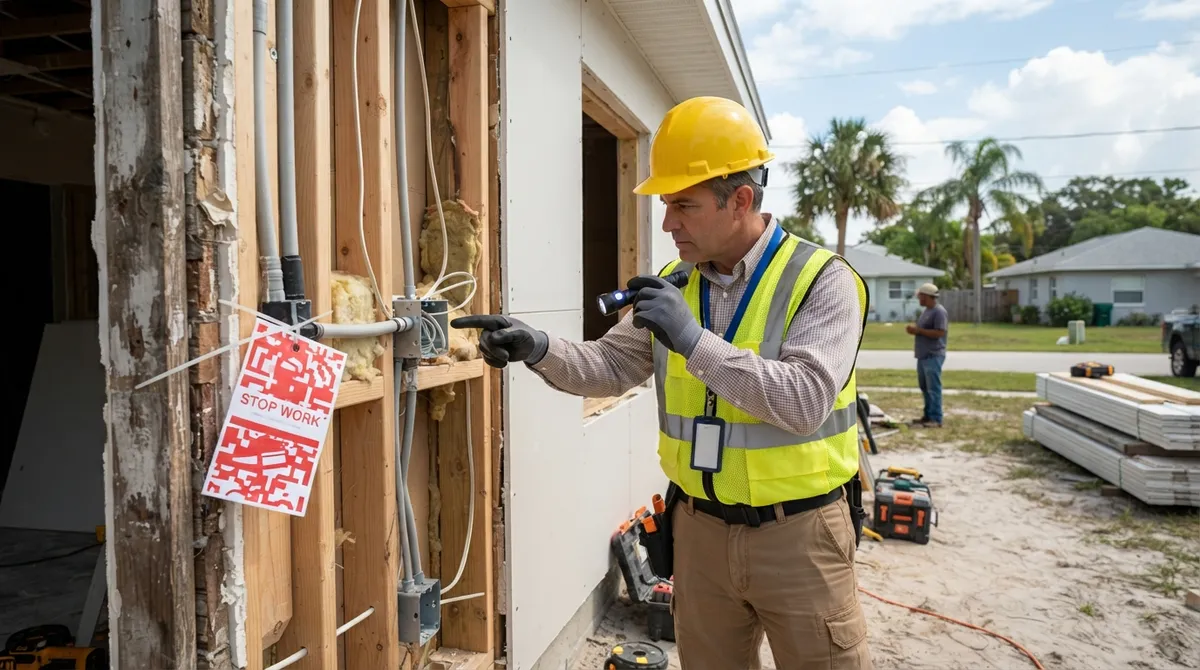
Florida Statutes §553.79 generally makes it unlawful to construct, alter, repair, or demolish a building without first obtaining the required permit from the local enforcing agency. Notice the focus on the work, not the project as a whole. If a specific task needed a permit and did not get one, that task is exposed, even if the project next to it is fully permitted.
Whether a particular task needs a permit depends on the work itself and on local rules. That is why two neighboring cities can answer the same question differently. Your local building department is always the final word on what must be permitted and how a violation gets resolved.
Think of it like a grocery receipt. Paying for most of the cart does not cover the items you carried out without scanning. The unscanned items still need to be accounted for, and the store decides how to handle that.
7 Steps to Take When Part of the Work Skipped the Permit
Every project is different, but this sequence works well as a general roadmap. Requirements vary by city and county, so treat it as a starting point and confirm details with your local authority.
1. Pause the Affected Work
The moment you realize a portion was done without a permit, stop any further work on that portion. Continuing to build on top of unpermitted work can bury problems and make inspections harder. Covering concealed work with drywall, insulation, or finishes often creates extra steps later.
You do not need to stop everything on the site. Work that is properly permitted and separate may be able to continue, but check with the building department before assuming so.
2. Gather Your Paperwork and Photos
Before you call anyone, collect what you already have. Good records can save real time and money later.
- Your existing permit card, application, and approved plans
- Contractor invoices, contracts, and material receipts
- Dated photos of the work before, during, and after installation
- Product specifications, manufacturer data, and equipment labels
- Names and license numbers of anyone who performed the work
Photos of concealed items, like wiring in a wall cavity or framing before drywall, are especially valuable. They help show what is behind the finish.
3. Confirm What Actually Required a Permit
Not every task needs one, and guessing in either direction causes trouble. Some minor work is exempt under the Florida Building Code and local rules, while structural, electrical, plumbing, mechanical, roofing, and similar work commonly is not. The exact line depends on the jurisdiction.
Your local building department can tell you which parts of your job were covered and which were not. If you are not sure which department controls your address, the building department lookup tool is a handy place to start, since city lines can be confusing.
4. Contact the Local Building Department
This is the step many people dread, but it is usually where relief begins. Ask about the department's after-the-fact or permit-regularization process. Many Florida jurisdictions have one, and the staff handle these situations regularly.
Expect questions about the scope, when the work happened, and who did it. Be honest and organized. A cooperative, prepared approach tends to make the whole process smoother. If you want to see what is already open on a property, the open permit search can help you understand the starting point.
For a deeper look at how this route works, see our guide to legalizing unpermitted work in Florida.
5. Prepare the After-the-Fact Application and Plans
Most departments will want an application, and often plans that show the work as it exists today. These are commonly called as-built drawings. Depending on the scope, the building department may also ask for engineering, such as a sealed structural letter or electrical and mechanical documentation.
This is where in-house drafting and engineering makes a big difference. At 1 Contractor Solutions, our team prepares as-built drawings and sealed engineer letters in house, so reviewer comments get answered fast rather than bouncing between outside consultants.
6. Be Ready to Expose Concealed Work
Here is the part owners worry about most. Inspectors may require concealed work to be exposed so they can verify it. That can mean opening a section of wall, ceiling, or flooring.
It does not always happen, though. Officials may accept alternatives such as photographs, contractor records, or reports from qualified design professionals. What is acceptable varies by jurisdiction and by the type of work. If the work cannot be verified, or if it does not meet code, corrective work or even removal may be required.
7. Complete Inspections and Close Out the Permit
Once the application is approved, the work goes through inspections like any other permitted job. Passing final inspection and closing the permit is what actually resolves the problem. Leaving a permit open or expired creates its own headaches later.
If you also have a permit that lapsed, our guide on how to close an expired permit in Florida covers that side of things.
Quick Look: Permitted Scope vs. Unpermitted Scope
It helps to see how a mixed-scope project can break down. Here is a simplified example of a kitchen remodel where only some of the work was permitted.
| Work Item | Permitted? | Likely Status |
|---|---|---|
| Cabinet and countertop replacement | Often exempt | Usually no action needed |
| New electrical circuits and subpanel | Permit typically required | Exposed if not on the permit |
| Relocated plumbing lines | Permit typically required | May need inspection or exposure |
| Removed or altered wall | Structural review often required | May need engineer letter |
| New HVAC ductwork | Permit typically required | May need documentation |
This table is illustrative only. The building department decides what applies to your project.
What Could It Cost? Fines vs. Permit Fees
People often blur two very different things: code-enforcement fines and permit fees. They are not the same.
An after-the-fact permit fee is what the building department charges to process and review the permit. Some jurisdictions add extra fees for work done before a permit was issued. A code-enforcement fine is a separate penalty handled through a code enforcement process.
| Cost Type | What It Is | Key Point |
|---|---|---|
| Permit fee | Charge to review and issue the permit | Set by the local jurisdiction |
| After-the-fact surcharge | Added fee some agencies apply | Varies by city and county |
| Code-enforcement fine | Penalty under local code enforcement | Not automatic; depends on enforcement |
| Engineering and drafting | Plans, letters, as-builts | Depends on scope and complexity |
| Corrective work | Repairs to meet code | Only if inspection finds issues |
For the statutory side, Florida Statutes §162.09 sets general maximum fines of up to $250 per day for a first violation and $500 per day for a repeat violation, with up to $5,000 for a violation found irreparable or irreversible. The statute also contains higher limits for specified categories. These are ceilings, not automatic charges, and they are not a prediction for your case. Confirm current rules with your local authority or legal counsel.
For a closer look at pricing, read about after-the-fact permit costs in Florida and the penalty for building without a permit in Florida.
Common Mistakes That Make Partial Permitting Worse
A few missteps show up again and again. Avoiding them can keep a small issue small.
- Assuming the existing permit covers everything. It only covers the scope described in it.
- Covering up the work. Closing walls over unverified work can mean opening them again later.
- Assuming approval is guaranteed. Applying after the fact does not guarantee approval or avoid penalties.
- Letting a permit expire. An open or lapsed permit can complicate inspections and sales.
- Waiting until closing. Surprises during a sale add pressure and cost.
A friendly rule of thumb: the sooner you address it, the more options you tend to have.
How Partial Unpermitted Work Affects Selling, Insuring, and Refinancing
Unresolved violations do not just sit quietly. They can complicate inspections, project completion, property transactions, insurance questions, and future permitting. A buyer's home inspector or appraiser may notice work that does not match permit records, and lenders or insurers may ask questions.
For realtors and investors, this is why permit research early in a deal is so valuable. For owners planning to sell, resolving it before listing is usually calmer than scrambling mid-closing. If you are already in that situation, these resources may help:
- What to do when an open permit is found at closing
- Realtor and closing support
- Urgent permit rescue for denials, stop work orders, and closings on hold
Tips for Each Type of Reader
Your role shapes your next move, so here is how it tends to play out for different folks.
General Contractors and Trades
If a sub did work outside the permitted scope, document it and talk to the building department early. Keeping scope descriptions tight on future permits helps prevent a repeat. Our services for general contractors cover filing, tracking, and revisions.
Solar Companies
Solar jobs often involve electrical and structural pieces that must match the permit. If an install went in before approval, clear documentation and engineering can support regularization. See our page for solar contractors.
Realtors, Investors, and Buyers
Check permit history before you commit. Mismatches between what was built and what was permitted are a common closing hurdle.
Homeowners and Owner-Builders
You are allowed to ask for help without feeling embarrassed. Our homeowner resources explain how drawings, permits, and reviews fit together, and owner-builder permits are another route worth understanding.
When It Helps to Bring In a Permitting Team
You can handle some of this yourself, especially for small, simple items. But many people find the process faster and less stressful with an experienced team that knows how local reviewers think.
That is where 1 Contractor Solutions comes in. We work as Florida's outsourced permitting department, filing and tracking permits, coordinating reviews, and producing sealed drawings in house. We take on after-the-fact and expired permits, handle code compliance violations, and provide structural and MEP engineering. We serve all 67 Florida counties and respond within 30 minutes, day or night. You can also see what customers say when you visit us on Google — 1 Contractor Solutions.
For more on the process, our overview of what happens if you build without a permit in Florida is a good companion read. Stay connected with tips and updates too: follow us on LinkedIn or follow us on Facebook. For official statutory language, you can review Florida Statutes §162.09 directly from the Florida Senate.
Final Thoughts: A Partial Problem Has a Practical Fix
So, what if only part of the job was done without a permit in Florida? You have a violation for that portion, but you also have a path. Stop the affected work, gather your records, confirm what needed a permit, talk to your building department, prepare accurate plans, be ready to verify concealed work, and finish the inspections. Do not assume approval, and do not assume a fine is automatic. Every jurisdiction handles it a little differently.
You do not have to figure it out alone. If you would like help sorting out your specific situation, reach out and get a free quote. We would be glad to help you get the permit, the plans, and the peace of mind.
FAQs
What should I do if part of my renovation was completed without a permit in Florida?
Stop work on the affected portion, gather your photos and records, and contact your local building department about its after-the-fact permitting process. They will tell you what plans, fees, and inspections are needed. You've got this, and it is usually very manageable.
Will the inspector make me open walls to inspect unpermitted work?
Sometimes, but not always. Officials may require concealed work to be exposed, or they may accept photos, contractor records, or reports from a qualified design professional instead. It depends on your jurisdiction and the type of work.
Can I be fined for doing only part of a job without a permit in Florida?
Yes, the unpermitted portion can still be a violation, even when other parts of the project are permitted. Florida Statutes §162.09 sets general fine limits, but those are maximums rather than automatic penalties. A code-enforcement fine is also different from an after-the-fact permit fee.
Can unpermitted work affect selling or insuring a Florida home?
It can. Unresolved violations may complicate inspections, closings, insurance questions, and future permitting. Resolving them before listing is usually much smoother than dealing with them mid-sale.
Does applying for a permit after the work is done guarantee approval?
No. Applying after the fact does not guarantee approval or avoid penalties, and agencies may charge additional fees. If the work does not meet code, corrections may be required, so confirm the process with your local building department.
We do this work every day across all 67 Florida counties. Call (866) 314-6931 and we will tell you what your situation actually requires — including when you do not need us.
Related services
Permit Facilitation & Filing
You have a crew scheduled, a client asking for dates, and a permit sitting somewhere in a queue you cannot see. We file it, w…
See the servicePlan Review Coordination
A permit in plan review is not one queue. On a commercial project it can be six queues, each with its own reviewer, its own c…
See the serviceReady to get your permit moving?
One call tells you which jurisdiction controls your project, what it will take, and what it will cost. Most of the time we can scope it on the phone.