
Blog
6 Steps to Get an After-the-Fact Permit in Any Florida County
Need an after-the-fact permit in any Florida county? Follow these 6 friendly steps, from jurisdiction to closeout, plus cost examples and tips.
Key Takeaways
-
Florida has no single statewide after-the-fact permit; each county or city sets its own forms, fees, inspections, and penalties, so confirm the exact office and requirements first.
-
Stop any unpermitted work immediately, since continuing can bring citations such as Hillsborough County's up to $500 per violation.
-
Confirm whether your property falls under a city or county building department, because applying to the wrong office is a common cause of delays.
-
Expect to provide as-built plans, and sealed engineering for structural, roof, or enclosure work, since reviewers usually need proof that finished work meets the Florida Building Code.
-
Be prepared for inspections of concealed work, which may require limited wall or ceiling openings or an engineer's field verification rather than full demolition.
-
Budget for penalty multipliers in some jurisdictions, such as Miami's 2x or 4x fees, and close out the permit with a final inspection and records to avoid problems at sale or refinance.
So you've discovered work on your property that never got a permit. Maybe you bought the house and the prior owner skipped the paperwork. Maybe a crew finished a job before anyone filed. Or maybe a notice from the county just landed in your mailbox. Take a breath. You are far from alone, and this is very fixable.
The good news is that Florida has a path for this. The not-so-simple news is that there is no single statewide application. An after the fact permit in any Florida county follows the same general logic, but each county or city sets its own forms, fees, inspections, and penalties. Florida Statutes §553.79 sets the baseline rule that covered work needs a permit from the local enforcing agency, and your local building official decides how to bring the work into compliance.
In this friendly walkthrough, we'll cover six practical steps, what to expect on cost, and how to avoid the mistakes that slow people down. Whether you're a homeowner, a contractor, a solar company, or a real estate pro, you'll find something useful here.

What an After-the-Fact Permit Actually Is
An after-the-fact permit (often called an ATF, retroactive, or "as-built" permit) is a permit application for work that started or finished without the required permit. It is not a special statewide permit type. It's the regular permit process, with extra scrutiny and usually extra fees.
Here's what that means in plain language:
- It isn't a free pass. Approval is not guaranteed, and noncompliant work may need to be corrected, redesigned, or removed.
- Local rules rule. Fees, penalties, and documents vary a lot between counties and cities.
- Inspection is the heart of it. Officials need proof the work meets the Florida Building Code, and that sometimes means exposing concealed work.
If your situation involves expired or unpermitted work, our team handles after-the-fact and expired permits across all 67 counties, including the files other firms decline.
Step 1: Stop Work and Confirm Who Has Jurisdiction
The first move is simple: pause any ongoing unpermitted work. Hillsborough County, for example, advises property owners to stop work and contact Building Services about an after-the-fact permit, and warns that continuing can bring a citation of up to $500 per violation.
Next, figure out who actually issues your permit. This trips up more people than you'd think. Many properties sit inside a city that runs its own building department, so the county isn't the right office at all. Near city lines, it's not always obvious.
A quick way to sort it out:
- Pull up your property address on the county property appraiser site to see your municipality.
- Use a building department lookup tool to find the correct office.
- Check for open permits tied to the address with an open permit search.
- Call the building department and ask how they handle work done without a permit.
Still unsure which office controls your project? Our guide on which Florida jurisdiction reviews your project walks through the common gotchas.
Step 2: Gather What the Building Department Will Ask For
Every office has its own checklist, but most ask for a familiar set of documents. Having these ready can save you weeks of back-and-forth.
| Document | Why It's Needed | Typically Required For |
|---|---|---|
| Permit application | Opens the official record | All projects |
| As-built plans or drawings | Shows what was actually built | Additions, structural, remodels |
| Site plan or survey | Confirms setbacks and placement | Additions, sheds, pools, fences |
| Engineer letter or sealed drawings | Verifies structural or code compliance | Structural, roof, truss, enclosure work |
| Product approvals and specs | Proves windows, doors, roofing meet code | Roofs, impact windows and doors |
| Contractor license or owner-builder paperwork | Confirms who is responsible | Most projects |
| Photos of the work | Documents conditions and concealed areas | Interior and concealed work |
Don't panic if you don't have all of this. Many owners start with nothing but a hunch and a photo or two. That's exactly where as-built drawings and engineer letters come in.
Step 3: Prepare As-Built Plans and Engineering
This is where most after-the-fact files succeed or stall. Reviewers want to see that the finished work meets the Florida Building Code, and they usually can't take your word for it.
When you can expect to need a sealed document
- Structural changes such as added rooms, removed walls, or modified framing
- Roof work, including truss questions and wind-load compliance
- Screen enclosures, pool cages, and lanais
- Electrical, plumbing, or mechanical modifications that need MEP review
- Anything in a high-wind or flood-prone area
Because our drafting and engineering are in house, we can draw the as-built set and have our own engineer sign and seal it. If a reviewer flags something, we fix it directly rather than waiting on an outside consultant. Have your own engineer already? We also offer drafting-only services, so you keep your seal and your client relationship.
Want the full picture on documents? Read our after-the-fact permit application guide for Florida.
Step 4: File the Application and Manage Plan Review
Once your packet is assembled, you submit it to the correct building department. Then the waiting game begins, and this is the stage where a lot of files quietly die. A missed comment, an unanswered reviewer question, or a lapsed resubmittal can stall everything.
Good file management looks like this:
- Track every status change. Don't assume silence means progress.
- Answer reviewer comments completely. Partial answers trigger another round.
- Resubmit quickly. Delays can cause the application to expire.
- Keep records. Save every comment letter, revision, and approval.
This is exactly what permit facilitation and filing and plan review coordination are built for. And if comments come back, revisions and resubmittals are handled by the same team that drew the plans.
Some jurisdictions also allow a private provider to perform plan review and inspections, which can help you skip the county queue. We're a licensed private provider ourselves. Learn more about private provider inspections and whether your jurisdiction accepts them.
Step 5: Pass Inspections (Yes, Even for Hidden Work)
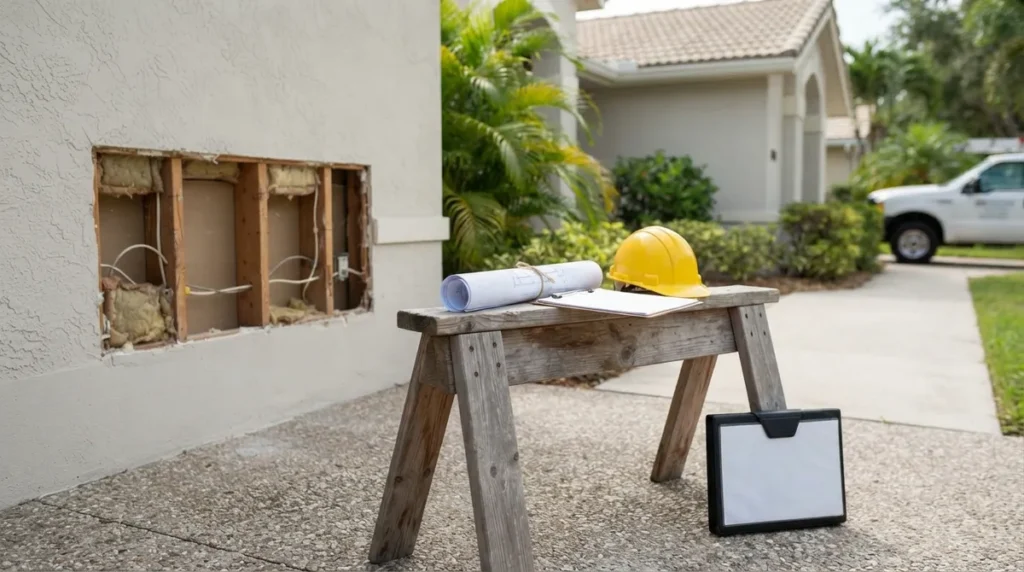
Here's the part that makes people nervous. When work is already finished and covered up, inspectors can't see what's behind the drywall, under the flooring, or above the ceiling. Depending on scope and jurisdiction, officials may ask you to:
- Open walls or ceilings at specific points
- Provide photos taken during construction, if they exist
- Supply an engineer's field verification letter
- Perform limited destructive testing
- Correct any items that don't meet code
It sounds scary, but the requirements are usually targeted, not a gut-the-house situation. An experienced team can often negotiate the smallest reasonable verification, such as a few inspection openings instead of full demolition.
You'll also want to know what happens when something fails. Our article on what happens during a Florida ATF site inspection sets expectations so there are no surprises.
Step 6: Close Out and Protect Your Property
You're not finished when the last inspection passes. Closing out properly keeps the problem from resurfacing during a sale, refinance, or insurance claim.
- Get final approval. Confirm the permit shows a final inspection and closed status.
- Request a Certificate of Occupancy or Use if applicable. See Certificate of Occupancy help if your project requires one.
- Keep your paperwork. Store the permit, approved plans, and inspection records.
- Tell your insurer and lender if needed. Closed permits help avoid disputes later.
Closeout matters most for sellers. A permit hold can derail a closing quickly, so realtors and investors may want to read about open permits found at closing before listing.
What an After-the-Fact Permit Costs Across Florida
Cost is the question everyone asks, and the honest answer is: it depends on your jurisdiction and your scope. Many localities add penalty multipliers on top of normal permit fees, plus the cost of plans and engineering.
| Jurisdiction Example | What the Local Authority States |
|---|---|
| Hillsborough County | Stop work and contact Building Services; citation of up to $500 per violation may be issued for continuing without a permit |
| City of Miami | Work started without a permit can incur 2x the scheduled fee plus a base fee for homestead properties, or 4x plus a base fee for non-homestead or commercial properties |
| Pinellas County | Storm-related after-the-fact permitting has its own rules; fees were reinstated July 1, 2026, with a $75 flat fee for mobile and manufactured homes |
These examples are snapshots, not guarantees. Fee schedules change, so always confirm current numbers directly with your authority having jurisdiction. For a deeper breakdown, see our guide to after-the-fact permit costs in Florida.
Storm repairs and flood zones deserve extra care
If your work was storm repair in a floodplain, extra rules can apply. Pinellas County, for instance, notes that certain completed storm repairs in unincorporated floodplains still require permits and that skipping them can jeopardize flood-insurance-related benefits, including the county's stated 40% National Flood Insurance Program premium discount. Deadlines and waivers are often time-limited, so check current terms before relying on them.
County and City Snapshots
Every office has its own personality. If you're in one of these areas, our local pages can help you get oriented:
You can browse every area we serve on our Florida counties page.
Common Mistakes That Slow Everyone Down
After handling thousands of permits, a few patterns show up again and again:
- Applying to the wrong office. City versus county confusion wastes weeks.
- Ignoring a notice. Citations and fines can grow while you wait.
- Submitting incomplete plans. Missing details trigger repeat review rounds.
- Skipping engineering. Structural and roof work often needs sealed verification.
- Assuming approval is automatic. Work that fails code must be corrected or removed.
If you already have a violation notice, our overview of code compliance violations shows how those cases get resolved.
Who Benefits Most From Professional Help
Plenty of owners tackle simple cases on their own, and that's perfectly fine. But some situations really reward expert support:
- General contractors juggling multiple jurisdictions and deadlines
- Solar and roofing companies needing fast, repeatable approvals
- Realtors and investors racing a closing date
- Homeowners facing a violation or an inherited unpermitted addition
- Design and trade professionals who want outsourced drafting and permit administration
Remember that a permitting service can organize the application, coordinate licensed professionals, and track reviews, but the local building department always makes the final decision. A good partner is honest about that.
Ready to Get Your Permit Back on Track?
Getting an after-the-fact permit in any Florida county comes down to six steps: stop work, confirm jurisdiction, gather documents, prepare as-built plans and engineering, manage the review, and pass inspections through closeout. It takes patience, but the path is real, and thousands of Florida property owners walk it every year.
If you'd like a friendly hand, 1 Contractor Solutions acts as Florida's outsourced permitting department. We respond within 30 minutes, day or night, and we're ready to help you get a free quote today. Prefer to see what others say first? Visit us on Google — 1 Contractor Solutions to read customer reviews. You can also follow us on LinkedIn or follow us on Facebook for Florida permitting updates. For the underlying law, review Florida Statutes §553.79 on the official legislature website.
FAQs
How do I get an after-the-fact permit in any Florida county?
You start by stopping work and confirming whether your county or city issues the permit. Then you gather plans and documents, submit the application, pass inspections, and close out the permit. Each jurisdiction has its own forms and fees, so confirm the details with your local building department.
Can I get a permit for work that's already finished?
Yes, in most cases you can apply for a permit even after work is complete. Just keep in mind that approval isn't guaranteed. Inspectors may require you to open up concealed areas, correct issues, or provide an engineer's letter to prove the work meets code.
How much does an after-the-fact permit cost in Florida?
It varies a lot by location and project size. Some places, like the City of Miami, charge multiples of the normal fee plus a base fee, while others add citations. Always check your local fee schedule, and remember to budget for plans and engineering too.
Will I have to tear out walls or finishes for inspection?
Sometimes, but not always. Officials may ask for limited openings or an engineer's field verification instead of full demolition. The requirement depends on your scope and jurisdiction, and a skilled team can often keep the disruption to a minimum.
Do storm repairs in a flood zone need an after-the-fact permit?
They often do. Some counties, such as Pinellas, say certain completed storm repairs in floodplains still require permits, and skipping them can affect flood-insurance-related benefits. Check current local rules and deadlines before assuming you're covered.
We do this work every day across all 67 Florida counties. Call (866) 314-6931 and we will tell you what your situation actually requires — including when you do not need us.
Related services
Permit Facilitation & Filing
You have a crew scheduled, a client asking for dates, and a permit sitting somewhere in a queue you cannot see. We file it, w…
See the servicePlan Review Coordination
A permit in plan review is not one queue. On a commercial project it can be six queues, each with its own reviewer, its own c…
See the serviceReady to get your permit moving?
One call tells you which jurisdiction controls your project, what it will take, and what it will cost. Most of the time we can scope it on the phone.