
Blog
12 ADU Without Permit Florida Mistakes That Cost You
Unpermitted ADU in Florida? Learn 12 costly mistakes, local rule differences, and the steps to legalize your unit in 2026.

Key Takeaways
-
Confirm zoning eligibility before spending on plans: Florida has no statewide ADU approval, so an ADU can be illegal on your parcel even if it is well built.
-
Don't rent out an unpermitted ADU; it can trigger code enforcement, insurance denials, and tenant disputes, and a fire or electrical failure becomes far more costly.
-
Act quickly on code enforcement notices: unresolved violations can lead to fines or liens, and after-the-fact permit fees can be double the standard fee in some counties like St. Lucie.
-
Document existing conditions with measured as-built drawings and engineering where needed, since incomplete submittals are the top cause of permit delays.
-
Recognize that legalization is not guaranteed; if the unit cannot meet current code and zoning, the jurisdiction may require alterations or demolition.
-
Verify your local rules, since requirements vary widely: Miami-Dade requires a 7,500 sq. ft. minimum lot and a Certificate of Use, while Orange County limits ADUs to qualifying homestead properties.
So you've got an accessory dwelling unit on your property, and you're not totally sure the paperwork ever happened. Maybe a previous owner converted the garage. Maybe a contractor said, "Don't worry, nobody checks." Maybe you just discovered the problem during a sale. First off, take a breath. You're far from alone, and in most cases there's a path forward.
Here's the thing: an ADU without permit in Florida isn't a problem you can wish away. It can show up at closing, during an insurance claim, or when a neighbor calls code enforcement. The good news is that owners who act early, and avoid a handful of common missteps, usually save serious time and money.
In this guide, we walk through 12 mistakes we see again and again, what they cost, and how to fix them in 2026. Whether you're a homeowner, a general contractor, or a realtor trying to save a deal, you'll find practical, friendly guidance here. One quick note up front: Florida ADU rules are highly local, so every answer below depends on your city or county.
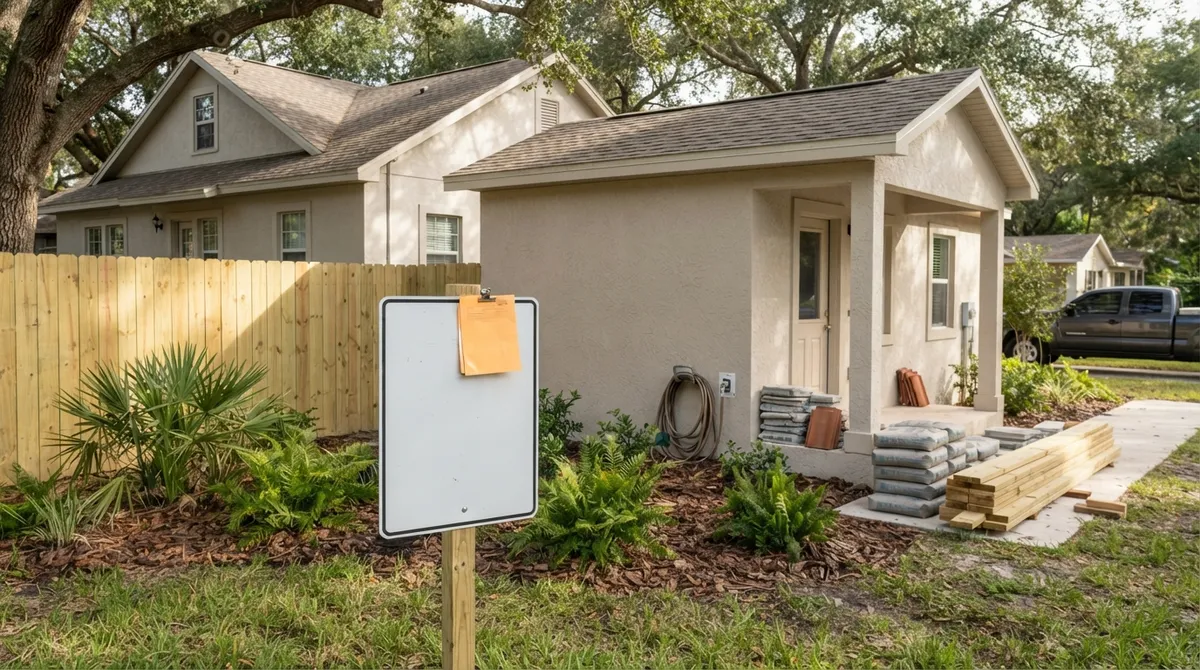
What Does "ADU Without a Permit" Actually Mean in Florida?
In Florida, an ADU is generally a secondary living unit on the same lot or within the same structure as the primary home. It typically has its own kitchen, bathroom, and sleeping area. State law defines the term, but your local government decides where ADUs are allowed and under what conditions.
An unpermitted ADU is any unit built, converted, or finished without the required building permit and approvals. That includes garage conversions, backyard cottages, guest houses, and above-garage apartments.
Florida has no single statewide rule that automatically legalizes ADUs everywhere. Instead, you'll deal with local zoning, land-development regulations, and property-specific limits like lot size, setbacks, parking, utilities, and rental restrictions.
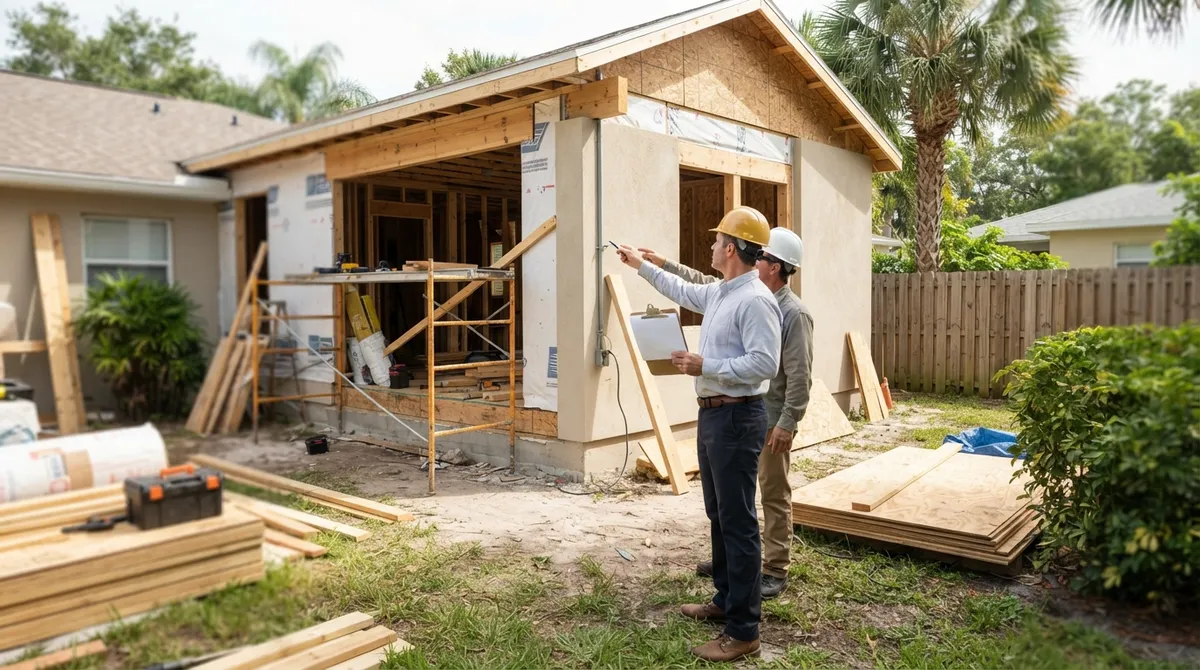
The 12 Mistakes That Cost Owners Time and Money
1. Assuming Your ADU Is Automatically Legal
This is the biggest one. Because there's no blanket statewide approval, an ADU can be physically beautiful and still be completely illegal on your parcel. Always confirm with your local planning and zoning office that an ADU is even allowed on your lot before you spend a dollar on plans.
2. Skipping the Zoning Check and Going Straight to Permits
Permits and zoning are two different gates. You can have flawless drawings and still be turned away because of lot size, setbacks, or ownership rules. Miami-Dade County, for example, lists a 7,500-square-foot minimum lot size for its ADU pathway. Orange County limits residential ADUs to qualifying homestead properties, with common ownership and owner occupancy of one of the units.
Check zoning first. If you're unsure which office controls your address, try our building department lookup tool.
3. Renting the Unit Before It's Legalized
It's tempting to cover your mortgage by renting out that cozy backyard unit. But renting an unpermitted ADU can expose you to code enforcement, insurance denials, and tenant disputes. If something goes wrong in the unit, such as a fire or an electrical failure, the missing permit becomes a very expensive problem.
4. Believing "Nobody Will Notice"
Unpermitted work gets discovered in more ways than owners expect. Home inspections, appraisals, title searches, neighbor complaints, utility upgrades, and insurance claims can all surface it. Our guide on how home inspections spot unpermitted work in Florida explains the common red flags.
5. Ignoring a Code Enforcement Notice
A notice isn't going away on its own. St. Lucie County, for instance, states that unresolved violations may lead to fines or a lien. Silence usually makes things worse. If you've received one, read our walkthrough on what to do when you get a code enforcement notice in Florida, and consider professional code compliance violation support.
6. Hiding the Unit From the Building Department
Some owners think pulling a permit for "a bathroom remodel" will quietly cover an entire hidden apartment. It won't. Misrepresenting the scope can create bigger problems, including permit revocation and added scrutiny. Honest, well-documented applications are far more likely to succeed.
7. Not Documenting What's Already Built
To legalize an existing ADU, jurisdictions typically want plans that show what's actually there. That means measured as-built drawings of the floor plan, electrical, plumbing, and structure. Skipping this step leads to rejections and wasted resubmittals. Learn more about as-built drawings and how they support your application.
8. Forgetting That Concealed Work Needs Proof
Walls are already closed, and inspectors can't see inside. Expect requests to expose wiring, plumbing, framing, or insulation, or to provide engineering documentation instead. A sealed engineer letter can sometimes verify concealed structural conditions, though acceptance depends on the jurisdiction.
9. Underestimating After-the-Fact Costs
After-the-fact permitting generally costs more than doing it right the first time. St. Lucie County states its after-the-fact permit fee is double the standard fee. That's one local example, not a statewide fee schedule, but it shows why waiting and guessing is expensive. For a deeper look, see our breakdown of after-the-fact permit costs in Florida.
10. Assuming Legalization Is Guaranteed
We wish we could promise it. Legalization isn't guaranteed. If the unit can't meet current requirements, the jurisdiction may require alterations or even removal. Hallandale Beach's amnesty-program document expressly notes that demolition may be required for structures that cannot comply. The earlier you evaluate feasibility, the fewer surprises you'll face. Our article on whether you'll really have to demolish unpermitted work covers this honestly.
11. Overlooking the Certificate of Use or Occupancy
Getting the building permit is only part of the story. Some jurisdictions also require a Certificate of Use or Certificate of Occupancy before the ADU can be legally occupied. Miami-Dade, for example, requires a Certificate of Use for its ADU pathway. Learn how these differ in our guide to Certificate of Occupancy vs. Certificate of Use, or explore our Certificate of Use services.
12. Doing It Alone When the Rules Are This Local
Rules vary by city, county, and sometimes by neighborhood overlay. Without experience, owners often file the wrong packet with the wrong department, then lose weeks to rejections. A professional familiar with your jurisdiction can spot issues before a reviewer does.
How Local Rules Differ Across Florida
To show just how different things can be, here are a few published local examples. These are illustrations, not universal rules, so always verify with your own jurisdiction.
| Jurisdiction | Published Requirement or Policy | Why It Matters |
|---|---|---|
| Miami-Dade County | Permit required to legalize an existing ADU; 7,500 sq. ft. minimum lot size; Certificate of Use required | Legalization follows the same general plan-review process as a new project |
| Orange County | Qualifying homestead; common ownership of primary home and ADU; owner occupies one unit | Investors and non-owner-occupants may not qualify |
| St. Lucie County | After-the-fact permit fee is double the standard fee; unresolved violations may lead to fines or a lien | Delay increases cost and legal exposure |
| Hallandale Beach | Amnesty-program document notes demolition may be required if a structure cannot comply | Non-compliant units may not be savable |
Want help finding your specific rules? Our county pages for Miami-Dade County, Orange County, and St. Lucie County are a good starting point.
What Can Happen If an ADU Stays Unpermitted
- Code enforcement action: Notices, fines, and potential liens if violations stay unresolved.
- Higher permit fees: After-the-fact fees are often doubled in some jurisdictions.
- Required inspections and exposure of work: You may need to open walls or supply engineering documentation.
- Insurance trouble: Claims tied to unpermitted areas can be disputed.
- Sale and financing delays: Appraisers, lenders, and title companies may flag the unit.
- Possible alterations or removal: If the unit can't comply, the jurisdiction may require changes or demolition.
If you're buying or selling, you may also want to read about open permits found at closing and our realtor and closing support.
How to Legalize an Unpermitted ADU in Florida: Step by Step
Every jurisdiction does this a little differently, but the overall road looks like this:
- Confirm the authority having jurisdiction. Near city lines, the controlling office isn't always obvious. Get this right first.
- Verify zoning eligibility. Ask whether an ADU is allowed on your parcel, and under what conditions (lot size, ownership, occupancy, parking, rental limits).
- Research open permits and violations. Our open permit search tool can help you see what's on record.
- Document existing conditions. Commission measured as-built drawings, plus structural and MEP documentation as needed.
- Engage engineering where required. Sealed structural, electrical, mechanical, or plumbing documents may be needed. See our engineering services.
- File the after-the-fact permit application. Submit complete plans and supporting documents so the clock can start.
- Respond to reviewer comments quickly. Revisions are normal. A fast, accurate response keeps things moving. Learn more about revisions and resubmittals.
- Correct deficiencies and pass inspections. You may need to open concealed work or make repairs.
- Close out the permit and obtain use approvals. Finish with final inspections and any required Certificate of Use or Occupancy.
Timelines: What to Realistically Expect
Florida Statutes section 553.792 sets review timeframes for complete applications. These are review deadlines, not guarantees of approval or total project completion.
| Structure Size | Generally Applicable Review Timeframe | Notes |
|---|---|---|
| Under 7,500 sq. ft. (specified residential permits) | 30 business days | Applies to complete applications reviewed by local government |
| 7,500 sq. ft. or larger | 60 business days | Review deadline only; corrections can extend the overall process |
In practice, incomplete submittals are the number-one cause of delays. For more context, read how long a building permit takes in Florida.
A Quick Word on Florida Statute 163.31771
Florida Statutes section 163.31771 addresses local ordinances that allow ADUs in areas zoned for single-family residential use. It includes an affordable-rent affidavit requirement for permit applications under ordinances adopted pursuant to that section. Whether and how this applies depends on your local ADU pathway, so verify with your jurisdiction before relying on it.
DIY vs. Working With a Permitting Professional
| Task | Going Solo | With a Permitting Team |
|---|---|---|
| Identifying the correct jurisdiction | Easy to get wrong near city lines | Confirmed up front |
| As-built plans and engineering | Often coordinated through several vendors | Handled in house with sealed drawings |
| Filing and tracking | Portals, fees, and follow-ups on you | Filed, tracked, and managed for you |
| Reviewer comments | Slow back-and-forth | Comments worked and revisions resubmitted quickly |
| Outcome | Possible rework and delays | Fewer rejections; no approval guarantees |
Who This Matters To Most
Homeowners: You want to protect your equity, keep insurance valid, and avoid fines. Start with our homeowner resources.
General contractors: A client's unpermitted ADU can stall your project or expose your license. See how we support general contractors.
Realtors and investors: An unpermitted unit can sink a closing. Early research and a clear legalization plan keep deals alive. Explore our realtor services.
Designers and trades: If you need dependable outsourced drafting or drafting only support, we can draw the permit set while you keep your own engineer and client relationship.
How 1 Contractor Solutions Can Help
At 1 Contractor Solutions, we're Florida's outsourced permitting department. We're not a construction contractor. We're the team you call when the permit is what stands between you and a legal, insurable, sellable property. Our in-house drafting and engineering team prepares as-built plans and sealed documents, and we handle permit filing and tracking, plan review coordination, and revisions through closeout.
We can't guarantee approval or waive code requirements, but we can help you identify the authority having jurisdiction, review property records and zoning, and manage the process properly. For the broader picture, see our guide to legalizing unpermitted work in Florida and our after-the-fact and expired permit services. If time is tight, our urgent permit rescue team can step in. Curious what others say? Visit us on Google — 1 Contractor Solutions to read customer reviews, and you can also follow us on LinkedIn or follow us on Facebook for updates.
Before You Buy, Rent, or Advertise a Suspected Unpermitted ADU
- Contact the local planning/zoning and building departments first.
- Ask for the permit history on the parcel.
- Don't advertise or rent the unit until its status is clear.
- Get any seller disclosures in writing.
- Budget for engineering, fees, and possible corrections.
Final Thoughts
An ADU without permit in Florida can feel overwhelming, but it's rarely hopeless. Most of the pain comes from the mistakes above: guessing instead of verifying, hiding instead of documenting, and waiting instead of acting. Take it one step at a time, get your zoning and jurisdiction confirmed, document what's built, and work with people who do this every day.
Ready to get your ADU on solid legal ground? We're here with same-day response and sealed drawings in house. Reach out today to get a free quote, and let's turn that permit problem into a finished checklist.
FAQs
Is it illegal to build an ADU without a permit in Florida?
Yes, building or converting space into an ADU generally requires a building permit, plus local zoning approval. Skipping those steps can lead to code enforcement, fines, and required corrections. The good news is that many owners can pursue an after-the-fact permit to get things back on track.
Can I get a permit after building an ADU in Florida?
Often, yes. Many jurisdictions allow after-the-fact permits, and Miami-Dade explicitly says a permit is needed to legalize an existing ADU. You'll typically need as-built plans, zoning approval, and passing inspections, and approval isn't guaranteed.
How much do after-the-fact permit fees cost for an unpermitted ADU?
It depends on where you live. St. Lucie County, for example, states that its after-the-fact permit fee is double the standard fee, but that's a local policy, not a statewide schedule. Add costs for drawings, engineering, and any corrections, and check with your local building department for exact numbers.
Can an unpermitted ADU be legalized, or will it have to be demolished?
Many can be legalized, but it's not guaranteed. If the unit can't meet current code and zoning requirements, the jurisdiction may require alterations or removal. Getting a feasibility review early helps you know which way things are likely to go.
Can I rent out an unpermitted ADU in Florida?
It's not a good idea. Renting an unpermitted unit can trigger enforcement, create insurance problems, and expose you to liability if something goes wrong. Legalize the unit first, and confirm any local rental limits before you list it.
We do this work every day across all 67 Florida counties. Call (866) 314-6931 and we will tell you what your situation actually requires — including when you do not need us.
Related services
Permit Facilitation & Filing
You have a crew scheduled, a client asking for dates, and a permit sitting somewhere in a queue you cannot see. We file it, w…
See the servicePlan Review Coordination
A permit in plan review is not one queue. On a commercial project it can be six queues, each with its own reviewer, its own c…
See the serviceReady to get your permit moving?
One call tells you which jurisdiction controls your project, what it will take, and what it will cost. Most of the time we can scope it on the phone.