
Blog
10 ADU Permit Port Charlotte FL Mistakes to Avoid in 2026
Planning an ADU in Port Charlotte? Avoid 10 costly permit mistakes, from jurisdiction checks to sealed plans, and keep your 2026 project on track.
Key Takeaways
-
Confirm whether your parcel is in unincorporated Charlotte County or another jurisdiction before designing, since a Port Charlotte mailing address doesn't determine which rules apply.
-
No dedicated ADU permit pathway appears in county permit pages; your project may be classified as an addition, new dwelling, or other type, so confirm classification with the county before submitting.
-
Check zoning, setbacks, and lot coverage early, since accessory structures may count toward maximum lot coverage and must meet compatibility standards.
-
Verify water, sewer, or septic capacity for your specific parcel, as no universal county ADU utility rule exists and septic systems may not handle an added household.
-
Submit signed and sealed plans with a construction permit application and site plan, and record a Notice of Commencement for contracts over $5,000 before the first inspection.
-
Avoid building before permitting, since unpermitted construction can lead to stop-work orders, fines, closing problems, and demands to open walls for inspection.
Dreaming of a backyard guest suite, an in-law apartment, or a rental unit that helps pay the mortgage? You're in good company. Plenty of Southwest Florida homeowners are looking at accessory dwelling units, and Port Charlotte's roomy lots make the idea feel very doable. The tricky part is the paperwork. An ADU permit in Port Charlotte, FL isn't a simple one-page form, and a few early missteps can cost you weeks of delays and real money.
Here's the friendly truth: nothing in the county's published permit pages lays out a dedicated, ADU-specific permit pathway. Depending on your design, your project may be reviewed as an addition, a new dwelling, or another permit type. That means you have to do some homework before you draw a single line. This guide walks you through ten common mistakes we see, so you can dodge them and keep your project moving. Whether you're a homeowner, a general contractor, a designer, or a realtor helping a client, you'll find practical, plain-English advice below.

Why ADU Permitting in Port Charlotte Feels Complicated
Part of the confusion comes from geography. A "Port Charlotte" mailing address can fall under unincorporated Charlotte County or another jurisdiction, so the rules that apply depend on your exact parcel. On top of that, the county's online resources describe residential permit categories rather than a one-size-fits-all ADU checklist.
The good news? Charlotte County offers an online Citizen Access Portal and Digital Plan Room, so applications and plan reviews can be handled digitally. Once you know which category fits your project, the process becomes much more predictable.
The Quick Snapshot
| Topic | What to Know |
|---|---|
| Jurisdiction | Confirm whether your parcel is in unincorporated Charlotte County or another jurisdiction |
| Permit category | May be treated as an addition, new dwelling, or other type; confirm with the county |
| Submittal method | Citizen Access Portal and Digital Plan Room |
| Plans | Signed and sealed; online plans need digital signature and third-party verification |
| Notice of Commencement | Required when direct contract price exceeds $5,000 |
Mistake 1: Assuming Your Address Tells You the Jurisdiction
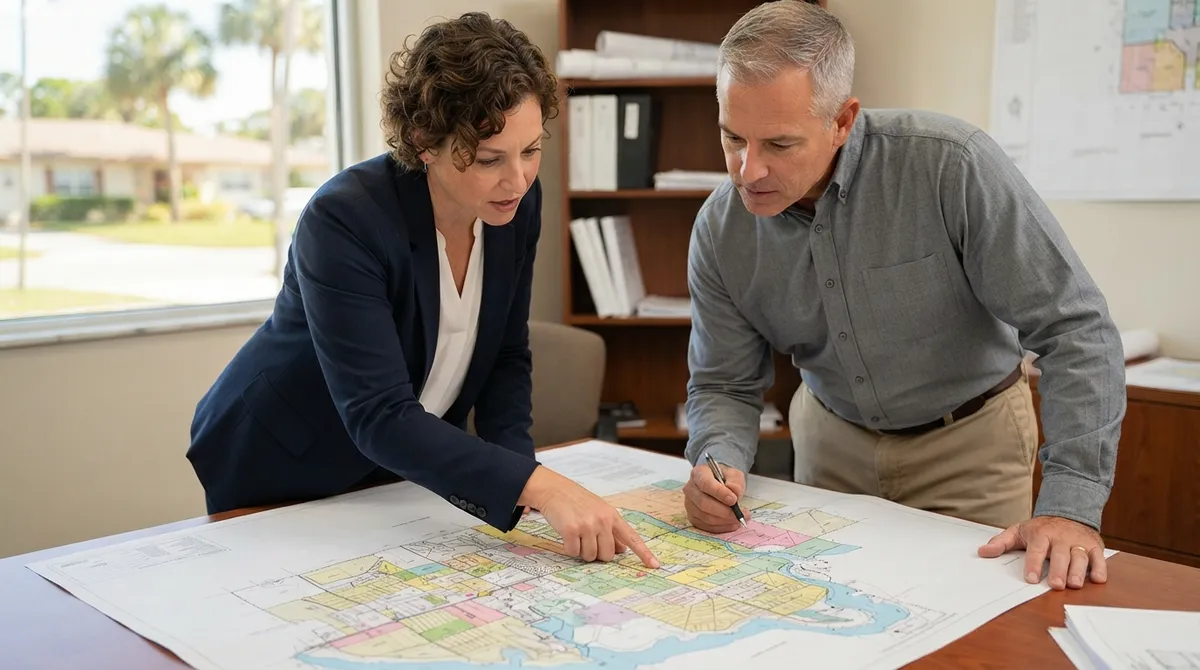
This is the number one trip-up. Homeowners see "Port Charlotte, FL" on their mail and assume the county rules apply. Sometimes that's right, and sometimes it isn't. Before you hire a designer or pay for plans, confirm which jurisdiction controls your parcel and what your zoning allows.
Charlotte County's Planning & Zoning Division can help at 941-743-1201, option 4. A quick call up front can save you from designing a unit that your parcel can't legally host. If you'd rather hand off the detective work, our team handles this kind of jurisdiction research across all 67 Florida counties, as shown on our Charlotte County page.
Mistake 2: Hunting for an "ADU Permit" Box That May Not Exist
Many owners search the county site for a button labeled "ADU permit" and feel stuck when they can't find one. The available county permit pages don't identify a dedicated ADU permit category or publish a complete ADU eligibility standard.
So what happens in practice? Your proposal might be reviewed as a residential addition, a new dwelling, or another permit type, depending on whether the unit is attached, detached, or converted from existing space. Confirm the correct classification with the county before you submit. Choosing the wrong category can mean rejected applications and wasted review fees.
Mistake 3: Skipping the Zoning, Setback, and Lot Coverage Check
Zoning review looks at land-development compliance, including zoning and setbacks. Accessory structures may also count toward maximum lot coverage and must meet applicable compatibility standards. For a detached ADU, those rules can make or break the design.
Before you fall in love with a floor plan, ask yourself:
- How close can the structure sit to each property line?
- How much of my lot is already covered by the home, pool, driveway, and other structures?
- Do compatibility standards limit the look or placement of the unit?
- Does my parcel's zoning even allow a second dwelling?
Answering these questions early keeps your design realistic and your budget intact.
Mistake 4: Ignoring Water, Sewer, and Septic Feasibility
A beautiful ADU design means nothing if the utilities can't support it. Utility feasibility is parcel-specific, and the sources we reviewed don't establish a universal county ADU utility rule. That puts the burden on you to verify.
Before committing to a design, check:
- Whether public water and sewer are available at your parcel.
- If you're on septic, whether the system has capacity for added bedrooms or fixtures.
- What health or utility approvals apply to your situation.
- Whether connection fees or upgrades will affect your budget.
For septic properties especially, don't assume the existing system can handle another household. Get answers from the utility and the relevant permitting authorities first.
Mistake 5: Showing Up With Unsealed or Incomplete Plans
County residential submittals commonly require a construction permit application, a site plan, and clear plans or engineering. The Residential Miscellaneous page specifies signed and sealed plans, and online plans must be digitally signed and sealed with third-party verification.
That detail trips up a lot of DIY applicants. A drawing that looks great but lacks the proper seal won't get far. If you're wondering who can legally stamp your drawings, our guide on who seals structural drawings for Florida permits breaks it down. Our in-house team prepares sealed drawings, so you aren't chasing an outside consultant when a reviewer asks questions.
What a Typical Package Includes
| Document | Purpose |
|---|---|
| Construction permit application | Starts the formal review |
| Site plan | Shows placement, setbacks, and lot coverage |
| Signed and sealed plans | Demonstrates code compliance |
| Engineering (as applicable) | Structural and MEP details |
| Notice of Commencement | Required over $5,000 contract price |
If your project needs foundation, framing, or load details, our overview of structural plans for a Florida residential permit explains what reviewers expect.
Mistake 6: Forgetting the Notice of Commencement
It's easy to overlook, and it can hold up your first inspection. The county requires a Notice of Commencement for improvements with a direct contract price over $5,000, and it must be submitted before the first inspection is scheduled, according to its Residential Miscellaneous permit guidance.
Since nearly every ADU will cross that $5,000 threshold, plan on recording it. Build it into your checklist right alongside the permit application so your schedule doesn't stall once the crew is ready to go.
Mistake 7: Guessing at Permit Fees
Fees depend on the permit classification, valuation, and the reviews required. The county's Residential Miscellaneous page lists several charges, but remember these are not an ADU-specific quote. Here's a snapshot of what's published for that category:
| Fee Item | Published Amount |
|---|---|
| Building flat fee | $90 |
| Surcharge on building fee | 2.5% |
| Building charge (valuation of $50,000 or more) | 0.004 × ICC valuation |
| Possible zoning review | $22 |
| Possible right-of-way review | $90 |
No ADU-specific county fee, maximum unit size, or countywide ADU approval statistic was available in the sources reviewed. Treat the numbers above as a starting reference only, and reconfirm amounts with the county before you apply. Want help estimating your own situation? Feel free to get a free quote.
Mistake 8: Treating Garage Conversions and In-Law Suites Like Simple Remodels
Turning a garage into living space or adding an attached suite might feel like "just a renovation," but it often changes how the structure is classified. The county may view it as an addition or a change that triggers fuller review, including utilities, egress, and structural considerations.
If you're converting existing space, confirm how the county will classify it before you start swinging hammers. Our steps to legalize a Florida garage conversion shows how these projects are handled when the work is already done, and our guide to building a mother-in-law suite in Florida covers the planning side.
Mistake 9: Building First and Permitting Later
Some owners figure they'll build the unit quietly and sort out permits down the road. That path tends to get expensive. Unpermitted construction can trigger stop-work orders, fines, trouble at closing, and sometimes demands to open up walls for inspection.
If you've already built something without approval, there are ways forward. Start with our practical overview of legalizing an after-the-fact ADU in Florida, and if a sale is looming, read how to sell a Florida house with unpermitted additions. Better yet, permit it properly from the start and skip the stress.
Mistake 10: Going It Alone When the Process Gets Tangled
Even confident builders hit snags: a reviewer comment you don't understand, a revision that restarts the clock, or a classification question nobody can answer quickly. That's where a Florida permitting service earns its keep.
A good partner can identify the correct permit classification, assemble plans and supporting documents, and coordinate county reviews while confirming current requirements directly with the county before submission. At 1 Contractor Solutions, we act as your outsourced permitting department. We file, track, work reviewer comments, and carry the project through closeout, with in-house drafting and engineering behind every set of plans. See how we support homeowners, general contractors, and realtors alike.
A Simple Roadmap for Your Port Charlotte ADU
Feeling a little overwhelmed? Take a breath. Here's a straightforward order of operations that keeps things manageable:
- Confirm jurisdiction and zoning for your exact parcel.
- Check lot coverage and setbacks before choosing a footprint.
- Verify water, sewer, or septic capacity.
- Confirm the permit classification with the county.
- Prepare sealed plans and a site plan.
- Submit through the Citizen Access Portal and Digital Plan Room.
- Record the Notice of Commencement before scheduling inspections.
- Respond quickly to review comments and keep inspections on schedule.
Once construction wraps up, you'll also need to plan for closeout. Our walkthrough on getting a Certificate of Occupancy in Port Charlotte covers that final stretch, and our look at private provider plan review in Port Charlotte shows one way to speed up reviews.
Tips for Different Readers
- Homeowners: Start with zoning and utilities before spending on design.
- General contractors: Confirm classification and sealed-plan requirements so your crew isn't left waiting.
- Realtors and investors: Verify permit history before listing or buying a property with a guest unit. Our guide on open permits found at closing is a useful read.
- Designers and trades: Outsource drafting, engineering, and permit administration so you don't need extra in-house staff.
Ready to Move Your ADU Forward?
Building an accessory dwelling unit should feel exciting, not exhausting. The best way to protect your timeline and budget is to confirm the rules for your parcel, choose the right permit pathway, and submit a clean, sealed package the first time. If any of this still feels murky, we're happy to help.
Our team answers around the clock, responds within 30 minutes, and speaks Spanish too. Ready to start? Get a free quote and let us handle the permit while you focus on the fun parts of the project. You can also see what our clients say when you visit us on Google — 1 Contractor Solutions, and stay connected when you follow us on LinkedIn or follow us on Facebook. For help getting your business found online, check out Brain Buzz Marketing.
FAQs
Does Charlotte County allow accessory dwelling units in Port Charlotte, Florida?
It depends on your specific parcel, zoning, and jurisdiction. The county's available permit pages don't publish a complete ADU-specific standard, so confirm eligibility with Planning & Zoning at 941-743-1201, option 4, before you design anything.
How much does an ADU permit cost in Charlotte County?
There's no verified ADU-specific fee in the sources we reviewed. The Residential Miscellaneous page lists a $90 building flat fee, a 2.5% surcharge, and a valuation-based charge of 0.004 × ICC valuation for projects valued at $50,000 or more, plus possible zoning and right-of-way review fees. Always reconfirm amounts with the county.
What plans do I need for an ADU permit in Port Charlotte?
Expect to provide a construction permit application, a site plan, and signed and sealed plans or engineering. Online plans must be digitally signed and sealed with third-party verification, and you'll also need a Notice of Commencement if the contract price is over $5,000.
Can I build an ADU on a property with a septic system?
Possibly, but it's parcel-specific. You'll need to verify septic capacity and any health approvals with the relevant authorities before committing to a design, since no universal county ADU utility rule was established in the sources reviewed.
Does a garage conversion or in-law suite need an ADU permit?
Converting a garage or adding an attached suite typically still requires a permit, though it may be classified as an addition or another permit type rather than a dedicated ADU permit. Confirm the right classification with the county before starting work.
We do this work every day across all 67 Florida counties. Call (866) 314-6931 and we will tell you what your situation actually requires — including when you do not need us.
Related services
Permit Facilitation & Filing
You have a crew scheduled, a client asking for dates, and a permit sitting somewhere in a queue you cannot see. We file it, w…
See the servicePlan Review Coordination
A permit in plan review is not one queue. On a commercial project it can be six queues, each with its own reviewer, its own c…
See the serviceReady to get your permit moving?
One call tells you which jurisdiction controls your project, what it will take, and what it will cost. Most of the time we can scope it on the phone.